
Do you know that Hazrat Ali is also called as Amir-u-lNahel which means Lord of honey bees.
Once in a war enemies decided that they will defeat army of Hazrat Ali by attack of honey bees. When they did so, honey bees started attacking and Hazrat Ali said what are you doing??Go away. All went away accept one big who want to see face of Mowla Ali [deedar]. Hazrat Ali than asked that honey bee you suck nectar from flwers, some are sour some are bitter than why honey from this nectar is sweet. Honey bee replied you know every thing why you are asking me. Hazrat Ali said Say in such a manner that every one here can listen it. Bee said we make it sweet by saying Ya Ali Ya Ali. It is in Surah Nehl of Quran that bees say name of Allah.
Honey bees
Bees are Ismailies
This story was related to me by Missionary Mohamedali Bhimani in Dallas.
Once Prince Aly Khan was visiting with a certain Jamat to do Jamati work as he used to do when Imam SMS was not keeping well. There was some commotion outside the Jamatkhana as there was a giant beehive right outside the Jamatkhana on its wall. Prince Aly Khan said that these are the ummat of my grandfather do not break this beehive.
Well the bees used to never sting the ismaili kids who would play with them. Many years later when the Jamat khana moved The moment the JK started at the new location, all the bees moved to the wall of the new Jamat khana and started on a new bee hive there.
thought you should know munir
Ya Aly Madad
Shams
Once Prince Aly Khan was visiting with a certain Jamat to do Jamati work as he used to do when Imam SMS was not keeping well. There was some commotion outside the Jamatkhana as there was a giant beehive right outside the Jamatkhana on its wall. Prince Aly Khan said that these are the ummat of my grandfather do not break this beehive.
Well the bees used to never sting the ismaili kids who would play with them. Many years later when the Jamat khana moved The moment the JK started at the new location, all the bees moved to the wall of the new Jamat khana and started on a new bee hive there.
thought you should know munir
Ya Aly Madad
Shams
About the the Bees
Ya Ali Madad, Shamu and Munir
I would like to share my knowledge about the bees. The bees moved from the old jamatkhana to the new jamatkhana. This happened in a village called methan the district was sidphur in gujurat where i was born. I used to play with those bees when i was four or five years old and recently about eight or ten years ago we built a new jamatkhana and all thode bees moved their hive there. You can see this even today in the jamatkhana of methan.
Karim Qazi
I would like to share my knowledge about the bees. The bees moved from the old jamatkhana to the new jamatkhana. This happened in a village called methan the district was sidphur in gujurat where i was born. I used to play with those bees when i was four or five years old and recently about eight or ten years ago we built a new jamatkhana and all thode bees moved their hive there. You can see this even today in the jamatkhana of methan.
Karim Qazi
-
Guest
-
alinizar313
- Posts: 112
- Joined: Sun Oct 12, 2003 9:17 pm
-
alinizar313
- Posts: 112
- Joined: Sun Oct 12, 2003 9:17 pm
Honey bee
The above post under guest is by me. I forgot to log in
-
from_Origin
- Posts: 28
- Joined: Tue Jun 03, 2003 7:51 pm
- Location: California
- Contact:
Re: Bees are Ismailies
What is "ummat"?shamsu wrote: Prince Aly Khan said that these are the ummat of my grandfather do not break this beehive.
Re: Bees are Ismailies
Ummat means community.from_Origin wrote:
What is "ummat"?
Something I felt connected...
Notre Dame beekeeper waits to learn fate of his 18,000 bees
PARIS - The beekeeper of Notre Dame Cathedral is in limbo waiting to hear the fate of his 18,000 bees after the devastating fire tore through the church.
Nicolas Géant is hoping that the bees, that live in hives on the roof of the sacristy, survived the inferno.
"If you look at the photos from the sky you see that everything is burnt, there are holes in the roof, but you can still see the three bee hives," Géant told NBC News Wednesday.
The 51-year-old beekeeper - who keeps bees across France and in California - has been unable to check on the colonies since the fire broke out Monday ravaging the world-famous cathedral.
"The policeman and fireman won't let me go up there," he said with frustration.
The investigation into the fire continued Wednesday with no more clues as to how the fire broke out. More details as to the extent of the damage inside the cathedral's magnificent stone walls trickled out, with firefighters warning that there is still a real risk that the building might collapse.
Sixty fire personnel are currently onsite and monitoring for any "hot spots" that could weaken the already ravaged structure, Lt. Col. Gabriel Plus told reporters at a press conference Wednesday.
But there is still no news of the bees.
Géant said he has been flooded with messages from all around the world asking if the insects had survived the fire. "I will try again tomorrow," he said.
The bee-enthusiast said it had always been his dream to keep bees on the roof of "the most beautiful church in the world" and in 2012 that dream came true.
"There is a historic relationship between bees and the church, for a long time they used the wax from the bees to make the candles," he explained.
a man standing in front of a river
© Saphora Smith
The beekeeper is not the only person connected to Notre Dame who is struggling to move on after the fire destroyed a piece of their life. Olivier De Châlus, the chief tour guide at the cathedral, struggled Wednesday to look at the wreckage without welling up.
"It is my home," he told NBC News, standing on the banks of the Seine.
"This church is really a friend for me, I know the church as you can know a person - I spent so much time going to look at her and to find all the details that no one ever saw before," he said.
Châlus, who is also researching a PHD on the medieval construction of Notre Dame, said for seven hours he could not prize his eyes away from the burning cathedral. The next day it took him four hours to muster the courage to walk through the doors and see the damage.
"This church is my life, it's my parish first, it's the place I work as a guide," he said.
More...
https://www.msn.com/en-ca/news/world/no ... ailsignout
Notre Dame beekeeper waits to learn fate of his 18,000 bees
PARIS - The beekeeper of Notre Dame Cathedral is in limbo waiting to hear the fate of his 18,000 bees after the devastating fire tore through the church.
Nicolas Géant is hoping that the bees, that live in hives on the roof of the sacristy, survived the inferno.
"If you look at the photos from the sky you see that everything is burnt, there are holes in the roof, but you can still see the three bee hives," Géant told NBC News Wednesday.
The 51-year-old beekeeper - who keeps bees across France and in California - has been unable to check on the colonies since the fire broke out Monday ravaging the world-famous cathedral.
"The policeman and fireman won't let me go up there," he said with frustration.
The investigation into the fire continued Wednesday with no more clues as to how the fire broke out. More details as to the extent of the damage inside the cathedral's magnificent stone walls trickled out, with firefighters warning that there is still a real risk that the building might collapse.
Sixty fire personnel are currently onsite and monitoring for any "hot spots" that could weaken the already ravaged structure, Lt. Col. Gabriel Plus told reporters at a press conference Wednesday.
But there is still no news of the bees.
Géant said he has been flooded with messages from all around the world asking if the insects had survived the fire. "I will try again tomorrow," he said.
The bee-enthusiast said it had always been his dream to keep bees on the roof of "the most beautiful church in the world" and in 2012 that dream came true.
"There is a historic relationship between bees and the church, for a long time they used the wax from the bees to make the candles," he explained.
a man standing in front of a river
© Saphora Smith
The beekeeper is not the only person connected to Notre Dame who is struggling to move on after the fire destroyed a piece of their life. Olivier De Châlus, the chief tour guide at the cathedral, struggled Wednesday to look at the wreckage without welling up.
"It is my home," he told NBC News, standing on the banks of the Seine.
"This church is really a friend for me, I know the church as you can know a person - I spent so much time going to look at her and to find all the details that no one ever saw before," he said.
Châlus, who is also researching a PHD on the medieval construction of Notre Dame, said for seven hours he could not prize his eyes away from the burning cathedral. The next day it took him four hours to muster the courage to walk through the doors and see the damage.
"This church is my life, it's my parish first, it's the place I work as a guide," he said.
More...
https://www.msn.com/en-ca/news/world/no ... ailsignout
A very interesting article on significance of bees..
Honey Song, by Neil Rusch
Excerpt:
REMEMBRANCE OF BEES
The dhikr of the heart is like the humming of the bees, neither loud nor disturbing.4
—Ibn Ata’Illah (d. 1309)
For millennia bees have held high status as exemplars for religious and sacred practices. Moreover, the depth of this veneration and the respect accorded to bees is further confirmed in the archaeological record. Some of the earliest written texts tell us about bees with great reverence and perceptivity. From these, and there are many, I select two that are particularly appealing. In the Salt Magical Papyrus, housed in the British Museum (No. 10051, recto 2, 5–6), we read that the Sun-god Ra created earth and sea. Further, the myth reveals that Ra’s eyes, right and left, are sun and moon respectively. Ra weeps and the falling tears become bees.
When Ra weeps, the water which flows from his eyes upon the ground turns into working bees. They work in flowers and trees of every kind and wax and honey come into being.
The second example comes from the Brihadaranyaka Upanishad, generally agreed to have been composed in the first millennium B.C. In this text, the chapter “Madhu Brahmana” tells that the secret essence of the Vedas themselves was called the “madhu-vidya or honey doctrine.” In the first verse we read:
This earth is the honey (madhu, the effect) of all beings, and all beings are the honey (madhu, the effect) of this earth. Likewise this bright, immortal person in this earth, and that bright immortal person incorporated in the body, both are madhu. He indeed is the same as that Self, that Immortal, that Brahman, that All.
The current tendency that would have us believe that honey is a commodity is pernicious. The idea that honey is a commercial product distances consumers from the primary source. Honey and bees are abstracted—removed from their organic context—and this, no doubt, is but one causal factor contributing to the current bee crisis, particularly in Western industrialised countries. If we listen to the myths, honey is not a commodity; it is a sacrament, the old wisdom keeps saying.
The language of myth contains its own logic and generates knowledge (epistemology) that takes forms that are poetical and musical rather than discursive. Re-kindling a respectful relationship between people and bees requires taking a new look at the old language. Mythological thinking employs the logic of association and metaphor, devices that stand in contrast to the analytical yes/no of disputation and categorization. Myth will always remain recalcitrant to reason, but therein lie its possibilities. There is an obvious need to adopt a shift that values equally relationality alongside analysis. As an alternative way of perceiving, myth can be highly visual; that is, visionary, as in thinking in pictures. In the Neolithic, without any means of writing, bees and honey were depicted in paintings. In the Drakensberg, South Africa, for example, there are seventy-six paintings depicting aspects of Bushman honey-gathering. These images are located in a two-hundred-square-kilometer area in the Ndedema Gorge and were found by Harald Pager. Many of these paintings are documented and exist in replicated form at the Rock Art Research Institute at the University of the Witwatersrand, including Pager’s renowned tracing of a honey gatherer that comes from the Matopos, Zimbabwe.To stand in these rock shelters in the presence of these paintings is to experience intimations of a reality different from the one we know.
For example honey, as creative substance, is crucial to the formation of the |Xam Bushman universe. Color, painting, and honey coalesce in their cosmology because honey, we are led to understand, is a primary substance, a sort of prima materia. If there were antelope prior to honey, then they were a pale version of themselves before honey of different types and colors was rubbed into their hides, at the time of creation. This action makes them recognizable for what they are (BC151 A2 1 052 04071–04074).5 Honey substance contributes to the emergence of individuated animal species such as Springbok, Hartebeest, Eland, Gemsbok, and Quagga. Honey is likewise formatory in creating the first Eland because honey as a priori substance becomes part of, and is integral to, the antelope when an old leather sandal is soaked in water and fed honey.
My own interest in |Xam knowledge is attracted to their understanding of bee communication.6 It appears that they intuitively understood the nature of vibroacoustics and therefore related to bees by means of vibration. This is astonishing because vibroacoustics is a neologism only recently adopted by bee researchers to better capture the nature of bee communication, both air particle oscillations that are heard by bees and substrate vibrations that are sensed (via the wax comb) but not heard. For their part, the |Xam said that they could “move bees to other people’s places” using a musical instrument called a !goin !goin that “vibrated the air.” The !goin !goin vibrates at a frequency in the order of ninety to 150 Hz and the effect of the sound produced is like that of a surround-sound-system. It reproduces an experience not unlike that of standing within a swarm of bees or the sound immersion amongst buzzing bees when taking honey from a hive. By association the !goin !goin has mnemonic potential and is capable of inducing co-presence with bees through the medium of sound. Thus, besides being used to move bees, the !goin !goin had an additional ritual role, which was to move people to dance the trance, or healing dance.
Vibroacoustics is known as such by the |Xam only because it is first a state of body intelligence, which in consonance with bee-sound imbues the body with !gi, or potency. Such insight is strengthened when we note that the word translated as beat, as in “the people beat the !goin !goin” or “beat the drum,” is the |Xam word !koukәn, also spelt !khaukәn, meaning to tremble.7 The implications are unequivocal; the trembling of the !goin !goin becomes a somatic experience felt as vibration in the body. Sound and vibration merge; both instrument and body tremble because in syntony they become synonymous. This suggests possibilities of communication, perhaps a proto-discourse, more ancient than words. In such a scenario there is no direct signification, of course, but assimilation and empathy arise on the basis of mimetic sound capacities. Out of this emerges a dialectic, obviously wordless, but nonetheless a dialogue of sorts, based on a correspondence of sound-vibration that the |Xam recognized. In turn, this mimetic and metamorphic relationship facilitated their intimate relationship with bees.
This knowledge is compelling and it accords with my own experience that afternoon years ago when I stood watching the bees pass through the veil of rock. To smell the honey redolent in the air, to be enveloped in sound and flying bees without harm, was to experience a fine vibration, a subtle state of consciousness.
Inspired by my own experience I built up an apiary of 130 bee hives. Each year, for over a decade, I harvested several tons of honey. In addition I migrated my hives to pollinate orchards of apple and pear. I learned much but I slowly became disillusioned by a mounting set of issues, now all too familiar: neonicotinoid pesticides, loss of habitat, eradication of nectar-producing plants, proliferation of electromagnetic waves and the ever-present pressures of commercialization and mechanization. My passion for bees was elevating and lucid but it slowly burned out. Any meaningful engagement with bees requires a re-evaluation, indeed demands rehabilitation of the senses and a recalibration of intelligence. This much I could understand but it took time before the way became clear again.
A honey hunter at a bees' nest, either smoking or using a plant charm (Matopos, Zimbabwe). International Bee Research Association poster based on Harald Pager tracing, South African Rock Art Digital Archive
https://parabola.org/2018/07/28/honey-s ... eil-rusch/
Honey Song, by Neil Rusch
Excerpt:
REMEMBRANCE OF BEES
The dhikr of the heart is like the humming of the bees, neither loud nor disturbing.4
—Ibn Ata’Illah (d. 1309)
For millennia bees have held high status as exemplars for religious and sacred practices. Moreover, the depth of this veneration and the respect accorded to bees is further confirmed in the archaeological record. Some of the earliest written texts tell us about bees with great reverence and perceptivity. From these, and there are many, I select two that are particularly appealing. In the Salt Magical Papyrus, housed in the British Museum (No. 10051, recto 2, 5–6), we read that the Sun-god Ra created earth and sea. Further, the myth reveals that Ra’s eyes, right and left, are sun and moon respectively. Ra weeps and the falling tears become bees.
When Ra weeps, the water which flows from his eyes upon the ground turns into working bees. They work in flowers and trees of every kind and wax and honey come into being.
The second example comes from the Brihadaranyaka Upanishad, generally agreed to have been composed in the first millennium B.C. In this text, the chapter “Madhu Brahmana” tells that the secret essence of the Vedas themselves was called the “madhu-vidya or honey doctrine.” In the first verse we read:
This earth is the honey (madhu, the effect) of all beings, and all beings are the honey (madhu, the effect) of this earth. Likewise this bright, immortal person in this earth, and that bright immortal person incorporated in the body, both are madhu. He indeed is the same as that Self, that Immortal, that Brahman, that All.
The current tendency that would have us believe that honey is a commodity is pernicious. The idea that honey is a commercial product distances consumers from the primary source. Honey and bees are abstracted—removed from their organic context—and this, no doubt, is but one causal factor contributing to the current bee crisis, particularly in Western industrialised countries. If we listen to the myths, honey is not a commodity; it is a sacrament, the old wisdom keeps saying.
The language of myth contains its own logic and generates knowledge (epistemology) that takes forms that are poetical and musical rather than discursive. Re-kindling a respectful relationship between people and bees requires taking a new look at the old language. Mythological thinking employs the logic of association and metaphor, devices that stand in contrast to the analytical yes/no of disputation and categorization. Myth will always remain recalcitrant to reason, but therein lie its possibilities. There is an obvious need to adopt a shift that values equally relationality alongside analysis. As an alternative way of perceiving, myth can be highly visual; that is, visionary, as in thinking in pictures. In the Neolithic, without any means of writing, bees and honey were depicted in paintings. In the Drakensberg, South Africa, for example, there are seventy-six paintings depicting aspects of Bushman honey-gathering. These images are located in a two-hundred-square-kilometer area in the Ndedema Gorge and were found by Harald Pager. Many of these paintings are documented and exist in replicated form at the Rock Art Research Institute at the University of the Witwatersrand, including Pager’s renowned tracing of a honey gatherer that comes from the Matopos, Zimbabwe.To stand in these rock shelters in the presence of these paintings is to experience intimations of a reality different from the one we know.
For example honey, as creative substance, is crucial to the formation of the |Xam Bushman universe. Color, painting, and honey coalesce in their cosmology because honey, we are led to understand, is a primary substance, a sort of prima materia. If there were antelope prior to honey, then they were a pale version of themselves before honey of different types and colors was rubbed into their hides, at the time of creation. This action makes them recognizable for what they are (BC151 A2 1 052 04071–04074).5 Honey substance contributes to the emergence of individuated animal species such as Springbok, Hartebeest, Eland, Gemsbok, and Quagga. Honey is likewise formatory in creating the first Eland because honey as a priori substance becomes part of, and is integral to, the antelope when an old leather sandal is soaked in water and fed honey.
My own interest in |Xam knowledge is attracted to their understanding of bee communication.6 It appears that they intuitively understood the nature of vibroacoustics and therefore related to bees by means of vibration. This is astonishing because vibroacoustics is a neologism only recently adopted by bee researchers to better capture the nature of bee communication, both air particle oscillations that are heard by bees and substrate vibrations that are sensed (via the wax comb) but not heard. For their part, the |Xam said that they could “move bees to other people’s places” using a musical instrument called a !goin !goin that “vibrated the air.” The !goin !goin vibrates at a frequency in the order of ninety to 150 Hz and the effect of the sound produced is like that of a surround-sound-system. It reproduces an experience not unlike that of standing within a swarm of bees or the sound immersion amongst buzzing bees when taking honey from a hive. By association the !goin !goin has mnemonic potential and is capable of inducing co-presence with bees through the medium of sound. Thus, besides being used to move bees, the !goin !goin had an additional ritual role, which was to move people to dance the trance, or healing dance.
Vibroacoustics is known as such by the |Xam only because it is first a state of body intelligence, which in consonance with bee-sound imbues the body with !gi, or potency. Such insight is strengthened when we note that the word translated as beat, as in “the people beat the !goin !goin” or “beat the drum,” is the |Xam word !koukәn, also spelt !khaukәn, meaning to tremble.7 The implications are unequivocal; the trembling of the !goin !goin becomes a somatic experience felt as vibration in the body. Sound and vibration merge; both instrument and body tremble because in syntony they become synonymous. This suggests possibilities of communication, perhaps a proto-discourse, more ancient than words. In such a scenario there is no direct signification, of course, but assimilation and empathy arise on the basis of mimetic sound capacities. Out of this emerges a dialectic, obviously wordless, but nonetheless a dialogue of sorts, based on a correspondence of sound-vibration that the |Xam recognized. In turn, this mimetic and metamorphic relationship facilitated their intimate relationship with bees.
This knowledge is compelling and it accords with my own experience that afternoon years ago when I stood watching the bees pass through the veil of rock. To smell the honey redolent in the air, to be enveloped in sound and flying bees without harm, was to experience a fine vibration, a subtle state of consciousness.
Inspired by my own experience I built up an apiary of 130 bee hives. Each year, for over a decade, I harvested several tons of honey. In addition I migrated my hives to pollinate orchards of apple and pear. I learned much but I slowly became disillusioned by a mounting set of issues, now all too familiar: neonicotinoid pesticides, loss of habitat, eradication of nectar-producing plants, proliferation of electromagnetic waves and the ever-present pressures of commercialization and mechanization. My passion for bees was elevating and lucid but it slowly burned out. Any meaningful engagement with bees requires a re-evaluation, indeed demands rehabilitation of the senses and a recalibration of intelligence. This much I could understand but it took time before the way became clear again.
A honey hunter at a bees' nest, either smoking or using a plant charm (Matopos, Zimbabwe). International Bee Research Association poster based on Harald Pager tracing, South African Rock Art Digital Archive
https://parabola.org/2018/07/28/honey-s ... eil-rusch/
Re: Honey bees
What a wonderful story! I had never heard it before. But it is really incredibly wise and informative!star_munir wrote:Do you know that Hazrat Ali is also called as Amir-u-lNahel which means Lord of honey bees.
Once in a war enemies decided that they will defeat army of Hazrat Ali by attack of honey bees. When they did so, honey bees started attacking and Hazrat Ali said what are you doing??Go away. All went away accept one big who want to see face of Mowla Ali [deedar]. Hazrat Ali than asked that honey bee you suck nectar from flwers, some are sour some are bitter than why honey from this nectar is sweet. Honey bee replied you know every thing why you are asking me. Hazrat Ali said Say in such a manner that every one here can listen it. Bee said we make it sweet by saying Ya Ali Ya Ali. It is in Surah Nehl of Quran that bees say name of Allah.
Are Insects Capable of Moral Behavior?
Some 19th-century naturalists believed that bugs could think and should therefore definitely know that biting is out of line.
Excerpt:
Still, Kirby, Spence, and other biologists wrestled with whether insects could be moral actors. Were they driven purely by instinct or capable of some sort of reason? And how could their more disgusting behaviors be reconciled with a universe ordered by God? Charles Darwin wrote that it was difficult to believe “that a beneficent & omnipotent God would have designedly created the Ichneumonidae with the express intention of their feeding within the living bodies of caterpillars.” Instead, he wrote, he preferred to “look at everything as resulting from designed laws, with the details, whether good or bad, left to the working out of what we may call chance.” “Not,” he added somewhat glumly, “that this at all satisfies me.”
Other naturalists presented insects as moral beings. Some chose to focus on a few charismatic species—notably bees, which had long been admired as sociable, productive creatures who were helpful to humans. But Samyn points to a different take on the value of insect life presented by Louis Figuier, a French writer who interpreted science for a popular audience. His 1868 book The Insect World fascinated and repulsed readers with descriptions of astonishing insect behavior. He ascribed conscious choice, industriousness, and sociality to the bugs. In some cases, he did this by anthropomorphizing them—describing a flea laying eggs as a “foreseeing mother,” for example. But often, the value he found was totally independent of human ethics, lying simply in their status as living creatures that play a part in the web of natural life. For example, he praised the “marvelous…industry, patience, and dexterity” and “biological intelligence” of parasitic fleas, ticks, and lice.
More...
https://daily.jstor.org/are-insects-cap ... dium=email
Some 19th-century naturalists believed that bugs could think and should therefore definitely know that biting is out of line.
Excerpt:
Still, Kirby, Spence, and other biologists wrestled with whether insects could be moral actors. Were they driven purely by instinct or capable of some sort of reason? And how could their more disgusting behaviors be reconciled with a universe ordered by God? Charles Darwin wrote that it was difficult to believe “that a beneficent & omnipotent God would have designedly created the Ichneumonidae with the express intention of their feeding within the living bodies of caterpillars.” Instead, he wrote, he preferred to “look at everything as resulting from designed laws, with the details, whether good or bad, left to the working out of what we may call chance.” “Not,” he added somewhat glumly, “that this at all satisfies me.”
Other naturalists presented insects as moral beings. Some chose to focus on a few charismatic species—notably bees, which had long been admired as sociable, productive creatures who were helpful to humans. But Samyn points to a different take on the value of insect life presented by Louis Figuier, a French writer who interpreted science for a popular audience. His 1868 book The Insect World fascinated and repulsed readers with descriptions of astonishing insect behavior. He ascribed conscious choice, industriousness, and sociality to the bugs. In some cases, he did this by anthropomorphizing them—describing a flea laying eggs as a “foreseeing mother,” for example. But often, the value he found was totally independent of human ethics, lying simply in their status as living creatures that play a part in the web of natural life. For example, he praised the “marvelous…industry, patience, and dexterity” and “biological intelligence” of parasitic fleas, ticks, and lice.
More...
https://daily.jstor.org/are-insects-cap ... dium=email
Climate Change: It’s a Buzzkill for Bumblebees, Study Finds
Behold the humble bumblebee.
Hot temperatures linked to climate change, especially extremes like heat waves, are contributing to the decline of these fuzzy and portly creatures, according to a study published Thursday in the journal Science.
Researchers found that bumblebee populations had recently declined by 46 percent in North America and by 17 percent across Europe when compared to a base period of 1901 to 1974. The biggest declines were in areas where temperatures spiked well beyond the historical range, which raises concerns that climate change could increase the risk of extinction for bees, which are already threatened by pesticide use and habitat loss.
“The scale of this decline is really worrying,” said Peter Soroye, a doctoral student in biology at the University of Ottawa and lead author of the study. “This group of organisms is such a critical pollinator in wild landscapes and agricultural regions.”
The common eastern bumblebee, or Bombus impatiens, shown below, is an important pollinator in eastern North America. It’s also the species you’re most likely to encounter in your garden.
Researchers found that observations of the bee had declined significantly over the past century. Their conclusions are based on samples gathered from unique locations by museums. (One “observation” can represent a single bee in a location, or multiple bees; either way, a sign that a colony is present.)
It’s an important insect: an earlier study by Cornell University researchers found that Bombus impatiens was twice as effective at pollinating pumpkin patches as were European honeybees.
Another North American species, the yellow-banded bumblebee, or Bombus terricola, saw a much larger decline over the same time period.
The research built on the work of Jeremy T. Kerr, a biology professor at the University of Ottawa and a co-author on the study. He had previously amassed a bee database with more than 500,000 observations of 66 species across North America and Europe.
The visualizations above reflect unique samples from the database, which spans the past century. The counts provide rough evidence for the magnitude of decline among bumblebee species. In their final analysis, the researchers used statistical methods to account for sampling and detection variation.
Having more than a century of data also allowed them to look for signals of climate change in the bumblebee declines.
“We predicted that it would have to do with these extremes in temperatures — not just average temperatures from climate change, gradually increasing, or making things hotter, but kind of the wild swings in temperatures and heat waves,” Mr. Soroye said.
The bees were, indeed, hardest-hit in places that had experienced these temperature spikes.
In addition to revealing where bee populations had declined, the model built by the researchers predicted some areas where bee populations were stable or had even increased, despite the warming climate.
“We can go to these bright spots where things are going well, and we can see what it is about those regions and those areas that’s allowing species to persist under climate change,” Mr. Soroye said. He added that researchers could take lessons from those spots and potentially apply them to other areas to help mitigate or possibly even reverse the declines seen.
Bumblebees are one piece of the ecological networks threatened by climate change.
“Bumblebees contribute to pollination services for a bunch of different plants, among them are things like tomatoes in greenhouses, but also a whole lot of other species in open-air agriculture,” Dr. Kerr said.
The bumblebees’ extra fuzz allows them to carry a lot of pollen on their bodies as they move from plant to plant in search of nectar. And, in North America, bumblebees are native pollinators, unlike honeybees, which were introduced mainly from Europe. Their tongue length (they can come in short, medium or long) and rapidly vibrating wings, which give bumblebees their characteristic buzzing sound, make them better than honeybees at pollinating certain plants, like sweet peppers and tomatoes, that are native to the Americas.
“These species used to be much more common,” Dr. Kerr said. “They are the ghosts from the childhoods of baby boomers in Europe and North America.”
Illustrations at:
https://www.nytimes.com/interactive/202 ... ather.html
*******
The Bees and Other Creatures of My Childhood Are Disappearing
So are my memories of them.
I read the other day that bumblebees are in sharp decline, victims of warming temperatures that raise their risk of extinction.
Researchers at the University of Ottawa and University College London, utilizing data from 550,000 observations, compared the distribution of 66 bumblebee species between the periods 1901 to 1974 and 2000 to 2014. The population fell 17 percent in Europe and plummeted a stunning 46 percent in North America.
More...
https://www.nytimes.com/2020/02/17/opin ... 0920200217
Behold the humble bumblebee.
Hot temperatures linked to climate change, especially extremes like heat waves, are contributing to the decline of these fuzzy and portly creatures, according to a study published Thursday in the journal Science.
Researchers found that bumblebee populations had recently declined by 46 percent in North America and by 17 percent across Europe when compared to a base period of 1901 to 1974. The biggest declines were in areas where temperatures spiked well beyond the historical range, which raises concerns that climate change could increase the risk of extinction for bees, which are already threatened by pesticide use and habitat loss.
“The scale of this decline is really worrying,” said Peter Soroye, a doctoral student in biology at the University of Ottawa and lead author of the study. “This group of organisms is such a critical pollinator in wild landscapes and agricultural regions.”
The common eastern bumblebee, or Bombus impatiens, shown below, is an important pollinator in eastern North America. It’s also the species you’re most likely to encounter in your garden.
Researchers found that observations of the bee had declined significantly over the past century. Their conclusions are based on samples gathered from unique locations by museums. (One “observation” can represent a single bee in a location, or multiple bees; either way, a sign that a colony is present.)
It’s an important insect: an earlier study by Cornell University researchers found that Bombus impatiens was twice as effective at pollinating pumpkin patches as were European honeybees.
Another North American species, the yellow-banded bumblebee, or Bombus terricola, saw a much larger decline over the same time period.
The research built on the work of Jeremy T. Kerr, a biology professor at the University of Ottawa and a co-author on the study. He had previously amassed a bee database with more than 500,000 observations of 66 species across North America and Europe.
The visualizations above reflect unique samples from the database, which spans the past century. The counts provide rough evidence for the magnitude of decline among bumblebee species. In their final analysis, the researchers used statistical methods to account for sampling and detection variation.
Having more than a century of data also allowed them to look for signals of climate change in the bumblebee declines.
“We predicted that it would have to do with these extremes in temperatures — not just average temperatures from climate change, gradually increasing, or making things hotter, but kind of the wild swings in temperatures and heat waves,” Mr. Soroye said.
The bees were, indeed, hardest-hit in places that had experienced these temperature spikes.
In addition to revealing where bee populations had declined, the model built by the researchers predicted some areas where bee populations were stable or had even increased, despite the warming climate.
“We can go to these bright spots where things are going well, and we can see what it is about those regions and those areas that’s allowing species to persist under climate change,” Mr. Soroye said. He added that researchers could take lessons from those spots and potentially apply them to other areas to help mitigate or possibly even reverse the declines seen.
Bumblebees are one piece of the ecological networks threatened by climate change.
“Bumblebees contribute to pollination services for a bunch of different plants, among them are things like tomatoes in greenhouses, but also a whole lot of other species in open-air agriculture,” Dr. Kerr said.
The bumblebees’ extra fuzz allows them to carry a lot of pollen on their bodies as they move from plant to plant in search of nectar. And, in North America, bumblebees are native pollinators, unlike honeybees, which were introduced mainly from Europe. Their tongue length (they can come in short, medium or long) and rapidly vibrating wings, which give bumblebees their characteristic buzzing sound, make them better than honeybees at pollinating certain plants, like sweet peppers and tomatoes, that are native to the Americas.
“These species used to be much more common,” Dr. Kerr said. “They are the ghosts from the childhoods of baby boomers in Europe and North America.”
Illustrations at:
https://www.nytimes.com/interactive/202 ... ather.html
*******
The Bees and Other Creatures of My Childhood Are Disappearing
So are my memories of them.
I read the other day that bumblebees are in sharp decline, victims of warming temperatures that raise their risk of extinction.
Researchers at the University of Ottawa and University College London, utilizing data from 550,000 observations, compared the distribution of 66 bumblebee species between the periods 1901 to 1974 and 2000 to 2014. The population fell 17 percent in Europe and plummeted a stunning 46 percent in North America.
More...
https://www.nytimes.com/2020/02/17/opin ... 0920200217
21 Strange And Awesome Uses For Honey You Should Try
Honey has been around for about as long as humans. The first recorded drawing of a human harvesting honey is approximately 8,000 years old. Archaeologists have found honeycombs buried with pharaohs in Egypt. In Rome, soldiers used it to heal their wounds. In the Old Testament, Israel was described as the land of flowing milk and honey. Throughout history, honey has been a form of payment or trade.
Liquid gold, as some call it, is no longer considered to be as valuable as in ancient times. Nowadays, we walk into a grocery store and grab a plastic bear filled with honey and feed it to our families.
Of course, there are differences in the quality of honey out there. Pasteurized honey has been heated and valuable nutrients have been removed in the process. This is why many are now looking to purchase raw honey to enjoy its full benefits.
But what can you do with honey besides eating it? We’ve found 21 awesome and sometimes slightly strange uses for honey that you should definitely give a try.
Slide show:
https://www.thealternativedaily.com/21- ... use-honey/
Honey has been around for about as long as humans. The first recorded drawing of a human harvesting honey is approximately 8,000 years old. Archaeologists have found honeycombs buried with pharaohs in Egypt. In Rome, soldiers used it to heal their wounds. In the Old Testament, Israel was described as the land of flowing milk and honey. Throughout history, honey has been a form of payment or trade.
Liquid gold, as some call it, is no longer considered to be as valuable as in ancient times. Nowadays, we walk into a grocery store and grab a plastic bear filled with honey and feed it to our families.
Of course, there are differences in the quality of honey out there. Pasteurized honey has been heated and valuable nutrients have been removed in the process. This is why many are now looking to purchase raw honey to enjoy its full benefits.
But what can you do with honey besides eating it? We’ve found 21 awesome and sometimes slightly strange uses for honey that you should definitely give a try.
Slide show:
https://www.thealternativedaily.com/21- ... use-honey/
The bees are waking up, and yes, that's a good thing. Bees are our friends.\ My allergy to beestings doesn't mean I can't appreciate their beauty, and be hurt by their decline. So this weekend's reading is on the bees, colonies, and the future of insects. Let's appreciate them.
The bee microbiome can fight back against fungi that cause Colony Collapse Disorder
Biocontrol may help bees where other interventions, like chemical pesticides, have failed
Fungal diseases get less attention than they deserve.
They are a major cause of food insecurity and economic loss for food producers. Huge proportions of staple plant crops like wheat and potato are lost every year to disease. Likewise, fungal infections threaten honey production in honeybees by killing huge numbers of the animal, and likely contributes to Colony Collapse Disorder (CCD).
Human activity often determines how far and how fast a fungus will spread, because we transport crops and livestock long distances and cram huge populations of a single species together. The plight of the honeybee is a perfect example. In the first episode of the Netflix series “Rotten,” honeybees throughout the US are transported en masse every spring to California, where they pollinate the enormous almond crop. Bringing so many bees together makes the spread of pathogens and disease unavoidable, and beekeepers around the country have lost hives as a result.
Fungi can infect hives that are already stressed, and cause disease in larvae and pupae. It is possible to treat hives with fungicidal chemicals, but pathogens are becoming resistant. In addition, chemical fungicides can often kill helpful microbes because they are rather indiscriminate, and may even harm bees directly. Pesticides are often cited as a contributor to CCD, although there is much disagreement and controversy on this point. Regardless, we desperately need alternatives to chemical pesticides.
In work recently posted to the pre-print site bioRxiv, scientists show how Bombella apis, a bacterium that commonly resides in bee hives, can actively help to protect bees against fungal infection. Rather than spray any synthetic chemicals into a hive, these bacteria appear to secrete their own personal anti-fungals.
Biological control – or biocontrol – is the use of living organisms to protect plants or animals against pests and pathogens. Biocontrol to protect crop plants is a well-established idea. The introduction of the mynah bird from India to Mauritius in the 18th century is an early example, as the birds kept down locust populations, protecting crops. Some suggest that biocontrol was also used as early as 4000 years ago in Egypt when cats were domesticated to hunt scavenging rats, and in ancient China where ants were used to control citrus pest populations.
B. apis can inhibit the growth of two common fungal pathogens, including one that infects 70 percent of all known insect species
In the modern era, ecologist Rachel Carson noted in Silent Spring that Bacillus bacteria had been used to kill flour moth larvae in Germany in 1911, and to control populations of the Japanese beetle in the Eastern US in the late 1930s. Bacteria are integral to many newly developed biocontrol technologies, and research shows that we may be able to develop bacterial biocontrol to help honeybees resist fungal disease.
B. apis is a bacterium found in honeybee hives, especially in nectar and royal jelly stores, and in the little rooms called cells where larvae live. Scientists at Indiana University really love bees, and they are working hard to understand the role of the microbiome of the European honeybee. Earlier work has indicated that the presence of B. apis is correlated with increased resistance to the nasty Nosema fungal infections that have devastated honeybee hives all around the world. This suggests that the bacterium has a protective effect.
In the new study, a team led by Irene Newton showed that B. apis can inhibit the growth of two common fungal pathogens, Beauveria bassiana that infects 70 percent of all known insect species and is actually used as a biological insecticide to kill herbivorous insect pests like mites, and the more relevant pathogen Aspergillus flavus that targets honeybee brood and can also infect crop plants. When B. apis was grown together with either fungus – what microbiologists call co-culturing – the fungi were severely impaired in the ability to form spores. The authors suggest that this not only reduces the occurrence of infection and disease among bees in the hive, but it may also reduce the likelihood that bees who go out foraging could spread the infection to another hive or to other insects.
The protection offered by B. apis to honeybees makes it a solid biocontrol candidate. The population of B. apis within a hive can be increased by delivering more bacterial cells within a sugar solution that bees feed on. Sugar/syrup solutions are used routinely by beekeepers to supplement the diet of bees who struggle to gather enough nectar during winter.
In fact, live bacteria are not even needed for this protective effect, according to the study. Molecules the bacterium secretes can be collected and on their own display the same anti-fungal effect observed during co-culture experiments. This is interesting from the perspective of understanding B. apis physiology, as it confirms that the anti-fungal molecules are secreted by bacterial cells. The molecules are likely polyketides, a known class of antifungals involved in other symbiotic relationships that confer pest resistance. It’s possible that these secreted molecules can be applied directly to the hive in concentrated form, to help when a hive is under threat.
We can use modern biotechnology to enhance the innate protective effect of symbiotic bacteria
These findings complement a recent study from the University of Texas where researchers engineered Snodgrassella alvi bacteria from the bee microbiome to drastically improve bee defenses against the virus DWV, which causes deformed wings and an inability to fly, and Varroa mites, both of which are heavily implicated in colony collapse. The mite especially has been blamed for devastating losses in the US honeybee population. The engineered S. alvi bacteria were sprayed into a hive in a sugar solution, so the bees took the new bacterial species into their guts. According to that study, the bacteria induces a bee immune response that kills mites and blocks viral infection. The result was a huge increase in survival rate in mite-infested bees, and an impressive reduction in deaths caused by the virus.
The Texas study shows that we can use modern biotechnology to enhance the innate protective effect of symbiotic bacteria. But the Indiana investigation underlines that there are still some interactions between naturally occurring microbes that we do not yet fully understand, but which impact how we should manage our food ecosystems. We now know that B. apis has a clear beneficial effect for honeybees, so anti-microbial compounds added to a hive to fight infection must be chosen carefully to avoid damaging the beneficial B. apis population.
Biocontrol is not expected to replace chemical fungicides entirely, but experts believe it can be part of an integrated pest management approach to sustainable food production, along with promoting biodiversity and reducing habitat loss for the animals and microbes that keep ecosystems functioning. We will lose a lot more than honey if colonies continue to collapse.
Video and more...
https://massivesci.com/articles/bacteri ... s+the+bees
The bee microbiome can fight back against fungi that cause Colony Collapse Disorder
Biocontrol may help bees where other interventions, like chemical pesticides, have failed
Fungal diseases get less attention than they deserve.
They are a major cause of food insecurity and economic loss for food producers. Huge proportions of staple plant crops like wheat and potato are lost every year to disease. Likewise, fungal infections threaten honey production in honeybees by killing huge numbers of the animal, and likely contributes to Colony Collapse Disorder (CCD).
Human activity often determines how far and how fast a fungus will spread, because we transport crops and livestock long distances and cram huge populations of a single species together. The plight of the honeybee is a perfect example. In the first episode of the Netflix series “Rotten,” honeybees throughout the US are transported en masse every spring to California, where they pollinate the enormous almond crop. Bringing so many bees together makes the spread of pathogens and disease unavoidable, and beekeepers around the country have lost hives as a result.
Fungi can infect hives that are already stressed, and cause disease in larvae and pupae. It is possible to treat hives with fungicidal chemicals, but pathogens are becoming resistant. In addition, chemical fungicides can often kill helpful microbes because they are rather indiscriminate, and may even harm bees directly. Pesticides are often cited as a contributor to CCD, although there is much disagreement and controversy on this point. Regardless, we desperately need alternatives to chemical pesticides.
In work recently posted to the pre-print site bioRxiv, scientists show how Bombella apis, a bacterium that commonly resides in bee hives, can actively help to protect bees against fungal infection. Rather than spray any synthetic chemicals into a hive, these bacteria appear to secrete their own personal anti-fungals.
Biological control – or biocontrol – is the use of living organisms to protect plants or animals against pests and pathogens. Biocontrol to protect crop plants is a well-established idea. The introduction of the mynah bird from India to Mauritius in the 18th century is an early example, as the birds kept down locust populations, protecting crops. Some suggest that biocontrol was also used as early as 4000 years ago in Egypt when cats were domesticated to hunt scavenging rats, and in ancient China where ants were used to control citrus pest populations.
B. apis can inhibit the growth of two common fungal pathogens, including one that infects 70 percent of all known insect species
In the modern era, ecologist Rachel Carson noted in Silent Spring that Bacillus bacteria had been used to kill flour moth larvae in Germany in 1911, and to control populations of the Japanese beetle in the Eastern US in the late 1930s. Bacteria are integral to many newly developed biocontrol technologies, and research shows that we may be able to develop bacterial biocontrol to help honeybees resist fungal disease.
B. apis is a bacterium found in honeybee hives, especially in nectar and royal jelly stores, and in the little rooms called cells where larvae live. Scientists at Indiana University really love bees, and they are working hard to understand the role of the microbiome of the European honeybee. Earlier work has indicated that the presence of B. apis is correlated with increased resistance to the nasty Nosema fungal infections that have devastated honeybee hives all around the world. This suggests that the bacterium has a protective effect.
In the new study, a team led by Irene Newton showed that B. apis can inhibit the growth of two common fungal pathogens, Beauveria bassiana that infects 70 percent of all known insect species and is actually used as a biological insecticide to kill herbivorous insect pests like mites, and the more relevant pathogen Aspergillus flavus that targets honeybee brood and can also infect crop plants. When B. apis was grown together with either fungus – what microbiologists call co-culturing – the fungi were severely impaired in the ability to form spores. The authors suggest that this not only reduces the occurrence of infection and disease among bees in the hive, but it may also reduce the likelihood that bees who go out foraging could spread the infection to another hive or to other insects.
The protection offered by B. apis to honeybees makes it a solid biocontrol candidate. The population of B. apis within a hive can be increased by delivering more bacterial cells within a sugar solution that bees feed on. Sugar/syrup solutions are used routinely by beekeepers to supplement the diet of bees who struggle to gather enough nectar during winter.
In fact, live bacteria are not even needed for this protective effect, according to the study. Molecules the bacterium secretes can be collected and on their own display the same anti-fungal effect observed during co-culture experiments. This is interesting from the perspective of understanding B. apis physiology, as it confirms that the anti-fungal molecules are secreted by bacterial cells. The molecules are likely polyketides, a known class of antifungals involved in other symbiotic relationships that confer pest resistance. It’s possible that these secreted molecules can be applied directly to the hive in concentrated form, to help when a hive is under threat.
We can use modern biotechnology to enhance the innate protective effect of symbiotic bacteria
These findings complement a recent study from the University of Texas where researchers engineered Snodgrassella alvi bacteria from the bee microbiome to drastically improve bee defenses against the virus DWV, which causes deformed wings and an inability to fly, and Varroa mites, both of which are heavily implicated in colony collapse. The mite especially has been blamed for devastating losses in the US honeybee population. The engineered S. alvi bacteria were sprayed into a hive in a sugar solution, so the bees took the new bacterial species into their guts. According to that study, the bacteria induces a bee immune response that kills mites and blocks viral infection. The result was a huge increase in survival rate in mite-infested bees, and an impressive reduction in deaths caused by the virus.
The Texas study shows that we can use modern biotechnology to enhance the innate protective effect of symbiotic bacteria. But the Indiana investigation underlines that there are still some interactions between naturally occurring microbes that we do not yet fully understand, but which impact how we should manage our food ecosystems. We now know that B. apis has a clear beneficial effect for honeybees, so anti-microbial compounds added to a hive to fight infection must be chosen carefully to avoid damaging the beneficial B. apis population.
Biocontrol is not expected to replace chemical fungicides entirely, but experts believe it can be part of an integrated pest management approach to sustainable food production, along with promoting biodiversity and reducing habitat loss for the animals and microbes that keep ecosystems functioning. We will lose a lot more than honey if colonies continue to collapse.
Video and more...
https://massivesci.com/articles/bacteri ... s+the+bees
What the Honeybees Showed Me
The colony entered my dreams, my thoughts, my conversations. Something about me had changed.
Excerpt:
The thing is that honeybees are so strange. When you look at a dog or cat — the arrangement of eyes, nose, mouth and ears — you are able to recognize and relate to a face. But with a bee you’d need a microscope, and even then the body is so alien that you might have to reach for diagrams to make sense of her: she has five eyes; her “ears” are in her antennae and in the crooks of her knees; her teeth are like pincers, arranged outside and to either side of her head. Which is to say nothing of the colony. A colony is nebulous and shifting; when it takes flight as a swarm it can seem to belong more to the air than anything in the material world. You can’t draw a ring around it; can’t make a body out of it. How, then, to begin relating to a superorganism of this kind — one I’d been tasked with keeping?
I was fascinated by the bees — though not, I realized, very confident about “keeping.” Jobs, rented rooms, relationships — all had come and gone in the last few years, each relocation seeming to hold the promise of something better or more. Perhaps this transience was just the way of things. Still, it bothered me. Did I lack the capacity for longevity? Was I missing the skills needed to sustain? And in a much wider sense, hadn’t our ability to maintain our environments and fellow creatures, even ourselves, reached a state of crisis? Humans and bees have coexisted for many thousands of years; how could it be, after all this time, that colonies were failing — that many wild species were in decline? How was it that we were witnessing great die-offs and extinctions, that we seemed to be failing the very creatures we knew ourselves to be dependent on?
More...
https://www.nytimes.com/2020/04/24/opin ... 778d3e6de3
The colony entered my dreams, my thoughts, my conversations. Something about me had changed.
Excerpt:
The thing is that honeybees are so strange. When you look at a dog or cat — the arrangement of eyes, nose, mouth and ears — you are able to recognize and relate to a face. But with a bee you’d need a microscope, and even then the body is so alien that you might have to reach for diagrams to make sense of her: she has five eyes; her “ears” are in her antennae and in the crooks of her knees; her teeth are like pincers, arranged outside and to either side of her head. Which is to say nothing of the colony. A colony is nebulous and shifting; when it takes flight as a swarm it can seem to belong more to the air than anything in the material world. You can’t draw a ring around it; can’t make a body out of it. How, then, to begin relating to a superorganism of this kind — one I’d been tasked with keeping?
I was fascinated by the bees — though not, I realized, very confident about “keeping.” Jobs, rented rooms, relationships — all had come and gone in the last few years, each relocation seeming to hold the promise of something better or more. Perhaps this transience was just the way of things. Still, it bothered me. Did I lack the capacity for longevity? Was I missing the skills needed to sustain? And in a much wider sense, hadn’t our ability to maintain our environments and fellow creatures, even ourselves, reached a state of crisis? Humans and bees have coexisted for many thousands of years; how could it be, after all this time, that colonies were failing — that many wild species were in decline? How was it that we were witnessing great die-offs and extinctions, that we seemed to be failing the very creatures we knew ourselves to be dependent on?
More...
https://www.nytimes.com/2020/04/24/opin ... 778d3e6de3
The Fungal Evangelist Who Would Save the Bees
How mushrooms could solve colony collapse disorder.
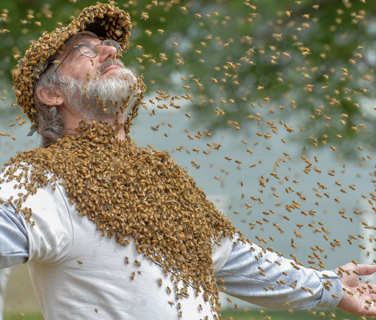
BEE HERE NOW: Paul Stamets, a mycologist on a mission, wears a bee beard to promote honey bee health and funding for a Honey Bee and Pollinator Research Center at Washington State University.
Excerpt:
When I showed up at Starship Agarikon, I found Stamets sitting on the deck fiddling around with a mason jar and a blue plastic dish. It was the prototype for a bee feeder he had invented. The jar dribbled sugar water laced with fungal extracts into the dish, and bees crawled through a chute to get to it. Even by Stamets’s standards, this project was a big headline. His 2018 study, co-authored with entomologists at the Washington State University bee lab, had been accepted by the journal Nature Scientific Reports. He and his team had shown that extracts of certain fungi could be used to reduce bee mortality dramatically.
About a third of global agricultural output depends on pollination from animals, particularly honeybees, and the precipitous decline in bee populations is one of the many pressing threats to humanity. A number of factors contribute to the syndrome known as colony collapse disorder. Widespread use of insecticides is one. Habitat loss is another. The most insidious problem, however, is the varroa mite, appropriately named Varroa destructor. Varroa mites are parasites that suck fluid from bees’ bodies and are vectors for a range of deadly viruses.
Give Paul Stamets an insoluble problem and he’ll toss you a new way it can be decomposed, poisoned, or healed by a fungus.
Wood-rotting fungi are a rich source of antiviral compounds, many of which have long been used as medicines, particularly in China. After 9/11, Stamets collaborated with the U.S. National Institutes of Health and Department of Defense in Project BioShield, a search for compounds that could be used to fight viral storms unleashed by biological terrorists. Of the thousands of compounds tested, some of Stamets’s extracts from wood-rotting fungi had the strongest activity against a number of deadly viruses, including smallpox, herpes, and flu. He had been producing these extracts for human consumption for several years—it is largely these products that have made Fungi Perfecti into a multimillion-dollar business. But the idea of using them to treat bees was a more recent brainwave.
The effects of the fungal extracts on the bees’ viral infections were unambiguous. Adding a one percent extract of amadou (or Fomes) and reishi (Ganoderma) to bees’ sugar water reduced deformed wing virus eighty-fold. Fomes extracts reduced levels of Lake Sinai virus nearly ninety-fold, and Ganoderma extracts reduced it forty-five-thousand-fold. Steve Sheppard, a professor of entomology at Washington State University and one of Stamets’s collaborators on the study, observed that he had not encountered any other substance that could extend the life of bees to this extent.
More...
http://nautil.us/issue/90/something-gre ... b00bf1f6eb
How mushrooms could solve colony collapse disorder.
BEE HERE NOW: Paul Stamets, a mycologist on a mission, wears a bee beard to promote honey bee health and funding for a Honey Bee and Pollinator Research Center at Washington State University.
Excerpt:
When I showed up at Starship Agarikon, I found Stamets sitting on the deck fiddling around with a mason jar and a blue plastic dish. It was the prototype for a bee feeder he had invented. The jar dribbled sugar water laced with fungal extracts into the dish, and bees crawled through a chute to get to it. Even by Stamets’s standards, this project was a big headline. His 2018 study, co-authored with entomologists at the Washington State University bee lab, had been accepted by the journal Nature Scientific Reports. He and his team had shown that extracts of certain fungi could be used to reduce bee mortality dramatically.
About a third of global agricultural output depends on pollination from animals, particularly honeybees, and the precipitous decline in bee populations is one of the many pressing threats to humanity. A number of factors contribute to the syndrome known as colony collapse disorder. Widespread use of insecticides is one. Habitat loss is another. The most insidious problem, however, is the varroa mite, appropriately named Varroa destructor. Varroa mites are parasites that suck fluid from bees’ bodies and are vectors for a range of deadly viruses.
Give Paul Stamets an insoluble problem and he’ll toss you a new way it can be decomposed, poisoned, or healed by a fungus.
Wood-rotting fungi are a rich source of antiviral compounds, many of which have long been used as medicines, particularly in China. After 9/11, Stamets collaborated with the U.S. National Institutes of Health and Department of Defense in Project BioShield, a search for compounds that could be used to fight viral storms unleashed by biological terrorists. Of the thousands of compounds tested, some of Stamets’s extracts from wood-rotting fungi had the strongest activity against a number of deadly viruses, including smallpox, herpes, and flu. He had been producing these extracts for human consumption for several years—it is largely these products that have made Fungi Perfecti into a multimillion-dollar business. But the idea of using them to treat bees was a more recent brainwave.
The effects of the fungal extracts on the bees’ viral infections were unambiguous. Adding a one percent extract of amadou (or Fomes) and reishi (Ganoderma) to bees’ sugar water reduced deformed wing virus eighty-fold. Fomes extracts reduced levels of Lake Sinai virus nearly ninety-fold, and Ganoderma extracts reduced it forty-five-thousand-fold. Steve Sheppard, a professor of entomology at Washington State University and one of Stamets’s collaborators on the study, observed that he had not encountered any other substance that could extend the life of bees to this extent.
More...
http://nautil.us/issue/90/something-gre ... b00bf1f6eb
A Man Found 15,000 Bees in His Car After Grocery Shopping
An off-duty firefighter in Las Cruces, N.M., whose hobby is beekeeping, safely removed the swarm from the man’s car in an Albertsons supermarket parking lot.

By the time a man returned from a 10-minute stop at an Albertsons supermarket in Las Cruces, N.M., a swarm of honey bees had invaded his car through an open window.Credit...Las Cruces Fire Department Engine 2
He had just finished grocery shopping, but a New Mexico man got much more than he bargained for when he returned to his car in the store’s parking lot: A swarm of 15,000 honey bees had taken over the back seat.
The man, whose name was not released, had left a window down in a Buick while he made a 10-minute stop at an Albertsons supermarket on Sunday afternoon in Las Cruces, N.M., the authorities said.
It wasn’t until he had started to drive away that he noticed that something was amiss, according to the Las Cruces Fire Department.
“Then he turned back and looked and like was, ‘Holy Cow,’ ” Jesse Johnson, an off-duty firefighter and paramedic whose hobby is beekeeping, said of the man’s reaction in an interview on Wednesday. “He called 911 because he didn’t know what to do.”
Mr. Johnson, 37, a 10-year member of the Fire Department and a father of two, said he had just finished a family barbecue when he got the call from the Fire Department and figured that he could safely remove and relocate the bees to his property.
“I’ll do anything to keep people from killing the bees,” he said.
It’s common in the spring for colonies of bees to split, with a swarm following a queen to another location, according to Mr. Johnson. He suggested that the bees, which collectively weighed about 3½ pounds, might have come from a parapet, gutter system or home in a nearby neighborhood. Mr. Johnson said the car’s open window presented an inviting place for the bees to take shelter until they could find a more permanent home.
“Luckily, when bees are swarming, they’re pretty docile,” he said. “They don’t have a home to protect for a moment. It’s much more intimidating than it is dangerous.”
But don’t tell that to the driver of the car, who Mr. Johnson said watched him wrangle the bees from a healthy distance in the parking lot of Albertsons.
“He didn’t want to have anything to do with it,” he said. “He was worried because the car was borrowed from a friend.”
Protected by a white beekeeper’s jacket and veil, Mr. Johnson approached the car with an empty hive box that he said he had treated with lemongrass oil.
“It really mimics the scent of the queen,” he said.
While this was one of the larger swarms he has relocated, Mr. Johnson said he could have completed the delicate task in just five to 10 minutes. But he didn’t want to rush it, so he said he spent 20 to 30 minutes at the scene. He put the bees in the empty hive box and loaded it into his truck for the ride home.
The Fire Department estimated that 15,000 bees were removed.
“The meat and potatoes part was real quick,” Mr. Johnson said, adding, “I didn’t want to leave him with 1,000 bees still in his car looking for their queen.”
No major injuries resulted from the encounter, according to the authorities, though they noted that a supermarket security guard and at least one firefighter were stung.
“One guy got stung on the lip, and we made fun of him the next morning,” Mr. Johnson said.
A representative for the supermarket chain Albertsons declined to comment on Wednesday and referred inquiries to the Las Cruces Fire Department.
Chief Jason Smith of the Las Cruces Fire Department said in an interview on Wednesday that Mr. Johnson had distinguished himself as an emergency responder.
“He was definitely willing to come down and help out the crew,” Chief Smith said.
The Fire Department ordinarily doesn’t remove bee swarms, but Chief Smith said that because the bees were in a relatively high-traffic area and were docile, it made sense for Mr. Johnson to remove them.
“We take a more patient or deliberate approach to try to let the bees do what they need to to find a new home,” he said.
Mr. Johnson said he had four hives at his home and has had as many as 12. His efforts on Sunday will come with a sweetener, he said: honey.
https://www.nytimes.com/2021/04/01/us/b ... 778d3e6de3
An off-duty firefighter in Las Cruces, N.M., whose hobby is beekeeping, safely removed the swarm from the man’s car in an Albertsons supermarket parking lot.
By the time a man returned from a 10-minute stop at an Albertsons supermarket in Las Cruces, N.M., a swarm of honey bees had invaded his car through an open window.Credit...Las Cruces Fire Department Engine 2
He had just finished grocery shopping, but a New Mexico man got much more than he bargained for when he returned to his car in the store’s parking lot: A swarm of 15,000 honey bees had taken over the back seat.
The man, whose name was not released, had left a window down in a Buick while he made a 10-minute stop at an Albertsons supermarket on Sunday afternoon in Las Cruces, N.M., the authorities said.
It wasn’t until he had started to drive away that he noticed that something was amiss, according to the Las Cruces Fire Department.
“Then he turned back and looked and like was, ‘Holy Cow,’ ” Jesse Johnson, an off-duty firefighter and paramedic whose hobby is beekeeping, said of the man’s reaction in an interview on Wednesday. “He called 911 because he didn’t know what to do.”
Mr. Johnson, 37, a 10-year member of the Fire Department and a father of two, said he had just finished a family barbecue when he got the call from the Fire Department and figured that he could safely remove and relocate the bees to his property.
“I’ll do anything to keep people from killing the bees,” he said.
It’s common in the spring for colonies of bees to split, with a swarm following a queen to another location, according to Mr. Johnson. He suggested that the bees, which collectively weighed about 3½ pounds, might have come from a parapet, gutter system or home in a nearby neighborhood. Mr. Johnson said the car’s open window presented an inviting place for the bees to take shelter until they could find a more permanent home.
“Luckily, when bees are swarming, they’re pretty docile,” he said. “They don’t have a home to protect for a moment. It’s much more intimidating than it is dangerous.”
But don’t tell that to the driver of the car, who Mr. Johnson said watched him wrangle the bees from a healthy distance in the parking lot of Albertsons.
“He didn’t want to have anything to do with it,” he said. “He was worried because the car was borrowed from a friend.”
Protected by a white beekeeper’s jacket and veil, Mr. Johnson approached the car with an empty hive box that he said he had treated with lemongrass oil.
“It really mimics the scent of the queen,” he said.
While this was one of the larger swarms he has relocated, Mr. Johnson said he could have completed the delicate task in just five to 10 minutes. But he didn’t want to rush it, so he said he spent 20 to 30 minutes at the scene. He put the bees in the empty hive box and loaded it into his truck for the ride home.
The Fire Department estimated that 15,000 bees were removed.
“The meat and potatoes part was real quick,” Mr. Johnson said, adding, “I didn’t want to leave him with 1,000 bees still in his car looking for their queen.”
No major injuries resulted from the encounter, according to the authorities, though they noted that a supermarket security guard and at least one firefighter were stung.
“One guy got stung on the lip, and we made fun of him the next morning,” Mr. Johnson said.
A representative for the supermarket chain Albertsons declined to comment on Wednesday and referred inquiries to the Las Cruces Fire Department.
Chief Jason Smith of the Las Cruces Fire Department said in an interview on Wednesday that Mr. Johnson had distinguished himself as an emergency responder.
“He was definitely willing to come down and help out the crew,” Chief Smith said.
The Fire Department ordinarily doesn’t remove bee swarms, but Chief Smith said that because the bees were in a relatively high-traffic area and were docile, it made sense for Mr. Johnson to remove them.
“We take a more patient or deliberate approach to try to let the bees do what they need to to find a new home,” he said.
Mr. Johnson said he had four hives at his home and has had as many as 12. His efforts on Sunday will come with a sweetener, he said: honey.
https://www.nytimes.com/2021/04/01/us/b ... 778d3e6de3
Re: Honey bees
Honey, Call the Bee Vet!
Veterinarians are gingerly embracing the honeybee, a vital pollinator for agriculture but one that’s in increasing danger.
Video: https://vp.nyt.com/video/2026/07/28/175 ... -1080p.mp4
By Emily AnthesPhotographs and Video by Will Crooks
Published Aug. 3, 2026
Updated Aug. 4, 2026
At the University of Georgia’s veterinary teaching hospital, aspiring animal doctors learn to minister to a menagerie: dogs with dermatitis and horses with colic, diabetic cats and malnourished parrots, bleeding rabbits and wheezing snakes.
“Whatever hops through the door,” said Dr. Jörg Mayer, an exotic-animal vet at the hospital. “Or slithers.”
But on a breezy Sunday morning in April, Dr. Mayer was in a small, overgrown field, teaching students how to make house calls on a group of patients that rarely made it through the hospital door — or onto the standard veterinary curriculum. The students climbed into stiff white jumpsuits, donned protective mesh hoods and prepared to make the rounds on hundreds of thousands of honeybees.
“Is everybody ready?” Dr. Mayer asked.
Over the next two hours, the students examined more than a dozen hives, holding the wax combs up to the sun and searching for signs of disease: the stunted wings, discolored larvae or minuscule mites that can spell serious trouble for the nation’s bees and, by extension, its food supply.
ImageSeveral students in white beekeeping outfits stand in a row.

Veterinary students listening to Dr. Jörg Mayer give a short lecture during a spring hive inspection at the University of Georgia.
Honeybees are agricultural all-stars, pollinating roughly $15 billion worth of crops — more than 130 types of fruit, vegetables and nuts — every year. They are also increasingly in danger, plagued by parasites and pathogens and weakened by climate change, pesticides and malnutrition.
Mass die-offs have become commonplace; during the 2024 to 2025 season, the United States lost more than half of its managed honeybee colonies. Beekeepers are “fighting a war trying to keep their bees alive,” said Bob Binnie, a commercial beekeeper who owns the Blue Ridge Honey Company in Lakemont, Ga.
The honeybee medicine program at the University of Georgia is part of a nascent but growing effort to enlist veterinarians in the fight. Most veterinary students are already required to master the biological basics of a range of domestic creatures, such as dogs, cats, horses, cows and pigs. “I think the honeybee deserves a similar status,” said Dr. Mayer, a professor at the university’s vet school.
If half of the nation’s dogs — or cats or cows or horses — were to unexpectedly drop dead every winter, it would be an animal health emergency. “Yet in beekeeping, it’s basically called Wednesday,” Dr. Mayer said. “It’s considered totally normal.”
A student in beekeeping garb holding a smoker on one hand and a frame of a nest in the other as bees swarm around them.
Three bee stingers on a wad of cotton on a table.

Using a smoker to calm the bees during the honey harvest; honeybee stingers used in an apitherapy treatment.
‘Basically micro-livestock’
Dr. Mayer, who grew up in a tiny agricultural town in southwestern Germany, spent much of his childhood around farm animals. But when he began veterinary school in Budapest, he found himself drawn to birds, lizards and the exotic creatures about which much less was known.
He also fell in love with honeybees. Unlike in the United States, many European vet schools made honeybee health part of the curriculum, presenting the invertebrates as “basically micro-livestock,” Dr. Mayer said.
Honeybee medicine was offbeat enough to capture his attention. “I also thought that’s super romantic, having your own bees, making your own honey,” Dr. Mayer said.
And in the early 2000s, after he took a job as an exotic-animal vet in the United States, he got a few hives of his own.
Image
A portrait of Jörg Mayer, who wears a loose white beekeeping garment with a hood on his back and poses in some tall grass.

Jörg Mayer at the University of Georgia’s apiary, before a long day of queen-capturing and re-queening at each hive.
By then, it was clear that honeybees were facing serious threats. Varroa destructor, an invasive, parasitic mite that feeds on living bees, was at the top of the list. But dozens of dangers lurked: wax moths, hive beetles, digestion-disrupting fungi, viruses that caused paralysis or wing deformities, bacteria that could wipe out all of a colony’s young.
For years, American beekeepers managed outbreaks mostly on their own, diagnosing many diseases visually and then administering their preferred treatments. The fact that beekeepers could buy antibiotics over the counter, without consulting a veterinarian, helped enable this self-sufficiency.
But in 2017, amid concern about the rise of antibiotic-resistant microbes, federal regulators tightened access to antibiotics. Suddenly, beekeepers who wanted to use the drugs needed veterinarians.
A close-up view of a pair of human fingers holding the green feathers of a parrot back as a bee clings to its skin.
A close-up view of a gloved human hand applying honey to a blemish on the back of an armadillo.
A close-up view of a syringe held by a human hand going into the leg of a horse.

Bee-sting apitherapy on a parrot; applying raw honey to a wounded armadillo; injecting a horse with arthritis with a bee venom compound.
There was just one problem. “In the U.S., we weren’t well trained for taking care of honeybees,” said Dr. Tracy S. Farone, a veterinarian at Grove City College in Pennsylvania who took a sabbatical in Europe to learn more.
Since 2017, several professional organizations, including a newly formed Honey Bee Veterinary Consortium, have been trying to bring practicing vets up to speed, creating continuing-education courses and special certifications. Interest in the subject has been growing, experts said.
“We certainly have made some great strides,” said Dr. Farone, who now studies and teaches about honeybee heath. “When I go to veterinary conferences and I speak about honeybees, my rooms are full.” (She added, “It’s not another dog-diarrhea lecture, right?”)
But the knowledge gap is large. In one survey, conducted in 2023 and 2024, 74 percent of veterinarians said they did not know how to write honeybee prescriptions; 89 percent indicated that they would be unable to identify honeybee diseases.
So some veterinary schools have also been working to give the next generation of vets a better grounding in bees.
“Having the vets come in is really needed because it’s so hard for the bees and the beekeepers right now,” said Meghan Milbrath, who helped establish, and now leads, a honeybee medicine program at Michigan State University and was an author of the vet survey. “We just really need all hands on deck.”
A student looks into a microscope in a university lab space.
A group of students in a classroom facing a projector screen that reads in part, "molecular resistance mechanisms" and has diagrams of a honey bee.

Viewing a parasite sample in a microscope; Dr. Mayer's classroom.
Minding the hives
At the University of Georgia, Dr. Mayer figured that he was well positioned to help vet students get a handle on honeybees. After the F.D.A. rule change, he said he asked himself, “Well, why don’t I just combine my hobby, the beekeeping, with my job?”
He teamed up with colleagues at the university’s agriculture school, which was already home to a renowned bee lab and beekeeper certification program. Together, they created a program in honeybee medicine, which now includes a bee club, a bee treatment crew and a three-week elective rotation.
Madison Morgan, a fourth-year vet student from Austell, Ga., surprised herself by signing up for all of it. She had arrived at school with no particular interest in bees. “They were not on my radar in the slightest,” she confessed.
But when she heard about the bee club, she was intrigued, and Dr. Mayer’s enthusiasm won her over.
“It ended up being a newfound love that I was not expecting,” said Ms. Morgan, who ultimately became a manager of the bee treatment crew. Seeing a bee return to the hive, transporting thick clumps of pollen on its legs, had become as exciting as watching her dog learn a new trick. “When we see them coming with pollen pants, we’re so proud of that bee,” she said.
But in some ways, bees challenge a central tenet of veterinary medicine, in which the life of each individual animal matters. “We all love animals, and we’re like, ‘Oh, we want to save each and every one,’” Ms. Morgan said.
A gloved hand uses a special marker to mark a queen bee held in a special container with a yellow top as honey worker bees fly around and inspect the gloved hands.
A huddle of bees at the end of a small wooden box containing a queen bee, held up by a veterinary student wearing a blue latex glove.

Marking a queen with a blue dot; Madison Morgan, a fourth-year vet student; a box containing a newly vaccinated queen to be introduced to a hive.
That approach makes little sense for honeybees, which have life spans that can be measured in weeks and can survive only as part of a larger colony. Colonies are often described as “superorganisms,” with the bees working collectively to perform some basic biological functions.
So in honeybee medicine, the bee is not the patient; the hive is. The vet school’s teaching apiary had 13 of them, each housed in a tower of stacked boxes that grew taller as the colony expanded.
The students on the bee treatment crew inspect the hives every week. They begin by examining the debris that accumulates at the bottom of each hive. Pollen grains and wax flakes are normal byproducts of a healthy, active colony. But finding hive beetles, mummified bee larvae or lots of tiny, reddish-brown specks — Varroa mites — on the bottom board can spell trouble.
The students also assess the wooden frames inside each hive, which hold the wax combs that bees use to store their food and raise their young: Is there enough pollen, nectar and honey to keep the colony nourished? Do the bees need more space? Are there signs of pests or pathogens?
Ghostly white fibers from a wax moth infection cling to an empty honey frame.
A close-up view of a gloved hand using a scraper to scrape the bottom of a bee's nest during a hive inspection.

A frame from a hive with a wax moth infestation; inspecting a hive’s bottom board.
Holistic health
On that breezy Sunday morning in April, the inspections did turn up two Varroa mites, which was no cause for panic. The mites have become so widespread that it’s not unusual to find a few in a hive; treatment would not be required unless the mite population rose.
Although Varroa can bring down even the strongest hive, healthy, well-fed colonies can keep some pests and pathogens “in check” on their own, said Lewis J. Bartlett, who leads research at the University of Georgia’s bee lab and helped create the honeybee medicine program.
“But if we run out of good food for them, because we’ve seen losses of pollinator habitat,” he added, “and we’re poisoning them with all these insecticides and fungicides and other agrochemicals that we know inhibit their immune system, then you can get these huge outbreaks.”
So the program encouraged students to think holistically about hive health, teaching them about the nutritional principles and environmental conditions that could protect bees, and beekeepers, from large-scale losses.
“If you get called out to an apiary,” Dr. Mayer said, “you don’t want to be that guy that just drives around in a station wagon and writes a prescription and says, ‘See you later.’”
Video
Veterinary Students Learn to Care for Honeybees as Populations Decline
0:40
Veterinary students at the University of Georgia learned to care for honeybees, which are vital pollinators for U.S. agriculture. Between 2024 and 2025 more than half of the managed colonies in the U.S. have been lost.CreditCredit...Will Crooks for The New York Times
Dr. Mayer doesn’t expect his students to orient their entire careers around bees but hopes that they will feel comfortable taking on beekeepers as customers.
Indeed, Ms. Morgan, recently decided to specialize in surgery. But, she said, she hopes to be a resource for local beekeepers and to keep her own hives at home.
Of course, that was how Dr. Mayer started, with just a casual beekeeping hobby and a separate professional specialty. Now, even his work with exotic animals incorporates bees: He has used honey, which may speed the healing of certain wounds, to treat injured turtles and armadillos and is investigating whether bee products might have benefits for animals with cancer. Bees, he said, have “really taken over my life.”
Emily Anthes
Animal science reporter
I’ve written about honeybees before, but reporting this story was the first time I had the chance to get up close and personal with a hive. The beekeeping suit was neither comfortable nor flattering (and I can’t imagine wearing the heavy garment in the middle of the Georgia summer), but I could see how people get hooked on beekeeping. There was something meditative about tending to the bees and the two-hour inspection flew by.
https://www.nytimes.com/2026/08/03/scie ... e9677ea768
Veterinarians are gingerly embracing the honeybee, a vital pollinator for agriculture but one that’s in increasing danger.
Video: https://vp.nyt.com/video/2026/07/28/175 ... -1080p.mp4
By Emily AnthesPhotographs and Video by Will Crooks
Published Aug. 3, 2026
Updated Aug. 4, 2026
At the University of Georgia’s veterinary teaching hospital, aspiring animal doctors learn to minister to a menagerie: dogs with dermatitis and horses with colic, diabetic cats and malnourished parrots, bleeding rabbits and wheezing snakes.
“Whatever hops through the door,” said Dr. Jörg Mayer, an exotic-animal vet at the hospital. “Or slithers.”
But on a breezy Sunday morning in April, Dr. Mayer was in a small, overgrown field, teaching students how to make house calls on a group of patients that rarely made it through the hospital door — or onto the standard veterinary curriculum. The students climbed into stiff white jumpsuits, donned protective mesh hoods and prepared to make the rounds on hundreds of thousands of honeybees.
“Is everybody ready?” Dr. Mayer asked.
Over the next two hours, the students examined more than a dozen hives, holding the wax combs up to the sun and searching for signs of disease: the stunted wings, discolored larvae or minuscule mites that can spell serious trouble for the nation’s bees and, by extension, its food supply.
ImageSeveral students in white beekeeping outfits stand in a row.
Veterinary students listening to Dr. Jörg Mayer give a short lecture during a spring hive inspection at the University of Georgia.
Honeybees are agricultural all-stars, pollinating roughly $15 billion worth of crops — more than 130 types of fruit, vegetables and nuts — every year. They are also increasingly in danger, plagued by parasites and pathogens and weakened by climate change, pesticides and malnutrition.
Mass die-offs have become commonplace; during the 2024 to 2025 season, the United States lost more than half of its managed honeybee colonies. Beekeepers are “fighting a war trying to keep their bees alive,” said Bob Binnie, a commercial beekeeper who owns the Blue Ridge Honey Company in Lakemont, Ga.
The honeybee medicine program at the University of Georgia is part of a nascent but growing effort to enlist veterinarians in the fight. Most veterinary students are already required to master the biological basics of a range of domestic creatures, such as dogs, cats, horses, cows and pigs. “I think the honeybee deserves a similar status,” said Dr. Mayer, a professor at the university’s vet school.
If half of the nation’s dogs — or cats or cows or horses — were to unexpectedly drop dead every winter, it would be an animal health emergency. “Yet in beekeeping, it’s basically called Wednesday,” Dr. Mayer said. “It’s considered totally normal.”
A student in beekeeping garb holding a smoker on one hand and a frame of a nest in the other as bees swarm around them.
Three bee stingers on a wad of cotton on a table.
Using a smoker to calm the bees during the honey harvest; honeybee stingers used in an apitherapy treatment.
‘Basically micro-livestock’
Dr. Mayer, who grew up in a tiny agricultural town in southwestern Germany, spent much of his childhood around farm animals. But when he began veterinary school in Budapest, he found himself drawn to birds, lizards and the exotic creatures about which much less was known.
He also fell in love with honeybees. Unlike in the United States, many European vet schools made honeybee health part of the curriculum, presenting the invertebrates as “basically micro-livestock,” Dr. Mayer said.
Honeybee medicine was offbeat enough to capture his attention. “I also thought that’s super romantic, having your own bees, making your own honey,” Dr. Mayer said.
And in the early 2000s, after he took a job as an exotic-animal vet in the United States, he got a few hives of his own.
Image
A portrait of Jörg Mayer, who wears a loose white beekeeping garment with a hood on his back and poses in some tall grass.
Jörg Mayer at the University of Georgia’s apiary, before a long day of queen-capturing and re-queening at each hive.
By then, it was clear that honeybees were facing serious threats. Varroa destructor, an invasive, parasitic mite that feeds on living bees, was at the top of the list. But dozens of dangers lurked: wax moths, hive beetles, digestion-disrupting fungi, viruses that caused paralysis or wing deformities, bacteria that could wipe out all of a colony’s young.
For years, American beekeepers managed outbreaks mostly on their own, diagnosing many diseases visually and then administering their preferred treatments. The fact that beekeepers could buy antibiotics over the counter, without consulting a veterinarian, helped enable this self-sufficiency.
But in 2017, amid concern about the rise of antibiotic-resistant microbes, federal regulators tightened access to antibiotics. Suddenly, beekeepers who wanted to use the drugs needed veterinarians.
A close-up view of a pair of human fingers holding the green feathers of a parrot back as a bee clings to its skin.
A close-up view of a gloved human hand applying honey to a blemish on the back of an armadillo.
A close-up view of a syringe held by a human hand going into the leg of a horse.
Bee-sting apitherapy on a parrot; applying raw honey to a wounded armadillo; injecting a horse with arthritis with a bee venom compound.
There was just one problem. “In the U.S., we weren’t well trained for taking care of honeybees,” said Dr. Tracy S. Farone, a veterinarian at Grove City College in Pennsylvania who took a sabbatical in Europe to learn more.
Since 2017, several professional organizations, including a newly formed Honey Bee Veterinary Consortium, have been trying to bring practicing vets up to speed, creating continuing-education courses and special certifications. Interest in the subject has been growing, experts said.
“We certainly have made some great strides,” said Dr. Farone, who now studies and teaches about honeybee heath. “When I go to veterinary conferences and I speak about honeybees, my rooms are full.” (She added, “It’s not another dog-diarrhea lecture, right?”)
But the knowledge gap is large. In one survey, conducted in 2023 and 2024, 74 percent of veterinarians said they did not know how to write honeybee prescriptions; 89 percent indicated that they would be unable to identify honeybee diseases.
So some veterinary schools have also been working to give the next generation of vets a better grounding in bees.
“Having the vets come in is really needed because it’s so hard for the bees and the beekeepers right now,” said Meghan Milbrath, who helped establish, and now leads, a honeybee medicine program at Michigan State University and was an author of the vet survey. “We just really need all hands on deck.”
A student looks into a microscope in a university lab space.
A group of students in a classroom facing a projector screen that reads in part, "molecular resistance mechanisms" and has diagrams of a honey bee.
Viewing a parasite sample in a microscope; Dr. Mayer's classroom.
Minding the hives
At the University of Georgia, Dr. Mayer figured that he was well positioned to help vet students get a handle on honeybees. After the F.D.A. rule change, he said he asked himself, “Well, why don’t I just combine my hobby, the beekeeping, with my job?”
He teamed up with colleagues at the university’s agriculture school, which was already home to a renowned bee lab and beekeeper certification program. Together, they created a program in honeybee medicine, which now includes a bee club, a bee treatment crew and a three-week elective rotation.
Madison Morgan, a fourth-year vet student from Austell, Ga., surprised herself by signing up for all of it. She had arrived at school with no particular interest in bees. “They were not on my radar in the slightest,” she confessed.
But when she heard about the bee club, she was intrigued, and Dr. Mayer’s enthusiasm won her over.
“It ended up being a newfound love that I was not expecting,” said Ms. Morgan, who ultimately became a manager of the bee treatment crew. Seeing a bee return to the hive, transporting thick clumps of pollen on its legs, had become as exciting as watching her dog learn a new trick. “When we see them coming with pollen pants, we’re so proud of that bee,” she said.
But in some ways, bees challenge a central tenet of veterinary medicine, in which the life of each individual animal matters. “We all love animals, and we’re like, ‘Oh, we want to save each and every one,’” Ms. Morgan said.
A gloved hand uses a special marker to mark a queen bee held in a special container with a yellow top as honey worker bees fly around and inspect the gloved hands.
A huddle of bees at the end of a small wooden box containing a queen bee, held up by a veterinary student wearing a blue latex glove.
Marking a queen with a blue dot; Madison Morgan, a fourth-year vet student; a box containing a newly vaccinated queen to be introduced to a hive.
That approach makes little sense for honeybees, which have life spans that can be measured in weeks and can survive only as part of a larger colony. Colonies are often described as “superorganisms,” with the bees working collectively to perform some basic biological functions.
So in honeybee medicine, the bee is not the patient; the hive is. The vet school’s teaching apiary had 13 of them, each housed in a tower of stacked boxes that grew taller as the colony expanded.
The students on the bee treatment crew inspect the hives every week. They begin by examining the debris that accumulates at the bottom of each hive. Pollen grains and wax flakes are normal byproducts of a healthy, active colony. But finding hive beetles, mummified bee larvae or lots of tiny, reddish-brown specks — Varroa mites — on the bottom board can spell trouble.
The students also assess the wooden frames inside each hive, which hold the wax combs that bees use to store their food and raise their young: Is there enough pollen, nectar and honey to keep the colony nourished? Do the bees need more space? Are there signs of pests or pathogens?
Ghostly white fibers from a wax moth infection cling to an empty honey frame.
A close-up view of a gloved hand using a scraper to scrape the bottom of a bee's nest during a hive inspection.
A frame from a hive with a wax moth infestation; inspecting a hive’s bottom board.
Holistic health
On that breezy Sunday morning in April, the inspections did turn up two Varroa mites, which was no cause for panic. The mites have become so widespread that it’s not unusual to find a few in a hive; treatment would not be required unless the mite population rose.
Although Varroa can bring down even the strongest hive, healthy, well-fed colonies can keep some pests and pathogens “in check” on their own, said Lewis J. Bartlett, who leads research at the University of Georgia’s bee lab and helped create the honeybee medicine program.
“But if we run out of good food for them, because we’ve seen losses of pollinator habitat,” he added, “and we’re poisoning them with all these insecticides and fungicides and other agrochemicals that we know inhibit their immune system, then you can get these huge outbreaks.”
So the program encouraged students to think holistically about hive health, teaching them about the nutritional principles and environmental conditions that could protect bees, and beekeepers, from large-scale losses.
“If you get called out to an apiary,” Dr. Mayer said, “you don’t want to be that guy that just drives around in a station wagon and writes a prescription and says, ‘See you later.’”
Video
Veterinary Students Learn to Care for Honeybees as Populations Decline
0:40
Veterinary students at the University of Georgia learned to care for honeybees, which are vital pollinators for U.S. agriculture. Between 2024 and 2025 more than half of the managed colonies in the U.S. have been lost.CreditCredit...Will Crooks for The New York Times
Dr. Mayer doesn’t expect his students to orient their entire careers around bees but hopes that they will feel comfortable taking on beekeepers as customers.
Indeed, Ms. Morgan, recently decided to specialize in surgery. But, she said, she hopes to be a resource for local beekeepers and to keep her own hives at home.
Of course, that was how Dr. Mayer started, with just a casual beekeeping hobby and a separate professional specialty. Now, even his work with exotic animals incorporates bees: He has used honey, which may speed the healing of certain wounds, to treat injured turtles and armadillos and is investigating whether bee products might have benefits for animals with cancer. Bees, he said, have “really taken over my life.”
Emily Anthes
Animal science reporter
I’ve written about honeybees before, but reporting this story was the first time I had the chance to get up close and personal with a hive. The beekeeping suit was neither comfortable nor flattering (and I can’t imagine wearing the heavy garment in the middle of the Georgia summer), but I could see how people get hooked on beekeeping. There was something meditative about tending to the bees and the two-hour inspection flew by.
https://www.nytimes.com/2026/08/03/scie ... e9677ea768