
What is the authority of H H the Aga Khan, the Imam of Isnaili Muslims, where does it come from, and how is it excercised. New article
Link http://www.ismaili.net/html/modules.php ... pic&t=9224
Imam and Imamat
-
swamidada1
- Posts: 239
- Joined: Sun Nov 18, 2018 9:21 pm
mahebubchatur wrote:What is the authority of H H the Aga Khan, the Imam of Isnaili Muslims, where does it come from, and how is it excercised. New article
Link http://www.ismaili.net/html/modules.php ... pic&t=9224
I agree with the following 3 paragraphs written by Mahebub Chatur on the topic of Imamat. It is true Imam is Noor of Allah, Mazhar of Allah, Hujjat of Allah, he is true guide, he is intercessor, he is trustee, he is door to Allah (Baabullah), he is shaheed (witness), that's why he is called 'Ainullah.
"Authority is a right which comes from a position of leadership. Leadership is much more that giving orders and enforcing them. The Aga Khan is first and foremost a religious Leader, an Imam , guiding over 15 million Ismaili Muslims worldwide. This guidance is called Farmans . His authority and position are derived from the Quran, which has come from Allah (God), through Prophet Mohammed. The first Ismaili Imam, was appointed by Prophet Mohammed with authority to continue the interpretation, and teaching of the Quran. This is a divinely ordained mandate, to light the way for all those who seek, called believers or murids. To the Imam they are all his beloved spiritual children".
"Imam is therefore an inheritor, intercessor & trustee, to continue the interpretations (Tawil), and teaching (Talim), of the Qur’an. This has been explained by the Imam, in the Ismaili constitution, and in many Farmans.
"There is a difference between Divinity and Divine or divinely ordained authority. IMAMS DO NOT CLAIM DIVINITY. PROPHET MUHAMMAD NEVER CLAIMED DIVINITY. According to Ismaili Muslims, Prophet Mohammed passed on authority, by appointing Imam Ali, as the inheritor and a successor. Imam’s guidance is for all who seek, and submit to his guidance".
Imam means many things to many people but as Imam himself has said, he is Pir to the one who consider him as Pir, he is a friend to one who consider him a friend etc.. All this has been discussed in the Imamat thread as well as in the Ali Allah thread.swamidada wrote:I agree with the following 3 paragraphs written by Mahebub Chatur on the topic of Imamat.
From the article of Mumtaz Ali Tajddin published in 2000 - "Divine Light of Ali - In all Imams"
“You should be rest assured that the Light (noor) of Murtza Ali is in me, present and apparent before you. We put on the (bodily) dress (jama) and put off in the world, but our One Light (noor) is descended since eternity, therefore, you must see One Light (in different bodies). There was One Light (noor) of Ali in Aga Ali Shah and my grandfather, even in their forefathers, and that very Light (noor) is descended in me. I am their heir apparent. The Light (noor) is present and apparent all the times, only the names are different. The Throne (gadi) of Mawla Murtza Ali is present and will remain till the Judgment Day. You jamat have no reason to deject in any way. I am present before you. There is no difference between me and them (only) the bodies have to change, therefore, the true believers must comprehend the foregoing point.” (Imam Sultan Muhammad Shah (Bombay, 8th September, 1885)
“You should be rest assured that the Light (noor) of Murtza Ali is in me, present and apparent before you. We put on the (bodily) dress (jama) and put off in the world, but our One Light (noor) is descended since eternity, therefore, you must see One Light (in different bodies). There was One Light (noor) of Ali in Aga Ali Shah and my grandfather, even in their forefathers, and that very Light (noor) is descended in me. I am their heir apparent. The Light (noor) is present and apparent all the times, only the names are different. The Throne (gadi) of Mawla Murtza Ali is present and will remain till the Judgment Day. You jamat have no reason to deject in any way. I am present before you. There is no difference between me and them (only) the bodies have to change, therefore, the true believers must comprehend the foregoing point.” (Imam Sultan Muhammad Shah (Bombay, 8th September, 1885)
-
swamidada1
- Posts: 239
- Joined: Sun Nov 18, 2018 9:21 pm
Imam Sultan Muhammad Shah became Imam on August 17, 1885 on Monday at age of 8 years. Two weeks after coronation, Imam gave Dedaar to Indian jamaits in Mumbai darkhana and made the following Farman on September 1, 1885. It is a lengthy Farman but I shall quote the portions of Farman related to subject of Imam and Noor e Imamat.
MSMS said," Jamaits, do not consider me small, I am the decendant of Prophet and my grand father is Hazrat Amirul Mu'mineen and my grand mother is Khatoon e Janat Hazrat Bibi Fatimah. I am the Noor of both Hazrat Ali and the Holy Prophet Muhammad. Though young in age I am exalted.
Hazrat Imam Zainul Abideen was also young in age, but had the same power and learning as Murtaza Ali. My Noor continues on from there and verily Noor of Ali ever remains in the world.
Apparently we have adopted DARVESHI but have got reverence from the court of Khudavand Ta'allah because we are Ahl e Bait, progeny of the Prophet.
You should differentiate between Truth and false, Insha Allah those who recognize us are like precious valuable jewels, follow the course of honesty and truthfulness (to recognize Imam of time).
MSMS said," Jamaits, do not consider me small, I am the decendant of Prophet and my grand father is Hazrat Amirul Mu'mineen and my grand mother is Khatoon e Janat Hazrat Bibi Fatimah. I am the Noor of both Hazrat Ali and the Holy Prophet Muhammad. Though young in age I am exalted.
Hazrat Imam Zainul Abideen was also young in age, but had the same power and learning as Murtaza Ali. My Noor continues on from there and verily Noor of Ali ever remains in the world.
Apparently we have adopted DARVESHI but have got reverence from the court of Khudavand Ta'allah because we are Ahl e Bait, progeny of the Prophet.
You should differentiate between Truth and false, Insha Allah those who recognize us are like precious valuable jewels, follow the course of honesty and truthfulness (to recognize Imam of time).
Manifestation and Concealment: Revival and Survival in Ismailism
Daryoush Mohammad Poor
D. Mohammad Poor
Ismailism begins its history, almost immediately with the experience of concealment (satr), which was interconnected with the inaccessibility of Ismaili Imams beginning with Muḥammad b. Ismāʿīl b. Jaʿfar al-Ṣādiq , who came to be known as Muḥammad al-Maktūm (the hidden). This period of concealment is also marked by the belief of early Ismailis in Muḥammad b. Ismāʿīl being the seventh enunciator and the qāʾim. This period comes to an end when the Fatimids rise to power and ʿAbd Allāh al-Mahdī (ʿUbayd Allāh, in non-Ismaili sources) (d. 322/934) establishes the Fatimid dynasty in North Africa as the first Fatimid Imam-Caliph. The notion of qāʾim is also, as a consequence, revised to accommodate the shift from the early doctrine of messianic beliefs to one that can incorporate the founding of an Ismaili state.
The Nizārī-Mustaʿlian split at the time of al-Mustanṣir (d. 487/1094), the eight Fatimid caliph, marks the beginning of another period of concealment with the same implication of the physical inaccessibility of the Imam, which lasts from the death of Nizār (d. 488/1095) until the death of Muḥammad b. Buzurg Umīd (d. 557/1162), the third ruler of Alamut, when his successor Ḥasan II (d. 561/1166) claims decent from Nizār but also claims shortly after to be the qāʾim. It is here that concealment and manifestation transmute fully into a doctrine which specifically deals with the religious law (sharīʿat) and its esoteric meaning (qiyāmat). While in earlier periods (and even later on) concealment often related to the physical accessibility of the Imam (not occultation unlike the Imamī tradition), this time concealment specifically referred to the period of the domination of religious laws and rituals. Manifestation, or be more precise the cycle of manifestation, referred to the era when under certain conditions, religious laws would be lifted.
The multiple meanings of satr and kashf, all of which were interconnected with how the doctrine of imamate was understood by Ismailis of different periods, reflect the dynamics of how authority was articulated and exercised in the Ismaili community. This paper will address how these multiple meanings are often invoked, interpreted and reinterpreted to accommodate socio-political and doctrinal changes in the Ismaili community. The paper will draw on the works of Sijistānī, Qāḍī al-Nuʿmān, Nāṣir-i Khusraw and Naṣīr al-Dīn al-Ṭūsī and a few unpublished fragments of manuscripts from the Alamut period of Ismaili history.
Location: Denver, MESA 2015
Event Date: Nov 23, 2015
Conference End Date: Nov 25, 2015
Conference Start Date: Nov 21, 2015
The entire paper can be accessed at:
https://www.academia.edu/19903957/Manif ... view-paper
Daryoush Mohammad Poor
D. Mohammad Poor
Ismailism begins its history, almost immediately with the experience of concealment (satr), which was interconnected with the inaccessibility of Ismaili Imams beginning with Muḥammad b. Ismāʿīl b. Jaʿfar al-Ṣādiq , who came to be known as Muḥammad al-Maktūm (the hidden). This period of concealment is also marked by the belief of early Ismailis in Muḥammad b. Ismāʿīl being the seventh enunciator and the qāʾim. This period comes to an end when the Fatimids rise to power and ʿAbd Allāh al-Mahdī (ʿUbayd Allāh, in non-Ismaili sources) (d. 322/934) establishes the Fatimid dynasty in North Africa as the first Fatimid Imam-Caliph. The notion of qāʾim is also, as a consequence, revised to accommodate the shift from the early doctrine of messianic beliefs to one that can incorporate the founding of an Ismaili state.
The Nizārī-Mustaʿlian split at the time of al-Mustanṣir (d. 487/1094), the eight Fatimid caliph, marks the beginning of another period of concealment with the same implication of the physical inaccessibility of the Imam, which lasts from the death of Nizār (d. 488/1095) until the death of Muḥammad b. Buzurg Umīd (d. 557/1162), the third ruler of Alamut, when his successor Ḥasan II (d. 561/1166) claims decent from Nizār but also claims shortly after to be the qāʾim. It is here that concealment and manifestation transmute fully into a doctrine which specifically deals with the religious law (sharīʿat) and its esoteric meaning (qiyāmat). While in earlier periods (and even later on) concealment often related to the physical accessibility of the Imam (not occultation unlike the Imamī tradition), this time concealment specifically referred to the period of the domination of religious laws and rituals. Manifestation, or be more precise the cycle of manifestation, referred to the era when under certain conditions, religious laws would be lifted.
The multiple meanings of satr and kashf, all of which were interconnected with how the doctrine of imamate was understood by Ismailis of different periods, reflect the dynamics of how authority was articulated and exercised in the Ismaili community. This paper will address how these multiple meanings are often invoked, interpreted and reinterpreted to accommodate socio-political and doctrinal changes in the Ismaili community. The paper will draw on the works of Sijistānī, Qāḍī al-Nuʿmān, Nāṣir-i Khusraw and Naṣīr al-Dīn al-Ṭūsī and a few unpublished fragments of manuscripts from the Alamut period of Ismaili history.
Location: Denver, MESA 2015
Event Date: Nov 23, 2015
Conference End Date: Nov 25, 2015
Conference Start Date: Nov 21, 2015
The entire paper can be accessed at:
https://www.academia.edu/19903957/Manif ... view-paper
-
mahebubchatur
- Posts: 853
- Joined: Mon Jan 13, 2014 7:01 pm
Imam's mission is on 3 levels
The Imam must direct Ismailis on the practice of their religion and constantly interpret the Qur’an for them according to our theology. On the spiritual plane, the Imam’s authority is absolute. Ismaili Muslims believe therefore that what the Imam says is the true interpretation (of the Quran) possible.
Mawlana Hazar Imam
L’Expansion Interview, Roger Priouret (Paris, France), March 1975
You see, my mission is situated on three levels. Firstly, religious: it concerns a symbolic exegesis of the Qur’an: interpreting the Divine Word, the adapting the needs of each community to the time; refashioning the law, constantly and relentlessly. Wherever one finds an Ismaili community, there exists a commission of theologians that engages in this research. But nothing is decided without me…. Our religion is esoteric, you understand. It is a perpetual initiation.
Mawlana Hazar Imam (Translation)
Jeune Afrique Interview (1st), Anne Loesch (Paris, France), 15 October 1967
ismailignosis.com/2018/04/02/how-the-ismaili-imam-teaches-the-esoteric-interpretation-tawil-of-the-holy-quran/
-------------
Note from Admin: This interview in its original format is already since 1993 on http://www.ismaili.net/intervue/i671015.html
Mawlana Hazar Imam
L’Expansion Interview, Roger Priouret (Paris, France), March 1975
You see, my mission is situated on three levels. Firstly, religious: it concerns a symbolic exegesis of the Qur’an: interpreting the Divine Word, the adapting the needs of each community to the time; refashioning the law, constantly and relentlessly. Wherever one finds an Ismaili community, there exists a commission of theologians that engages in this research. But nothing is decided without me…. Our religion is esoteric, you understand. It is a perpetual initiation.
Mawlana Hazar Imam (Translation)
Jeune Afrique Interview (1st), Anne Loesch (Paris, France), 15 October 1967
ismailignosis.com/2018/04/02/how-the-ismaili-imam-teaches-the-esoteric-interpretation-tawil-of-the-holy-quran/
-------------
Note from Admin: This interview in its original format is already since 1993 on http://www.ismaili.net/intervue/i671015.html
-
mahebubchatur
- Posts: 853
- Joined: Mon Jan 13, 2014 7:01 pm
Beautiful chart of the genealogy of Mowlana Shah Karim Aga Khan IV in direct descent of Hazrat Ali with the line of Imams.
The chart contains dates for each Imam. Please note that I have not verified the date. The chart is desgned by Pyarali Jiwa. It is a handy tool to go through Ismaili Imam's historical dates.
The larger version is on this link:
http://ismaili.net/source/charts/imamat-chart.pdf
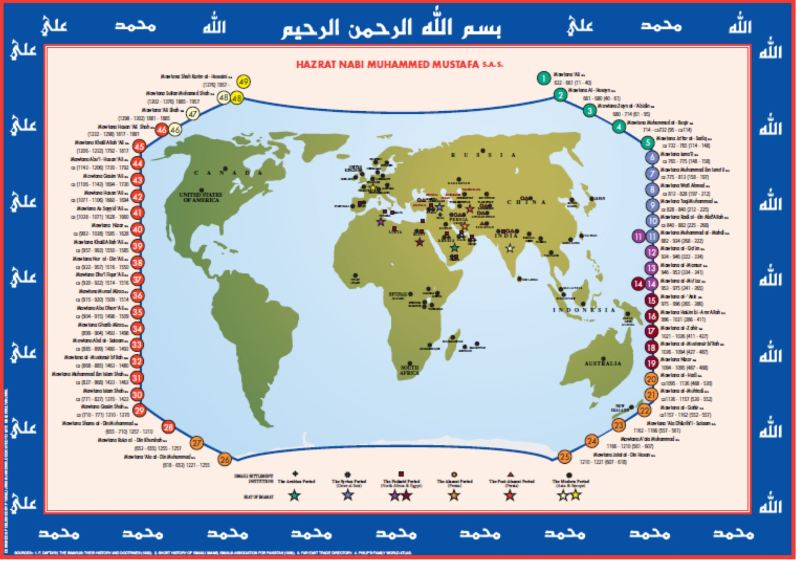
The chart contains dates for each Imam. Please note that I have not verified the date. The chart is desgned by Pyarali Jiwa. It is a handy tool to go through Ismaili Imam's historical dates.
The larger version is on this link:
http://ismaili.net/source/charts/imamat-chart.pdf
Rehmat Ni Varsha - A Shower of Blessings (With Lyrics & Translations
Video:
https://www.youtube.com/watch?v=XSDCKHP ... e=youtu.be
Video:
https://www.youtube.com/watch?v=XSDCKHP ... e=youtu.be
-
ismaili103
- Posts: 504
- Joined: Wed Mar 20, 2013 1:40 am
It is narrated through Ammar-e Yasir, Jabir bin Abdullah, Malik-e Ashtar and Miqdad Aswad al Kindi (r.a), that when Imam Ali [a.s] was proceeding towards Shaam [for the battle at Siffin], he stopped and turned his horse away from the direction of Shaam and looked around for quite some time and then proceeded in one direction [away from Shaam]. His companions were astonished at this and asked him the reason for the change of direction.
Imam Ali [a.s] replied: "I see what you are unable to see, for the hidden [Ghaib] is screened from your eyes. There is a monastry in this forest in which a Christian Monk is waiting with the sword tied around his waist and is ready to blow the trumpet. I want to break his sword and shatter his trumpet to pieces. If you are with me then follow me".
He, along with his companions then proceeded to the place where they found the monastry and the hermit. The hermit was attracted by the luminiscent face of Imam Ali [a.s] surrounded by his companions.
The herimt asked: "O, You Fair Gentleman where are you coming from?"
Imam Ali [a.s] replied : "I am coming from Madina and we are proceeding to fight a battle at Shaam"
The personality of Imam Ali [a.s] so impressed the hermit that his heart was illumined with faith.
The hermit asked: "O, you, Young man with the effulgent face are you an angel or a human being?"
Imam Ali [a.s] replied: "I am a human being and a Guide to the jinns and leader of the angles"
The hermit said: "In the Bible I have read the name as Taab Taab. O you the Effulgent One, Is that your name?".
Imam Ali [a.s] replied: "Taab Taab is the name of Muhammad the Chosen One [Mustafa] [s.a.w] My name is Santiyya".
The hermit asked: "Is your name mentioned as Meet Meet in the Torah?"
Imam Ali [a.s] replied: "Meet Meet is the name of Muhammad the Chosen One [Mustafa] [s.a.w] and my name is Aeliya"
The hermit asked : "Are you the Messiah who has descended from the skies to alliviate the melancholy and sorrow of the denizens of the earth?"
Imam Ali [a.s] replied: "No. I am not Jesus, but Jesus is one of those who adore me"
The hermit asked: "Are you Moses come down with his staff to show his miracles to mankind?"
Imam Ali [a.s] replied: "Iam not Moses but Moses is one of those who loves me"
The hermit said: "For God's sake tell me your name and your descent [geneology]"
Imam Ali [s] replied: "In every country and community I bear different names. The Arabs call me Hal `Ata and search for me in this title. The people of Tayif call me Tahmeed. Among the Meccans I am known as Babul Balad. The denizens of the skies write my name as Ahad. The Turks call me Balya and the Zangis call me Majeelan. And the Hindus call me Kishen Kishen. The Firangis call me Hami Isa. And the people of Khataya call me Bolya. I am reknowned in Iraq as Ameerun Nahl. In Khurasan I am knoewwn as Haider. In the first firmament I am known as Abdul Hameed. In the second fiermament I am known as Abdul Samad. In the third firmament I am known as Abdul Majeed. In the fourth firmamwnt I am known as Zul `Ulaa. In the fifth firmament my nanmew is Ali al `Aalaa. The Glorious Lord has made me sit upon theThrone of Authority [Musnad-e-Imaarat] and designated me as Ameerul Mominin. The Chief of the two worlds [Khwaja-e-Do-Saraa] Muhammade Mustafa [s.a.w] named me Abu Turaab. My father gave Abul Hasan as my agnomen and my mother gave the agnomen Abul `Ashar"
Reference from Book-:
('Kaukab-e-Durri',page.no 364-365)
Imam Ali [a.s] replied: "I see what you are unable to see, for the hidden [Ghaib] is screened from your eyes. There is a monastry in this forest in which a Christian Monk is waiting with the sword tied around his waist and is ready to blow the trumpet. I want to break his sword and shatter his trumpet to pieces. If you are with me then follow me".
He, along with his companions then proceeded to the place where they found the monastry and the hermit. The hermit was attracted by the luminiscent face of Imam Ali [a.s] surrounded by his companions.
The herimt asked: "O, You Fair Gentleman where are you coming from?"
Imam Ali [a.s] replied : "I am coming from Madina and we are proceeding to fight a battle at Shaam"
The personality of Imam Ali [a.s] so impressed the hermit that his heart was illumined with faith.
The hermit asked: "O, you, Young man with the effulgent face are you an angel or a human being?"
Imam Ali [a.s] replied: "I am a human being and a Guide to the jinns and leader of the angles"
The hermit said: "In the Bible I have read the name as Taab Taab. O you the Effulgent One, Is that your name?".
Imam Ali [a.s] replied: "Taab Taab is the name of Muhammad the Chosen One [Mustafa] [s.a.w] My name is Santiyya".
The hermit asked: "Is your name mentioned as Meet Meet in the Torah?"
Imam Ali [a.s] replied: "Meet Meet is the name of Muhammad the Chosen One [Mustafa] [s.a.w] and my name is Aeliya"
The hermit asked : "Are you the Messiah who has descended from the skies to alliviate the melancholy and sorrow of the denizens of the earth?"
Imam Ali [a.s] replied: "No. I am not Jesus, but Jesus is one of those who adore me"
The hermit asked: "Are you Moses come down with his staff to show his miracles to mankind?"
Imam Ali [a.s] replied: "Iam not Moses but Moses is one of those who loves me"
The hermit said: "For God's sake tell me your name and your descent [geneology]"
Imam Ali [s] replied: "In every country and community I bear different names. The Arabs call me Hal `Ata and search for me in this title. The people of Tayif call me Tahmeed. Among the Meccans I am known as Babul Balad. The denizens of the skies write my name as Ahad. The Turks call me Balya and the Zangis call me Majeelan. And the Hindus call me Kishen Kishen. The Firangis call me Hami Isa. And the people of Khataya call me Bolya. I am reknowned in Iraq as Ameerun Nahl. In Khurasan I am knoewwn as Haider. In the first firmament I am known as Abdul Hameed. In the second fiermament I am known as Abdul Samad. In the third firmament I am known as Abdul Majeed. In the fourth firmamwnt I am known as Zul `Ulaa. In the fifth firmament my nanmew is Ali al `Aalaa. The Glorious Lord has made me sit upon theThrone of Authority [Musnad-e-Imaarat] and designated me as Ameerul Mominin. The Chief of the two worlds [Khwaja-e-Do-Saraa] Muhammade Mustafa [s.a.w] named me Abu Turaab. My father gave Abul Hasan as my agnomen and my mother gave the agnomen Abul `Ashar"
Reference from Book-:
('Kaukab-e-Durri',page.no 364-365)
I own a copy of the famous book KAUKAB DURRI, no where on pages 364/365 the story you mentioned is narrated. Please double check your source.ismaili103 wrote:It is narrated through Ammar-e Yasir, Jabir bin Abdullah, Malik-e Ashtar and Miqdad Aswad al Kindi (r.a), that when Imam Ali [a.s] was proceeding towards Shaam [for the battle at Siffin], he stopped and turned his horse away from the direction of Shaam and looked around for quite some time and then proceeded in one direction [away from Shaam]. His companions were astonished at this and asked him the reason for the change of direction.
Imam Ali [a.s] replied: "I see what you are unable to see, for the hidden [Ghaib] is screened from your eyes. There is a monastry in this forest in which a Christian Monk is waiting with the sword tied around his waist and is ready to blow the trumpet. I want to break his sword and shatter his trumpet to pieces. If you are with me then follow me".
He, along with his companions then proceeded to the place where they found the monastry and the hermit. The hermit was attracted by the luminiscent face of Imam Ali [a.s] surrounded by his companions.
The herimt asked: "O, You Fair Gentleman where are you coming from?"
Imam Ali [a.s] replied : "I am coming from Madina and we are proceeding to fight a battle at Shaam"
The personality of Imam Ali [a.s] so impressed the hermit that his heart was illumined with faith.
The hermit asked: "O, you, Young man with the effulgent face are you an angel or a human being?"
Imam Ali [a.s] replied: "I am a human being and a Guide to the jinns and leader of the angles"
The hermit said: "In the Bible I have read the name as Taab Taab. O you the Effulgent One, Is that your name?".
Imam Ali [a.s] replied: "Taab Taab is the name of Muhammad the Chosen One [Mustafa] [s.a.w] My name is Santiyya".
The hermit asked: "Is your name mentioned as Meet Meet in the Torah?"
Imam Ali [a.s] replied: "Meet Meet is the name of Muhammad the Chosen One [Mustafa] [s.a.w] and my name is Aeliya"
The hermit asked : "Are you the Messiah who has descended from the skies to alliviate the melancholy and sorrow of the denizens of the earth?"
Imam Ali [a.s] replied: "No. I am not Jesus, but Jesus is one of those who adore me"
The hermit asked: "Are you Moses come down with his staff to show his miracles to mankind?"
Imam Ali [a.s] replied: "Iam not Moses but Moses is one of those who loves me"
The hermit said: "For God's sake tell me your name and your descent [geneology]"
Imam Ali [s] replied: "In every country and community I bear different names. The Arabs call me Hal `Ata and search for me in this title. The people of Tayif call me Tahmeed. Among the Meccans I am known as Babul Balad. The denizens of the skies write my name as Ahad. The Turks call me Balya and the Zangis call me Majeelan. And the Hindus call me Kishen Kishen. The Firangis call me Hami Isa. And the people of Khataya call me Bolya. I am reknowned in Iraq as Ameerun Nahl. In Khurasan I am knoewwn as Haider. In the first firmament I am known as Abdul Hameed. In the second fiermament I am known as Abdul Samad. In the third firmament I am known as Abdul Majeed. In the fourth firmamwnt I am known as Zul `Ulaa. In the fifth firmament my nanmew is Ali al `Aalaa. The Glorious Lord has made me sit upon theThrone of Authority [Musnad-e-Imaarat] and designated me as Ameerul Mominin. The Chief of the two worlds [Khwaja-e-Do-Saraa] Muhammade Mustafa [s.a.w] named me Abu Turaab. My father gave Abul Hasan as my agnomen and my mother gave the agnomen Abul `Ashar"
Reference from Book-:
('Kaukab-e-Durri',page.no 364-365)
In the following passage, you wrote," In the first firmament I am known as Abdul Hameed. In the second fiermament I am known as Abdul Samad. In the third firmament I am known as Abdul Majeed. In the fourth firmamwnt I am known as Zul `Ulaa. In the fifth firmament my nanmew is Ali al `Aalaa. The Glorious Lord has made me sit upon theThrone of Authority [Musnad-e-Imaarat] and designated me as Ameerul Mominin. The Chief of the two worlds [Khwaja-e-Do-Saraa] Muhammade Mustafa [s.a.w] named me Abu Turaab. My father gave Abul Hasan as my agnomen and my mother gave the agnomen Abul `Ashar"
Reference from Book-: ('Kaukab-e-Durri',page.no 364-365)
You have mentioned names 'Abdul Hameed, Abdul Samad, Abdul Majeed',
Abd means slave, ghullam, servant which goes against your ideology!!
The name Hyder was given by Bibi Fatimah.
-
ismaili103
- Posts: 504
- Joined: Wed Mar 20, 2013 1:40 am
It's copied from The.ismaili missionary FB page and I also have PDF of this book in Urdu in which this anecdote is mentioned on page 364. After reading this anecdote on FB, I verified it with the book I have before posting it here.
Secondly, my ideology is based on the Farmans of Hazir Imam and Ginans of Pirs.
Secondly, my ideology is based on the Farmans of Hazir Imam and Ginans of Pirs.


I would suggest that you ignore the postings of Swamidada, his all aim is to create doubt in the minds of ismailis about the legitimacy of our faith and our documents.ismaili103 wrote:It's copied from The.ismaili missionary FB page and I also have PDF of this book in Urdu in which this anecdote is mentioned on page 364. After reading this anecdote on FB, I verified it with the book I have before posting it here.
Secondly, my ideology is based on the Farmans of Hazir Imam and Ginans of Pirs.
I remember when I gave the reference of Gibbon's book on Mowlana Hakim's declaration that Mowlana Hakim was the Tenth manifestation of God on earth, he questioned my reference and I had to waste precious time going through boxes to find the book and scan a copy of the page to post for all to see that he was making ridiculous counter claims. I can see that he is doing the same with you. Just ignore him.
Thank you again for bringing this important text to the attention of all those who seek and search for the path to the truth.
WOH ALI JO:
Woh Ali jo Mowla e Kainaat hai.
Woh Ali jo Mazharul 'ajaaib hai.
Woh Ali jo Saheb e Mu'jizaat hai.
Woh Ali jo madinatul ilm hai.
Woh Ali jo Sirat e Mustaqeem hai.
Woh Ali jo amr e 'aalameen hai.
Woh Ali jo mufakar e Quran hai.
Woh Ali jo 'aalam e ilm e luduni hai.
Woh Ali jo Hadi e khalq hai.
Woh Ali jo la fata hai.
Woh Ali jo Saheb e Zulfiqar hai.
Woh Ali jo kalimatu Rahman hai.
Woh Ali jo kaleed Saheb e Hikmat hai.
Woh Ali jo Saheb e suluni hai.
Woh Ali jo Basheer wa Nazeer hai.
Woh Ali jo Imam e Awwal hai.
Woh Ali jo Amirul mu'mineen hai.
Woh Ali jo quwwat e Paigamber hai.
Woh Ali jo nafs e Rasul hai.
Woh Ali jo faateh Badar, Khaibar,khandaq wa hunnain hai.
Woh Ali jo jahnasheen Ahmad e Mursal hai.
Woh Ali jo Imam e mahshar hai.
Woh Ali jo Islam ka suttun hai.
Woh Ali jo Sidiq e Akbar hai.
Woh Ali jo Qazi e dahar hai.
Woh Ali jo Sultan e uns wa jaan hai.
Woh Ali jo Imamul mutaqeen hai.
Woh Ali jo hal e mushkilaat hai.
Woh Ali jo marji'a e ikhlaq hai.
Woh Ali jo koh e tur par Noor tha.
Woh Ali jo koh e abu 'ubaid par Massiha bana.
Woh Ali jo koh e zaitun par mu'ajiza bana.
Woh Ali jo mimbar e Ghadir par Mowla bana.
Woh Ali jo 'arshe Muneer par 'Alla bana.
Woh Ali jo kisi ka GHULLAM nahi.
Woh Ali jo subb ka MOWLA ALI hai.
Woh Ali jo Mowla e Kainaat hai.
Woh Ali jo Mazharul 'ajaaib hai.
Woh Ali jo Saheb e Mu'jizaat hai.
Woh Ali jo madinatul ilm hai.
Woh Ali jo Sirat e Mustaqeem hai.
Woh Ali jo amr e 'aalameen hai.
Woh Ali jo mufakar e Quran hai.
Woh Ali jo 'aalam e ilm e luduni hai.
Woh Ali jo Hadi e khalq hai.
Woh Ali jo la fata hai.
Woh Ali jo Saheb e Zulfiqar hai.
Woh Ali jo kalimatu Rahman hai.
Woh Ali jo kaleed Saheb e Hikmat hai.
Woh Ali jo Saheb e suluni hai.
Woh Ali jo Basheer wa Nazeer hai.
Woh Ali jo Imam e Awwal hai.
Woh Ali jo Amirul mu'mineen hai.
Woh Ali jo quwwat e Paigamber hai.
Woh Ali jo nafs e Rasul hai.
Woh Ali jo faateh Badar, Khaibar,khandaq wa hunnain hai.
Woh Ali jo jahnasheen Ahmad e Mursal hai.
Woh Ali jo Imam e mahshar hai.
Woh Ali jo Islam ka suttun hai.
Woh Ali jo Sidiq e Akbar hai.
Woh Ali jo Qazi e dahar hai.
Woh Ali jo Sultan e uns wa jaan hai.
Woh Ali jo Imamul mutaqeen hai.
Woh Ali jo hal e mushkilaat hai.
Woh Ali jo marji'a e ikhlaq hai.
Woh Ali jo koh e tur par Noor tha.
Woh Ali jo koh e abu 'ubaid par Massiha bana.
Woh Ali jo koh e zaitun par mu'ajiza bana.
Woh Ali jo mimbar e Ghadir par Mowla bana.
Woh Ali jo 'arshe Muneer par 'Alla bana.
Woh Ali jo kisi ka GHULLAM nahi.
Woh Ali jo subb ka MOWLA ALI hai.
An excerpt from the lecture by famous Islamic scholar from Pakistan Jawed Ghamadi about real Imam and Imamat: He said:
Imam is appointed by Allah as He appointed Prophets. When Allah appointed Prophets He never consulted any one. It is His Divine right to appoint any Prophet. Same way He appoints Imam without asking or consulting any one. Imams are appointed by His Divine will. Imams can not be appointed according to wishes of public, otherwise there would be chaos and many will claim to be imams, like it happens in political era. Allah ordered The Prophet to declare Ali as Imam, which he did. But many at that time ignored and criticized Prophet, they were unjust people.
Jawed Ghamadi.
Imam is appointed by Allah as He appointed Prophets. When Allah appointed Prophets He never consulted any one. It is His Divine right to appoint any Prophet. Same way He appoints Imam without asking or consulting any one. Imams are appointed by His Divine will. Imams can not be appointed according to wishes of public, otherwise there would be chaos and many will claim to be imams, like it happens in political era. Allah ordered The Prophet to declare Ali as Imam, which he did. But many at that time ignored and criticized Prophet, they were unjust people.
Jawed Ghamadi.
Contemplations on Love

One of the most powerful emotions experienced by an individual is love. We are willing to go to the ends of the earth and beyond for the love of another individual. Muslims across centuries have relied on the language of love to express love for the Divine as well as to imagine the intensity of Divine love.
In Jawhar al-Dhat, the Persian poet Farid al-Din Attar illuminates the depths of Divine love when he writes:
From each a mystic silence Love demands.
What do we all seek so earnestly? ‘Tis Love.
What do they whisper to each other? Love.
Love is the subject of their inmost thoughts.
In Love, no longer “thou” and “I” exist, for Self has passed away in the Beloved.1
Love, in this framing, emerges as an organic connection that humans share with each other, and with the Divine.
In the Shia tradition, the Ahl al-Bayt, the family of the Prophet, and the Imams, become the center of the believers’ love and devotion. Ibn Hani al-Andalusi, a court poet of the Fatimid Imam-caliph al-Muizz, emphasizes his devotion and love for the descendants of Hazrat Ali and Hazrat Bibi Fatima (a.s.), as he writes:
O Children of Fatima! Is there in our resurrection a means of protection for us, a sure refuge other than you? You are the friends of God and the friends of His people, God’s pious khalifas and proofs, ever-present on earth. You are from the people of prophecy, messengership and guidance, the pure chiefs manifest, clearly for everyone to see.2
Ibn Hani affirms the status of the descendants of Imam Ali and Bibi Fatima as the khalifas, stewards or deputies, of God on earth. His expression of love for them thus becomes an intentional act of faith.
In contemporary times too, Shia Ismaili Muslims express their love for Mawlana Hazar Imam in similar poetic forms. Isma’il Adra, a Shia Ismaili poet, beautifully articulates his love for the Imam of the Time:
O Karim! O my sovereign! You are my destination and to you I come running with a breathless heart. Come close to me in your love and presence, with that which is between your purity and mercy. Since I have made you the sovereign of my heart, increase its yearning for you who are so near to me.3
Adra yearns for the proximity of the Imam and draws upon the established Arabic poetic tradition to simultaneously express and strengthen his spiritual bond.
While Ismaili murids of the past and present have expressed love for the Imam in myriad ways, we have been blessed to experience a glimpse of the unconditional love of the Imam for us, his Jamat. In a message to the global jamat, on March 29, 2020, Hazar Imam said:
“Please convey my best paternal and my best maternal loving blessings to my worldwide Jamat, and tell them that I think of them every minute of the day, each day, and I pray for Mushkil Asan and for their peace and happiness.”4
Let us find joy and strength in this shared bond of love. May it lead us to further strengthen our spiritual bond with each other and with our Imam. Ameen.
1 Smith, Margaret. The Persian Mystics, Attar. New York: E. P. Dutton & Company, Inc. 1932. p. 93.
2 Hunzai, Faquir M. (Ed). Shimmering Light: An Anthology of Ismaili Poetry. London: IB Tauris Publishers, The Institute of Ismaili Studies. 1996. p. 25.
3 Ibid., p.136.
4 Mawlana Hazar Imam conveys blessings for the worldwide Jamat. 29 March 2020. https://the.ismaili/global/news/imamat- ... -conveys-b...
https://the.ismaili/usa/contemplations-love
One of the most powerful emotions experienced by an individual is love. We are willing to go to the ends of the earth and beyond for the love of another individual. Muslims across centuries have relied on the language of love to express love for the Divine as well as to imagine the intensity of Divine love.
In Jawhar al-Dhat, the Persian poet Farid al-Din Attar illuminates the depths of Divine love when he writes:
From each a mystic silence Love demands.
What do we all seek so earnestly? ‘Tis Love.
What do they whisper to each other? Love.
Love is the subject of their inmost thoughts.
In Love, no longer “thou” and “I” exist, for Self has passed away in the Beloved.1
Love, in this framing, emerges as an organic connection that humans share with each other, and with the Divine.
In the Shia tradition, the Ahl al-Bayt, the family of the Prophet, and the Imams, become the center of the believers’ love and devotion. Ibn Hani al-Andalusi, a court poet of the Fatimid Imam-caliph al-Muizz, emphasizes his devotion and love for the descendants of Hazrat Ali and Hazrat Bibi Fatima (a.s.), as he writes:
O Children of Fatima! Is there in our resurrection a means of protection for us, a sure refuge other than you? You are the friends of God and the friends of His people, God’s pious khalifas and proofs, ever-present on earth. You are from the people of prophecy, messengership and guidance, the pure chiefs manifest, clearly for everyone to see.2
Ibn Hani affirms the status of the descendants of Imam Ali and Bibi Fatima as the khalifas, stewards or deputies, of God on earth. His expression of love for them thus becomes an intentional act of faith.
In contemporary times too, Shia Ismaili Muslims express their love for Mawlana Hazar Imam in similar poetic forms. Isma’il Adra, a Shia Ismaili poet, beautifully articulates his love for the Imam of the Time:
O Karim! O my sovereign! You are my destination and to you I come running with a breathless heart. Come close to me in your love and presence, with that which is between your purity and mercy. Since I have made you the sovereign of my heart, increase its yearning for you who are so near to me.3
Adra yearns for the proximity of the Imam and draws upon the established Arabic poetic tradition to simultaneously express and strengthen his spiritual bond.
While Ismaili murids of the past and present have expressed love for the Imam in myriad ways, we have been blessed to experience a glimpse of the unconditional love of the Imam for us, his Jamat. In a message to the global jamat, on March 29, 2020, Hazar Imam said:
“Please convey my best paternal and my best maternal loving blessings to my worldwide Jamat, and tell them that I think of them every minute of the day, each day, and I pray for Mushkil Asan and for their peace and happiness.”4
Let us find joy and strength in this shared bond of love. May it lead us to further strengthen our spiritual bond with each other and with our Imam. Ameen.
1 Smith, Margaret. The Persian Mystics, Attar. New York: E. P. Dutton & Company, Inc. 1932. p. 93.
2 Hunzai, Faquir M. (Ed). Shimmering Light: An Anthology of Ismaili Poetry. London: IB Tauris Publishers, The Institute of Ismaili Studies. 1996. p. 25.
3 Ibid., p.136.
4 Mawlana Hazar Imam conveys blessings for the worldwide Jamat. 29 March 2020. https://the.ismaili/global/news/imamat- ... -conveys-b...
https://the.ismaili/usa/contemplations-love
A Guiding Light – The Imamat of the Shia Ismaili Muslims (Hindi)

Video:
https://www.youtube.com/watch?v=FqjsjSS-td8
Video:
https://www.youtube.com/watch?v=FqjsjSS-td8
Re: Imam and Imamat
Stories of the Ismaili Imams

As we count down to Imamat Day, discover Stories of the Ismaili Imams, a new series exploring each Imam’s life and the continuity of Imamat from Mawlana Ali to the present day.
Informed by materials from The Institute of Ismaili Studies, these stories illustrate the values and contributions of the Imamat through history. Scroll down to learn about our first seven Imams and check again next week for more…

Stories of the Ismaili Imams: Mawlana Ali
Video: https://www.youtube.com/watch?v=2ib10jmShTc&t=1s
Biography
Mawlana Ali (peace be upon him) was born in Mecca around 600. He was the younger cousin of Prophet Muhammad (peace be upon him and his progeny) and married the Prophet’s daughter, Hazrat Bibi Fatima (peace be upon her). He is regarded as one of the greatest heroes of the early Muslim community, a model of ethical conduct and leadership, and one of Islam’s most authoritative spiritual teachers. Shia Muslims believe he was appointed by the Prophet at Ghadir Khumm to be his successor and the first hereditary Imam. He was also the fourth caliph, ruling the early Muslim empire from 656 until his assasination at Kufa in 661. The city of Najaf grew around his mausoleum. A work called Nahj al-Balagha contains sermons, letters, and sayings attributed to Imam Ali.
Story
One day, Mawlana Ali (peace be upon him) was bowing down in prayer when a poor man approached him asking for help. Without getting up, Imam Ali held out his hand, offering a ring for the man to take. Shia Muslims believe that this event is referred to in sura 5, aya 55 of the Holy Qur’an, which says, “Indeed your guardian [wali] is Allah and His Messenger and those who believe and establish prayer and give the alms while bowing down [during the prayer].” The word wali also has the same Arabic root as the word mawla, both of which can imply a relationship of authority and of closeness. The Shia interpret this verse as referring to Allah, Prophet Muhammad (peace be upon him and his family), and Mawlana Ali as guardians of the believers.
Era: Early Shia Period
Quote
“Truly Allah has made remembrance a polish for the hearts, by which they hear after being deaf, and see after being blind.”
Mawlana Ali
Sources
Daftary, Farhad. The Ismaili Imams, 2020.
IIS Secondary Curriculum: Faith & Practice in Islamic Traditions, vol. 1, p. 155.
******************************

Mawlana Husayn was travelling to Kufa in 680 to oppose the succession of the Umayyad caliph, Yazid. An army sent by Yazid intercepted Imam Husayn and his supporters at the plains of Karbala.
The night before the battle, Imam Husayn released his family and companions of their oath of allegiance, or bay‘a, encouraging them to flee under cover of night. Nearly all his followers reaffirmed their allegiance, pledging to protect their Imam…
Mawlana Husayn, our second Imam
Video: https://www.youtube.com/watch?v=THpOtrQ ... he.ismaili
Biography
Mawlana Husayn (peace be upon him) was born in Medina in 626. He was the grandson of Prophet Muhammad (peace be upon him and his progeny) through the marriage of Hazrat Bibi Fatima (peace be upon her), the Prophet’s beloved daughter, and Mawlana Ali (peace be upon him), the Prophet’s cousin and the first Shia Imam. He and his older brother, Hazrat Hasan (peace be upon him) initially grew up in the Prophet’s household and there are many stories of the Prophet’s great love for them. He died during the Battle of Karbala in 680, which is commemorated by millions of Shia Muslims each year in Muharram. His mausoleum in Karbala is one of the most widely visited pilgrimage sites in the world.
Story
Mawlana Husayn (peace be upon him) was travelling to Kufa in 680 to oppose the succession of the Umayyad caliph, Yazid. An army sent by Yazid intercepted Imam Husayn and his supporters at the plains of Karbala. The night before the battle, Imam Husayn released his family and companions of their oath of allegiance, or bay‘a, encouraging them to flee under cover of night. Nearly all his followers reaffirmed their allegiance, pledging to protect their Imam. While the Battle of Karbala tragically ended with the death of Imam Husayn and many of his family members, the line of Imamat continued through his only surviving son, Mawlana Zayn al-Abidin (peace be upon him). Karbala is a powerful example of allegiance, sacrifice, and the upholding of justice, as well as the continuation of the Imamat in the face of great persecution.
Era: Early Shia Period
Quote
“We are Muhammad’s family, those who possess his authority, those who have been made his trustees and his inheritors. We are those who have more claim to this position among the people than anyone else.”
Mawlana Husayn
Sources
Daftary, Farhad. The Ismaili Imams, 2020.
IIS Secondary Curriculum: Muslim Societies and Civilisations, vol. 1, pp. 147-156.
Madelung, Wilferd. “Husayn B. ‘Ali: Life and Significance in Shi‘ism,” 2004.
************************

One day, Prince Hisham, the son of the Umayyad caliph Abd al-Malik, was performing the pilgrimage in Mecca, but was unable to touch the sacred Black Stone on the Ka‘ba because of the crowds.
When Mawlana Zayn al-Abidin approached, the crowd parted to let him through. Prince Hisham asked his entourage, “who is this?” A poet named al-Farazdaq was nearby and replied with a spontaneous poem in praise of the Imam…
Mawlana Zayn al-Abidin, our third Imam
Video: https://www.youtube.com/watch?v=-KMAqWg ... he.ismaili
Biography
Mawlana Zayn al-Abidin (peace be upon him) was born in Medina around 658 with the given name of Ali. He was the sole surviving son of Mawlana Husayn (peace be upon him) at the Battle of Karbala, succeeding to the Imamat in 680. He returned to Medina and came to be known for his piety and knowledge, while generally avoiding any political activity. He had two honorific titles: Zayn al-Abidin (“Ornament of the Worshippers”) and al-Sajjad (“He who prostrates himself in prayer”). A famous collection of prayers, al-Sahifa al-Sajjadiyya, is attributed to him. After an Imamat of 34 years, he died in 714 and is buried in the historic Baqi cemetery in Medina.
Story
One day, Prince Hisham, the son of the Umayyad caliph Abd al-Malik, was performing the pilgrimage in Mecca, but was unable to touch the sacred Black Stone on the Ka‘ba because of the crowds. When Mawlana Zayn al-Abidin (peace be upon him) approached, the crowd parted to let him through. Prince Hisham asked his entourage, “who is this?” A poet named al-Farazdaq was nearby and replied with a spontaneous poem in praise of the Imam, including these lines:
This is the child of the best of all God’s servants,
Peerless, pious, pure, and pristine,
Are you ignorant of who he is?
He is the son of Fatima,
God’s prophets were sealed with his grandfather.
This story shows the deep affection and respect that many Muslims had for Imam Zayn al-Abidin and the family of Prophet Muhammad (peace be upon him and his progeny).
Era: Early Shia Period
Quote
“O Reliever of worry! O Remover of grief! O Merciful in this world and the next and Compassionate in both! Bless Muhammad and his Household, relieve my worry and remove my grief, preserve me, purify me, and take away my affliction.”
Mawlana Zayn al-Abidin
al-Sahifa al-Sajjadiyya
Sources
Daftary, Farhad. The Ismaili Imams, 2020.
IIS Secondary Curriculum: Muslim Societies and Civilisations, vol. 1, pp. 206-208.
Video (IIS): An Early Source of Shi'i Piety: al-Ṣaḥīfa al-Sajjādiyya
******************

Mawlana Muhammad al-Baqir (peace be upon him) was known for the breadth and depth of his knowledge. The title al-Baqir is short for baqir al-ilm, meaning “one who splits open knowledge.”
He is considered a defining scholar of the religious sciences in their early stages of development. He explained the Shia principles of Imamat, building on ideas introduced by the Imams before him…
Mawlana Muhammad al-Baqir, our fourth Imam
Video: https://www.youtube.com/watch?v=QM1Nd7- ... he.ismaili
Biography
Mawlana Muhammad al-Baqir (peace be upon him) was born in Medina in 677 and succeeded to the Imamat in 714. His teachings formed the doctrinal basis for the Imami Shia interpretation, particularly regarding the authority of the Imam. Unlike his half-brother Zayd, after whom the Zaydi Shia are named and who died in an uprising against the Umayyads in 740, Imam al-Baqir avoided political activity. He died at Medina in 732 and is buried in the Baqi cemetery.
Story
Mawlana Muhammad al-Baqir (peace be upon him) was known for the breadth and depth of his knowledge. The title al-Baqir is short for baqir al-ilm, meaning “one who splits open knowledge.” He is considered a defining scholar of the religious sciences in their early stages of development. He explained the Shia principles of Imamat, building on ideas introduced by the Imams before him, including the Imam’s divinely inspired knowledge, or ilm. He also discussed the concept of nass, which is the absolute prerogative of the Imam-of-the-Time to appoint his successor from among his direct descendants. Imam al-Baqir’s teachings continue to shape the beliefs and practices of the two major communities of the Imami Shia: Ismailis and Ithna‘asharis, and his example speaks to us of the importance of knowledge and learning.
Era: Early Shia Period
Quote
“The believer who is most perfect in faith is the one who has the best character.”
Mawlana Muhammad al-Baqir
Sources
Daftary, Farhad. The Ismaili Imams, 2020, pp. 37-40.
IIS Secondary Curriculum: Muslim Societies and Civilisations, vol. 1, pp. 155, 209, 211
IIS Secondary Curriculum: Faith and Practice in Islamic Traditions, Vol. 1., pp. 69, 71
******************

Mawlana Ja‘far al-Sadiq had a widespread reputation as a religious scholar in Shia and Sunni circles, as well as among Sufis, whether Sunni or Shia. He is said to have had scholarly relations with both Abu Hanifa and Malik ibn Anas , after whom two Sunni schools of law, or madhhabs, are named.
He contributed to the wider debates and discussions taking place among religious scholars of that time. The Imami Shia school of law is named the Ja‘fari madhhab after him, because of his articulation of the principles of Imamat…
Mawlana Ja‘far al-Sadiq, our fifth Imam
Video: https://www.youtube.com/watch?v=5bB4EpT ... he.ismaili
Biography
Mawlana Ja‘far al-Sadiq (peace be upon him) was born in 702 in Medina and succeeded to the Imamat in 732. He was known by the title of al-Sadiq, meaning “the trustworthy.” He is the last Imam recognised by the two major communities of the Imami Shia: Ismailis and Ithna‘asharis. Mawlana Ja‘far al-Sadiq avoided political involvement despite living during a turbulent time in the Muslim world, particularly the Abbasids overthrowing the Umayyad empire in 750. He died in 765 in Medina and was buried alongside several other Imams at the Baqi cemetery.
Story
Mawlana Ja‘far al-Sadiq (peace be upon him) had a widespread reputation as a religious scholar in Shia and Sunni circles, as well as among Sufis, whether Sunni or Shia. He is said to have had scholarly relations with both Abu Hanifa and Malik ibn Anas, after whom two Sunni schools of law, or madhhabs, are named. He contributed to the wider debates and discussions taking place among religious scholars of that time. The Imami Shia school of law is named the Ja‘fari madhhab after him, because of his articulation of the principles of Imamat. His teachings have also had a deep influence on the spirituality of the Sufi tradition of Islam. Mawlana Ja‘far al-Sadiq's scholarly pursuits demonstrate his contributions to the knowledge society of his time.
Era: Early Shia Period
Quote
“Faith consists in professing by the tongue, believing with the heart, and acting in accordance with its tenets.”
Mawlana Ja‘far al-Sadiq
Sources
Daftary, Farhad. The Ismaili Imams, 2020, pp. 41-44
IIS Secondary Curriculum: Muslim Societies and Civilisations, vol. 2, pp. 30-33
IIS Secondary Curriculum: Faith and Practice in Islamic Traditions, Vol. 1., pp. 69, 71, 143
******************************

A miniature watercolour painting of Prophet Muhammad's Mosque in Medina.Image: Khalili Collections
Mawlana Isma‘il was explicitly designated by nass to succeed his father, Mawlana Ja‘far al-Sadiq (peace be upon him). However, he was the subject of anti-Shia persecution by the ruling Abbasid caliphate, which forced him to hide his activities. While some reports claimed that he died before his father, other reports suggested that he was later seen in Basra…
Mawlana Isma‘il, our sixth Imam
Biography
Mawlana Isma‘il (peace be upon him) was born around 720 in Medina. He was the second eldest son of Mawlana Ja‘far al-Sadiq (peace be upon him) and was known as al-Mubarak (“the blessed one”). During his father’s Imamat, he may have been in contact with Shia groups that were involved in anti-Abbasid political activity, causing him to face government persecution. There was confusion about his whereabouts when his father died in 765, and there are conflicting reports about the year of his death. The name Ismailis refers to the followers of Imam Isma‘il and his descendants.
Story
Mawlana Isma‘il (peace be upon him) was explicitly designated by nass to succeed his father, Mawlana Ja‘far al-Sadiq (peace be upon him). However, he was the subject of anti-Shia persecution by the ruling Abbasid caliphate, which forced him to hide his activities. While some reports claimed that he died before his father, other reports suggested that he was later seen in Basra. Ultimately, he was not present at the time of his father’s death to publicly assume the Imamat, causing confusion that led to the formation of the two main Imami Shia communities. The Ismailis followed the lineage of Imam Isma‘il, whereas the Ithna‘asharis followed Imam Isma‘il’s younger half-brother, Musa al-Kazim. It is from Imam Isma‘il that the name Ismaili comes.
Era: Early Shia Period
Quote
“[God’s] Light in the heavens is His guidance, and His light in the earth is the Imams through whom one is rightly guided.”
Ja‘far b. Mansur al-Yaman from the The Book of Unveiling, p. 95
Sources
Daftary, Farhad. The Ismaili Imams, 2020, pp. 45-47
Gillion, Fârès. The Book of Unveiling, p. 95
****************************

Mawlana Muhammad b. Isma‘il went into hiding in Khuzistan in Persia, marking the start of the first dawr al-satr, or “period of concealment.”Photo: Mahmoud Hashemi
Mawlana Muhammad b. Isma‘il, our seventh Imam
Biography
Mawlana Muhammad ibn Isma‘il (peace be upon him) was born around 738 in Medina. He was known as al-Maymun (“The Fortunate One”) and later as al-Maktum (“The Hidden One”). He was 26 years old and already had two sons when his grandfather, Mawlana Ja‘far al-Sadiq (peace be upon him), died in 765. He led the earliest Ismaili community in the absence of his father, Mawlana Isma‘il (peace be upon him). Sometime after 766, he left Medina and went into hiding in southwestern Persia. He had four more sons during this time, including his successor, Mawlana Wafi Ahmad (peace be upon him). He died soon after 795 in Khuzistan.
Story
Not long after assuming the leadership of the early Ismaili community in 765, Mawlana Muhammad ibn Isma‘il (peace be upon him) left Medina to avoid persecution by the ruling Abbasid empire. He went into hiding in Khuzistan in Persia, marking the start of the first dawr al-satr, or “period of concealment”, during which the Imams hid their true identity. Despite this, Mawlana Muhammad ibn Isma‘il kept in touch with his followers in Kufa and sent missionaries, or da‘is, to southern Iraq to teach the faith. His story is an example of resilience in the face of difficulties.
Era: Period of Concealment
Quote
“[God] has not left the earth without an Imam on it for the community, who states the truth and who serves as the proof (hujja), even if… the entrusted Imams go into seclusion as a precaution.”
Qadi al-Nu‘man, 10th century Da‘i
Sources
Daftary, Farhad. The Ismaili Imams, 2020, pp. 49-50
Haji, Hamid. Founding the Fatimid State, p.
https://the.ismaili/us/en/news/mawlana- ... venth-imam
As we count down to Imamat Day, discover Stories of the Ismaili Imams, a new series exploring each Imam’s life and the continuity of Imamat from Mawlana Ali to the present day.
Informed by materials from The Institute of Ismaili Studies, these stories illustrate the values and contributions of the Imamat through history. Scroll down to learn about our first seven Imams and check again next week for more…
Stories of the Ismaili Imams: Mawlana Ali
Video: https://www.youtube.com/watch?v=2ib10jmShTc&t=1s
Biography
Mawlana Ali (peace be upon him) was born in Mecca around 600. He was the younger cousin of Prophet Muhammad (peace be upon him and his progeny) and married the Prophet’s daughter, Hazrat Bibi Fatima (peace be upon her). He is regarded as one of the greatest heroes of the early Muslim community, a model of ethical conduct and leadership, and one of Islam’s most authoritative spiritual teachers. Shia Muslims believe he was appointed by the Prophet at Ghadir Khumm to be his successor and the first hereditary Imam. He was also the fourth caliph, ruling the early Muslim empire from 656 until his assasination at Kufa in 661. The city of Najaf grew around his mausoleum. A work called Nahj al-Balagha contains sermons, letters, and sayings attributed to Imam Ali.
Story
One day, Mawlana Ali (peace be upon him) was bowing down in prayer when a poor man approached him asking for help. Without getting up, Imam Ali held out his hand, offering a ring for the man to take. Shia Muslims believe that this event is referred to in sura 5, aya 55 of the Holy Qur’an, which says, “Indeed your guardian [wali] is Allah and His Messenger and those who believe and establish prayer and give the alms while bowing down [during the prayer].” The word wali also has the same Arabic root as the word mawla, both of which can imply a relationship of authority and of closeness. The Shia interpret this verse as referring to Allah, Prophet Muhammad (peace be upon him and his family), and Mawlana Ali as guardians of the believers.
Era: Early Shia Period
Quote
“Truly Allah has made remembrance a polish for the hearts, by which they hear after being deaf, and see after being blind.”
Mawlana Ali
Sources
Daftary, Farhad. The Ismaili Imams, 2020.
IIS Secondary Curriculum: Faith & Practice in Islamic Traditions, vol. 1, p. 155.
******************************
Mawlana Husayn was travelling to Kufa in 680 to oppose the succession of the Umayyad caliph, Yazid. An army sent by Yazid intercepted Imam Husayn and his supporters at the plains of Karbala.
The night before the battle, Imam Husayn released his family and companions of their oath of allegiance, or bay‘a, encouraging them to flee under cover of night. Nearly all his followers reaffirmed their allegiance, pledging to protect their Imam…
Mawlana Husayn, our second Imam
Video: https://www.youtube.com/watch?v=THpOtrQ ... he.ismaili
Biography
Mawlana Husayn (peace be upon him) was born in Medina in 626. He was the grandson of Prophet Muhammad (peace be upon him and his progeny) through the marriage of Hazrat Bibi Fatima (peace be upon her), the Prophet’s beloved daughter, and Mawlana Ali (peace be upon him), the Prophet’s cousin and the first Shia Imam. He and his older brother, Hazrat Hasan (peace be upon him) initially grew up in the Prophet’s household and there are many stories of the Prophet’s great love for them. He died during the Battle of Karbala in 680, which is commemorated by millions of Shia Muslims each year in Muharram. His mausoleum in Karbala is one of the most widely visited pilgrimage sites in the world.
Story
Mawlana Husayn (peace be upon him) was travelling to Kufa in 680 to oppose the succession of the Umayyad caliph, Yazid. An army sent by Yazid intercepted Imam Husayn and his supporters at the plains of Karbala. The night before the battle, Imam Husayn released his family and companions of their oath of allegiance, or bay‘a, encouraging them to flee under cover of night. Nearly all his followers reaffirmed their allegiance, pledging to protect their Imam. While the Battle of Karbala tragically ended with the death of Imam Husayn and many of his family members, the line of Imamat continued through his only surviving son, Mawlana Zayn al-Abidin (peace be upon him). Karbala is a powerful example of allegiance, sacrifice, and the upholding of justice, as well as the continuation of the Imamat in the face of great persecution.
Era: Early Shia Period
Quote
“We are Muhammad’s family, those who possess his authority, those who have been made his trustees and his inheritors. We are those who have more claim to this position among the people than anyone else.”
Mawlana Husayn
Sources
Daftary, Farhad. The Ismaili Imams, 2020.
IIS Secondary Curriculum: Muslim Societies and Civilisations, vol. 1, pp. 147-156.
Madelung, Wilferd. “Husayn B. ‘Ali: Life and Significance in Shi‘ism,” 2004.
************************
One day, Prince Hisham, the son of the Umayyad caliph Abd al-Malik, was performing the pilgrimage in Mecca, but was unable to touch the sacred Black Stone on the Ka‘ba because of the crowds.
When Mawlana Zayn al-Abidin approached, the crowd parted to let him through. Prince Hisham asked his entourage, “who is this?” A poet named al-Farazdaq was nearby and replied with a spontaneous poem in praise of the Imam…
Mawlana Zayn al-Abidin, our third Imam
Video: https://www.youtube.com/watch?v=-KMAqWg ... he.ismaili
Biography
Mawlana Zayn al-Abidin (peace be upon him) was born in Medina around 658 with the given name of Ali. He was the sole surviving son of Mawlana Husayn (peace be upon him) at the Battle of Karbala, succeeding to the Imamat in 680. He returned to Medina and came to be known for his piety and knowledge, while generally avoiding any political activity. He had two honorific titles: Zayn al-Abidin (“Ornament of the Worshippers”) and al-Sajjad (“He who prostrates himself in prayer”). A famous collection of prayers, al-Sahifa al-Sajjadiyya, is attributed to him. After an Imamat of 34 years, he died in 714 and is buried in the historic Baqi cemetery in Medina.
Story
One day, Prince Hisham, the son of the Umayyad caliph Abd al-Malik, was performing the pilgrimage in Mecca, but was unable to touch the sacred Black Stone on the Ka‘ba because of the crowds. When Mawlana Zayn al-Abidin (peace be upon him) approached, the crowd parted to let him through. Prince Hisham asked his entourage, “who is this?” A poet named al-Farazdaq was nearby and replied with a spontaneous poem in praise of the Imam, including these lines:
This is the child of the best of all God’s servants,
Peerless, pious, pure, and pristine,
Are you ignorant of who he is?
He is the son of Fatima,
God’s prophets were sealed with his grandfather.
This story shows the deep affection and respect that many Muslims had for Imam Zayn al-Abidin and the family of Prophet Muhammad (peace be upon him and his progeny).
Era: Early Shia Period
Quote
“O Reliever of worry! O Remover of grief! O Merciful in this world and the next and Compassionate in both! Bless Muhammad and his Household, relieve my worry and remove my grief, preserve me, purify me, and take away my affliction.”
Mawlana Zayn al-Abidin
al-Sahifa al-Sajjadiyya
Sources
Daftary, Farhad. The Ismaili Imams, 2020.
IIS Secondary Curriculum: Muslim Societies and Civilisations, vol. 1, pp. 206-208.
Video (IIS): An Early Source of Shi'i Piety: al-Ṣaḥīfa al-Sajjādiyya
******************
Mawlana Muhammad al-Baqir (peace be upon him) was known for the breadth and depth of his knowledge. The title al-Baqir is short for baqir al-ilm, meaning “one who splits open knowledge.”
He is considered a defining scholar of the religious sciences in their early stages of development. He explained the Shia principles of Imamat, building on ideas introduced by the Imams before him…
Mawlana Muhammad al-Baqir, our fourth Imam
Video: https://www.youtube.com/watch?v=QM1Nd7- ... he.ismaili
Biography
Mawlana Muhammad al-Baqir (peace be upon him) was born in Medina in 677 and succeeded to the Imamat in 714. His teachings formed the doctrinal basis for the Imami Shia interpretation, particularly regarding the authority of the Imam. Unlike his half-brother Zayd, after whom the Zaydi Shia are named and who died in an uprising against the Umayyads in 740, Imam al-Baqir avoided political activity. He died at Medina in 732 and is buried in the Baqi cemetery.
Story
Mawlana Muhammad al-Baqir (peace be upon him) was known for the breadth and depth of his knowledge. The title al-Baqir is short for baqir al-ilm, meaning “one who splits open knowledge.” He is considered a defining scholar of the religious sciences in their early stages of development. He explained the Shia principles of Imamat, building on ideas introduced by the Imams before him, including the Imam’s divinely inspired knowledge, or ilm. He also discussed the concept of nass, which is the absolute prerogative of the Imam-of-the-Time to appoint his successor from among his direct descendants. Imam al-Baqir’s teachings continue to shape the beliefs and practices of the two major communities of the Imami Shia: Ismailis and Ithna‘asharis, and his example speaks to us of the importance of knowledge and learning.
Era: Early Shia Period
Quote
“The believer who is most perfect in faith is the one who has the best character.”
Mawlana Muhammad al-Baqir
Sources
Daftary, Farhad. The Ismaili Imams, 2020, pp. 37-40.
IIS Secondary Curriculum: Muslim Societies and Civilisations, vol. 1, pp. 155, 209, 211
IIS Secondary Curriculum: Faith and Practice in Islamic Traditions, Vol. 1., pp. 69, 71
******************
Mawlana Ja‘far al-Sadiq had a widespread reputation as a religious scholar in Shia and Sunni circles, as well as among Sufis, whether Sunni or Shia. He is said to have had scholarly relations with both Abu Hanifa and Malik ibn Anas , after whom two Sunni schools of law, or madhhabs, are named.
He contributed to the wider debates and discussions taking place among religious scholars of that time. The Imami Shia school of law is named the Ja‘fari madhhab after him, because of his articulation of the principles of Imamat…
Mawlana Ja‘far al-Sadiq, our fifth Imam
Video: https://www.youtube.com/watch?v=5bB4EpT ... he.ismaili
Biography
Mawlana Ja‘far al-Sadiq (peace be upon him) was born in 702 in Medina and succeeded to the Imamat in 732. He was known by the title of al-Sadiq, meaning “the trustworthy.” He is the last Imam recognised by the two major communities of the Imami Shia: Ismailis and Ithna‘asharis. Mawlana Ja‘far al-Sadiq avoided political involvement despite living during a turbulent time in the Muslim world, particularly the Abbasids overthrowing the Umayyad empire in 750. He died in 765 in Medina and was buried alongside several other Imams at the Baqi cemetery.
Story
Mawlana Ja‘far al-Sadiq (peace be upon him) had a widespread reputation as a religious scholar in Shia and Sunni circles, as well as among Sufis, whether Sunni or Shia. He is said to have had scholarly relations with both Abu Hanifa and Malik ibn Anas, after whom two Sunni schools of law, or madhhabs, are named. He contributed to the wider debates and discussions taking place among religious scholars of that time. The Imami Shia school of law is named the Ja‘fari madhhab after him, because of his articulation of the principles of Imamat. His teachings have also had a deep influence on the spirituality of the Sufi tradition of Islam. Mawlana Ja‘far al-Sadiq's scholarly pursuits demonstrate his contributions to the knowledge society of his time.
Era: Early Shia Period
Quote
“Faith consists in professing by the tongue, believing with the heart, and acting in accordance with its tenets.”
Mawlana Ja‘far al-Sadiq
Sources
Daftary, Farhad. The Ismaili Imams, 2020, pp. 41-44
IIS Secondary Curriculum: Muslim Societies and Civilisations, vol. 2, pp. 30-33
IIS Secondary Curriculum: Faith and Practice in Islamic Traditions, Vol. 1., pp. 69, 71, 143
******************************
A miniature watercolour painting of Prophet Muhammad's Mosque in Medina.Image: Khalili Collections
Mawlana Isma‘il was explicitly designated by nass to succeed his father, Mawlana Ja‘far al-Sadiq (peace be upon him). However, he was the subject of anti-Shia persecution by the ruling Abbasid caliphate, which forced him to hide his activities. While some reports claimed that he died before his father, other reports suggested that he was later seen in Basra…
Mawlana Isma‘il, our sixth Imam
Biography
Mawlana Isma‘il (peace be upon him) was born around 720 in Medina. He was the second eldest son of Mawlana Ja‘far al-Sadiq (peace be upon him) and was known as al-Mubarak (“the blessed one”). During his father’s Imamat, he may have been in contact with Shia groups that were involved in anti-Abbasid political activity, causing him to face government persecution. There was confusion about his whereabouts when his father died in 765, and there are conflicting reports about the year of his death. The name Ismailis refers to the followers of Imam Isma‘il and his descendants.
Story
Mawlana Isma‘il (peace be upon him) was explicitly designated by nass to succeed his father, Mawlana Ja‘far al-Sadiq (peace be upon him). However, he was the subject of anti-Shia persecution by the ruling Abbasid caliphate, which forced him to hide his activities. While some reports claimed that he died before his father, other reports suggested that he was later seen in Basra. Ultimately, he was not present at the time of his father’s death to publicly assume the Imamat, causing confusion that led to the formation of the two main Imami Shia communities. The Ismailis followed the lineage of Imam Isma‘il, whereas the Ithna‘asharis followed Imam Isma‘il’s younger half-brother, Musa al-Kazim. It is from Imam Isma‘il that the name Ismaili comes.
Era: Early Shia Period
Quote
“[God’s] Light in the heavens is His guidance, and His light in the earth is the Imams through whom one is rightly guided.”
Ja‘far b. Mansur al-Yaman from the The Book of Unveiling, p. 95
Sources
Daftary, Farhad. The Ismaili Imams, 2020, pp. 45-47
Gillion, Fârès. The Book of Unveiling, p. 95
****************************
Mawlana Muhammad b. Isma‘il went into hiding in Khuzistan in Persia, marking the start of the first dawr al-satr, or “period of concealment.”Photo: Mahmoud Hashemi
Mawlana Muhammad b. Isma‘il, our seventh Imam
Biography
Mawlana Muhammad ibn Isma‘il (peace be upon him) was born around 738 in Medina. He was known as al-Maymun (“The Fortunate One”) and later as al-Maktum (“The Hidden One”). He was 26 years old and already had two sons when his grandfather, Mawlana Ja‘far al-Sadiq (peace be upon him), died in 765. He led the earliest Ismaili community in the absence of his father, Mawlana Isma‘il (peace be upon him). Sometime after 766, he left Medina and went into hiding in southwestern Persia. He had four more sons during this time, including his successor, Mawlana Wafi Ahmad (peace be upon him). He died soon after 795 in Khuzistan.
Story
Not long after assuming the leadership of the early Ismaili community in 765, Mawlana Muhammad ibn Isma‘il (peace be upon him) left Medina to avoid persecution by the ruling Abbasid empire. He went into hiding in Khuzistan in Persia, marking the start of the first dawr al-satr, or “period of concealment”, during which the Imams hid their true identity. Despite this, Mawlana Muhammad ibn Isma‘il kept in touch with his followers in Kufa and sent missionaries, or da‘is, to southern Iraq to teach the faith. His story is an example of resilience in the face of difficulties.
Era: Period of Concealment
Quote
“[God] has not left the earth without an Imam on it for the community, who states the truth and who serves as the proof (hujja), even if… the entrusted Imams go into seclusion as a precaution.”
Qadi al-Nu‘man, 10th century Da‘i
Sources
Daftary, Farhad. The Ismaili Imams, 2020, pp. 49-50
Haji, Hamid. Founding the Fatimid State, p.
https://the.ismaili/us/en/news/mawlana- ... venth-imam
Re: Imam and Imamat
2025: A year of transition

In the cold first days of January this year, as offices reopened and children returned to school, few could have predicted the events that would soon transpire. The year began like those before it, replete with resolutions to fulfil. But by early February, Ismailis the world over realised 2025 would be unlike any other year in our lifetimes.
An extraordinary year
On 4 February, we learned that Mawlana Shah Karim, our beloved 49th Imam https://the.ismaili/news/mawlana-shah-k ... -49th-imam, had passed peacefully to Allah’s grace. For most of us at the time, he was the only Imam we knew. For more than 67 years, his love for us was boundless, and his commitment to our progress enhanced the quality of our lives. In times of uncertainty, he was a calm, stabilising presence, and we miss him dearly.
Fortunately, our faith assures us that we are never without an Imam. At the moment of his passing, the authority, inspiration, and umbrella of protection for the Jamat passed seamlessly from Shah Karim to the next Imam—before we even realised. He designated Prince Rahim as our 50th Imam: our spiritual parent, pir and murshid, our guiding light, and the fifth Aga Khan. Our Khudavind Hazar Imam. We now follow his lead, seek his blessings, and serve his mission.
On a bright day in Lisbon, Portugal, among the early spring daffodils and almond blossom, Shah Rahim declared that the homage ceremony on 11 February would be his Takht-nishini, and graciously authorised a live broadcast in Jamatkhanas around the world. It was a moment for millions of Ismailis of all ages and backgrounds to pledge allegiance to their new Imam, and unite with one another in real time.

Mawlana Hazar Imam vowed to dedicate his life to care for our spiritual and material well-being, and spoke of the principles of our tariqa. He reaffirmed the importance of balance between worldly and spiritual matters, and the regular practice of the faith. His first Farman focused on peace, tolerance, inclusion and support for those in need. He wants his Jamat to be loyal and active citizens of the countries in which they live, he said, and urged us to lead by example in matters related to climate change.
We remember it as a uniquely emotional time. Though we’ll never forget our 49th Imam, we realised—or rather remembered—how blessed the Jamat is to be part of a strong, united community with a living guide. And there would be more reminders in the following months.
Progress and stasis
2025 was a year of transition beyond the Jamat too, with several countries installing new national leaders, while the Catholic community welcomed a new pope. There were plenty of positive news stories that didn’t make headlines this year, including a promising ocean treaty, healthier ageing, more green energy, medical advances, more liveable cities, and reductions in poverty. These show that with goodwill and cooperation, progress is possible.

But there was also plenty to question.
The natural environment continued to press its case: Fires raged in California in January, flooding swept through southern Europe in spring, whilst record-breaking heatwaves turned parts of Asia into no-go zones this summer. The human cost was staggering, the economic toll immeasurable, yet the global response remained frustratingly inadequate.
It was another year in which artificial intelligence became deeply, even disturbingly, embedded in daily life. We found ourselves chatting with AI assistants as naturally as we might speak with a colleague, whilst artists and musicians grappled with tools that could mimic their work with unsettling proficiency. The technology promised much. But it also produced a sea of slop, and raised questions about what it means to be human today.
Mental health surged up the global agenda. Research by the WHO showed that more than a billion people live with a mental health condition, while public polling in the US and UK underscored growing distress and societal pressures weighing on wellbeing. As screen-time and social media use ramp up, seemingly so do depression and anxiety.

Amid a fracturing international order, deep cultural divides, and uncertainty around the climate, our world can sometimes feel bleak. But on several occasions this year, the Ismaili community came together to showcase the very best of human character and virtue.
Lighting the spirit
Under a scorching sun in Dubai, this summer’s eagerly-anticipated Global Encounters Festival was a colourful display of talent, pluralism, and service in action. For the 25,000 athletes, artists, spectators and volunteers present—and those following along from home—it was a week to remember.
In a special video message, Mawlana Hazar Imam sent his good wishes for the Festival’s success. He conveyed Mubarak to all participants and their families, spoke of his gratitude for the thousands of volunteers, and expressed his special thoughts to all those unable to attend in person.
“To fulfil our potential as creatives or athletes is to realise a blessing,” he said. “Sport and arts are not only beautiful, they have the unique power to build bridges.”
Hazar Imam also spoke of the ethics of our faith, which has kept the Jamat united for centuries: “Let us cherish this unity,” he said, “which has brought us so far and seen us through every challenge with courage and conviction.”

With each passing day, and all the new sights and sounds, there were reasons to smile, to feel proud of our achievements, and marvel at the scale of our aspirations. After witnessing elite sporting competition, absorbing artistic expressions, and connecting with friends old and new, attendees returned home with precious memories and an enhanced sense of belonging to our cherished One Jamat.
More memories and momentum followed, as Hazar Imam embarked on a historic cycle of visits to his Jamats under the jurisdictions of France, Kenya, Uganda, the USA, and Portugal—blessing them with didar and spending additional time with the youth, multifaith families and Jamati leaders. With dignity and humility, members of the Jamat reaffirmed their bay‘a, while the Imam expressed his love and blessings, and offered guidance on everything from screen-time to sports. Faith is an integral part of life, he said, and living our values is a way to express one’s faith. He also reiterated his intention to visit as many of his Jamats as possible in the months to come.
While in the USA in November, Hazar Imam inaugurated the Ismaili Center in Houston, a milestone moment for the Jamat in North America. Set among more than nine acres of gardens and green space, the building—combining modern technology with traditional Persian forms and ornament—is the first of its kind in the United States.
This year, he also met with several Heads of State and high level leaders in Europe, North America, Africa, and Asia; opened a new Aga Khan University campus in Kampala; presided over the Aga Khan Award for Architecture ceremony in Bishkek; attended conferences on the future of Syria, on oceans and on nutrition; signed landmark agreements in Maputo, Paris, and Nairobi, and even completed a marathon on his birthday!
Members of Hazar Imam’s family represented him at various events over the course of the year, including at the GE Festival, the Aga Khan Music Awards, and the Global Pluralism Award, while Prince Amyn and Princess Zahra were each honoured for their decades-long service to humanity.
Ismaili volunteers displayed their dedication to ensure the smooth running of the events in February, and at all the various events surrounding Hazar Imam’s visits. Ismaili CIVIC volunteers cared for their neighbouring communities by donating blood and building resilience, and protected the natural environment by clearing waste and planting trees. In his speech at the GE Festival opening ceremony, Prince Aly Muhammad called our centuries-old tradition of service “our superpower.”
New year, new hopes
At this time of year, we keep in our thoughts all the Imam’s murids who haven’t been able to participate in activities as fully as they’d like: Recent migrants who live far from a Jamatkhana space, employees stuck at work, elderly Ismailis in intensive care, and young children at school. We also think of our sisters and brothers living in areas of civil strife or conflict, and pray that one day soon they will experience peace and stability.
In the cold first days of January, little did we know what the year ahead had in store for us, though now we can be sure that 2025, with all its emotions and sensations, will live in our memories for evermore. Looking ahead, we can strive to live each day with conviction, but with the knowledge that everything can change in an instant.
As we enter 2026 with all the ups and downs it’s sure to bring, we give thanks for the continuity of Imamat, which lights our path through good times and difficult ones. Amid the instability in today’s world, our faith and unity will help us face any and all challenges with hope, courage and wisdom—day after day, and year after year.
https://the.ismaili/us/en/news/2025-a-y ... transition
In the cold first days of January this year, as offices reopened and children returned to school, few could have predicted the events that would soon transpire. The year began like those before it, replete with resolutions to fulfil. But by early February, Ismailis the world over realised 2025 would be unlike any other year in our lifetimes.
An extraordinary year
On 4 February, we learned that Mawlana Shah Karim, our beloved 49th Imam https://the.ismaili/news/mawlana-shah-k ... -49th-imam, had passed peacefully to Allah’s grace. For most of us at the time, he was the only Imam we knew. For more than 67 years, his love for us was boundless, and his commitment to our progress enhanced the quality of our lives. In times of uncertainty, he was a calm, stabilising presence, and we miss him dearly.
Fortunately, our faith assures us that we are never without an Imam. At the moment of his passing, the authority, inspiration, and umbrella of protection for the Jamat passed seamlessly from Shah Karim to the next Imam—before we even realised. He designated Prince Rahim as our 50th Imam: our spiritual parent, pir and murshid, our guiding light, and the fifth Aga Khan. Our Khudavind Hazar Imam. We now follow his lead, seek his blessings, and serve his mission.
On a bright day in Lisbon, Portugal, among the early spring daffodils and almond blossom, Shah Rahim declared that the homage ceremony on 11 February would be his Takht-nishini, and graciously authorised a live broadcast in Jamatkhanas around the world. It was a moment for millions of Ismailis of all ages and backgrounds to pledge allegiance to their new Imam, and unite with one another in real time.
Mawlana Hazar Imam vowed to dedicate his life to care for our spiritual and material well-being, and spoke of the principles of our tariqa. He reaffirmed the importance of balance between worldly and spiritual matters, and the regular practice of the faith. His first Farman focused on peace, tolerance, inclusion and support for those in need. He wants his Jamat to be loyal and active citizens of the countries in which they live, he said, and urged us to lead by example in matters related to climate change.
We remember it as a uniquely emotional time. Though we’ll never forget our 49th Imam, we realised—or rather remembered—how blessed the Jamat is to be part of a strong, united community with a living guide. And there would be more reminders in the following months.
Progress and stasis
2025 was a year of transition beyond the Jamat too, with several countries installing new national leaders, while the Catholic community welcomed a new pope. There were plenty of positive news stories that didn’t make headlines this year, including a promising ocean treaty, healthier ageing, more green energy, medical advances, more liveable cities, and reductions in poverty. These show that with goodwill and cooperation, progress is possible.
But there was also plenty to question.
The natural environment continued to press its case: Fires raged in California in January, flooding swept through southern Europe in spring, whilst record-breaking heatwaves turned parts of Asia into no-go zones this summer. The human cost was staggering, the economic toll immeasurable, yet the global response remained frustratingly inadequate.
It was another year in which artificial intelligence became deeply, even disturbingly, embedded in daily life. We found ourselves chatting with AI assistants as naturally as we might speak with a colleague, whilst artists and musicians grappled with tools that could mimic their work with unsettling proficiency. The technology promised much. But it also produced a sea of slop, and raised questions about what it means to be human today.
Mental health surged up the global agenda. Research by the WHO showed that more than a billion people live with a mental health condition, while public polling in the US and UK underscored growing distress and societal pressures weighing on wellbeing. As screen-time and social media use ramp up, seemingly so do depression and anxiety.
Amid a fracturing international order, deep cultural divides, and uncertainty around the climate, our world can sometimes feel bleak. But on several occasions this year, the Ismaili community came together to showcase the very best of human character and virtue.
Lighting the spirit
Under a scorching sun in Dubai, this summer’s eagerly-anticipated Global Encounters Festival was a colourful display of talent, pluralism, and service in action. For the 25,000 athletes, artists, spectators and volunteers present—and those following along from home—it was a week to remember.
In a special video message, Mawlana Hazar Imam sent his good wishes for the Festival’s success. He conveyed Mubarak to all participants and their families, spoke of his gratitude for the thousands of volunteers, and expressed his special thoughts to all those unable to attend in person.
“To fulfil our potential as creatives or athletes is to realise a blessing,” he said. “Sport and arts are not only beautiful, they have the unique power to build bridges.”
Hazar Imam also spoke of the ethics of our faith, which has kept the Jamat united for centuries: “Let us cherish this unity,” he said, “which has brought us so far and seen us through every challenge with courage and conviction.”
With each passing day, and all the new sights and sounds, there were reasons to smile, to feel proud of our achievements, and marvel at the scale of our aspirations. After witnessing elite sporting competition, absorbing artistic expressions, and connecting with friends old and new, attendees returned home with precious memories and an enhanced sense of belonging to our cherished One Jamat.
More memories and momentum followed, as Hazar Imam embarked on a historic cycle of visits to his Jamats under the jurisdictions of France, Kenya, Uganda, the USA, and Portugal—blessing them with didar and spending additional time with the youth, multifaith families and Jamati leaders. With dignity and humility, members of the Jamat reaffirmed their bay‘a, while the Imam expressed his love and blessings, and offered guidance on everything from screen-time to sports. Faith is an integral part of life, he said, and living our values is a way to express one’s faith. He also reiterated his intention to visit as many of his Jamats as possible in the months to come.
While in the USA in November, Hazar Imam inaugurated the Ismaili Center in Houston, a milestone moment for the Jamat in North America. Set among more than nine acres of gardens and green space, the building—combining modern technology with traditional Persian forms and ornament—is the first of its kind in the United States.
This year, he also met with several Heads of State and high level leaders in Europe, North America, Africa, and Asia; opened a new Aga Khan University campus in Kampala; presided over the Aga Khan Award for Architecture ceremony in Bishkek; attended conferences on the future of Syria, on oceans and on nutrition; signed landmark agreements in Maputo, Paris, and Nairobi, and even completed a marathon on his birthday!
Members of Hazar Imam’s family represented him at various events over the course of the year, including at the GE Festival, the Aga Khan Music Awards, and the Global Pluralism Award, while Prince Amyn and Princess Zahra were each honoured for their decades-long service to humanity.
Ismaili volunteers displayed their dedication to ensure the smooth running of the events in February, and at all the various events surrounding Hazar Imam’s visits. Ismaili CIVIC volunteers cared for their neighbouring communities by donating blood and building resilience, and protected the natural environment by clearing waste and planting trees. In his speech at the GE Festival opening ceremony, Prince Aly Muhammad called our centuries-old tradition of service “our superpower.”
New year, new hopes
At this time of year, we keep in our thoughts all the Imam’s murids who haven’t been able to participate in activities as fully as they’d like: Recent migrants who live far from a Jamatkhana space, employees stuck at work, elderly Ismailis in intensive care, and young children at school. We also think of our sisters and brothers living in areas of civil strife or conflict, and pray that one day soon they will experience peace and stability.
In the cold first days of January, little did we know what the year ahead had in store for us, though now we can be sure that 2025, with all its emotions and sensations, will live in our memories for evermore. Looking ahead, we can strive to live each day with conviction, but with the knowledge that everything can change in an instant.
As we enter 2026 with all the ups and downs it’s sure to bring, we give thanks for the continuity of Imamat, which lights our path through good times and difficult ones. Amid the instability in today’s world, our faith and unity will help us face any and all challenges with hope, courage and wisdom—day after day, and year after year.
https://the.ismaili/us/en/news/2025-a-y ... transition
Re: Imam and Imamat
Mawlana Wafi Ahmad, our eighth Imam

Band-e Lashkar bridge in Khuzistan, Iran near where Askar Mukram was located.Photo: Mmojtabaa
Biography
Mawlana Wafi Ahmad (peace be upon him) was the first Imam who lived completely during the “period of concealment” (dawr al-satr), due to persecution by the Abbasid empire. He was born sometime after 766 and succeeded to the Imamat after 795. His given name was Abd Allah, but he was known by various other code names to protect his identity, including al-Radi and Wafi Ahmad. He mainly lived in Askar Mukram in Persia, but was later forced to flee to Basra and eventually Salamiyya. He had two sons in Salamiyya and died in the mid-9th century, probably sometime after 850. In 1009, the Fatimids built a mausoleum over Imam Wafi Ahmad’s grave in Salamiyya that still exists today.
Story
Mawlana Wafi Ahmad (peace be upon him) had to flee persecution by the Abbasid empire several times. To hide his true identity from the public, Imam Wafi Ahmad posed as a wealthy merchant in Askar Mukram. He sent missionaries, or da‘is, to teach the Ismaili faith in Khuzistan and southern Iraq, which drew hostile reactions, so he fled to Basra and later to Syria. In Syria, a group of da‘is made contact with the Imam and acquired land for him in Salamiyya. He permanently settled there, continuing to pose as a wealthy merchant from the tribe of Prophet Muhammad (peace be upon him and his progeny). He built a mansion that became the Imamat’s secret headquarters until the year 902, from which da‘is were sent to various regions of the Muslim world. Despite the difficult circumstances they lived in, the Imams continued to find ways to guide the community.
Era: Period of Concealment
Quote
“Conceal our secret, obey our command, do not circulate our word, and we shall make you the elite of creation.”
One of the concealed Imams, quoted by Ja‘far b. Mansur al-Yaman
Sources
Daftary, Farhad. The Ismaili Imams, 2020, pp. 53-56.
Gillion, Fârès. The Book of Unveiling, p. 75.
https://the.ismaili/us/en/news/mawlana- ... ighth-imam
***********
Mawlana Taqi Muhammad, our ninth Imam

Manuscript of Kitab al-Alim wa’l-Ghulam.Photo: IIS
Biography
Mawlana Taqi Muhammad (peace be upon him) was the second Imam to live fully during the “period of concealment” (dawr al-satr), so exact dates of his birth and death are not known due to a lack of historical sources from this time. He was born with the name Ahmad, but used various code names to hide his identity, including Taqi Muhammad. He succeeded to the Imamat in the mid-9th century, posing as a wealthy merchant in Salamiyya, Syria. He is also known to have travelled to Kufa and Askar Mukram, where his family had some properties. Imam Taqi Muhammad died in the second half of the 9th century and was buried in the family mausoleum in Salamiyya.
Story
Mawlana Taqi Muhammad (peace be upon him), like other Imams of the dawr al-satr, did not publicly reveal his identity as the Ismaili Imam, instead posing as the hujja, or “proof”, of the hidden Imam. To protect the identity of the Imam-of-the-Time, the da‘wa continued to refer to the Imam by the name Mawlana Muhammad ibn Isma‘il (peace be upon him). Despite this, Imam Taqi Muhammad successfully organised the da‘wa from his headquarters in Salamiyya, sending missionaries, or da‘is, to different regions of the Muslim world. Notable Ismaili da‘is of this period include Hamdan Qarmat and Mansur al-Yaman. The success of the da‘wa demonstrates the Imamat’s ongoing commitment to education and learning, even in the most difficult of times.
Era: Period of Concealment
Quote
“He presented himself as the Proof who guides towards the Imam, while, in fact, he was guiding towards himself. No one knew this, except a small number among the elite of his Summoners.”
Ja‘far b. Mansur al-Yaman, 10th century Ismaili Da‘i
Sources
Daftary, Farhad. The Ismaili Imams, 2020, pp. 57-60.
Gillion, Fârès. The Book of Unveiling, p. 328.
https://the.ismaili/us/en/news/mawlana- ... ninth-imam
****************
Mawlana Radi al-Din Abd Allah, our 10th Imam

Gate at Sijilmasa, where Fatimid Imams first emerged.Photo: Hmidanix
Biography
Mawlana Radi al-Din Abd Allah (peace be upon him) was the third and final Imam to live fully during the “period of concealment” (dawr al-satr). His given name was Husayn, but he used code names to protect his identity, including Radi al-Din Abd Allah. He succeeded to the Imamat at an unknown date during the mid-9th century and died in or around 881 in Askar Mukram in Persia, where he was buried.
Story
Despite operating in secrecy for over a century, by the time of Mawlana Radi al-Din Abd Allah (peace be upon him), the Imamat had developed an effective, unified, and well-organised Ismaili da‘wa under their central leadership at Salamiyya. The Abbasid empire was beginning to weaken, allowing Ismaili missionaries, or da‘is, to have more success in various regions of the Muslim world, including in Persia, Iraq, Bahrayn, Yemen, and North Africa. They laid the foundation for the re-emergence of the Imamat into public view and the establishment of the Fatimid state. These da‘is are an example of the commitment and sacrifice required to serve the Imamat during a challenging time.
Era: Period of Concealment
Quote
“Resolve, in the name of God, for by God, indeed God will cause you to triumph and da‘is will indeed proceed from you to the remotest parts of the earth.”
One of the concealed Imams to the da‘i Mansur al-Yaman
Sources
Daftary, Farhad. The Ismaili Imams, 2020, pp. 57-60.
Haji, Hamid. Founding the Fatimid State, p. 28.
https://the.ismaili/us/en/news/mawlana- ... -10th-imam
***********
Mawlana Muhammad al-Mahdi, our 11th Imam

Painting of Fatimid palaces at Mahdiyya.Image: Bodleian Library, University of Oxford
Biography
Mawlana Muhammad al-Mahdi (peace be upon him) was born with the given name of Abd Allah around 873 in Askar Mukram in Persia. He was only eight years old when he succeeded to the Imamat in 881. In 902, he fled Salamiyya after his identity was revealed to the Abbasids. After several years in Egypt, he travelled to North Africa where he was eventually installed as the ruler of the new Fatimid caliphate in 909, taking the royal title of al-Mahdi bi’llah (“The One Rightly Guided by God”). In 921, he settled in his new capital city of Mahdiyya, named after him (in present-day Tunisia). He died there in March 934.
Story
Mawlana Muhammad al-Mahdi (peace be upon him) ended the dawr al-satr, or “period of concealment”, and became the first Imam-caliph of the Fatimid state. In 899, he felt secure enough to openly declare to the Ismaili da‘wa that he and his ancestors were Imams. Some da‘is accepted his claim to the Imamat, while others refused to accept it, forming a separate community called the Qarmatis. Following a successful campaign by the da‘i Abu Abd Allah al-Shi‘i, the Fatimid state was established in North Africa with the Imam being installed as the first caliph. Mawlana Muhammad al-Mahdi became the first Shia Imam to rule an empire since Mawlana Ali (peace be upon him).
Era: Fatimid Caliphate
Quote
“There is not a gathering more illustrious on earth than this one, as four Imams are gathered here.”
Mawlana Muhammad al-Mahdi, when sitting with his son (Imam al-Qa’im), grandson (Imam al-Mansur), and his infant great-grandson (Imam al-Mu‘izz)
Sources
Daftary, Farhad. The Ismaili Imams, 2020, pp. 73-76.
Jiwa, Shainool. The Fatimids, Part 1, p. 52.
https://the.ismaili/us/en/news/mawlana- ... -11th-imam
***********
Mawlana al-Qa’im, our 12th Imam

Fatimid art of a griffin with the Imam's name inscribed.Photo: Aga Khan Museum
Biography
Mawlana al-Qa’im (peace be upon him) was born in 890 at Salamiyya in Syria, with the given name of Muhammad. He succeeded to the Imamat in March 934, becoming the second Fatimid Imam-caliph, taking the royal title of al-Qa’im bi-Amr Allah (“The One who Carries out the Command of God”). In 943, a rebellion led by a figure named Abu Yazid managed to quickly conquer most of the early Fatimid state. By 945, the rebels laid siege to Mahdiyya, but the Fatimid army prevented the capture of their capital city. After an Imamat of 12 years, Mawlana al-Qa’im died in May 946 at Mahdiyya, but his death was not made public until Abu Yazid’s revolt was defeated.
Story
The early Fatimid Imams showed a passion for books and learning. Once when Mawlana Muhammad al-Mahdi (peace be upon him) was travelling, a group of robbers attacked his caravan. During the attack, many books were stolen. When Mawlana al-Qa’im (peace be upon him) conducted his first expedition to Egypt, he tracked down the robbers and forced them to return the books. Emphasising the value the Imams placed on learning and intellect, Mawlana al-Mahdi remarked, “Even if this expedition had been undertaken only to recover the books, it would have been a great victory.”
Era: Fatimid Caliphate
Quote
“[The Imams] are the ones who uphold, on behalf of God, His truth and those who summon to him whoever desires to obey Him. He singled them out by the Imamat, which is the highest of the ranks below prophecy.”
Mawlana al-Qa’im
Sources
Daftary, Farhad. The Ismaili Imams, 2020, pp. 77-79.
IIS Secondary Curriculum: Muslim Societies and Civilisations, vol. 2, p. 227.
https://the.ismaili/us/en/news/mawlana- ... -12th-imam
*********
Mawlana al-Mansur, our 13th Imam

A Fatimid Era coin inscribed in with the Imam's name.Image: CNG
Biography
Mawlana al-Mansur (peace be upon him) was born with the given name Isma‘il at Raqadda in 914, making him the first Imam born in North Africa. He personally led the Fatimid army against Abu Yazid’s rebellion, which was defeated in 947. It was only then that the death of Mawlana al-Qa’im (peace be upon him) in 946 was made public, and his son was proclaimed the new Fatimid Imam-caliph, taking the royal title al-Mansur bi’llah (“The Victorious One through God”). Mansuriyya, a new capital city named after the Imam, was established in 948. There is a written work on Imamat attributed to him called Tathbit al-Imama. Mawlana al-Mansur died in March 953 after a brief but eventful Imamat of only seven years.
Story
Mawlana al-Mansur (peace be upon him) made an important shift towards making Fatimid society more inclusive. The Imam-caliph appointed judges from the Sunni Maliki community in cities that were majority Maliki, allowing different Muslim communities to follow their own interpretations and legal traditions. Through this policy, the Fatimid state respected and recognised different communities of interpretation in Islam. This was a significant development in governing Muslim societies, reflecting the Fatimids’ commitment to inclusiveness and pluralism.
Era: Fatimid Caliphate
Quote
“Those in authority among us are the knowledgeable among us. They are our Imams and the Prophet’s vicegerents over us. They are the ark of Noah. He who boards it is saved.”
Mawlana al-Mansur
Sources
Daftary, Farhad. The Ismaili Imams, 2020, pp. 65-71.
Makaram, Sami. The Shi‘i Imamate, 2013, p. 65.
IIS Secondary Curriculum: Muslim Societies and Civilisations, vol. 2, p. 186-189
https://the.ismaili/us/en/news/mawlana- ... -13th-imam
**************
Mawlana al-Mu‘izz, our 14th Imam

Al Azhar Mosque in modern-day Cairo, Egypt.
Biography
Mawlana al-Mu‘izz (peace be upon him) was born at Mahdiyya in 931 with the given name of Ma‘add. He succeeded to the Imamat in 953 as the fourth Fatimid Imam-caliph, taking on the royal title al-Mu’izz li-Din Allah (“The Glorifier of the Religion of God”). He was known to be well-versed in literary and scholarly matters and it is said that he inspired the invention of the fountain pen. Under his supervision, Fatimid Ismaili law was codified through the work of Qadi al-Nu‘man. Mawlana al-Mu‘izz expanded the Fatimid state into Egypt in 969, transferring the seat of his Imamat from Mahdiyya to his new capital city of Cairo in 973. After a 22-year reign, he died in December 975 at the age of 44.
Story
Mawlana al-Mu‘izz (peace be upon him) transformed the Fatimid state from a North African regional power to a significant empire when he peacefully took power over Egypt in 969. Under the Imam’s leadership, the Fatimid army general offered an aman, or guarantee of safety to the Egyptian people, including freedom of religious practice. The new Fatimid capital city was named al-Qahira al-Mu‘izziyya, meaning “The Victorious City of al-Mu‘izz”, known today as Cairo. The plans of the city were drawn up by the Imam himself, based on the design of their previous capital, Mansuriyya. This is a powerful reminder of the Imamat’s mandate to improve the quality of life for all people, in order to build more peaceful and stable societies.
Era: Fatimid Caliphate
Quote
“Indeed, even when you are physically away from us, our souls are together, in our mutual love for each other and in our affection for you and in your affection to us… Your souls... are close to us, even if our bodies and locations are apart.”
Mawlana al-Mu‘izz
Sources
Daftary, Farhad. The Ismaili Imams, 2020, pp. 81-87.
IIS Secondary Curriculum: Muslim Societies and Civilisations, vol. 1, pp. 190-203, 220-224.
IIS Secondary Curriculum: Faith and Practice in Islamic Traditions, vol. 1., p. 167.
https://the.ismaili/us/en/news/mawlana- ... -14th-imam
Band-e Lashkar bridge in Khuzistan, Iran near where Askar Mukram was located.Photo: Mmojtabaa
Biography
Mawlana Wafi Ahmad (peace be upon him) was the first Imam who lived completely during the “period of concealment” (dawr al-satr), due to persecution by the Abbasid empire. He was born sometime after 766 and succeeded to the Imamat after 795. His given name was Abd Allah, but he was known by various other code names to protect his identity, including al-Radi and Wafi Ahmad. He mainly lived in Askar Mukram in Persia, but was later forced to flee to Basra and eventually Salamiyya. He had two sons in Salamiyya and died in the mid-9th century, probably sometime after 850. In 1009, the Fatimids built a mausoleum over Imam Wafi Ahmad’s grave in Salamiyya that still exists today.
Story
Mawlana Wafi Ahmad (peace be upon him) had to flee persecution by the Abbasid empire several times. To hide his true identity from the public, Imam Wafi Ahmad posed as a wealthy merchant in Askar Mukram. He sent missionaries, or da‘is, to teach the Ismaili faith in Khuzistan and southern Iraq, which drew hostile reactions, so he fled to Basra and later to Syria. In Syria, a group of da‘is made contact with the Imam and acquired land for him in Salamiyya. He permanently settled there, continuing to pose as a wealthy merchant from the tribe of Prophet Muhammad (peace be upon him and his progeny). He built a mansion that became the Imamat’s secret headquarters until the year 902, from which da‘is were sent to various regions of the Muslim world. Despite the difficult circumstances they lived in, the Imams continued to find ways to guide the community.
Era: Period of Concealment
Quote
“Conceal our secret, obey our command, do not circulate our word, and we shall make you the elite of creation.”
One of the concealed Imams, quoted by Ja‘far b. Mansur al-Yaman
Sources
Daftary, Farhad. The Ismaili Imams, 2020, pp. 53-56.
Gillion, Fârès. The Book of Unveiling, p. 75.
https://the.ismaili/us/en/news/mawlana- ... ighth-imam
***********
Mawlana Taqi Muhammad, our ninth Imam
Manuscript of Kitab al-Alim wa’l-Ghulam.Photo: IIS
Biography
Mawlana Taqi Muhammad (peace be upon him) was the second Imam to live fully during the “period of concealment” (dawr al-satr), so exact dates of his birth and death are not known due to a lack of historical sources from this time. He was born with the name Ahmad, but used various code names to hide his identity, including Taqi Muhammad. He succeeded to the Imamat in the mid-9th century, posing as a wealthy merchant in Salamiyya, Syria. He is also known to have travelled to Kufa and Askar Mukram, where his family had some properties. Imam Taqi Muhammad died in the second half of the 9th century and was buried in the family mausoleum in Salamiyya.
Story
Mawlana Taqi Muhammad (peace be upon him), like other Imams of the dawr al-satr, did not publicly reveal his identity as the Ismaili Imam, instead posing as the hujja, or “proof”, of the hidden Imam. To protect the identity of the Imam-of-the-Time, the da‘wa continued to refer to the Imam by the name Mawlana Muhammad ibn Isma‘il (peace be upon him). Despite this, Imam Taqi Muhammad successfully organised the da‘wa from his headquarters in Salamiyya, sending missionaries, or da‘is, to different regions of the Muslim world. Notable Ismaili da‘is of this period include Hamdan Qarmat and Mansur al-Yaman. The success of the da‘wa demonstrates the Imamat’s ongoing commitment to education and learning, even in the most difficult of times.
Era: Period of Concealment
Quote
“He presented himself as the Proof who guides towards the Imam, while, in fact, he was guiding towards himself. No one knew this, except a small number among the elite of his Summoners.”
Ja‘far b. Mansur al-Yaman, 10th century Ismaili Da‘i
Sources
Daftary, Farhad. The Ismaili Imams, 2020, pp. 57-60.
Gillion, Fârès. The Book of Unveiling, p. 328.
https://the.ismaili/us/en/news/mawlana- ... ninth-imam
****************
Mawlana Radi al-Din Abd Allah, our 10th Imam
Gate at Sijilmasa, where Fatimid Imams first emerged.Photo: Hmidanix
Biography
Mawlana Radi al-Din Abd Allah (peace be upon him) was the third and final Imam to live fully during the “period of concealment” (dawr al-satr). His given name was Husayn, but he used code names to protect his identity, including Radi al-Din Abd Allah. He succeeded to the Imamat at an unknown date during the mid-9th century and died in or around 881 in Askar Mukram in Persia, where he was buried.
Story
Despite operating in secrecy for over a century, by the time of Mawlana Radi al-Din Abd Allah (peace be upon him), the Imamat had developed an effective, unified, and well-organised Ismaili da‘wa under their central leadership at Salamiyya. The Abbasid empire was beginning to weaken, allowing Ismaili missionaries, or da‘is, to have more success in various regions of the Muslim world, including in Persia, Iraq, Bahrayn, Yemen, and North Africa. They laid the foundation for the re-emergence of the Imamat into public view and the establishment of the Fatimid state. These da‘is are an example of the commitment and sacrifice required to serve the Imamat during a challenging time.
Era: Period of Concealment
Quote
“Resolve, in the name of God, for by God, indeed God will cause you to triumph and da‘is will indeed proceed from you to the remotest parts of the earth.”
One of the concealed Imams to the da‘i Mansur al-Yaman
Sources
Daftary, Farhad. The Ismaili Imams, 2020, pp. 57-60.
Haji, Hamid. Founding the Fatimid State, p. 28.
https://the.ismaili/us/en/news/mawlana- ... -10th-imam
***********
Mawlana Muhammad al-Mahdi, our 11th Imam
Painting of Fatimid palaces at Mahdiyya.Image: Bodleian Library, University of Oxford
Biography
Mawlana Muhammad al-Mahdi (peace be upon him) was born with the given name of Abd Allah around 873 in Askar Mukram in Persia. He was only eight years old when he succeeded to the Imamat in 881. In 902, he fled Salamiyya after his identity was revealed to the Abbasids. After several years in Egypt, he travelled to North Africa where he was eventually installed as the ruler of the new Fatimid caliphate in 909, taking the royal title of al-Mahdi bi’llah (“The One Rightly Guided by God”). In 921, he settled in his new capital city of Mahdiyya, named after him (in present-day Tunisia). He died there in March 934.
Story
Mawlana Muhammad al-Mahdi (peace be upon him) ended the dawr al-satr, or “period of concealment”, and became the first Imam-caliph of the Fatimid state. In 899, he felt secure enough to openly declare to the Ismaili da‘wa that he and his ancestors were Imams. Some da‘is accepted his claim to the Imamat, while others refused to accept it, forming a separate community called the Qarmatis. Following a successful campaign by the da‘i Abu Abd Allah al-Shi‘i, the Fatimid state was established in North Africa with the Imam being installed as the first caliph. Mawlana Muhammad al-Mahdi became the first Shia Imam to rule an empire since Mawlana Ali (peace be upon him).
Era: Fatimid Caliphate
Quote
“There is not a gathering more illustrious on earth than this one, as four Imams are gathered here.”
Mawlana Muhammad al-Mahdi, when sitting with his son (Imam al-Qa’im), grandson (Imam al-Mansur), and his infant great-grandson (Imam al-Mu‘izz)
Sources
Daftary, Farhad. The Ismaili Imams, 2020, pp. 73-76.
Jiwa, Shainool. The Fatimids, Part 1, p. 52.
https://the.ismaili/us/en/news/mawlana- ... -11th-imam
***********
Mawlana al-Qa’im, our 12th Imam
Fatimid art of a griffin with the Imam's name inscribed.Photo: Aga Khan Museum
Biography
Mawlana al-Qa’im (peace be upon him) was born in 890 at Salamiyya in Syria, with the given name of Muhammad. He succeeded to the Imamat in March 934, becoming the second Fatimid Imam-caliph, taking the royal title of al-Qa’im bi-Amr Allah (“The One who Carries out the Command of God”). In 943, a rebellion led by a figure named Abu Yazid managed to quickly conquer most of the early Fatimid state. By 945, the rebels laid siege to Mahdiyya, but the Fatimid army prevented the capture of their capital city. After an Imamat of 12 years, Mawlana al-Qa’im died in May 946 at Mahdiyya, but his death was not made public until Abu Yazid’s revolt was defeated.
Story
The early Fatimid Imams showed a passion for books and learning. Once when Mawlana Muhammad al-Mahdi (peace be upon him) was travelling, a group of robbers attacked his caravan. During the attack, many books were stolen. When Mawlana al-Qa’im (peace be upon him) conducted his first expedition to Egypt, he tracked down the robbers and forced them to return the books. Emphasising the value the Imams placed on learning and intellect, Mawlana al-Mahdi remarked, “Even if this expedition had been undertaken only to recover the books, it would have been a great victory.”
Era: Fatimid Caliphate
Quote
“[The Imams] are the ones who uphold, on behalf of God, His truth and those who summon to him whoever desires to obey Him. He singled them out by the Imamat, which is the highest of the ranks below prophecy.”
Mawlana al-Qa’im
Sources
Daftary, Farhad. The Ismaili Imams, 2020, pp. 77-79.
IIS Secondary Curriculum: Muslim Societies and Civilisations, vol. 2, p. 227.
https://the.ismaili/us/en/news/mawlana- ... -12th-imam
*********
Mawlana al-Mansur, our 13th Imam
A Fatimid Era coin inscribed in with the Imam's name.Image: CNG
Biography
Mawlana al-Mansur (peace be upon him) was born with the given name Isma‘il at Raqadda in 914, making him the first Imam born in North Africa. He personally led the Fatimid army against Abu Yazid’s rebellion, which was defeated in 947. It was only then that the death of Mawlana al-Qa’im (peace be upon him) in 946 was made public, and his son was proclaimed the new Fatimid Imam-caliph, taking the royal title al-Mansur bi’llah (“The Victorious One through God”). Mansuriyya, a new capital city named after the Imam, was established in 948. There is a written work on Imamat attributed to him called Tathbit al-Imama. Mawlana al-Mansur died in March 953 after a brief but eventful Imamat of only seven years.
Story
Mawlana al-Mansur (peace be upon him) made an important shift towards making Fatimid society more inclusive. The Imam-caliph appointed judges from the Sunni Maliki community in cities that were majority Maliki, allowing different Muslim communities to follow their own interpretations and legal traditions. Through this policy, the Fatimid state respected and recognised different communities of interpretation in Islam. This was a significant development in governing Muslim societies, reflecting the Fatimids’ commitment to inclusiveness and pluralism.
Era: Fatimid Caliphate
Quote
“Those in authority among us are the knowledgeable among us. They are our Imams and the Prophet’s vicegerents over us. They are the ark of Noah. He who boards it is saved.”
Mawlana al-Mansur
Sources
Daftary, Farhad. The Ismaili Imams, 2020, pp. 65-71.
Makaram, Sami. The Shi‘i Imamate, 2013, p. 65.
IIS Secondary Curriculum: Muslim Societies and Civilisations, vol. 2, p. 186-189
https://the.ismaili/us/en/news/mawlana- ... -13th-imam
**************
Mawlana al-Mu‘izz, our 14th Imam
Al Azhar Mosque in modern-day Cairo, Egypt.
Biography
Mawlana al-Mu‘izz (peace be upon him) was born at Mahdiyya in 931 with the given name of Ma‘add. He succeeded to the Imamat in 953 as the fourth Fatimid Imam-caliph, taking on the royal title al-Mu’izz li-Din Allah (“The Glorifier of the Religion of God”). He was known to be well-versed in literary and scholarly matters and it is said that he inspired the invention of the fountain pen. Under his supervision, Fatimid Ismaili law was codified through the work of Qadi al-Nu‘man. Mawlana al-Mu‘izz expanded the Fatimid state into Egypt in 969, transferring the seat of his Imamat from Mahdiyya to his new capital city of Cairo in 973. After a 22-year reign, he died in December 975 at the age of 44.
Story
Mawlana al-Mu‘izz (peace be upon him) transformed the Fatimid state from a North African regional power to a significant empire when he peacefully took power over Egypt in 969. Under the Imam’s leadership, the Fatimid army general offered an aman, or guarantee of safety to the Egyptian people, including freedom of religious practice. The new Fatimid capital city was named al-Qahira al-Mu‘izziyya, meaning “The Victorious City of al-Mu‘izz”, known today as Cairo. The plans of the city were drawn up by the Imam himself, based on the design of their previous capital, Mansuriyya. This is a powerful reminder of the Imamat’s mandate to improve the quality of life for all people, in order to build more peaceful and stable societies.
Era: Fatimid Caliphate
Quote
“Indeed, even when you are physically away from us, our souls are together, in our mutual love for each other and in our affection for you and in your affection to us… Your souls... are close to us, even if our bodies and locations are apart.”
Mawlana al-Mu‘izz
Sources
Daftary, Farhad. The Ismaili Imams, 2020, pp. 81-87.
IIS Secondary Curriculum: Muslim Societies and Civilisations, vol. 1, pp. 190-203, 220-224.
IIS Secondary Curriculum: Faith and Practice in Islamic Traditions, vol. 1., p. 167.
https://the.ismaili/us/en/news/mawlana- ... -14th-imam
Re: Imam and Imamat
Mawlana al-Aziz our 15th Imam
Video: https://www.youtube.com/watch?v=2kOfsLB ... he.ismaili
Courtyard of Al-Azhar Mosque, Cairo, 1869. Image: Illustration from Die Gartenlaube journal (1869), public domain, via Wikimedia Commons.
Biography
Mawlana al-Aziz (peace be upon him) was born at Mahdiyya in 955 with the given name Nizar. He succeeded to the Imamat in 975 as the fifth Fatimid Imam-caliph, taking the royal title of al-Aziz bi’llah (“The Glorious by God”). Under his rule, the Fatimids reached the height of their territorial growth, stretching across North Africa, Egypt, the Hijaz, Syria, and Palestine. He also emphasised learning, with the Mosque of Al-Azhar first being used as a university for teaching during his rule, and many stories about the impressive collection of books at the royal library. He died soon after falling ill at Bilbays on his way to Syria in 996.
Story
The Fatimids governed a diverse society in which people from any ethnic or religious background could rise to high positions in the government. Mawlana al-Aziz (peace be upon him) appointed individuals from across the Muslim spectrum as well as diverse faith traditions, including Christians and Jews. He appointed Isa ibn Nasturus as the first Coptic Christian to hold the position of vizier, which was the highest ranking government position under the Imam-caliph. He also gave permission for the restoration of a Coptic church, even offering funds. The Fatimids did not impose Ismaili Islam on their subjects, instead demonstrating a commitment to building a pluralistic and meritocratic society.
Era: Fatimid Caliphate
Quote
“If it had not been for Aziz,
the trustee of God, my soul would
never have turned to seek refuge from
the vagaries of time, nor would it
have found sanctuary with him.”
Amir Tamim al-Fatimi, brother of Mawlana al-Aziz
https://the.ismaili/us/en/news/mawlana- ... -15th-imam
************************
Mawlana al-Hakim bi-Amr Allah our 16th Imam
Video: https://www.youtube.com/watch?v=JeTGdqa ... he.ismaili
Book manuscript of Canon of Medicine. Image: Aga Khan Museum Collection
Biography
Mawlana al-Hakim bi-Amr Allah (peace be upon him) was born at Cairo in 985 with the given name of al-Mansur, the first Egyptian-born Imam. He was just 11 when he succeeded to the Imamat in 996. His royal title, al-Hakim bi-Amr Allah, means “The Ruler by the Command of God”. For centuries, anti-Ismaili sources from the rival Abbasid empire depicted his behaviour as strange or erratic, but Fatimid sources suggest he was popular among his subjects. He was a patron of learning and architecture, establishing Dar al-Ilm, emphasising the training of da‘is, and inaugurating the Mosque of al-Hakim in 1013. In the 25th year of his reign as Imam-caliph, at age 36, he went out riding on the night of 13 February 1021, but never returned. The mystery of his disappearance has never been solved.
Story
In 1005, Mawlana al-Hakim bi-Amr Allah (peace be upon him) established a major centre of learning called Dar al-Ilm, the Academy of Knowledge, in his palace. It was open to all people and was funded by the Imam-caliph. A wide range of subjects were taught there: Qur’an, Hadith, grammar, poetry, philosophy, mathematics, astronomy, and the natural sciences. Scholars were paid salaries and even writing supplies were paid for by Imam al-Hakim. The substantial library included books on many subjects, including from the Imam’s own library, which is a significant reminder of the Imamat’s centuries-long commitment to learning.
Era: Fatimid Caliphate
Quote
“On this Saturday… the Dar al-Ilm in Cairo was inaugurated… Into this house they brought all the books that the Commander of the Faithful al-Hakim bi-Amr Allah ordered to bring there, that is, the manuscripts in all the domains of science and culture, to an extent which they had never been brought together for a prince. He allowed access to all this to people of all walks of life, whether they wanted to read books or dip into them.”
Al-Musabbihi, 11th century Fatimid court chronicler
Sources
Daftary, Farhad. The Ismaili Imams, 2020, pp. 93-98.
IIS Secondary Curriculum: Muslim Societies and Civilisations, vol. 2, pp. 227-8.
Sources
Daftary, Farhad. The Ismaili Imams, 2020, pp. 89-92.
IIS Secondary Curriculum: Muslim Societies and Civilisation, vol. 2, pp. 227-229.
Hunzai, Faquir, trans. Shimmering Light, p. 42.
https://the.ismaili/us/en/news/mawlana- ... -16th-imam
*****************************
Mawlana al-Zahir our 17th Imam
Video: https://www.youtube.com/watch?v=0ra9EYZ ... he.ismaili
Wood carved panel. Image: The Metropolitan Museum of Art
Biography
Mawlana al-Zahir (peace be upon him) was born in 1005 at Cairo, with the given name of Ali. He was just 16 when he succeeded to the Imamat in 1021, taking the royal title of al-Zahir li-I‘zaz Din Allah (“He who Appears Openly to Glorify the Religion of God”). He was installed as the Fatimid Imam-caliph 40 days after the disappearance of his father, Mawlana al-Hakim (peace be upon him). It was the princess Sitt al-Mulk, Imam al-Hakim’s half-sister, who ensured the smooth transition of the Imamat during a time of uncertainty, and governed the state as the young Imam’s regent until her death in 1023. Under Imam al-Zahir’s leadership, the Ismaili da‘wa continued to be active beyond Fatimid lands. After ruling as Imam-caliph for 15 years, he died in 1036 at just 31 years old.
Story
Mawlana al-Zahir (peace be upon him), like many Fatimid Imam-caliphs, was a patron of the arts and architecture. Following an earthquake in 1016, Imam al-Zahir ordered the restoration of the Dome of the Rock and the Aqsa Mosque in Jerusalem, which was ruled by the Fatimids at that time. An inscription on the “triumphal arch” in the Aqsa Mosque still bears his name. In Fatimid Cairo, many craftworkers and artisans made masterpieces out of various materials, including textiles, ceramics, metalwork, wood carvings, and rock crystal. Cairo became a major centre for the production of crafts and one of the most important cultural centres in the Muslim world.
Era: Fatimid Caliphate
Quote
“Has renovated its construction, our lord Ali Abu al-Hasan, the Imam al-Zahir li-I‘zaz Din Allah, Commander of the Faithful, son of al-Hakim bi-Amr Allah, Commander of the Faithful, may the blessing of God be on him, on his pure ancestors and on his noble descendants.”
Inscription on the “triumphal arch” at the Aqsa Mosque in Jerusalem
Sources
Daftary, Farhad. The Ismaili Imams, 2020, pp. 99-102.
IIS Secondary Curriculum: Muslim Societies and Civilisations, vol. 2, pp. 230-233.
Bloom, Jonathan M. Arts of the City Victorious, pp. 81-83.
https://the.ismaili/us/en/news/mawlana- ... -17th-imam
************************
Mawlana al-Mustansir bi’llah our 18th Imam
Video: https://www.youtube.com/watch?v=oh2OM0x ... he.ismaili
The gate of Bab al-Nasr and the al-Hakim Mosque, 1882. Image: Fondo Antiguo de la Biblioteca de la Universidad de Sevilla, CC BY 2.0
Biography
Mawlana al-Mustansir bi’llah (peace be upon him) was born in 1029 at Cairo with the given name of Ma‘add. He was just eight years old when he succeeded to the Imamat in 1036. As the 18th Fatimid Imam-caliph, he took the royal title al-Mustansir bi’llah (“He Who Asks God for Aid”). During his reign, Fatimid society faced army infighting and a long economic crisis caused by famine, but peace and prosperity were restored after 1074. Several important da‘is were active in this time including al-Shirazi, Nasir Khusraw, Hasan-i Sabbah, and Queen Arwa, who was the ruler of the Ismaili Sulayhid dynasty in Yemen and the highest ranking woman in the history of the Fatimid da‘wa. Imam-caliph al-Mustansir bi’llah died in 1094 after a 58-year reign, the longest in Fatimid history.
Story
In the year 1048, Mawlana al-Mustansir bi’llah (peace be upon him) graced the da‘i al-Shirazi with an audience. Al-Shirazi was so overcome with emotion that he found himself unable to speak, writing: “My eyes had barely fallen on him when awe took hold of me and reverence overcame me… I stayed in his presence for an hour, my tongue not rising to speech nor finding the way to words.” When someone tried to make al-Shirazi stand up and speak, the Imam responded, “Let him be until he calms down and becomes accustomed.” Finally, al-Shirazi rose, kissed the Imam’s hand, and left. He remained a loyal servant of the Imam, eventually being appointed as chief da‘i a decade later. This is a moving account of being in the presence of the Imam-of-the-Time, and demonstrates the Imam’s patience and graciousness.
Era: Fatimid Caliphate
Quote
“Peace be upon you, O sovereign-lord of Cairo, and all their gain abides with you.
I sacrifice my soul to Mustansir, who is supported by the legions of heaven.
I bear witness that it is your blessed face which illumines the faces of your followers.”
Al-Mu’ayyad fi’l-Din al-Shirazi, 11th century Da‘i
Sources
Daftary, Farhad. The Ismaili Imams, 2020, pp. 103-109.
Hunzai, Faquir, trans. Shimmering Light, p. 44.
https://the.ismaili/us/en/news/mawlana- ... -18th-imam
******************************
Mawlana Nizar our 19th Imam
Video: https://www.youtube.com/watch?v=khNaXbK ... he.ismaili
Painting of Alexandria, late 18th century. Image: Luigi Mayer
Biography
Mawlana Nizar (peace be upon him) was born in September 1045 at Cairo. Despite being publicly designated by nass as the successor to Mawlana al-Mustansir bi’llah (peace be upon him), a palace coup was staged the day after his father’s death in December 1094. His half-brother Ahmad was installed as the new Fatimid Imam-caliph with the title al-Musta‘li bi’llah. Imam Nizar fled to Alexandria, where his supporters recognised him as the rightful heir to the Fatimid throne, taking the title of al-Mustafa li-Din Allah (“The Chosen One of the Religion of God”). He raised an army in an attempt to reclaim the throne, but he was ultimately defeated and imprisoned in Cairo. After a tumultuous Imamat of just one year, Imam Nizar was executed in late 1095 at about the age of 50.
Story
The Imamat of Mawlana Nizar (peace be upon him) was probably the shortest in Ismaili history, but left a lasting legacy. After being deposed from the Fatimid throne in favour of his half-brother, al-Musta‘li, the Ismailis were permanently divided into two separate communities: the Nizaris and Musta‘lis. The Fatimid state continued under the leadership of the Musta‘li line of Imams until 1171, which was widely accepted at the time in Egypt, Yemen, India, and Syria. The most prominent supporter of Imam Nizar’s claim to Imamat was the da‘i Hasan-i Sabbah, who had captured several mountain fortresses in Persia since 1090. Alamut now became the headquarters of an independent Persian Nizari Ismaili state, which broke off from the Musta‘li Fatimid state. Under threat of persecution, Imam Nizar’s descendants were forced to live in secrecy, before eventually reemerging at Alamut. Their story shows the perseverance of the Imamat through times of extreme crisis.
Era: Fatimid Caliphate
Quote
“The elect of God’s faith, Nizar, Commander of the Faithful, the blessings of God be upon him and his pure fathers and his most generous sons.”
Inscription on a coin struck at Alamut in 1162
Sources
Daftary, Farhad. The Ismaili Imams, 2020, pp. 111-113.
IIS Secondary Curriculum: Muslim Societies and Civilisations, vol. 2, pp. 248-251.
IIS Secondary Curriculum: Encounters in Muslim History, vol. 1, p. 133.
https://the.ismaili/us/en/news/mawlana- ... -19th-imam
*******************************
Mawlana al-Hadi our 20th Imam

Remains of Alamut castleImage: Ninara (CC BY 2.0)
Biography
Mawlana al-Hadi (peace be upon him) succeeded to the Imamat in 1095 after Mawlana Nizar (peace be upon him) was deposed and killed by the Musta‘li Fatimids. Using the code name al-Hadi, meaning “The One who Guides,” he spent his entire Imamat hiding from the Musta‘li Fatimids, so very few details are known about him. It is a fact that Mawlana Nizar had at least two sons, al-Hasan and al-Husayn, and that some of his descendants continued living in Egypt and North Africa. From 1131 to 1161, Imam Nizar’s descendants launched at least three unsuccessful revolts against the Musta‘li Fatimids. Some sources identify Mawlana al-Hadi as Imam Nizar’s son al-Hasan, who lived in North Africa. At some point, either Mawlana al-Hadi or his son Mawlana al-Muhtadi (peace be upon him) was secretly taken to Alamut in the care of the da‘i Hasan-i Sabbah.
Story
Mawlana al-Hadi (peace be upon him) was forced into hiding after his father, Mawlana Nizar (peace be upon him), was deposed and executed by the Musta‘li Fatimids. This began a second “period of concealment” or dawr al-satr, in our history. In the Imam’s absence, Hasan-i Sabbah, the leader of the Persian Nizari state at Alamut, became the hujja or “proof” of the concealed Imam. Hasan-i Sabbah taught a doctrine called ta‘lim, meaning “teaching”. He argued that humans required a divinely appointed teacher who possessed spiritual knowledge, or ilm, and that this person was the Nizari Ismaili Imam-of-the-Time. In a time of great difficulty and crisis, Hasan-i Sabbah stands as one of the most important examples from our history of unwavering sacrifice and service to the Imamat.
Era: Second Period of Concealment
Quote
“Much have I gone astray;
Now I will never stray from Your door.
For me, there is no path
Other than Yours.”
Hasan-i Sabbah
Sources
Daftary, Farhad. The Ismaili Imams, 2020, pp. 117-123.
IIS Secondary Curriculum: Encounters in Muslim History, vol. 1, pp. 128-129.
https://the.ismaili/us/en/news/mawlana- ... -20th-imam
*************************
Mawlana al-Muhtadi our 21st Imam

Fatimid Al-Aqmar Mosque. Image: Radosław Botev, CC BY 3.0 PL
Biography
Mawlana al-Muhtadi (peace be upon him) was the second Imam who lived in hiding after his grandfather, Mawlana Nizar (peace be upon him), was deposed from the Fatimid throne in 1094. It is likely that Imam al-Muhtadi was secretly taken from Egypt to the Persian fortress of Alamut in 1095, travelling with a qadi named Abu’l-Hasan Sa'idi. He was known by the code name al-Muhtadi, meaning “The Rightly Guided One”. Because of ongoing persecution of the Nizari Imams by the Fatimids, and the ongoing hostility by the Saljuq empire towards the Nizari Ismailis in Persia, it was not safe for the Imam to reveal his identity publicly. Only a handful of sources have survived from this time period, so little else is presently known about Mawlana al-Muhtadi’s life and Imamat.
Story
While not many details are known about Mawlana al-Muhtadi (peace be upon him), by the early 12th century, there was a widespread rumour that a hidden Nizari Ismaili Imam was living at the Persian fortress of Alamut. Imam al-Muhtadi likely was taken there in 1095 to escape Musta‘li Fatimid persecution of the Nizaris. In 1122, the Fatimid caliph al-Amir felt threatened enough by this rumour that he publicly ridiculed the idea that a descendant of Mawlana Nizar (peace be upon him) was living at Alamut. The Imam’s true identity was only known to a small inner circle of Persian da‘is led by Hasan-i Sabbah and his successors. While he remained in hiding throughout his Imamat, Mawlana al-Muhtadi’s story shows the lengths to which the Imams have gone to lead and guide the community.
Era: Second Period of Concealment
Quote
“O God, be my guide towards Yourself,
And make me proficient in my task!
O God, help me to complete my work,
And if I am incomplete, make me complete!”
Hasan-i Sabbah
Sources
Daftary, Farhad. The Ismaili Imams, 2020, pp. 117-120.
IIS Secondary Curriculum: Encounters in Muslim History, vol. 1, p. 129.
https://the.ismaili/us/en/news/mawlana- ... -21st-imam
Video: https://www.youtube.com/watch?v=2kOfsLB ... he.ismaili
Courtyard of Al-Azhar Mosque, Cairo, 1869. Image: Illustration from Die Gartenlaube journal (1869), public domain, via Wikimedia Commons.
Biography
Mawlana al-Aziz (peace be upon him) was born at Mahdiyya in 955 with the given name Nizar. He succeeded to the Imamat in 975 as the fifth Fatimid Imam-caliph, taking the royal title of al-Aziz bi’llah (“The Glorious by God”). Under his rule, the Fatimids reached the height of their territorial growth, stretching across North Africa, Egypt, the Hijaz, Syria, and Palestine. He also emphasised learning, with the Mosque of Al-Azhar first being used as a university for teaching during his rule, and many stories about the impressive collection of books at the royal library. He died soon after falling ill at Bilbays on his way to Syria in 996.
Story
The Fatimids governed a diverse society in which people from any ethnic or religious background could rise to high positions in the government. Mawlana al-Aziz (peace be upon him) appointed individuals from across the Muslim spectrum as well as diverse faith traditions, including Christians and Jews. He appointed Isa ibn Nasturus as the first Coptic Christian to hold the position of vizier, which was the highest ranking government position under the Imam-caliph. He also gave permission for the restoration of a Coptic church, even offering funds. The Fatimids did not impose Ismaili Islam on their subjects, instead demonstrating a commitment to building a pluralistic and meritocratic society.
Era: Fatimid Caliphate
Quote
“If it had not been for Aziz,
the trustee of God, my soul would
never have turned to seek refuge from
the vagaries of time, nor would it
have found sanctuary with him.”
Amir Tamim al-Fatimi, brother of Mawlana al-Aziz
https://the.ismaili/us/en/news/mawlana- ... -15th-imam
************************
Mawlana al-Hakim bi-Amr Allah our 16th Imam
Video: https://www.youtube.com/watch?v=JeTGdqa ... he.ismaili
Book manuscript of Canon of Medicine. Image: Aga Khan Museum Collection
Biography
Mawlana al-Hakim bi-Amr Allah (peace be upon him) was born at Cairo in 985 with the given name of al-Mansur, the first Egyptian-born Imam. He was just 11 when he succeeded to the Imamat in 996. His royal title, al-Hakim bi-Amr Allah, means “The Ruler by the Command of God”. For centuries, anti-Ismaili sources from the rival Abbasid empire depicted his behaviour as strange or erratic, but Fatimid sources suggest he was popular among his subjects. He was a patron of learning and architecture, establishing Dar al-Ilm, emphasising the training of da‘is, and inaugurating the Mosque of al-Hakim in 1013. In the 25th year of his reign as Imam-caliph, at age 36, he went out riding on the night of 13 February 1021, but never returned. The mystery of his disappearance has never been solved.
Story
In 1005, Mawlana al-Hakim bi-Amr Allah (peace be upon him) established a major centre of learning called Dar al-Ilm, the Academy of Knowledge, in his palace. It was open to all people and was funded by the Imam-caliph. A wide range of subjects were taught there: Qur’an, Hadith, grammar, poetry, philosophy, mathematics, astronomy, and the natural sciences. Scholars were paid salaries and even writing supplies were paid for by Imam al-Hakim. The substantial library included books on many subjects, including from the Imam’s own library, which is a significant reminder of the Imamat’s centuries-long commitment to learning.
Era: Fatimid Caliphate
Quote
“On this Saturday… the Dar al-Ilm in Cairo was inaugurated… Into this house they brought all the books that the Commander of the Faithful al-Hakim bi-Amr Allah ordered to bring there, that is, the manuscripts in all the domains of science and culture, to an extent which they had never been brought together for a prince. He allowed access to all this to people of all walks of life, whether they wanted to read books or dip into them.”
Al-Musabbihi, 11th century Fatimid court chronicler
Sources
Daftary, Farhad. The Ismaili Imams, 2020, pp. 93-98.
IIS Secondary Curriculum: Muslim Societies and Civilisations, vol. 2, pp. 227-8.
Sources
Daftary, Farhad. The Ismaili Imams, 2020, pp. 89-92.
IIS Secondary Curriculum: Muslim Societies and Civilisation, vol. 2, pp. 227-229.
Hunzai, Faquir, trans. Shimmering Light, p. 42.
https://the.ismaili/us/en/news/mawlana- ... -16th-imam
*****************************
Mawlana al-Zahir our 17th Imam
Video: https://www.youtube.com/watch?v=0ra9EYZ ... he.ismaili
Wood carved panel. Image: The Metropolitan Museum of Art
Biography
Mawlana al-Zahir (peace be upon him) was born in 1005 at Cairo, with the given name of Ali. He was just 16 when he succeeded to the Imamat in 1021, taking the royal title of al-Zahir li-I‘zaz Din Allah (“He who Appears Openly to Glorify the Religion of God”). He was installed as the Fatimid Imam-caliph 40 days after the disappearance of his father, Mawlana al-Hakim (peace be upon him). It was the princess Sitt al-Mulk, Imam al-Hakim’s half-sister, who ensured the smooth transition of the Imamat during a time of uncertainty, and governed the state as the young Imam’s regent until her death in 1023. Under Imam al-Zahir’s leadership, the Ismaili da‘wa continued to be active beyond Fatimid lands. After ruling as Imam-caliph for 15 years, he died in 1036 at just 31 years old.
Story
Mawlana al-Zahir (peace be upon him), like many Fatimid Imam-caliphs, was a patron of the arts and architecture. Following an earthquake in 1016, Imam al-Zahir ordered the restoration of the Dome of the Rock and the Aqsa Mosque in Jerusalem, which was ruled by the Fatimids at that time. An inscription on the “triumphal arch” in the Aqsa Mosque still bears his name. In Fatimid Cairo, many craftworkers and artisans made masterpieces out of various materials, including textiles, ceramics, metalwork, wood carvings, and rock crystal. Cairo became a major centre for the production of crafts and one of the most important cultural centres in the Muslim world.
Era: Fatimid Caliphate
Quote
“Has renovated its construction, our lord Ali Abu al-Hasan, the Imam al-Zahir li-I‘zaz Din Allah, Commander of the Faithful, son of al-Hakim bi-Amr Allah, Commander of the Faithful, may the blessing of God be on him, on his pure ancestors and on his noble descendants.”
Inscription on the “triumphal arch” at the Aqsa Mosque in Jerusalem
Sources
Daftary, Farhad. The Ismaili Imams, 2020, pp. 99-102.
IIS Secondary Curriculum: Muslim Societies and Civilisations, vol. 2, pp. 230-233.
Bloom, Jonathan M. Arts of the City Victorious, pp. 81-83.
https://the.ismaili/us/en/news/mawlana- ... -17th-imam
************************
Mawlana al-Mustansir bi’llah our 18th Imam
Video: https://www.youtube.com/watch?v=oh2OM0x ... he.ismaili
The gate of Bab al-Nasr and the al-Hakim Mosque, 1882. Image: Fondo Antiguo de la Biblioteca de la Universidad de Sevilla, CC BY 2.0
Biography
Mawlana al-Mustansir bi’llah (peace be upon him) was born in 1029 at Cairo with the given name of Ma‘add. He was just eight years old when he succeeded to the Imamat in 1036. As the 18th Fatimid Imam-caliph, he took the royal title al-Mustansir bi’llah (“He Who Asks God for Aid”). During his reign, Fatimid society faced army infighting and a long economic crisis caused by famine, but peace and prosperity were restored after 1074. Several important da‘is were active in this time including al-Shirazi, Nasir Khusraw, Hasan-i Sabbah, and Queen Arwa, who was the ruler of the Ismaili Sulayhid dynasty in Yemen and the highest ranking woman in the history of the Fatimid da‘wa. Imam-caliph al-Mustansir bi’llah died in 1094 after a 58-year reign, the longest in Fatimid history.
Story
In the year 1048, Mawlana al-Mustansir bi’llah (peace be upon him) graced the da‘i al-Shirazi with an audience. Al-Shirazi was so overcome with emotion that he found himself unable to speak, writing: “My eyes had barely fallen on him when awe took hold of me and reverence overcame me… I stayed in his presence for an hour, my tongue not rising to speech nor finding the way to words.” When someone tried to make al-Shirazi stand up and speak, the Imam responded, “Let him be until he calms down and becomes accustomed.” Finally, al-Shirazi rose, kissed the Imam’s hand, and left. He remained a loyal servant of the Imam, eventually being appointed as chief da‘i a decade later. This is a moving account of being in the presence of the Imam-of-the-Time, and demonstrates the Imam’s patience and graciousness.
Era: Fatimid Caliphate
Quote
“Peace be upon you, O sovereign-lord of Cairo, and all their gain abides with you.
I sacrifice my soul to Mustansir, who is supported by the legions of heaven.
I bear witness that it is your blessed face which illumines the faces of your followers.”
Al-Mu’ayyad fi’l-Din al-Shirazi, 11th century Da‘i
Sources
Daftary, Farhad. The Ismaili Imams, 2020, pp. 103-109.
Hunzai, Faquir, trans. Shimmering Light, p. 44.
https://the.ismaili/us/en/news/mawlana- ... -18th-imam
******************************
Mawlana Nizar our 19th Imam
Video: https://www.youtube.com/watch?v=khNaXbK ... he.ismaili
Painting of Alexandria, late 18th century. Image: Luigi Mayer
Biography
Mawlana Nizar (peace be upon him) was born in September 1045 at Cairo. Despite being publicly designated by nass as the successor to Mawlana al-Mustansir bi’llah (peace be upon him), a palace coup was staged the day after his father’s death in December 1094. His half-brother Ahmad was installed as the new Fatimid Imam-caliph with the title al-Musta‘li bi’llah. Imam Nizar fled to Alexandria, where his supporters recognised him as the rightful heir to the Fatimid throne, taking the title of al-Mustafa li-Din Allah (“The Chosen One of the Religion of God”). He raised an army in an attempt to reclaim the throne, but he was ultimately defeated and imprisoned in Cairo. After a tumultuous Imamat of just one year, Imam Nizar was executed in late 1095 at about the age of 50.
Story
The Imamat of Mawlana Nizar (peace be upon him) was probably the shortest in Ismaili history, but left a lasting legacy. After being deposed from the Fatimid throne in favour of his half-brother, al-Musta‘li, the Ismailis were permanently divided into two separate communities: the Nizaris and Musta‘lis. The Fatimid state continued under the leadership of the Musta‘li line of Imams until 1171, which was widely accepted at the time in Egypt, Yemen, India, and Syria. The most prominent supporter of Imam Nizar’s claim to Imamat was the da‘i Hasan-i Sabbah, who had captured several mountain fortresses in Persia since 1090. Alamut now became the headquarters of an independent Persian Nizari Ismaili state, which broke off from the Musta‘li Fatimid state. Under threat of persecution, Imam Nizar’s descendants were forced to live in secrecy, before eventually reemerging at Alamut. Their story shows the perseverance of the Imamat through times of extreme crisis.
Era: Fatimid Caliphate
Quote
“The elect of God’s faith, Nizar, Commander of the Faithful, the blessings of God be upon him and his pure fathers and his most generous sons.”
Inscription on a coin struck at Alamut in 1162
Sources
Daftary, Farhad. The Ismaili Imams, 2020, pp. 111-113.
IIS Secondary Curriculum: Muslim Societies and Civilisations, vol. 2, pp. 248-251.
IIS Secondary Curriculum: Encounters in Muslim History, vol. 1, p. 133.
https://the.ismaili/us/en/news/mawlana- ... -19th-imam
*******************************
Mawlana al-Hadi our 20th Imam
Remains of Alamut castleImage: Ninara (CC BY 2.0)
Biography
Mawlana al-Hadi (peace be upon him) succeeded to the Imamat in 1095 after Mawlana Nizar (peace be upon him) was deposed and killed by the Musta‘li Fatimids. Using the code name al-Hadi, meaning “The One who Guides,” he spent his entire Imamat hiding from the Musta‘li Fatimids, so very few details are known about him. It is a fact that Mawlana Nizar had at least two sons, al-Hasan and al-Husayn, and that some of his descendants continued living in Egypt and North Africa. From 1131 to 1161, Imam Nizar’s descendants launched at least three unsuccessful revolts against the Musta‘li Fatimids. Some sources identify Mawlana al-Hadi as Imam Nizar’s son al-Hasan, who lived in North Africa. At some point, either Mawlana al-Hadi or his son Mawlana al-Muhtadi (peace be upon him) was secretly taken to Alamut in the care of the da‘i Hasan-i Sabbah.
Story
Mawlana al-Hadi (peace be upon him) was forced into hiding after his father, Mawlana Nizar (peace be upon him), was deposed and executed by the Musta‘li Fatimids. This began a second “period of concealment” or dawr al-satr, in our history. In the Imam’s absence, Hasan-i Sabbah, the leader of the Persian Nizari state at Alamut, became the hujja or “proof” of the concealed Imam. Hasan-i Sabbah taught a doctrine called ta‘lim, meaning “teaching”. He argued that humans required a divinely appointed teacher who possessed spiritual knowledge, or ilm, and that this person was the Nizari Ismaili Imam-of-the-Time. In a time of great difficulty and crisis, Hasan-i Sabbah stands as one of the most important examples from our history of unwavering sacrifice and service to the Imamat.
Era: Second Period of Concealment
Quote
“Much have I gone astray;
Now I will never stray from Your door.
For me, there is no path
Other than Yours.”
Hasan-i Sabbah
Sources
Daftary, Farhad. The Ismaili Imams, 2020, pp. 117-123.
IIS Secondary Curriculum: Encounters in Muslim History, vol. 1, pp. 128-129.
https://the.ismaili/us/en/news/mawlana- ... -20th-imam
*************************
Mawlana al-Muhtadi our 21st Imam
Fatimid Al-Aqmar Mosque. Image: Radosław Botev, CC BY 3.0 PL
Biography
Mawlana al-Muhtadi (peace be upon him) was the second Imam who lived in hiding after his grandfather, Mawlana Nizar (peace be upon him), was deposed from the Fatimid throne in 1094. It is likely that Imam al-Muhtadi was secretly taken from Egypt to the Persian fortress of Alamut in 1095, travelling with a qadi named Abu’l-Hasan Sa'idi. He was known by the code name al-Muhtadi, meaning “The Rightly Guided One”. Because of ongoing persecution of the Nizari Imams by the Fatimids, and the ongoing hostility by the Saljuq empire towards the Nizari Ismailis in Persia, it was not safe for the Imam to reveal his identity publicly. Only a handful of sources have survived from this time period, so little else is presently known about Mawlana al-Muhtadi’s life and Imamat.
Story
While not many details are known about Mawlana al-Muhtadi (peace be upon him), by the early 12th century, there was a widespread rumour that a hidden Nizari Ismaili Imam was living at the Persian fortress of Alamut. Imam al-Muhtadi likely was taken there in 1095 to escape Musta‘li Fatimid persecution of the Nizaris. In 1122, the Fatimid caliph al-Amir felt threatened enough by this rumour that he publicly ridiculed the idea that a descendant of Mawlana Nizar (peace be upon him) was living at Alamut. The Imam’s true identity was only known to a small inner circle of Persian da‘is led by Hasan-i Sabbah and his successors. While he remained in hiding throughout his Imamat, Mawlana al-Muhtadi’s story shows the lengths to which the Imams have gone to lead and guide the community.
Era: Second Period of Concealment
Quote
“O God, be my guide towards Yourself,
And make me proficient in my task!
O God, help me to complete my work,
And if I am incomplete, make me complete!”
Hasan-i Sabbah
Sources
Daftary, Farhad. The Ismaili Imams, 2020, pp. 117-120.
IIS Secondary Curriculum: Encounters in Muslim History, vol. 1, p. 129.
https://the.ismaili/us/en/news/mawlana- ... -21st-imam
Re: Imam and Imamat

Mawlana al-Qahir, our 22nd Imam
Biography
Mawlana al-Qahir (peace be upon him) was the third and final Imam to fully live in hiding during the second dawr al-satr or “period of concealment”. He lived in the vicinity of Alamut, where he secretly guided the da‘wa, and was known by the code name al-Qahir, meaning “The Supreme One”. Due to a lack of surviving sources from this period, not much else is presently known about his life and Imamat.
Story
Mawlana al-Qahir (peace be upon him) lived near the fortress of Alamut as the last hidden Imam during the second dawr al-satr, or “period of concealment”. Guided by the concealed Imams, Hasan-i Sabbah and his successors held the title of hujja, as the “proof” of the Imam-of-the-Time. But, by the time of Mawlana al-Qahir’s Imamat, the political landscape was changing. The Musta‘li Fatimid state was becoming weaker, while the Saljuq empire in Persia was not persecuting the Nizari Ismailis as much. These developments paved the way for the Imams to re-emerge from hiding. As they had at the end of the first dawr al-satr, the Imams returned into public view at the head of a strong, united, well-organised community.
Era: Second Period of Concealment
Quote:
“In the absence of the Imam, [the hujjat] acts as his vicegerent… The function of the supreme hujjat is to lay down genuine foundations for the religious mission of the Imam.”
Nasir al-Din Tusi, 13th century Nizari Ismaili scholar
Source
Daftary, Farhad. The Ismaili Imams, 2020, pp. 117-120.
Badakhchani, S. J. Paradise of Submission, p. 132.
https://the.ismaili/gb/en/news/mawlana- ... -22nd-imam
**************************

Mawlana Hasan ala Dhikrihi’l-Salam, our 23rd Imam
Biography
Mawlana Hasan Ala Dhikrihi al-Salam (peace be upon him) was born in 1126. From a young age, he showed a strong interest in Ismaili teachings and esoteric interpretation, as well as studying philosophy and Sufi writings. He began to gain followers who already started to consider him the hidden Imam. It is unclear what date he succeeded to the Imamat, but in 1162, he became the fourth lord ruling at Alamut, posing initially as the hujja of the hidden Imam. In 1164, after almost 70 years in concealment, he openly claimed the Imamat for himself and his forefathers. He came to be referred to with the epithet Ala Dhikrihi al-Salam, meaning “on his mention be peace”. His leadership at Alamut was short-lived, as he died on 9 January 1166.
Story
Mawlana Hasan Ala Dhikrihi al-Salam (peace be upon him) was still concealing his true identity as the Imam when he was declared the hujja or “proof”, the highest ranking member of the Nizari Ismaili da‘wa and ruler of Alamut. In 1164, he delivered a sermon with new instructions from the hidden Imam. He announced that the community was now entering a new era of spiritual resurrection, or qiyama, which meant that hidden religious truths would now be unveiled by the Imam-of-the-Time. A second sermon raised Mawlana Hasan Ala Dhikrihi al-Salam’s rank to that of God’s khalifa, or representative on earth, just as the Fatimid Imams were known. In essence, Mawlana Hasan Ala Dhikrihi al-Salam had revealed himself as the Nizari Ismaili Imam, ending seven decades of concealment and now actively guiding the community. For the next nine decades, the Imams would rule publicly at Alamut.
Era: Alamut Period
Quote
“Know that this Imamat is a reality [which] will never cease, change or be altered. It will continue forever to be transmitted through the progeny of our lords. It will never leave them, whether in form, meaning or reality.”
Mawlana Hasan Ala Dhikrihi al-Salam
Sources
Daftary, Farhad. The Ismaili Imams, 2020, pp. 125.
Badakhchani, S. J. Paradise of Submission, p. 122.
IIS Secondary Curriculum: Encounters in Muslim History, vol. 1, pp. 135-136.
https://the.ismaili/gb/en/news/mawlana- ... -23rd-imam
********************
Mawlana A‘la Muhammad, our 24th Imam

Biography
Mawlana A‘la Muhammad (peace be upon him) was born in March 1148 and succeeded to the Imamat on 9 January 1166 at the age of nineteen. Also known as Nur al-Din Muhammad, he fully claimed the Imamat for himself and his forefathers, and devoted his Imamat to managing the Nizari da‘wa and state from Alamut. He was a scholar and prolific writer who contributed to Nizari Ismaili thought of his time. He died in September 1210 after a 44-year Imamat, which was the longest of the Alamut period.
Story
Mawlana A‘la Muhammad (peace be upon him) was the first Imam to fully rule openly at the fortress of Alamut. His teachings emphasised the ta‘lim or teaching authority of the present, living Imam over all previous authorities. His Imamat also coincided with the leadership of the prominent da‘i Rashid al-Din Sinan at the fortress of Masyaf in Syria. European Crusaders first came into contact with the Ismailis of Syria during Sinan’s time. Later European chroniclers, such as Marco Polo, told fanciful legends about the Nizari Ismailis, referring to them as Assassins, which became extremely popular. These legends have persisted for centuries, although modern historians have debunked them as being mostly fictional. These legends are a reminder of how easily imagined ideas can be twisted into factual misinformation, and the importance of rigorously seeking the truth through critical thinking.
Era: Alamut Period
Quote
“Thanks be to God that he has become the khalifa to, protect and preserve the community of Ala dhikrihis-salam.”
Hasan-i Mahmud-i Katib, 13th century Nizari Ismaili poet and historian
Sources
Daftary, Farhad. The Ismaili Imams, 2020, pp. 131-134.
Hunzai, Faquir, trans. Shimmering Light, p. 84.
https://the.ismaili/gb/en/news/mawlana- ... -24th-imam
*************************************
Mawlana Jalal al-Din Hasan, our 25th Imam

Biography
Mawlana Jalal al-Din Hasan (peace be upon him) was born in 1166 and succeeded to the Imamat in September 1210, becoming the ruler of the Alamut state. His Imamat was focused on peace-building and diplomacy with other communities. In 1211, the Abbasid caliph recognised the Imam as the governor of Ismaili territories. He negotiated peace terms with the Mongols in 1219, who had begun to threaten the Muslim world. Mawlana Jalal al-Din Hasan died in November 1221 after an Imamat of 11 years.
Story
After decades of conflict and inward-facing policies, the Nizari Ismailis had become isolated from the outside world in their mountain towns and fortresses. Mawlana Jalal al-Din Hasan (peace be upon him) devoted his Imamat to building better diplomatic relationships with other communities. As a result of his policies, the Abbasid caliph al-Nasir issued a decree in 1211 officially recognising the rights of the Ismailis to their territories and recognising the Imam as their amir, or governor. Later, as the threat posed by the Mongols to the Muslim world grew, the Imam sent envoys in 1219 to Chingiz Khan, the Great Khan of the Mongols. He became one of the first Muslim rulers to negotiate peace terms with the Mongols. Mawlana Jalal al-Din Hasan’s diplomatic policies emphasise the Imamat’s role in building bridges in an attempt to secure the peace and security of the community.
Era: Alamut Period
Quote
“The Lord has appeared in the fortress of Alamut.
We are blessed, O brother, with happiness forever.
O God, he has come and the community enjoys good fortune.
Hail the appearance of the Lord Ali in the west, O brother!”
Pir Sadardin
Sources
Daftary, Farhad. The Ismaili Imams, 2020, pp. 135-136.
IIS Secondary Curriculum: Encounters in Muslim History, vol. 1, pp. 136, 193-196.
***********************************
Mawlana Ala al-Din Muhammad, our 26th Imam

Biography
Mawlana Ala al-Din Muhammad (peace be upon him) was born in 1212 and was just nine years old when he succeeded to the Imamat in November 1221. Because of the ongoing Mongol invasion, his Imamat was during an extremely turbulent period throughout the entire Muslim East. During the 1220s, the Ismailis had a diplomatic understanding with the Mongols, but this began to deteriorate. In 1238, the Imam and the Abbasid caliph sent a joint envoy to the monarchs of England and France, seeking an alliance between Muslims and Christians against the Mongols, however it was rejected. By 1253, the Mongols had destroyed numerous Ismaili towns and fortresses in Persia. During the ongoing military campaigns of the Mongols, Mawlana Ala al-Din Muhammad was found murdered on 1 December 1255 in the castle of Shirkuh, near Alamut.
Story
In the 13th century, as the Mongols were violently sweeping across Persia, Mawlana Ala al-Din Muhammad (peace be upon him) allowed refugees fleeing the Mongols to settle in Ismaili towns and fortresses. This became a time of intense intellectual activity at Alamut among Ismaili scholars, most notably Nasir al-Din Tusi, who wrote several important works on Ismaili thought and ethics. The intellectual life of the community was also invigorated by the influx of outside scholars, who were allowed to study in the libraries at Alamut and other fortresses. Meanwhile, the Nizari Ismaili da‘wa had success during this period in Central Asia and the Indian Subcontinent. Despite the increasing threat posed by the Mongols, Mawlana Ala al-Din Muhammad’s reign demonstrates the Imamat’s ongoing support for intellectual activity and a pluralistic commitment to offer open access to their libraries.
Era: Alamut Period
Quote
“There is always a community following the Imam in this world. Through them he is known, and through him they are known.”
Nasir al-Din Tusi, 13th century Nizari Ismaili scholar
Sources
Daftary, Farhad. The Ismaili Imams, 2020, pp. 137-141.
IIS Secondary Curriculum: Encounters in Muslim History, vol. 1, pp. 198-199.
Badakhchani, S. J. Paradise of Submission, p. 121.
https://the.ismaili/gb/en/news/mawlana- ... -26th-imam
*****************************
Mawlana Rukn al-Din Khur Shah, our 27th Imam

Biography
Mawlana Rukn al-Din Khur Shah (peace be upon him) was born in 1230 in Rudbar in northern Persia. He succeeded to the Imamat on 1 December 1255 at the age of 25, amidst the Mongol military campaign against the Nizari Ismailis of Persia. He unsuccessfully tried to negotiate, and on 19 November 1256, he was forced to surrender after a two-month campaign in Rudbar. In March 1257, the Imam travelled to Mongolia, but the Great Khan refused to meet him. After an Imamat of just over one year, Mawlana Rukn al-Din Khur Shah was killed by his Mongol guards in the late spring of 1257.
Story
The Imamat of Mawlana Rukn al-Din Khur Shah (peace be upon him) was the second shortest in recorded Ismaili history, lasting just over one year. He assumed the Imamat during the Mongol invasion of Ismaili territories in December 1255, and was forced to surrender less than a year later in November 1256. Alamut and its famed library were destroyed, along with some 40 other castles, causing the loss of many historical Ismaili sources from this time period. Mawlana Rukn al-Din Khur Shah travelled to Mongolia to plead on behalf of his community, but the Great Khan refused to meet him and he was killed in the spring of 1257. Hoping to wipe the Ismailis from the face of the earth, the Mongols ordered a general massacre, killing thousands. This was among the most violent incidents in Ismaili history, but the Imamat and the community did, in fact, survive, demonstrating immense courage and resilience in overcoming immeasurable tragedy.
Era: Alamut Period
Quote
“I stood in Abadan looking into the Tigris,
like red blood flowing to the sea.
Do not ask me what the separation has done to my heart;
the wounds in my heart cannot be known by probing.”
Sa‘di Shirazi, on the Mongol destruction of Baghdad in 1258
Sources
Daftary, Farhad. The Ismaili Imams, 2020, pp. 143-145.
IIS Secondary Curriculum: Encounters in Muslim History, vol. 1, pp. 199-200.
https://the.ismaili/gb/en/news/mawlana- ... -27th-imam
*********************************
Mawlana Shams al-Din Muhammad, our 28th Imam

Biography
Mawlana Shams al-Din Muhammad (peace be upon him) was born in the late 1240s or early 1250s. He was secretly taken into hiding as a young child during the Mongol siege in 1256, succeeding to the Imamat a year later in the spring of 1257. He eventually settled near Tabriz in Azerbaijan where he was known by the nickname Zarduz, likely because he concealed his identity as an embroiderer. Some legendary accounts mistakenly identified Imam Shams al-Din Muhammad as Shams-i Tabriz, the spiritual master of the Sufi poet Jalal al-Din Rumi. However, Shams-i Tabriz died around 1247, probably before the Imam was even born. Mawlana Shams al-Din Muhammad died around 1310 after an Imamat of around 53 years.
Story
Mawlana Shams al-Din Muhammad (peace be upon him) succeeded to the Imamat as a young child in 1257, in the aftermath of the Mongol destruction of the Ismaili state at Alamut. The Imam eventually settled near Tabriz in Azerbaijan, where the da‘wa had been active for a long time, disguising his identity as a Sufi and an embroiderer. The Ismaili da‘i and poet Nizari Quhistani visited Tabriz in 1280. In his travelogue, using carefully coded language, he alludes to meeting with Ismaili da‘is, attending spiritual gatherings, and seeing the Imam. Nizari Quhistani’s writings offer an invaluable insight into the Imamat of Shams al-Din Muhammad in organising the da‘wa and guiding the community during a challenging period of history.
Era: Post-Alamut Period
Quote
“It is well that you should follow the Imam,
For the light of God is within his pure heart,
Through that light you will be freed from darkness.
Follow that light and may peace be with you.”
Nizari Quhistani
Sources
Daftary, Farhad. The Ismaili Imams, 2020, pp. 149-153.
Jamal, Nadia E. Surviving the Mongols, pp. 131-135.
IIS Secondary Curriculum: Encounters in Muslim History, vol. 2, pp. 14-17.
https://the.ismaili/gb/en/news/mawlana- ... -28th-imam
-
swamidada786
- Posts: 375
- Joined: Tue Apr 29, 2025 8:56 pm
Re: Imam and Imamat
Kmaherali, will you please elaborate and explain the contradictions in following two paragraphs;
Mawlana Hasan ala Dhikrihi’l-Salam, our 23rd Imam
Biography
Mawlana Hasan Ala Dhikrihi al-Salam (peace be upon him) was born in 1126. From a young age, he showed a strong interest in Ismaili teachings and esoteric interpretation, as well as studying philosophy and Sufi writings. He began to gain followers who already started to consider him the hidden Imam. It is unclear what date he succeeded to the Imamat, but in 1162, he became the fourth lord ruling at Alamut, posing initially as the hujja of the hidden Imam. In 1164, after almost 70 years in concealment, he openly claimed the Imamat for himself and his forefathers. He came to be referred to with the epithet Ala Dhikrihi al-Salam, meaning “on his mention be peace”. His leadership at Alamut was short-lived, as he died on 9 January 1166.
Story
Mawlana Hasan Ala Dhikrihi al-Salam (peace be upon him) was still concealing his true identity as the Imam when he was declared the hujja or “proof”, the highest ranking member of the Nizari Ismaili da‘wa and ruler of Alamut. In 1164, he delivered a sermon with new instructions from the hidden Imam. He announced that the community was now entering a new era of spiritual resurrection, or qiyama, which meant that hidden religious truths would now be unveiled by the Imam-of-the-Time. A second sermon raised Mawlana Hasan Ala Dhikrihi al-Salam’s rank to that of God’s khalifa, or representative on earth, just as the Fatimid Imams were known. In essence, Mawlana Hasan Ala Dhikrihi al-Salam had revealed himself as the Nizari Ismaili Imam, ending seven decades of concealment and now actively guiding the community. For the next nine decades, the Imams would rule publicly at Alamut.
You mentioned;
.... but in 1162, he became the fourth lord ruling at Alamut, posing initially as the hujja of the hidden Imam.
Imam Hasan Ala Zikrihis Salaam was REAL IMAM, why he interodused himself as the ' Hujjah of the hidden Imam'?
In second paragraph, you mentioned;
" A second sermon raised Mawlana Hasan Ala Dhikrihi al-Salam’s rank to that of God’s khalifa, or representative on earth".
This above sentence creates confusion that Imam is the Khalifa or representative on earth by Allah. A representative cann't be called owner of universe!!
Why Imam Hasan Ala Zikrihis Salaam was assassinated and by whom?
Mawlana Hasan ala Dhikrihi’l-Salam, our 23rd Imam
Biography
Mawlana Hasan Ala Dhikrihi al-Salam (peace be upon him) was born in 1126. From a young age, he showed a strong interest in Ismaili teachings and esoteric interpretation, as well as studying philosophy and Sufi writings. He began to gain followers who already started to consider him the hidden Imam. It is unclear what date he succeeded to the Imamat, but in 1162, he became the fourth lord ruling at Alamut, posing initially as the hujja of the hidden Imam. In 1164, after almost 70 years in concealment, he openly claimed the Imamat for himself and his forefathers. He came to be referred to with the epithet Ala Dhikrihi al-Salam, meaning “on his mention be peace”. His leadership at Alamut was short-lived, as he died on 9 January 1166.
Story
Mawlana Hasan Ala Dhikrihi al-Salam (peace be upon him) was still concealing his true identity as the Imam when he was declared the hujja or “proof”, the highest ranking member of the Nizari Ismaili da‘wa and ruler of Alamut. In 1164, he delivered a sermon with new instructions from the hidden Imam. He announced that the community was now entering a new era of spiritual resurrection, or qiyama, which meant that hidden religious truths would now be unveiled by the Imam-of-the-Time. A second sermon raised Mawlana Hasan Ala Dhikrihi al-Salam’s rank to that of God’s khalifa, or representative on earth, just as the Fatimid Imams were known. In essence, Mawlana Hasan Ala Dhikrihi al-Salam had revealed himself as the Nizari Ismaili Imam, ending seven decades of concealment and now actively guiding the community. For the next nine decades, the Imams would rule publicly at Alamut.
You mentioned;
.... but in 1162, he became the fourth lord ruling at Alamut, posing initially as the hujja of the hidden Imam.
Imam Hasan Ala Zikrihis Salaam was REAL IMAM, why he interodused himself as the ' Hujjah of the hidden Imam'?
In second paragraph, you mentioned;
" A second sermon raised Mawlana Hasan Ala Dhikrihi al-Salam’s rank to that of God’s khalifa, or representative on earth".
This above sentence creates confusion that Imam is the Khalifa or representative on earth by Allah. A representative cann't be called owner of universe!!
Why Imam Hasan Ala Zikrihis Salaam was assassinated and by whom?
Re: Imam and Imamat
Because until that moment of he was considered as the Hujjah of the Imam for reasons of taqiyyah. Perhaps the circumstances were not appropriate for him to call himself the REAL IMAM. It was only initially he posed as the hujjah but later he made himself known as the real Imam.swamidada786 wrote: Wed Jan 14, 2026 10:25 pm You mentioned;
.... but in 1162, he became the fourth lord ruling at Alamut, posing initially as the hujja of the hidden Imam.
Imam Hasan Ala Zikrihis Salaam was REAL IMAM, why he interodused himself as the ' Hujjah of the hidden Imam'?
Where is it mentioned that he was mentioned the owner of the universe and where is it mentioned that he was assasinated?swamidada786 wrote: Wed Jan 14, 2026 10:25 pm A representative cann't be called owner of universe!!
Why Imam Hasan Ala Zikrihis Salaam was assassinated and by whom?
Re: Imam and Imamat
Mawlana Qasim Shah, our 29th Imam

Biography
Mawlana Qasim Shah (peace be upon him) succeeded to the Imamat around 1310 and likely continued to live in Azerbaijan while publicly concealing his identity. He was either the son or, more likely, the grandson of Mawlana Shams al-Din Muhammad (peace be upon him). His Imamat was contested by his brother or cousin, Muhammad Shah, resulting in the community becoming divided. He died around 1370, following the first recorded Imamat to reach about 60 years.
Story
In the 14th century, there was a succession dispute between Mawlana Qasim Shah (peace be upon him) and his brother or cousin, Muhammad Shah, who claimed the Imamat for himself. This resulted in the emergence of two separate Nizari Ismaili communities: Qasim-Shahis and Muhammad-Shahis. Imam Qasim Shah spent much of his 60-year Imamat defending the legitimacy of his succession and organising the da‘wa in his name, including sending Pir Shams to preach the faith in South Asia. The Imam’s life was apparently in danger due to the succession dispute, and it seems he was ultimately poisoned to death by his rival, Muhammad Shah. The Muhammad-Shahi line of Imams eventually ended in the 18th century and today the community only has a few thousand followers living in Syria. The line of Imams from Mawlana Qasim Shah continues today through the Aga Khans.
Era: Post-Alamut Period
Quote
“Serve sincerely the Light of the True Guide; know he is lord Qasim Shah,
Thus spoke Guru Shams the Pir: [Do this and] you will reap the fruit.”
Pir Shams
Sources
Daftary, Farhad. The Ismaili Imams, 2020, pp. 155-158.
Virani, Shafique N. The Ismailis in the Middle Ages, pp. 77-87.
Kassam, Tazim. Songs of Wisdom and Circles of Dance, pp. 328-329.
https://the.ismaili/gb/en/news/mawlana- ... -29th-imam
********************************
Mawlana Islam Shah, our 30th Imam

Biography
Mawlana Islam Shah (peace be upon him) was born with the name Ahmad, and succeeded to the Imamat in 1370. While the Imam was still publicly concealing his identity, he left Tabriz and travelled to central Persia near Qum and Mahallat, and possibly Anjudan. Ismaili activity at Anjudan began to draw outside attention, resulting in Timur, also known as Tamerlane, leading a military campaign that killed many Anjudani Ismailis in May 1393. A number of ginans, poetic compositions from South Asia, suggest that Pir Sadardin visited Imam Islam Shah at Alamut, where the Imamat may have reestablished itself for a period of time. Mawlana Islam Shah died around 1425 after a long Imamat of 55 years, and may have been buried in Shahr-i Babak in Kirman.
Story
While Mawlana Islam Shah (peace be upon him) was not able to publicly disclose his identity, the da‘wa continued to be active in many regions under his leadership. One of the most prominent da‘is to operate during his Imamat was Pir Sadardin, who mentions Imam Islam Shah in various ginans that he composed, including journeying to visit the Imam in Persia. The Imam is said to have blessed ab-i shifa, water of healing, for those who visited him to take back to their communities. Under Mawlana Islam Shah’s leadership, Pir Sadardin is also credited with establishing the first Ismaili jamatkhanas in South Asia, which today serve as the primary space of worship and gathering for Ismailis around the world. Like other significant figures from Ismaili history, the lasting legacy of Pir Sadardin is a magnificent example of unwavering service to the Imamat.
Era: Post-Alamut Period
Quote
“The disputes of worldly people are because of the greed for the world, wealth and fame. It is of paramount importance that the members of this community not show greed for the world nor sacrifice their noble spirits….”
Mawlana Islam Shah
Sources
Daftary, Farhad. The Ismaili Imams, 2020, pp. 155-158.
Virani, Shafique N. The Ismailis in the Middle Ages, pp. 40-43, 94-108.
https://the.ismaili/gb/en/news/mawlana- ... -30th-imam
*********************
Mawlana Muhammad b. Islam Shah, our 31st Imam

Biography
Mawlana Muhammad ibn Islam Shah (peace be upon him) succeeded to the Imamat in 1425. Because both he and his father were known by the name Islam Shah, and both lived in concealment, it can be difficult to determine which Imam Islam Shah is being referred to in historical sources. He died in 1463 and may have been buried in Shahr-i Babak in Kirman alongside his father.
Story
During the 14th and 15th centuries, Ismailis often had to hide their religious identity to avoid persecution. Mawlana Muhammad ibn Islam Shah (peace be upon him), like his predecessors, posed outwardly as the head of a Sufi tariqa, or order. Ismailis and Sufis shared similar ideas, including esoteric interpretation and following a spiritual guide on the path to enlightenment. Persian Ismailis began to adopt Sufi concepts and language into their practices. The Imams were now referred to with Sufi terms like pir or murshid, while their followers were referred to as murids, or disciples. The Imams also began to use the name Shah, which was common among Sufi masters, while the community came to regard some of the most prominent Sufis as Ismailis. This demonstrates the community’s adaptability in the face of changing historical circumstances, as well as the shared spiritual heritage of esoterically-focused Muslim communities.
Era: Post-Alamut Period
Quote
“We received the lord Islam Shah who bestowed on us the mysteries of faith. We recognised him in a form beyond description and he fulfilled all our desires.”
Pir Sadardin
Sources
Daftary, Farhad. The Ismaili Imams, 2020, pp. 155-158.
Virani, Shafique N. The Ismailis in the Middle Ages, pp. 94-108.
https://the.ismaili/gb/en/news/mawlana- ... -31st-imam
****************************
Mawlana al-Mustansir bi’llah II, our 32nd Imam

Biography
Mawlana al-Mustansir bi’llah II (peace be upon him) succeeded to the Imamat around 1463. The seat of his Imamat was based in Anjudan in Central Persia. Ismailis of this period continued to hide their identity by posing as a Sufi tariqa, so Imam al-Mustansir bi’llah was also known by the Sufi name Shah Qalandar. After an Imamat of 17 years, he died in 1480, where he is buried in a mausoleum that still stands in Anjudan.
Story
Mawlana al-Mustansir bi’llah II (peace be upon him) was the first Imam known to have lived at Anjudan in Central Persia, which became the seat of the Imamat for much of the next two centuries. A book of guidance called Pandiyat-i Jawanmardi, or “Counsels of Chivalry”, is attributed to Imam al-Mustansir bi’llah. That being said, Mawlana Gharib Mirza (peace be upon him) was also known as al-Mustansir bi’llah, so it is possible that the book contains his guidance instead of his grandfather’s. Either way, the book spread far and wide among Ismaili communities, being translated into different languages. In it, the Imam emphasises many enduring principles of the faith, such as the importance of recognising the Imam-of-the-Time and living an ethical life.
Era: Anjudan Period
Quote
“One must strive to walk along the correct path, lit by the candle, and reach the abode of haqiqat [true reality]. The foundation of haqiqat is to recognise the Imam.”
Mawlana al-Mustansir bi’llah, Pandiyat-i Jawanmardi
Sources
Daftary, Farhad. The Ismaili Imams, 2020, pp. 161-166.
Virani, Shafique N. The Ismailis in the Middle Ages, pp. 116-126.
IIS Secondary Curriculum: Encounters in Muslim History, vol. 2, pp. 168-171.
https://the.ismaili/gb/en/news/mawlana- ... bi-llah-ii
*****************************
Mawlana Abd al-Salam, our 33rd Imam

Biography
Mawlana Abd al-Salam (peace be upon him) succeeded to the Imamat in 1480. His given name was Mahmud, but he was known by the title Abd al-Salam, meaning “the Servant of Peace”. He was the second Imam of the Anjudan period, which saw a significant flourishing of religious writing and the composition of devotional poetry in Persia. He died in 1493 after an Imamat of 13 years, although his burial place has not been found.
Story
Mawlana Abd al-Salam (peace be upon him) composed religious poetry that continues to be recited by Ismaili communities today. In Shia Ismaili thought, the text of the Holy Qur’an is silent and requires an authoritative interpreter to act as the speaking book, who is the hereditary Imam-of-the-Time descended from Prophet Muhammad (peace be upon him and his progeny). Thus, in his qasida, Imam Abd al-Salam calls on those who seek union with God to follow his teachings, saying: “Heed my words, for I am the Book of God that speaks!” Mawlana Abd al-Salam’s literary activities, combined with the scholarship and poetry of several Ismailis under the patronage of the Imams, were part of the most significant revival of Ismaili scholarship and creative expression since the fall of Alamut over two centuries earlier.
Era: Anjudan Period
Quote
“If you desire that I open for you the door of mysteries, then enroll in the school of submission and attend to my teachings with all your heart.”
Mawlana Abd al-Salam
Sources
Daftary, Farhad. The Ismaili Imams, 2020, pp. 161-166.
Virani, Shafique N. The Ismailis in the Middle Ages, pp. 119-121, 168-169.
https://the.ismaili/gb/en/news/mawlana- ... -33rd-imam
***********************************
Mawlana Gharib Mirza, our 34th Imam

Biography
Mawlana Gharib Mirza (peace be upon him) succeeded to the Imamat in 1493. He was known as Abbas Shah, and carried the honorific title al-Mustansir bi’llah (“He Who Asks God for Aid”). It is said that he was forced into exile for a time, so he came to be known as Gharib Mirza, meaning “the Exiled Prince”. Despite having a short Imamat, he is named as the Imam in the works of at least four Ismaili writers. He also authored both poetry and prose, and may possibly be the author of the Pandiyat-i Jawanmardi or “Counsels of Chivalry”, which is attributed to an Imam named al-Mustansir bi’llah, meaning it was either this Imam or his grandfather. Mawlana Gharib Mirza died in 1498 after a short Imamat of five years, and his mausoleum still exists today in Anjudan.
Story
Like his predecessors, Mawlana Gharib Mirza (peace be upon him) continued to adopt Sufism as a cover to protect him and his followers from persecution. To the outside world, the Imam appeared as the pir or murshid of a Sufi tariqa, as well as being respected as pious sayyids, or descendants of Prophet Muhammad (peace be upon him and his progeny). Because of political fragmentation, Persia was becoming more favourable to Shia ideas by the end of the 15th century, such as devotion towards Mawlana Ali (peace be upon him) and the family of the Prophet. Within a few years of Mawlana Gharib Mirza’s death, the political situation would change significantly with the rise of the Safavid empire, demonstrating how the guidance of the Imams has helped Ismailis adapt through continuously changing historical contexts.
Era: Anjudan Period
Quote
“Having liberated ourselves from the clutches of the demon of ego,
We serve the Imam-of-the-Time with sincerity…
We make the exalted name of the sovereign of faith,
Gharib Mirza, the litany of our tongues.”
Husayn, 15th century Ismaili poet
Sources
Daftary, Farhad. The Ismaili Imams, 2020, pp. 161-166.
Virani, Shafique N. The Ismailis in the Middle Ages, pp. 121-126.
Landolt, Sheikh & Kassam, eds. An Anthology of Ismaili Literature, p. 292.
https://the.ismaili/gb/en/news/mawlana- ... -34th-imam
******************************
Mawlana Abu Dharr Ali, our 35th Imam

Biography
Mawlana Abu Dharr Ali (peace be upon him) succeeded to the Imamat in 1498. He was also known as Nur al-Din Muhammad. His Imamat overlapped with the reigns of the first two Safavid rulers, Shah Isma‘il (r. 1501-1524) and Shah Tahmasp (r. 1524-1576), and he married a Safavid princess. He died at an unknown date during the mid-16th century.
Story
The Imamat of Mawlana Abu Dharr Ali (peace be upon him) coincided with a significant political and religious shift that took place in Persia during the 16th century. In 1501, the Safavid empire came to power and immediately proclaimed Shia Ithna‘ashari Islam as the state religion of Persia. This offered hope to other Shia communities for a more tolerant environment towards their beliefs, so Ismailis started to become more open about their activities. The Imam seems to have built positive relationships with the Safavids, given that he married a sister or daughter of Shah Tahmasp. This demonstrates the continuously shifting contexts through which Mawlana Abu Dharr Ali had to guide his followers, and the diplomatic bridges that he worked to build to safeguard the quality of life of the community.
Era: Anjudan Period
Quote
“Then the lord Islam Shah had come to dwell in Kahak.
From his descendants came Abu Dharr Ali as the manifestation of the Lord.”
Sayyid Imam Shah, Janatpuri (Ginan)
Sources
Daftary, Farhad. The Ismaili Imams, 2020, pp. 169-173.
Virani, Shafique N. The Ismailis in the Middle Ages, p. 125.
Shackle, C. & Moir, Z. Ismaili Hymns from South Asia, p. 139.
https://the.ismaili/gb/en/news/mawlana- ... -35th-imam
Biography
Mawlana Qasim Shah (peace be upon him) succeeded to the Imamat around 1310 and likely continued to live in Azerbaijan while publicly concealing his identity. He was either the son or, more likely, the grandson of Mawlana Shams al-Din Muhammad (peace be upon him). His Imamat was contested by his brother or cousin, Muhammad Shah, resulting in the community becoming divided. He died around 1370, following the first recorded Imamat to reach about 60 years.
Story
In the 14th century, there was a succession dispute between Mawlana Qasim Shah (peace be upon him) and his brother or cousin, Muhammad Shah, who claimed the Imamat for himself. This resulted in the emergence of two separate Nizari Ismaili communities: Qasim-Shahis and Muhammad-Shahis. Imam Qasim Shah spent much of his 60-year Imamat defending the legitimacy of his succession and organising the da‘wa in his name, including sending Pir Shams to preach the faith in South Asia. The Imam’s life was apparently in danger due to the succession dispute, and it seems he was ultimately poisoned to death by his rival, Muhammad Shah. The Muhammad-Shahi line of Imams eventually ended in the 18th century and today the community only has a few thousand followers living in Syria. The line of Imams from Mawlana Qasim Shah continues today through the Aga Khans.
Era: Post-Alamut Period
Quote
“Serve sincerely the Light of the True Guide; know he is lord Qasim Shah,
Thus spoke Guru Shams the Pir: [Do this and] you will reap the fruit.”
Pir Shams
Sources
Daftary, Farhad. The Ismaili Imams, 2020, pp. 155-158.
Virani, Shafique N. The Ismailis in the Middle Ages, pp. 77-87.
Kassam, Tazim. Songs of Wisdom and Circles of Dance, pp. 328-329.
https://the.ismaili/gb/en/news/mawlana- ... -29th-imam
********************************
Mawlana Islam Shah, our 30th Imam
Biography
Mawlana Islam Shah (peace be upon him) was born with the name Ahmad, and succeeded to the Imamat in 1370. While the Imam was still publicly concealing his identity, he left Tabriz and travelled to central Persia near Qum and Mahallat, and possibly Anjudan. Ismaili activity at Anjudan began to draw outside attention, resulting in Timur, also known as Tamerlane, leading a military campaign that killed many Anjudani Ismailis in May 1393. A number of ginans, poetic compositions from South Asia, suggest that Pir Sadardin visited Imam Islam Shah at Alamut, where the Imamat may have reestablished itself for a period of time. Mawlana Islam Shah died around 1425 after a long Imamat of 55 years, and may have been buried in Shahr-i Babak in Kirman.
Story
While Mawlana Islam Shah (peace be upon him) was not able to publicly disclose his identity, the da‘wa continued to be active in many regions under his leadership. One of the most prominent da‘is to operate during his Imamat was Pir Sadardin, who mentions Imam Islam Shah in various ginans that he composed, including journeying to visit the Imam in Persia. The Imam is said to have blessed ab-i shifa, water of healing, for those who visited him to take back to their communities. Under Mawlana Islam Shah’s leadership, Pir Sadardin is also credited with establishing the first Ismaili jamatkhanas in South Asia, which today serve as the primary space of worship and gathering for Ismailis around the world. Like other significant figures from Ismaili history, the lasting legacy of Pir Sadardin is a magnificent example of unwavering service to the Imamat.
Era: Post-Alamut Period
Quote
“The disputes of worldly people are because of the greed for the world, wealth and fame. It is of paramount importance that the members of this community not show greed for the world nor sacrifice their noble spirits….”
Mawlana Islam Shah
Sources
Daftary, Farhad. The Ismaili Imams, 2020, pp. 155-158.
Virani, Shafique N. The Ismailis in the Middle Ages, pp. 40-43, 94-108.
https://the.ismaili/gb/en/news/mawlana- ... -30th-imam
*********************
Mawlana Muhammad b. Islam Shah, our 31st Imam
Biography
Mawlana Muhammad ibn Islam Shah (peace be upon him) succeeded to the Imamat in 1425. Because both he and his father were known by the name Islam Shah, and both lived in concealment, it can be difficult to determine which Imam Islam Shah is being referred to in historical sources. He died in 1463 and may have been buried in Shahr-i Babak in Kirman alongside his father.
Story
During the 14th and 15th centuries, Ismailis often had to hide their religious identity to avoid persecution. Mawlana Muhammad ibn Islam Shah (peace be upon him), like his predecessors, posed outwardly as the head of a Sufi tariqa, or order. Ismailis and Sufis shared similar ideas, including esoteric interpretation and following a spiritual guide on the path to enlightenment. Persian Ismailis began to adopt Sufi concepts and language into their practices. The Imams were now referred to with Sufi terms like pir or murshid, while their followers were referred to as murids, or disciples. The Imams also began to use the name Shah, which was common among Sufi masters, while the community came to regard some of the most prominent Sufis as Ismailis. This demonstrates the community’s adaptability in the face of changing historical circumstances, as well as the shared spiritual heritage of esoterically-focused Muslim communities.
Era: Post-Alamut Period
Quote
“We received the lord Islam Shah who bestowed on us the mysteries of faith. We recognised him in a form beyond description and he fulfilled all our desires.”
Pir Sadardin
Sources
Daftary, Farhad. The Ismaili Imams, 2020, pp. 155-158.
Virani, Shafique N. The Ismailis in the Middle Ages, pp. 94-108.
https://the.ismaili/gb/en/news/mawlana- ... -31st-imam
****************************
Mawlana al-Mustansir bi’llah II, our 32nd Imam
Biography
Mawlana al-Mustansir bi’llah II (peace be upon him) succeeded to the Imamat around 1463. The seat of his Imamat was based in Anjudan in Central Persia. Ismailis of this period continued to hide their identity by posing as a Sufi tariqa, so Imam al-Mustansir bi’llah was also known by the Sufi name Shah Qalandar. After an Imamat of 17 years, he died in 1480, where he is buried in a mausoleum that still stands in Anjudan.
Story
Mawlana al-Mustansir bi’llah II (peace be upon him) was the first Imam known to have lived at Anjudan in Central Persia, which became the seat of the Imamat for much of the next two centuries. A book of guidance called Pandiyat-i Jawanmardi, or “Counsels of Chivalry”, is attributed to Imam al-Mustansir bi’llah. That being said, Mawlana Gharib Mirza (peace be upon him) was also known as al-Mustansir bi’llah, so it is possible that the book contains his guidance instead of his grandfather’s. Either way, the book spread far and wide among Ismaili communities, being translated into different languages. In it, the Imam emphasises many enduring principles of the faith, such as the importance of recognising the Imam-of-the-Time and living an ethical life.
Era: Anjudan Period
Quote
“One must strive to walk along the correct path, lit by the candle, and reach the abode of haqiqat [true reality]. The foundation of haqiqat is to recognise the Imam.”
Mawlana al-Mustansir bi’llah, Pandiyat-i Jawanmardi
Sources
Daftary, Farhad. The Ismaili Imams, 2020, pp. 161-166.
Virani, Shafique N. The Ismailis in the Middle Ages, pp. 116-126.
IIS Secondary Curriculum: Encounters in Muslim History, vol. 2, pp. 168-171.
https://the.ismaili/gb/en/news/mawlana- ... bi-llah-ii
*****************************
Mawlana Abd al-Salam, our 33rd Imam
Biography
Mawlana Abd al-Salam (peace be upon him) succeeded to the Imamat in 1480. His given name was Mahmud, but he was known by the title Abd al-Salam, meaning “the Servant of Peace”. He was the second Imam of the Anjudan period, which saw a significant flourishing of religious writing and the composition of devotional poetry in Persia. He died in 1493 after an Imamat of 13 years, although his burial place has not been found.
Story
Mawlana Abd al-Salam (peace be upon him) composed religious poetry that continues to be recited by Ismaili communities today. In Shia Ismaili thought, the text of the Holy Qur’an is silent and requires an authoritative interpreter to act as the speaking book, who is the hereditary Imam-of-the-Time descended from Prophet Muhammad (peace be upon him and his progeny). Thus, in his qasida, Imam Abd al-Salam calls on those who seek union with God to follow his teachings, saying: “Heed my words, for I am the Book of God that speaks!” Mawlana Abd al-Salam’s literary activities, combined with the scholarship and poetry of several Ismailis under the patronage of the Imams, were part of the most significant revival of Ismaili scholarship and creative expression since the fall of Alamut over two centuries earlier.
Era: Anjudan Period
Quote
“If you desire that I open for you the door of mysteries, then enroll in the school of submission and attend to my teachings with all your heart.”
Mawlana Abd al-Salam
Sources
Daftary, Farhad. The Ismaili Imams, 2020, pp. 161-166.
Virani, Shafique N. The Ismailis in the Middle Ages, pp. 119-121, 168-169.
https://the.ismaili/gb/en/news/mawlana- ... -33rd-imam
***********************************
Mawlana Gharib Mirza, our 34th Imam
Biography
Mawlana Gharib Mirza (peace be upon him) succeeded to the Imamat in 1493. He was known as Abbas Shah, and carried the honorific title al-Mustansir bi’llah (“He Who Asks God for Aid”). It is said that he was forced into exile for a time, so he came to be known as Gharib Mirza, meaning “the Exiled Prince”. Despite having a short Imamat, he is named as the Imam in the works of at least four Ismaili writers. He also authored both poetry and prose, and may possibly be the author of the Pandiyat-i Jawanmardi or “Counsels of Chivalry”, which is attributed to an Imam named al-Mustansir bi’llah, meaning it was either this Imam or his grandfather. Mawlana Gharib Mirza died in 1498 after a short Imamat of five years, and his mausoleum still exists today in Anjudan.
Story
Like his predecessors, Mawlana Gharib Mirza (peace be upon him) continued to adopt Sufism as a cover to protect him and his followers from persecution. To the outside world, the Imam appeared as the pir or murshid of a Sufi tariqa, as well as being respected as pious sayyids, or descendants of Prophet Muhammad (peace be upon him and his progeny). Because of political fragmentation, Persia was becoming more favourable to Shia ideas by the end of the 15th century, such as devotion towards Mawlana Ali (peace be upon him) and the family of the Prophet. Within a few years of Mawlana Gharib Mirza’s death, the political situation would change significantly with the rise of the Safavid empire, demonstrating how the guidance of the Imams has helped Ismailis adapt through continuously changing historical contexts.
Era: Anjudan Period
Quote
“Having liberated ourselves from the clutches of the demon of ego,
We serve the Imam-of-the-Time with sincerity…
We make the exalted name of the sovereign of faith,
Gharib Mirza, the litany of our tongues.”
Husayn, 15th century Ismaili poet
Sources
Daftary, Farhad. The Ismaili Imams, 2020, pp. 161-166.
Virani, Shafique N. The Ismailis in the Middle Ages, pp. 121-126.
Landolt, Sheikh & Kassam, eds. An Anthology of Ismaili Literature, p. 292.
https://the.ismaili/gb/en/news/mawlana- ... -34th-imam
******************************
Mawlana Abu Dharr Ali, our 35th Imam
Biography
Mawlana Abu Dharr Ali (peace be upon him) succeeded to the Imamat in 1498. He was also known as Nur al-Din Muhammad. His Imamat overlapped with the reigns of the first two Safavid rulers, Shah Isma‘il (r. 1501-1524) and Shah Tahmasp (r. 1524-1576), and he married a Safavid princess. He died at an unknown date during the mid-16th century.
Story
The Imamat of Mawlana Abu Dharr Ali (peace be upon him) coincided with a significant political and religious shift that took place in Persia during the 16th century. In 1501, the Safavid empire came to power and immediately proclaimed Shia Ithna‘ashari Islam as the state religion of Persia. This offered hope to other Shia communities for a more tolerant environment towards their beliefs, so Ismailis started to become more open about their activities. The Imam seems to have built positive relationships with the Safavids, given that he married a sister or daughter of Shah Tahmasp. This demonstrates the continuously shifting contexts through which Mawlana Abu Dharr Ali had to guide his followers, and the diplomatic bridges that he worked to build to safeguard the quality of life of the community.
Era: Anjudan Period
Quote
“Then the lord Islam Shah had come to dwell in Kahak.
From his descendants came Abu Dharr Ali as the manifestation of the Lord.”
Sayyid Imam Shah, Janatpuri (Ginan)
Sources
Daftary, Farhad. The Ismaili Imams, 2020, pp. 169-173.
Virani, Shafique N. The Ismailis in the Middle Ages, p. 125.
Shackle, C. & Moir, Z. Ismaili Hymns from South Asia, p. 139.
https://the.ismaili/gb/en/news/mawlana- ... -35th-imam
Re: Imam and Imamat
The photo of the Khojki page IN THE ARTICLE ABOVE would have been interesting to read if it was not upside down on the ONLY OFFICIAL APPROUVED AUTHORISED The.ismaili page.... 
-
swamidada786
- Posts: 375
- Joined: Tue Apr 29, 2025 8:56 pm
Re: Imam and Imamat
Was Imam scared of worldly powers (I donn't think so) that he went into Taqqiyah, calling himself first Hujjah of Hidden Imam, and then Khalifa and representative of Allah, finally settled as Real Imam!!! Brainless Ismaili Nizari Historians have degraded the Institution of Imamah (following secondary sources, mostly written by enemies of Ismailis).kmaherali wrote: Tue Jan 20, 2026 4:47 pmBecause until that moment of he was considered as the Hujjah of the Imam for reasons of taqiyyah. Perhaps the circumstances were not appropriate for him to call himself the REAL IMAM. It was only initially he posed as the hujjah but later he made himself known as the real Imam.swamidada786 wrote: Wed Jan 14, 2026 10:25 pm You mentioned;
.... but in 1162, he became the fourth lord ruling at Alamut, posing initially as the hujja of the hidden Imam.
Imam Hasan Ala Zikrihis Salaam was REAL IMAM, why he interodused himself as the ' Hujjah of the hidden Imam'?Where is it mentioned that he was mentioned the owner of the universe and where is it mentioned that he was assasinated?swamidada786 wrote: Wed Jan 14, 2026 10:25 pm A representative cann't be called owner of universe!!
Why Imam Hasan Ala Zikrihis Salaam was assassinated and by whom?
Kmaherali you wrote:... and where is it mentioned that he was assasinated?
First proof: Imam was assasinated by his brother in law named Hasan Namawar. Name of book; Tarikh A'ama e Ismailia part 3, page 62, published by Ismaila Association Pakistan, year 1980.
Second proof: Name of book: The Ismailis, their history and doctrines by Farhad Daftary, page 391. Published by Cambridge University press in 1990. Imam was stabbed by his brother in law Hasan Namawar in castle of Lamasar.
Re: Imam and Imamat
It is well known in our history, that Imams concealed their true identities hence we have periods of concealment (Satr). What is your understanding of Dawr-i Satr?swamidada786 wrote: Wed Jan 21, 2026 10:14 pm Was Imam scared of worldly powers (I donn't think so) that he went into Taqqiyah, calling himself first Hujjah of Hidden Imam, and then Khalifa and representative of Allah, finally settled as Real Imam!!! Brainless Ismaili Nizari Historians have degraded the Institution of Imamah (following secondary sources, mostly written by enemies of Ismailis).
Kmaherali you wrote:... and where is it mentioned that he was assasinated?
True but I did not mention these facts in my post!swamidada786 wrote: Wed Jan 21, 2026 10:14 pm First proof: Imam was assasinated by his brother in law named Hasan Namawar. Name of book; Tarikh A'ama e Ismailia part 3, page 62, published by Ismaila Association Pakistan, year 1980.
Second proof: Name of book: The Ismailis, their history and doctrines by Farhad Daftary, page 391. Published by Cambridge University press in 1990. Imam was stabbed by his brother in law Hasan Namawar in castle of Lamasar.