Video: https://www.youtube.com/watch?v=Ta_xPxiWWx4&t=11s
In anticipation of the Aga Khan Music Awards this weekend, take a look at this 10-minute Ismaili Sounds special behind the scenes video, “The making of Shukrana.” A collection of 50 music artists came together earlier this year to produce Shukrana in celebration of Mawlana Hazar Imam’s 65th Imamat Day. The song is an expression of gratitude for the guidance and leadership of our Imam-of-the-Time. Filmed in Toronto and Lisbon, this short film tells the story of a unique international collaboration.
View the original song at https://youtu.be/vxu3le_m2qM
ISMAILI ART AND MUSIC
The making of Nur Un Ala Nur
Inspiration for the song came from Ayat an-Nur. “God is the Light of the heavens and the earth” is cleverly depicted with a reflection in the sea and the names of the Imams appearing like stars in the sky.
One of the most constructive outlets for humans to express feeling and emotion is via art and music, as we will witness at the Aga Khan Awards this weekend. As an example, earlier this year, a collection of accomplished Ismaili musicians came together to perform a special song reflective of the Jamat’s loyalty and devotion to the Imam-of-the-Time. This is the story of their collaboration.
Over many centuries, Ismaili murids have celebrated their love and devotion for their Imams through expressions of poetry and music. To commemorate the special occasion of Mawlana Hazar Imam’s 65th Imamat Day this year, The Ismaili Sounds released one such devotional musical expression, Nur Un Ala Nur. Composed by Salim-Sulaiman, this offering brought together globally renowned Ismaili artists for a soul-stirring expression reaffirming our spiritual allegiance to the Imam-of-the-Time and our commitment to the ethics of our faith.
Inspiration for the song came from Quranic verses, literature on the concept of Imamat, as well as the Silver, Golden, and Diamond Jubilee motifs. It focuses on the eternal Nur (Divine Light), which illuminates the entire world - day and night - and lights the path of believers who follow the guidance of the Imam, leading them to spiritual enlightenment.
The composition beautifully showcases the power of lyrical simplicity, achieving a perfectly natural balance between repetition and change, making it melodious and appealing to global audiences. “What comes across as a simple phrase ‘Risalat hai Rasool ki, Imamat hai Imam ki’ has a much deeper meaning,” says lead lyricist Kamal Haji. Adding to the beauty of these simple words was the exquisite rendition by Australia’s UNESCO and global music award winning Sufi artist, Farhan Shah.
Renowned Indian composers Salim and Sulaiman Merchant’s skillfully executed composition leaves listeners wanting more. “It’s our Zikr and love for our Imam,” said Salim Merchant, who expressed how fortunate they felt for the opportunity to produce music on this occasion.
“Kamal came up with the phrase Nur Un Ala Nur for the song and I latched on to it,” says Salim when asked about the creative process. “I immediately sang a phrase that came to me...it just naturally comes to you with this kind of music.” Reminiscing that the project had to be completed while juggling many other assignments, he added “when your niyat (intention) is right, everything falls into place.”
Nobovar Chanorov, a famous singer from Tajikistan, felt that the track was so powerful and timely for the challenging times we live in. “Life has been rather tough on everyone around the globe recently…but there is always light after a dark night, and that’s what this song felt like while creating it back in July this year,” he said. “This form of artistic expression enables people from all walks of life to engage with their faith and connect with each other…music is a language of the soul, and a way to reach God.”
An important and unique element of the composition was the stunning video featuring a combination of live action sequences with the artists, and animation rendered in exquisite Kufic calligraphy. Inspiration came from Ayat an-Nur. “God is the Light of the heavens and the earth” is cleverly depicted with a reflection in the sea of the names of the Imams appearing like stars in the sky.
“There is this indescribable feeling of fulfilment in witnessing artists of this exquisite calibre manoeuvre together so graciously and generously through their creative process,” concludes Nureen. “It is always humbling, fascinating, and inspiring for me.”
https://the.ismaili/global/news/feature ... un-ala-nur
Re: ISMAILI ART by Nargis Mawjee
Nargis Mawjee, Canadian Ismaili artist has launched two Ismaili Art books in 2022, we are posting here a downloadable PDF on the occasion of Salgirah Khushiali. The art image is made pixel by pixel each of a different color which demands hours of concentration and dedication, patience and love. It is a very demanding form of art unlike painting on paper or canvas.
http://ismaili.net/source/cahier-peinture-vol25-2.pdf
http://ismaili.net/source/cahier-peinture-vol25-1.pdf
http://ismaili.net/source/cahier-peinture-vol25-2.pdf
http://ismaili.net/source/cahier-peinture-vol25-1.pdf
Baroo (Rain) | New Hazaragi Romantic Song
Experience Fahima Sultani's captivating rendition of "Baroo" (Rain), a new romantic Hazaragi melody. The lyrics are written by Aminullah Anwary and music beautifully crafted by S Raheemani and Zishan Jaffer. The immersive video is produced by the skilled team at KN Productions, based in Montreal, Canada.
Hazaragi is an eastern variety of Persian that is spoken by the Hazara people, who primarily live in central Afghanistan and Pakistan. This language has been influenced by various languages including Dari (a variety of Persian spoken in Afghanistan), Pashto, and Mongolic languages due to the diverse historical influences in the region. Hazaragi is also spoken by the Hazaras of Pakistan and Iran, and also by the Hazara diaspora living elsewhere.
Hazaragi is not just limited to spoken language but also has a rich tradition of poetry, folk songs, and proverbs. It is typically written using the Persian alphabet.
The Hazara people themselves are an ethnic group native to the region of Hazarajat in central Afghanistan, and they are recognized for their distinct culture, language, and religious practices, with the majority being Twelver Shi'a Muslims. They have a long and complex history, with theories of their origin ranging from being descendants of the Mongol Empire to various indigenous groups.
https://www.youtube.com/watch?v=V95hxfqhBtU
Re: ISMAILI ART AND MUSIC
Imamat Day Cake in MOntreal Jamatkhana 2013-07-11
"Lakh Tuhinja Ehsaan"
https://www.youtube.com/watch?v=RQgJJn6iy0I
Lakh Tuhinja Ehsaan
We are so grateful for Your love
Delve deep into the echoes of gratitude and the heartfelt longing of countless souls. The latest soulful track, "Lakh Tuhinja Ehsaan", is a heart-felt tribute to the Beloved, capturing the essence of thankfulness from thousands of hearts.
Experience the intensity of love articulated in the rich tapestry of Sindhi language.
Produced with finesse by Mr. Nizar Noorali Kassam, the song brings words to life penned by the gifted Mr. Zulfiqar Ali Jessani. The melodic masterpiece is composed by Mr. Aqeel Ahmed, and the soul-stirring vocals are from Saleem J. Tejani.
For our non-Sindhi speaking audience and everyone eager to dive deeper into the lyrics, translations have been provided within the video.
Celebrate love, gratitude, and musical artistry, all harmoniously blended into one track.
https://www.youtube.com/watch?v=RQgJJn6iy0I
"Daman Lagiaan Maula" Sufi Song - Jamil Assani
Daman Lagiaan Maula
My heart is attached to you, my Lord
"Daman Lagiyan Maula" is a popular Sufi song. Sufi music is a genre of music inspired by Sufism, and Sufi songs often involve themes of divine love and spiritual longing. The title "Daman Lagiyan Maula" suggests a plea to God (Maula) for spiritual closeness or union. The word "Daman" generally signifies the hem of a garment, implying a sense of closeness or holding on. "Lagiyan" is a form of the verb "to attach" or "to cling." So the title itself might be understood to express a deep longing for spiritual union with the Divine.
These songs are often characterized by soulful singing, and they may be set to traditional or modern arrangements, depending on the artist's interpretation. "Daman Lagiyan Maula" might be performed in various styles, from qawwali to more contemporary formats.
Abida Parveen and Sajjad Ali have popular renditions of the song "Daman Lagiyan Maula." Sufi songs often have multiple renditions by different artists, each bringing their unique interpretation and style to the composition.
https://www.youtube.com/watch?v=dQeNA2CUoRY
DARSHAN | Punjabi Sufi Song | Sehr Khwaja | Zulfiqar Ali Jessani | Aqeel Ahmed | Wafa, Adeena, Hiba
Video: https://www.youtube.com/watch?v=5vl-j4Ftyd4
"Darshan," is a captivating journey into the heart of Punjabi Sufi mysticism. This song is a hymn of love and a tribute to the profound emotion that connects us to the Divine. Penned by Mr. Zulfiqar Ali Jessani and music by Aqeel Ahmed with soul-stirring vocals of Dr. Sehr Khwaja, the song becomes a sanctuary where love and spirituality coalesce.
The visual narrative of the song is equally enthralling, featuring a mesmerizing performance and choreography by the incredibly talented trio Wafa, Adeena, Hiba. Conceptualized and edited by Mr. Saleem J. Tejani, the video is a sensorial feast that captures the essence of Darshan – an auspicious sight of the Beloved.
Heartfelt gratitude to Mr. Nizar Noorali Kassam, who produced this project and made it all possible.
Join us in this poetic and musical exploration of Sufi wisdom and love. Translations of lyrics are provided for your enhanced experience. Let "Darshan" take you on a spiritual sojourn that lingers in your soul long after the final note has been played.
Re: ISMAILI ART AND MUSIC
Duhaan: Smoke - A Song for Peace - Dr. Karim Gillani
Duhaan: Smoke
A Song for Peace
In a world often clouded by the shadows of conflict and despair, the powerful new music video "Duhaan: Smoke" emerges as a beacon of hope and a call for peace. This poignant song, voiced with passion by Dr. Karim Gillani and penned by Rahim Gillani, is not just a musical composition but a heartfelt plea echoing the cries of innocence lost in wars and conflicts around the globe.
Between October 2023 and January 2024, over 10,000 innocent children have tragically lost their lives in the throes of war, a stark reminder of the urgent need for peace and humanity in our times. "Duhaan: Smoke" is more than a song; it is a wake-up call to the world to recognize the profound impact of war on the most vulnerable.
The lyrics, deeply moving and thought-provoking, are beautifully complemented by the soulful composition of Dr. Karim Gillani and the intricate arrangements by Din's Production. Directed and captured by Alizain Mevawala, the video brings to life the haunting reality of conflict and the longing for peace that resides in every heart.
This release aims to educate and inspire. It's a reminder that every child matters and that the path to peace is paved with empathy, understanding, and dialogue.
Through the powerful message of "Duhaan: Smoke", we hope to contribute to a world where human rights are not just an ideal, but a reality. We invite listeners and viewers around the world to join us in this journey towards a more peaceful, harmonious world, where the smoke of despair gives way to the light of hope and understanding.
Video: https://www.youtube.com/watch?v=UZ72SrrXOiA
Names of Allah | Shabnam Merali | Waqas Ali | Globe N Us Productions
In the devotional song video "Names of Allah," renowned singer Shabnam Merali lends her voice to a spiritually enriching performance that aims to celebrate and honor the divine. Produced by Waqas Ali and brought to life visually by Globe N Us Productions, this piece stands as a testament to the profound depth of Islamic spirituality and the beauty of devotional music. The song weaves together the names and attributes of God, inviting listeners into a state of reflection and reverence.
Shabnam Merali, with her extensive background in performing a diverse array of musical genres such as ginans, geets, ghazals, qawwalis, and Sufi kalaams, brings a unique depth to this piece. Her international recognition and numerous albums, including "Expressions," "Khushi," "Sunehra Safar," "Shukran," "Shaan e Ali," "Ishq e Ali," "Shahnama e Karimi," and various ginan series like "Ilm e Ginan," "Anant Akhado," among others, highlight her versatility and dedication to her craft.
The musical accompaniment in "Names of Allah" features a blend of traditional instruments that enrich the song's spiritual ambiance. With Waseem Abbas on the Djembe, Hassan Raza on the Tabla, Mahesh on the Sitar, Waqas Ali playing the Flute, Khawar Hussain on the Keyboard, and Zaber Taqi on the Bass Guitar, the arrangement provides a lush backdrop to Shabnam's vocals, creating a piece that is both uplifting and deeply moving.
Published by JollyGul Main Channel, the song video is a beautiful offering to the divine, capturing the essence of faith and devotion through the medium of music. It serves not only as a showcase of Shabnam Merali's exceptional talent but also as a bridge connecting listeners to the spiritual and cultural richness of Islamic devotion.
Video: https://www.youtube.com/watch?v=8sMvncRhUFA
Jis Simt Bhi Dekhoon | Ghazal | Ahmad Faraz | Kashif Din | Dr. Karim Gillani | Eid al-Fitr 2024
For the joyous occasion of Eid al-Fitr 2024, JollyGul is excited to present a ghazal, with an original composition, that resonates with the beauty and depth of Urdu poetry, capturing hearts and stirring souls.
We are thrilled to unveil "Jis Simt Bhi Dekhoon," a masterpiece penned by the legendary poet Ahmad Faraz from Pakistan, whose verses have been melodiously brought to life by the exceptionally talented voice of Kashif Din from Hunza, Pakistan, and soulfully composed by Dr. Karim Gillani from Edmonton, Canada.
Ahmad Faraz, born as Syed Ahmad Shah on January 12, 1931, in Kohat, emerged from a Pashtun Syed family to become one of the most celebrated poets in Urdu literature. Influenced by iconic poets such as Faiz Ahmad Faiz and Ali Sardar Jafri, Faraz carved his niche with ghazals that not only captured the essence of human emotions but also reflected the socio-political landscapes of his times. Despite facing adversities, including arrest and exile for his outspoken poetry during General Zia-ul-Haq's regime, Faraz's work continued to inspire and evoke, earning him accolades including the Sitara-i-Imtiaz and Hilal-e-Imtiaz from the Government of Pakistan.
The ghazal "Jis Simt Bhi Dekhoon" is a tribute to Faraz's enduring legacy, beautifully rendered by Kashif Din, with Dr. Karim Gillani’s evocative composition bringing a fresh perspective to the timeless words. The music, produced by Din’s Productions, features the enchanting sounds of the flute and guitar by Shehzad Hunzai, enveloping the lyrics in a melody that transcends boundaries. This collaborative effort also includes a translation by Begum Zakia Zaheer (Delhi), making the ghazal accessible to a broader audience.
This joint production by Dr. Karim Gillani and JollyGul is more than just a musical release; it's an invitation to immerse in the rich tapestry of Urdu poetry and experience the universal emotions of love, longing, and reflection. As we celebrate Eid al-Fitr, let "Jis Simt Bhi Dekhoon" be a reminder of the beauty that language and music can bring into our lives.
We hope this beautiful production will find a special place in your hearts and homes. Share the joy and the profound messages encapsulated in this ghazal with friends and family, and let the magic of Ahmad Faraz's poetry and the melody of Kashif Din and Dr. Karim Gillani's creation resonate this Eid and beyond.
Song: Jis Simt Bhi Dekhoon
Video: https://www.youtube.com/watch?v=6NsrbVRgCmY
Munjha Sahiban | Karim Karimani | Zulfiqar Ali Jessani | Aqeel Ahmed Khan | Sindhi Devotional Song
Munjha Sahiban
Sindhi Devotional Song
Experience the divine essence of love and devotion with "Munja Sahiban," a soul-stirring Sindhi song that celebrates the eternal bond between the devotee and the beloved.
Immerse yourself in the enchanting verses that express profound admiration and reverence towards the Beloved, the embodiment of love and light. Each line beautifully captures the essence of devotion, depicting the beloved as sweet as a bee and radiant as the moon.
This captivating rendition of "Munja Sahiban" is penned by Zulfiqar Jessani and sung by Karim Karimani. The audio production is masterfully crafted by Nizar Noorali Kassam, while the video production is brought to life by Ismaili Alyabad Orchestra Karachi Pakistan. Saleem Rajani's expert videography beautifully captures the essence of the song, and Saleem J. Tejani's skilled editing adds a captivating touch to the video.
Join us on this spiritual journey, where love knows no bounds and devotion knows no limits. Experience the blissful enchantment of "Munja Sahiba" and embark on a transcendental voyage of love and faith.
Video: https://www.youtube.com/watch?v=7iz8sW_F_RU
"Mowla Ka Ehsaan" - A Tribute From Alyabad Colony
Mowla Ka Ehsaan
A Tribute From Alyabad Colony
The Ismaili Alyabad Colony proudly presents "Mowla Ka Ehsaan," a heartfelt song that evokes the love and unity of Alyabad. This tribute captures the beautiful memories of both current and former residents of Alyabad Colony, a close-knit community in Federal B Area, Karachi, Pakistan, established in 1962.
Produced by the Alyabad Orchestra on behalf of all residents, this video celebrates the togetherness and affection that define this loving colony. It expresses gratitude to Hazar Imam, whose vision brought this and many other such colonies to life, fostering communities where love and harmony flourish.
Join us in this musical journey to honor our heritage and the bonds that make us one.
Video: https://www.youtube.com/watch?v=1hBsjGaaZvU
ISMAILI ART AND MUSIC
2024, July 11: Khushiali cake in MOntreal HQ Jamatkhana in honour of the Imamat Day of Mowlana Shah Karim Aga Khan IV.
Re: ISMAILI ART AND MUSIC
Imran Ullah Hunzai: Dedication to the craft

Growing up in Hunza Valley of Gilgit Baltistan, Imran was always immersed in nature. This inspired his artworks, which feature themes of interconnectedness of flora, fauna and the surrounding ecosystem. He’s now getting ready to showcase his art at the Global Encounters Festival.
Graduating with a Distinction in Sculpture from the National College of Arts (NCA) Lahore, Imran Ullah Hunzai brings more than 18 years of experience to the arts world. He’s a visual artist working across disciplines, a poet, and educator.
Over the years Imran has grown a diverse portfolio of curatorial work, artist residencies, and exhibitions around the world. He has earned prestigious awards, such as the Sadequain Pride of Performance Award and the Public Choice Award at the Karachi Biennale. As of now, he sits on the Board of Governors for Pakistan’s National Council of the Arts (PNCA).
At the start of Imran's artistic journey, the tools and resources now available to budding artists didn’t exist for him. “At that time, art wasn’t seen as a sustainable profession,” Imran explains. “It lacked financial security and recognition, and the opportunities to grow or survive as an artist were limited.”
However, that was not going to deter him from pursuing his passion. “It was a commitment rooted in clarity, passion, and the belief that creativity holds deep value in shaping society,” he says. “Looking back, that moment stands out as a foundation, when the journey began not just to create, but to contribute to the cultural and emotional fabric of the world through artistic expression.”
From a young age he came to appreciate Earth’s natural resources and our responsibility to care for the environment.
“By addressing environmental concerns, the reconstruction of nature, and the balance of life on Earth, the artwork becomes a shared space - accessible to all. These are common human concerns,” says Imran. “When artistic expression remains honest and grounded, it naturally forms meaningful connections.”
However, his career as an artist has not been without its challenges.
“Survival as an artist required immense dedication, often without recognition or financial support. Artists, especially in remote areas, had to build from the ground up.”
Fortunately, over time, the art scene evolved. “The tools now available offer endless opportunities—but the foundation remains the same: perseverance, honesty, and deep engagement with the work.” Whilst there was a lot to contend with in the early stages, they taught him valuable lessons relevant to this day.
Imran hopes to spread important messages through his art. “Just as doctors or engineers serve humanity, artists contribute by shaping awareness, inspiring empathy, and telling visual stories that move across language and culture.”
“Imagery, after all, is the first language of humanity. From ancient cave paintings to contemporary visual art, images have always held the power to speak beyond borders. When an artwork carries a clear message, it lingers—long after words are forgotten.”
Imran’s work will be displayed in the International Art Gallery https://the.ismaili/globalencounters/fe ... rt-gallery at the Festival. During the week he hopes artists from across the globe are able to unite and learn from one another.
“The professional growth that stems from this kind of exposure is invaluable,” Imran says. “And more importantly, the festival becomes a message to the world—of peace, harmony, and the transformative power of creativity in bridging human experience.”
https://the.ismaili/ca/en/news/imran-ul ... -the-craft
Re: ISMAILI ART AND MUSIC
The International Film Festival: Celebrating our filmmakers

Prince Hussain being provided a tour during the IFF.Photo: IPL / Zain Karmali

Jazzmin Jiwa delivering her keynote address.Photo: IPL / Zain Karmali

A display at the IFF.Photo: IPL / Shireen Nazim

Art installation at the IFF.Photo: IPL / Aliza Alnoor

Prince Hussain, Princess Fareen and Chair Malik Talib during the IFF red carpet event.Photo: IPL / Zain Karmali

Zahra Kassam delivering her speech during the IFF event.Photo: IPL / Zain Karmali

Festival attendees enjoying an IFF event.Photo: IPL / Aliza Alnoor
Over the past eight days, the International Film Festival (IFF) has been screening films produced by talented auteurs in the Jamat. This week has offered a platform for budding and seasoned filmmakers to showcase their work.
The IFF was created to unite Ismaili filmmakers from across the globe and share the craft of filmmaking with the Jamat.
Under the theme of ‘Care’ the artists shared poignant stories on a wide spectrum of topics. From love to loss, to the power of connection and emotions, exploring the impacts of climate change and overcoming challenges, there was something for everyone, and of all ages. There was even a special screening of The Ismaili TV’s new children’s show, Five Feathered Friends, with Prince Amyn, Prince Hussain and Princess Fareen in attendance.
In true Film Festival fashion, a dazzling red carpet event was hosted to celebrate the artists and the art of filmmaking. Individuals who submitted films, artists within the community and distinguished guests were all invited to the event which featured photowalls, immersive art installations and a keynote address by Jazzmin Jiwa.
“Just as our eyes witness the world, the camera lens bears witness,” said Jazzmine in her address. “It records. It archives. It creates a living record so that history cannot be denied or erased. Our perspective is valid. Our lens is necessary. And it is our responsibility, as documentarians, to record our world — our truth — and to contribute constructively to it.”
During the evening, a compilation of films with powerful stories from across the world were screened covering themes of hope, resilience and care. The films were screened for Prince Hussain, Princess Fareen and leaders of the Jamat.
Beyond screening, masterclasses about the details of cinema have also taken place during the Festival.
An interactive masterclass session, led by Ahsan Mawji, focused on the significance of sound design in cinema. Ahsan has been working in Pakistan’s film industry for the past eight years, serving as both a sound designer and video producer. He has collaborated with several advertising agencies and contributed to multiple feature films.
It was a highly engaging session. “Sound itself mesmerized the attendees,” said Ahsan. Although time was limited to one hour, he appreciated the students’ enthusiasm and looked forward to continuing conversations after the masterclass.
Ahsan shared advice for budding creatives: “Keep making films. Keep telling stories. Telling stories is something that has been with humans for the longest time, and writing your own natural stories is important. It's important for everyone, for their brains, for themselves to feel at peace.”
The opportunity to showcase artists’ works to such a large audience was extraordinary. “When I saw my film being played in parallel with other films at the IFF, I felt happy and it's amazing to be seen with other such talented filmmakers and interact with them,” said Rozina Budwani from India. “The master classes are also another opportunity that I am going to remember for the rest of my life.”
"Make films that matter to you. Direct them, edit them, master them with intention and skill. Let your message, your characters, and your stories move people. And above all, keep going — despite it all," said Jasmine at the end of her address.

Prince Hussain being provided a tour during the IFF.Photo: IPL / Zain Karmali
Jazzmin Jiwa delivering her keynote address.Photo: IPL / Zain Karmali
A display at the IFF.Photo: IPL / Shireen Nazim
Art installation at the IFF.Photo: IPL / Aliza Alnoor
Prince Hussain, Princess Fareen and Chair Malik Talib during the IFF red carpet event.Photo: IPL / Zain Karmali
Zahra Kassam delivering her speech during the IFF event.Photo: IPL / Zain Karmali
Festival attendees enjoying an IFF event.Photo: IPL / Aliza Alnoor
Over the past eight days, the International Film Festival (IFF) has been screening films produced by talented auteurs in the Jamat. This week has offered a platform for budding and seasoned filmmakers to showcase their work.
The IFF was created to unite Ismaili filmmakers from across the globe and share the craft of filmmaking with the Jamat.
Under the theme of ‘Care’ the artists shared poignant stories on a wide spectrum of topics. From love to loss, to the power of connection and emotions, exploring the impacts of climate change and overcoming challenges, there was something for everyone, and of all ages. There was even a special screening of The Ismaili TV’s new children’s show, Five Feathered Friends, with Prince Amyn, Prince Hussain and Princess Fareen in attendance.
In true Film Festival fashion, a dazzling red carpet event was hosted to celebrate the artists and the art of filmmaking. Individuals who submitted films, artists within the community and distinguished guests were all invited to the event which featured photowalls, immersive art installations and a keynote address by Jazzmin Jiwa.
“Just as our eyes witness the world, the camera lens bears witness,” said Jazzmine in her address. “It records. It archives. It creates a living record so that history cannot be denied or erased. Our perspective is valid. Our lens is necessary. And it is our responsibility, as documentarians, to record our world — our truth — and to contribute constructively to it.”
During the evening, a compilation of films with powerful stories from across the world were screened covering themes of hope, resilience and care. The films were screened for Prince Hussain, Princess Fareen and leaders of the Jamat.
Beyond screening, masterclasses about the details of cinema have also taken place during the Festival.
An interactive masterclass session, led by Ahsan Mawji, focused on the significance of sound design in cinema. Ahsan has been working in Pakistan’s film industry for the past eight years, serving as both a sound designer and video producer. He has collaborated with several advertising agencies and contributed to multiple feature films.
It was a highly engaging session. “Sound itself mesmerized the attendees,” said Ahsan. Although time was limited to one hour, he appreciated the students’ enthusiasm and looked forward to continuing conversations after the masterclass.
Ahsan shared advice for budding creatives: “Keep making films. Keep telling stories. Telling stories is something that has been with humans for the longest time, and writing your own natural stories is important. It's important for everyone, for their brains, for themselves to feel at peace.”
The opportunity to showcase artists’ works to such a large audience was extraordinary. “When I saw my film being played in parallel with other films at the IFF, I felt happy and it's amazing to be seen with other such talented filmmakers and interact with them,” said Rozina Budwani from India. “The master classes are also another opportunity that I am going to remember for the rest of my life.”
"Make films that matter to you. Direct them, edit them, master them with intention and skill. Let your message, your characters, and your stories move people. And above all, keep going — despite it all," said Jasmine at the end of her address.
Re: ISMAILI ART AND MUSIC
The arts of the Fatimids, Mawlana Hazar Imam’s ancestors, continue to inspire
BY NIMIRA DEWJI POSTED ON AUGUST 1, 2025
The official logo for Hazar Imam’s visits comprises the word nur, Arabic for light, repeated five times with gold calligraphy https://nimirasblog.wordpress.com/2022/ ... abi-talib/ patterns, as per the video https://www.youtube.com/watch?v=TlzsCWZDPPg.

Official Logo. Image: The.Ismaili

Arabic word nur. Image: The.Ismaili

Image: The.Ismaili

Image: The.Ismaili
Throughout the ages, and in most faiths and traditions, light is a universal symbol of the spiritual and divine, of illumination and knowledge. In the context of Muslim spirituality, this symbol takes highest significance because of its association with Mi’raj, the heavenly journey of the Prophet. Esoteric traditions consider light as a special gift Allah bestowed upon the Prophet during his journey into divine presence (Mir Baiz Khan, Chiragh-i Roshan: Prophetic Light in the Isma’ili Tradition).
According to Shi’i Ismaili interpretation, this nur continued after the Prophet in accordance with divine command in the Prophet’s legatee (wasi) who was ‘Ali b. Abi Talib. Hazrat Ali.
The central theological doctrine of the Ismailis, in common with all Shi’i communities, is based on the belief in the permanent need for humankind for a divinely inspired Imam who, after the Prophet, would be the authoritative guide of the community in their spiritual and secular matters. This doctrine further taught that the Prophet had designated his cousin and son-in-law Ali b. Abi Talib as his successor by an explicit designation (nass) under divine command. After Hazrat Ali, who was the Imam of the time, the Imamate would be transmitted to his son by the rule of nass, among the descendants of Hazrat Ali and his spouse Hazrat Fatima, the Prophet’s daughter. And after their son Husayn b. Ali, it would continue in the Husaynid line until the end of Time. Presently, the Nizari Ismailis are the only Shi’i community led by a living Imam, Shah Rahim al-Husayni Aga Khan V, recognised at the 50th descendant of the Prophet and bearer of the nur.
The design of the official logo is inspired by the art of the Fatimids, Mawlana Hazar Imam’s ancestors who ruled a vast empire for over two centuries (The.Ismaili).
Fatimids
Named after the Prophet’s daughter, the Fatimids were a major Ismaili dynasty that ruled a vast empire stretching across North Africa (including Algeria, Tunisia, Libya, Morocco), Sicily, Egypt, and many parts of the Arabian peninsula. In 909, Imam al-Mahdi established their rule in Qayrawan (Kairouan, in modern-day Tunisia). In 972, Imam al-Mu’izz transferred the seat of the dynasty to Cairo, a city he had founded. Originally named al-Mansuriyya after its namesake in Tunisia (founded by and named after Imam al-Mansur), the city was re-named al-Qahira al-Mu’izziya (‘the Victorious One of al-Mu’izz’), al-Qahira for short, today known as Cairo. The Fatimids placed a high value on intellectual activities and their capital became a flourishing centre of scholarship, learning, and the arts, as well as a vibrant commercial centre of the trade network that extended as far as Spain in the west and India in the east.

Image: The Instituted of Ismaili Studies
In their public texts such as coins and mosques, the Fatimid Caliph-Imams developed a distinctive visual language, prominently displaying their theology centred around Imamat.
Coins
Coins minted during the early Fatimid reign followed the style used by their predecessor, the Aghlabids. The Fatimid mint employed the same craftsmen to produce the coins, adding only Qur’anic verses and names of Imams. Furthermore, subjects of new rulers “do not readily accept unfamiliar coins. Thus the value of the Fatimid coins was initially assured by their fineness and their weight” (Bloom, Arts of the City Victorious, p 36).

Dated 909 and struck in Qayrawan. The inscription states” There is no god but God, alone without associate. Image: Paul Walker

Reverse of early Fatimid coin struck in Qayrawan, 909. ‘Praise be to the God, the Lord of the worlds; Muhammad is the messenger of God.’ Image: Paul Walker
Walker states that Imam al-Mansur began a distinctive Fatimid style “that featured concentric circles of writing around a central field with a horizontal inscription” (Exploring an Islamic Empire p 96). Imam Al-Mu’izz further changed the design and included Shi’i content in the inscription. He dropped the horizontal field in favour of three concentric circular bands of writing centred around a dot, illustrating that all things originate from the dot, the centre, although no specific information was provided for the changes. (Walker, Exploring an Islamic Empire p 97).

Fatimid coin struck in Egypt, bearing the name of Imam al-Mu’izz, dated 358/969. From inner to outer:
There is no god but God; Muhammad is the Messenger of God.
Ali is the most excellent of executors and deputy to the best of those sent by God. Muhammad is the Apostle of Gog; God sent him with the guidance and religion of truth to proclaim it above every religion (Qur’an 9:33 and 61:9) Image and text: Paul Walker, Exploring an Islamic Empire

Reverse of Fatimid coin struck in Egypt, dated 358/969. From outer to inner: In the name of God, this dinar was struck at Misr in the year 358.
The Imam Ma’add summons to the absolute oneness of God the Eternal.
Al-Mu’izz li-Din Allah, amir al-mu’minin. Image and text: Paul Walker, Exploring an Islamic Empire

Coin of Fatimid Caliph-Imam al-Mu’izz minted in Misr (Cairo), Egypt, in 972-3. Image: The British Museum
Historians suggest that this motif symbolised the centrality of Imamat, drawing on the frequent use of circles as metaphors in Ismaili doctrine. While their number varied, and the dot was sometimes removed in favour of a central, horizontally inscribed field, the three concentric circles on obverse and reverse remained as the standard pattern for subsequent Fatimid dinars until the end of the dynasty. Walker adds “from 996 to the end of the dynasty, all coins … carried the quintessential Shi’i [doctrine] attesting to the wilaya of Ali b. Abi Talib” (Walker, Exploring an Islamic Empire p 96).
Mosques
The Fatimid Caliph-Imams also incorporated Shi’i Ismaili doctrines into their mosque decorative art comprising circular forms with designs focusing on the centres.

Facade of the Al-Azhar Mosque in Cairo. (Photo: Islam: Art and Architecture)
Facade of the Al-Azhar Mosque in Cairo. Image: Islam: Art and Architecture

Facade of Aqmar Mosque. Image: Jonathan M. Bloom

Medallion in the archway of the Aqmar Mosque, Cairo, 1125. The ribbed, upper part of the arch, over the gateway, contains a circular area with an inscription repeating the name of Muhammad. The name of Ali is at the center. Image: Jonathan Bloom

The word Allah is carved on the base of a minaret of the Mosque of Fatimid Caliph-Imam al-Hakim. It resonates a call to God within a circle with five loops, framed by interlacing pentagons, the number five representing “Five Persons of the House [of Muhammad], ” i.e. Prophet Muhammad, Hazrat Ali, Fatima, Hasan, and Husayn. Image: The World of the Fatimids
Mawlana Hazar Imam’s official logo is, in my opinion, a contemporary adaptation of Fatimid art centred around the doctrine of Imamat, with the word nur repeating five times, representing the ahl al-bayt. The unending circular form, similar to the public visuals of the Fatimids, is reminiscent of the unending nur of Imamat that will continue until the end of Time through the Prophet’s family.
“The Nur of Imamat (“the Light of Imamat”) or the Nur of ‘Ali (“the Light of ‘Ali”) is a term used … to refer to the inner, spiritual, or metaphysical reality of the Imam. This “Light” is a singular, eternal, and spiritual reality that transcends the individual personalities of the historical Imams and has existed from eternity. The single “Light of Imamat” illuminates, inspires, and manifests in each Imam of the Time” (Ismailignosis).

Mawlana Shah Rahim Al-Husayni Aga Khan V. Image: The.Ismaili
The lineage of Nizari Ismaili Imams has continued historically without interruption from Hazrat Ali to the present Imam Shah Rahim al-Husayni as the 50th Imam.
Allahumma salli ala Muhammadin wa-aali Muhammad.
O Allah, send Your blessings on Muhammad and his family.
Contributed by Nimira Dewji, who also has her own blog – Nimirasblog – where she writes short articles on Ismaili history and Muslim civilisations.
Sources:
Jonathan M. Bloom, “The Legacies of Fatimid Art”, Arts of the City Victorious, Yale University Press, 2007
Jonathan M. Bloom, The Origins of Fatimid Art, Archnet
Paul Walker, Exploring an Islamic Empire: Fatimid History and its Sources, I.B. Tauris, London, 2002
Suzan Yalman, The Art of the Fatimid Period (909-1171), Heilbrun Timeline of Art History, The Met Museum
The World of the Fatimids, Edited by Assadullah Souren Melikian-Chirvani, Hirmer Publishers, 2018
Towards a Shi’i Mediterranean Empire, Fatimid Egypt and the Founding of Cairo Translated by Shainool Jiwa, I.B. Tauris, London, 2009
https://ismailimail.blog/2025/08/01/the ... o-inspire/
BY NIMIRA DEWJI POSTED ON AUGUST 1, 2025
The official logo for Hazar Imam’s visits comprises the word nur, Arabic for light, repeated five times with gold calligraphy https://nimirasblog.wordpress.com/2022/ ... abi-talib/ patterns, as per the video https://www.youtube.com/watch?v=TlzsCWZDPPg.
Official Logo. Image: The.Ismaili
Arabic word nur. Image: The.Ismaili
Image: The.Ismaili
Image: The.Ismaili
Throughout the ages, and in most faiths and traditions, light is a universal symbol of the spiritual and divine, of illumination and knowledge. In the context of Muslim spirituality, this symbol takes highest significance because of its association with Mi’raj, the heavenly journey of the Prophet. Esoteric traditions consider light as a special gift Allah bestowed upon the Prophet during his journey into divine presence (Mir Baiz Khan, Chiragh-i Roshan: Prophetic Light in the Isma’ili Tradition).
According to Shi’i Ismaili interpretation, this nur continued after the Prophet in accordance with divine command in the Prophet’s legatee (wasi) who was ‘Ali b. Abi Talib. Hazrat Ali.
The central theological doctrine of the Ismailis, in common with all Shi’i communities, is based on the belief in the permanent need for humankind for a divinely inspired Imam who, after the Prophet, would be the authoritative guide of the community in their spiritual and secular matters. This doctrine further taught that the Prophet had designated his cousin and son-in-law Ali b. Abi Talib as his successor by an explicit designation (nass) under divine command. After Hazrat Ali, who was the Imam of the time, the Imamate would be transmitted to his son by the rule of nass, among the descendants of Hazrat Ali and his spouse Hazrat Fatima, the Prophet’s daughter. And after their son Husayn b. Ali, it would continue in the Husaynid line until the end of Time. Presently, the Nizari Ismailis are the only Shi’i community led by a living Imam, Shah Rahim al-Husayni Aga Khan V, recognised at the 50th descendant of the Prophet and bearer of the nur.
The design of the official logo is inspired by the art of the Fatimids, Mawlana Hazar Imam’s ancestors who ruled a vast empire for over two centuries (The.Ismaili).
Fatimids
Named after the Prophet’s daughter, the Fatimids were a major Ismaili dynasty that ruled a vast empire stretching across North Africa (including Algeria, Tunisia, Libya, Morocco), Sicily, Egypt, and many parts of the Arabian peninsula. In 909, Imam al-Mahdi established their rule in Qayrawan (Kairouan, in modern-day Tunisia). In 972, Imam al-Mu’izz transferred the seat of the dynasty to Cairo, a city he had founded. Originally named al-Mansuriyya after its namesake in Tunisia (founded by and named after Imam al-Mansur), the city was re-named al-Qahira al-Mu’izziya (‘the Victorious One of al-Mu’izz’), al-Qahira for short, today known as Cairo. The Fatimids placed a high value on intellectual activities and their capital became a flourishing centre of scholarship, learning, and the arts, as well as a vibrant commercial centre of the trade network that extended as far as Spain in the west and India in the east.
Image: The Instituted of Ismaili Studies
In their public texts such as coins and mosques, the Fatimid Caliph-Imams developed a distinctive visual language, prominently displaying their theology centred around Imamat.
Coins
Coins minted during the early Fatimid reign followed the style used by their predecessor, the Aghlabids. The Fatimid mint employed the same craftsmen to produce the coins, adding only Qur’anic verses and names of Imams. Furthermore, subjects of new rulers “do not readily accept unfamiliar coins. Thus the value of the Fatimid coins was initially assured by their fineness and their weight” (Bloom, Arts of the City Victorious, p 36).
Dated 909 and struck in Qayrawan. The inscription states” There is no god but God, alone without associate. Image: Paul Walker
Reverse of early Fatimid coin struck in Qayrawan, 909. ‘Praise be to the God, the Lord of the worlds; Muhammad is the messenger of God.’ Image: Paul Walker
Walker states that Imam al-Mansur began a distinctive Fatimid style “that featured concentric circles of writing around a central field with a horizontal inscription” (Exploring an Islamic Empire p 96). Imam Al-Mu’izz further changed the design and included Shi’i content in the inscription. He dropped the horizontal field in favour of three concentric circular bands of writing centred around a dot, illustrating that all things originate from the dot, the centre, although no specific information was provided for the changes. (Walker, Exploring an Islamic Empire p 97).
Fatimid coin struck in Egypt, bearing the name of Imam al-Mu’izz, dated 358/969. From inner to outer:
There is no god but God; Muhammad is the Messenger of God.
Ali is the most excellent of executors and deputy to the best of those sent by God. Muhammad is the Apostle of Gog; God sent him with the guidance and religion of truth to proclaim it above every religion (Qur’an 9:33 and 61:9) Image and text: Paul Walker, Exploring an Islamic Empire
Reverse of Fatimid coin struck in Egypt, dated 358/969. From outer to inner: In the name of God, this dinar was struck at Misr in the year 358.
The Imam Ma’add summons to the absolute oneness of God the Eternal.
Al-Mu’izz li-Din Allah, amir al-mu’minin. Image and text: Paul Walker, Exploring an Islamic Empire
Coin of Fatimid Caliph-Imam al-Mu’izz minted in Misr (Cairo), Egypt, in 972-3. Image: The British Museum
Historians suggest that this motif symbolised the centrality of Imamat, drawing on the frequent use of circles as metaphors in Ismaili doctrine. While their number varied, and the dot was sometimes removed in favour of a central, horizontally inscribed field, the three concentric circles on obverse and reverse remained as the standard pattern for subsequent Fatimid dinars until the end of the dynasty. Walker adds “from 996 to the end of the dynasty, all coins … carried the quintessential Shi’i [doctrine] attesting to the wilaya of Ali b. Abi Talib” (Walker, Exploring an Islamic Empire p 96).
Mosques
The Fatimid Caliph-Imams also incorporated Shi’i Ismaili doctrines into their mosque decorative art comprising circular forms with designs focusing on the centres.
Facade of the Al-Azhar Mosque in Cairo. (Photo: Islam: Art and Architecture)
Facade of the Al-Azhar Mosque in Cairo. Image: Islam: Art and Architecture
Facade of Aqmar Mosque. Image: Jonathan M. Bloom
Medallion in the archway of the Aqmar Mosque, Cairo, 1125. The ribbed, upper part of the arch, over the gateway, contains a circular area with an inscription repeating the name of Muhammad. The name of Ali is at the center. Image: Jonathan Bloom
The word Allah is carved on the base of a minaret of the Mosque of Fatimid Caliph-Imam al-Hakim. It resonates a call to God within a circle with five loops, framed by interlacing pentagons, the number five representing “Five Persons of the House [of Muhammad], ” i.e. Prophet Muhammad, Hazrat Ali, Fatima, Hasan, and Husayn. Image: The World of the Fatimids
Mawlana Hazar Imam’s official logo is, in my opinion, a contemporary adaptation of Fatimid art centred around the doctrine of Imamat, with the word nur repeating five times, representing the ahl al-bayt. The unending circular form, similar to the public visuals of the Fatimids, is reminiscent of the unending nur of Imamat that will continue until the end of Time through the Prophet’s family.
“The Nur of Imamat (“the Light of Imamat”) or the Nur of ‘Ali (“the Light of ‘Ali”) is a term used … to refer to the inner, spiritual, or metaphysical reality of the Imam. This “Light” is a singular, eternal, and spiritual reality that transcends the individual personalities of the historical Imams and has existed from eternity. The single “Light of Imamat” illuminates, inspires, and manifests in each Imam of the Time” (Ismailignosis).
Mawlana Shah Rahim Al-Husayni Aga Khan V. Image: The.Ismaili
The lineage of Nizari Ismaili Imams has continued historically without interruption from Hazrat Ali to the present Imam Shah Rahim al-Husayni as the 50th Imam.
Allahumma salli ala Muhammadin wa-aali Muhammad.
O Allah, send Your blessings on Muhammad and his family.
Contributed by Nimira Dewji, who also has her own blog – Nimirasblog – where she writes short articles on Ismaili history and Muslim civilisations.
Sources:
Jonathan M. Bloom, “The Legacies of Fatimid Art”, Arts of the City Victorious, Yale University Press, 2007
Jonathan M. Bloom, The Origins of Fatimid Art, Archnet
Paul Walker, Exploring an Islamic Empire: Fatimid History and its Sources, I.B. Tauris, London, 2002
Suzan Yalman, The Art of the Fatimid Period (909-1171), Heilbrun Timeline of Art History, The Met Museum
The World of the Fatimids, Edited by Assadullah Souren Melikian-Chirvani, Hirmer Publishers, 2018
Towards a Shi’i Mediterranean Empire, Fatimid Egypt and the Founding of Cairo Translated by Shainool Jiwa, I.B. Tauris, London, 2009
https://ismailimail.blog/2025/08/01/the ... o-inspire/
Art as an expression of faith

Photos: AKDN
By Imaan Kanji
Art surrounds us—on our walls, in the streets, and even online. But have you ever stopped to consider the deeper role it plays in connecting us to something greater than ourselves?
Have you ever walked into a space—perhaps a place of worship—and felt your heart shift, or your spirit stirred? It’s in those moments that design transcends decoration; it becomes a bridge to the Divine.
Throughout history, humans have been drawn to art, which informs, challenges, and shapes the way we see ourselves and the world around us. Art even tells stories, bringing people together and evoking emotion through vivid movement or expressive language. In its many forms, art serves as a way to comment on the individual and collective human experience.
Art also plays a significant role in the practice of faith, helping us to understand and recognise elements of the Divine in everyday life.
In various different religions, painting, sculpture, literature, and iconography serve as mediums for expressing one’s faith. The way religious symbols and figures are showcased brings history to life, helping scholars to better understand different cultures and civilizations.
But beyond academia, art acts as a creative outlet for artists and audiences to engage with the Divine and glorify God. In Islam, art emphasises the connection between the physical and the spiritual, helping us to recognise the Divine within the self. Common art forms used to explore this connection are music, architecture, calligraphy, geometric patterns, and poetry.
Music has the power to stir the heart and soul. In 2019, Mawlana Shah Karim shared a powerful insight on its importance at the Aga Khan Music Awards in Lisbon, Portugal:
“In some parts of the world, the words “Muslim” and “music” are not often linked together in the public mind. But they should be,” he said.
“The cultural heritage of Islam has long embraced musical language as an elemental expression of human spirituality. Listening to music, practicing music, sharing music, performing music—have long been an intimate part of life for Muslim communities across the world, as has the chanting of devotional and historical or epic texts.”
Similarly, architecture can be viewed as a bridge between the physical and spiritual worlds. The physicality of buildings acts as a marker of faith and culture, while the designs that adorn them speak to the symbolic meanings rooted in various interpretations of Islam.
This is especially evident in Jamatkhanas and Ismaili Centres. These spaces are constructed not only for functionality, but also to convey a sense of identity for those who use them. The beauty of Ismaili Centres can be found in their various architectural components—arches, domes, atriums, and gardens—in which traditional elements are fused with spiritual symbolism, to inspire contemplation.
Calligraphy is another popular art form in some parts of the world. The Arabic language is expressed artistically and brought to life in spiritual texts and decorative objects. Calligraphy is also considered talismanic, particularly with objects that bear the 99 names of Allah, the names of the Prophets, or Qur’anic verses. Due to its intricacy, elegance, and symbolism, calligraphy is often incorporated into art forms as an expression of spiritual reverence.
Meanwhile, geometric patterns also play a central role in Islamic art. They decorate architectural structures, ceramics and textiles, with their patterns relying on the repetition and symmetry of shapes to evoke the notion of infinity. These almost perfect, seemingly endless designs invite us to reflect on the unity of Creation and the concept of eternity.
Poetry has also proven a powerful literary medium, drawing audiences closer to the Divine. The works of Jalal ad-din Rumi, for example, speak to the connection between Creator and Creation. To know and love Creation is to know and love the Creator, as much as is humanly possible, explains Rumi.
Overall, art frees us from the constraints of logical thinking and opens the door to the transcendent. Through colours, patterns, sounds and words, we engage in a conversation with the unseen, in a way words alone cannot express.
In your everyday life, as you notice the symmetry of a building, the melody of a song, or the flow of a poem—consider how it might be inviting you into a deeper connection with the Divine.
https://the.ismaili/ug/en/news/art-as-a ... n-of-faith
Re: ISMAILI ART AND MUSIC
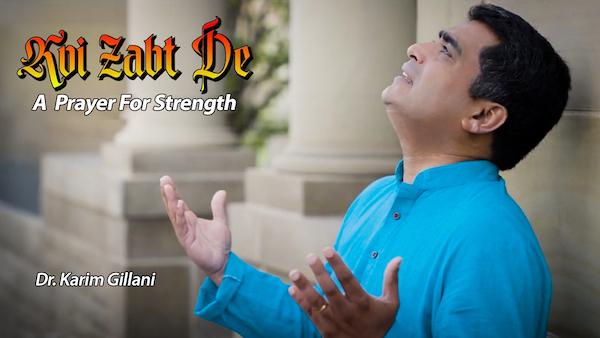
Koi Zabt De
A Prayer for Strength
Dr. Karim Gillani’s "Koi Zabt De: A Prayer for Strength" is more than a song — it is a meditation of the soul, a quiet plea rising from the heart of a seeker. In this moving new release, he brings to life the timeless words of Allama Muhammad Iqbal, offering not a prayer for power or ease, but for the strength to shoulder the burdens of others and to walk with purpose through adversity.
With music delicately arranged by Waqas Ali and a visually poetic direction by Alizain Mevawala, the piece unfolds like a spiritual journey. Dr. Gillani’s voice — raw, resonant, and profoundly human — becomes a vessel through which the listener is invited to pause, reflect, and feel.
At its essence, "Koi Zabt De" speaks to the quiet battles we each face — the longing to remain grounded when the world shakes beneath us, to choose compassion over comfort, and to rise with grace when we are called to serve. It is about awakening the self, aligning with truth, and seeking divine strength not to escape struggle, but to move through it with dignity and purpose.
With six acclaimed albums and a global presence, Dr. Karim Gillani has long been known for creating music that transcends borders and touches the spirit. His art is rooted in a deep reverence for poetry, storytelling, and the human condition — and in this latest work, that devotion is felt in every note.
Koi Zabt De is the result of love — love for the craft, love for the message, and love for those in search of meaning. We offer it humbly, hoping it brings you not just beauty, but also solace, courage, and reflection.
If this prayer finds a home in your heart, we invite you to share it — with those walking their own path of struggle, strength, and light.
Video: https://www.youtube.com/watch?v=ECoNGJCsEXM
Re: ISMAILI ART AND MUSIC
Aleyah Kasam: Singing for the Jamat

Aleyah performing live on stage.
By The Ismaili
16 year-old Aleyah Kasam’s journey to becoming a vocalist has involved more than just honing a skill. For Aleyah, it’s about using her voice to comfort people amidst the uncertainties of life.
“She was barely three the day it happened,” explained Aleyah’s mum, Shilpa Kasam. “She stood beneath the glass ceiling of our living room, gazing upward, her little finger pointing toward the sky. “That’s the stage, Mama,” she said, her voice barely a whisper. “That’s where everyone is watching me sing.”
Based in Mumbai, India Aleyah was set on pursuing the art form from a young age. More than that, she was determined to sing in front of the Imam, hopeful her voice could somehow reach him.
“Sing from your heart, my love. If your voice is truthful, it will reach him,” assured her mother.
Several years later, she realised the power and reach of song: the moment she was cast to sing the Five Feathered Friends theme song I’ll be the Best Me Today https://youtu.be/ZLHBKSnZ4WU?si=JgAV68tAYxuZ9Yrx for The Ismaili TV.
The song was written and produced by Faizan Kazani and Sameer Remtullah and features over 20 global musicians, vocalists, and sound engineers who volunteered their time and talent to create the show’s memorable theme song.
Aleyah credits her family, and mother, for always encouraging her to pursue her passion. “I'm grateful my mum noticed something and enrolled me in a singing class for western singing as well as for Hindustani classical,” explained Aleyah. “It was therapeutic, in fact very meditative. I felt a strong sense of connection with the beats.”
For Aleyah, her success as a singer isn’t measured in the number of listeners or how full a theatre is. Instead, it’s measured in how her voice has impacted a person.
“I feel that if my music can strike a chord in someone's heart, there's nothing more I can ask for,” she said. “In this world of technology, wars and chaos bringing uncertainty, if I can bring about calm, love and peace and do my bit towards Mawlana Hazar Imam’s purpose in bringing unity and pluralism within the Jamat and the world, I would be grateful.”
Aleyah’s connection with music is special. For her, music isn’t just sound, it’s a secret language she instinctively understands.
“She learnt multiplication tables through melody, the periodic table through rhythm,” said her mother. But her interests extend beyond the arts. She’s also a DSO yellow belt gold medalist in karate, silver medalist in inter-school basketball, and has trained in several other sports.
Throughout the years, her talent has been widely recognised in various fields with awards in elocution, dramatics, and singing. She was also the recipient of the Star Achievers Award by the Aga Khan Youth and Sports Board.
Aleyah shares how she keeps herself motivated: “My faith in Allah, conviction for the purpose and gratitude for my gift. The smiles and encouragement from my family and our community really drives me on.”
“I am her first audience, her lifelong admirer. Her teacher, her creative partner and her soul companion. She is not just my daughter—she is every prayer I’ve ever whispered,” said Shilpa.
Recently, Aleyah performed in Dubai during the Global Encounters Festival, sharing her gift with the community who has strongly supported her.
“I had dreamt of the day—the stage, the mic, the lights and the audience—since I was seven. I was so excited! It was so much fun! It was an inexplicable sense of peace and an honour, to be chosen, to do my bit on Mawlana Hazar Imam’s platform, and that is something I will carry forward into my life.”
Aleyah shares wise words to aspiring artists: “Stay grounded, believe in yourself and always value and remain grateful for any support you may have received. Wisdom consists in knowing that you know nothing, humility and the learning attitude is important. Know that the driving force within you that seeks knowledge, leads you on God's chosen path—and keep working hard.”
https://the.ismaili/ug/en/news/aleyah-k ... -the-jamat
Re: ISMAILI ART AND MUSIC
Eshan Lakhani: Inspiring through rhythm

By The Ismaili
At 15 years old, Eshan Lakhani, a neurodiverse drummer from Australia, embodies the adage ‘don’t let anything stand in your way.’ His journey is one of passion and resilience, showcasing how the power of rhythm can transcend limitations.
At an early age Eshan was diagnosed with intellectual disability, developmental delay, attention deficit hyperactivity disorder (ADHD) and has struggled with heart issues. “Growing up, I faced some challenges, but I’ve learned that with support, hard work, and faith, anything is possible,” said Eshan. “As an Ismaili, I’ve always been guided by the values of kindness, community, and perseverance, which have shaped my journey. I believe in inclusivity and work to break barriers, showing that everyone, no matter their background or challenges, deserves a fair chance to succeed.”
Eshan began performing at the tender age of four. A few years later, at age eight, he put on his first big showcase at Melbourne’s renowned Rod Laver Arena, the first grand performance of many. Since then, Eshan has performed all over Australia and other parts of the world. He’s also showcased his talent in front of celebrated artists such as A.R. Rahman, Atif Aslam, Ali Zafar, Bhoomi Trivedi, Karan Aujla and Aamir Khan.
His drumming skills have been honed under the mentorship of Cindy Santana, wife of legendary guitarist, Carlos Santana.
“Last year I travelled to the U.S. for mentorship, and it really helped me improve as a musician,” explained Eshan, who doesn't let anything stand in the way of his passion. With perfect pitch he just needs to hear a melody once before being able to easily repeat it. This gift has allowed him to build up a repertoire of over 500 songs on the piano, without the help of an instructor, and be a talented singer.
During the Global Encounters Festival in Dubai, Eshan performed in the Global Village. The crowd was instantly captivated by his talent, dancing throughout his set list—even requesting an encore!
Eshan’s parents were amidst the crowd, proudly supporting their son. Erum and Imran have supported Eshan through every step of his journey. In his early years, as soon as one of Eshan’s school teachers pointed out his musical talent, they were quick to get the support required so he could pursue music further. They’re proud to be recognised as his parents and advocate for an increase in knowledge and inclusion for children with Neurodiversities.
“For the last few years, I have been recognised as Eshan’s father. It's a big, big achievement for a parent. People call me and ask ‘oh, you’re Eshan’s father.’ Because of him, people know me, and that is more than enough,” said Imran.
Erum had words of advice to other parents of children with Neurodiversities: “Worry is going to be with every parent, and thinking about what lies in your child’s future. But with proper therapies, proper strategies, these small steps can make a big difference leading to a better outcome,” she explained.
“There should also be a question surfacing in parent’s brains about what next we can do to make their life better.”
Recently, Eshan performed in front of Bollywood actor Aamir Khan during the Indian Film Festival in Melbourne.
“Today is one of the most rewarding moments of our journey as parents. All the sacrifices, hard work, and sleepless nights feel truly worth it when Mr. Perfectionist, Aamir Khan, or A.R. Rahman, or other top musicians and artists personally appreciate Eshan’s talent and passion for music,” said Imran.
Eshan's popularity has continued to surge in recent years, earning him close to half a million followers on Tik Tok inspiring youth across the globe to break boundaries and follow their dreams.
“I hope my story can inspire other young musicians, especially those facing difficulties, and show parents of children with disabilities that dreams can come true.”
https://the.ismaili/ug/en/news/eshan-la ... ugh-rhythm
Re: ISMAILI ART AND MUSIC
Kausar Mohammed: Amplifying Underrepresented Voices through Art and Activism

Image of Kausar Mohammed in the sci-fi film “4400,” which portrays the lives of 4400 people presumed dead or reported missing over several decades, who return to earth with startling powers.
By Karim Manji
"Finding what you love is so important and trusting that you’ll find your way in it. We need our voices to be loud," says Kausar Mohammed, an Ismaili actress, writer, and activist. With her Bangladeshi-Pakistani heritage, she is known for her diverse roles and impactful advocacy, and is dedicated to bringing underrepresented voices to the forefront of entertainment.
While attending the University of California, Los Angeles, Kausar discovered the power of art and activism. She actively participated in sketch comedy, gaining valuable experience and developing a profound love for the craft. "I realized acting can also be impactful work," she noted. Her breakout role in Paul Feig's “East of La Brea https://hikaayat.com/east-of-la-brea-is ... llennials/,” allowed her to portray a Muslim woman in her 20s, an opportunity she cherished for its authenticity and relatability.
A versatile actress celebrated for her voiceovers on Netflix and her portrayal of a comic book superhero, Kausar expressed gratitude for roles that reflect her identity. "I am always grateful when I get to play characters with my actual identity," she shared, referring to a September 2022 report by the USC Annenberg Inclusion Initiative that highlighted the lack of Muslim representation in popular media. "Of course, I want to play the superhero or the villain, but in [the TV series] 4400, I got to play a queer, Muslim woman. Whichever role I play, I take with great responsibility and do it as honestly as possible."
Kausar’s dedication to authenticity in her roles extends beyond acting into her activism. She co-founded SHIFT https://www.shiftingculture.co/, a racial and gender equity consulting group, with Natalie Bui and Veline Mojarro. "On a personal level, I found the work we loved to do was with, and for our own community," said Kausar, emphasizing SHIFT’s focus on creating spaces for discussions about gender and racial equality, particularly within BIPOC (Black, Indigenous, and People of Color) communities. Her current work with the group includes facilitating workshops that tie in storytelling and artmaking -- particularly around comedy and horror -- into conversations for healing and liberatory practices.
Kausar's journey began with a deep-seated love for storytelling. "I was a reader growing up, and from there came a love of writing. My mom would have me read my books aloud to her, which probably brought me to performance and acting," she explained. Her passion for storytelling evolved into a pursuit of acting, despite initially viewing it as an improbable career path. "I was doing theater since elementary school as an after-school extracurricular and found I really loved it," Kausar said.
Kausar’s commitment to representing her culture and advocating for change is deeply rooted in her upbringing as an Ismaili Muslim. "Seva is something that is ingrained in us as children. It has a connection with the desire to be active in social justice and anti-oppression spaces," she said. Her involvement with SHIFT and her artistic endeavors reflect this commitment to community and representation.
Reflecting on her journey, Kausar credits her success to the people around her. "My people really define me," she states, acknowledging the influence of her sisters, her partner, and close friends, as well as support from other Ismaili and Muslim colleagues and mentors in the industry. She emphasizes the importance of surrounding oneself with supportive individuals who share a commitment to uplifting marginalized voices.
This past year, Kausar was awarded a fellowship by the Sundance Institute https://deadline.com/tag/sundance-institute/, Doris Duke Foundation https://deadline.com/tag/doris-duke-foundation/, and Islamic Scholarship Fund https://islamicscholarshipfund.org/for its Building Bridges Fellowship https://deadline.com/tag/building-bridges-fellowship/. This is part of the larger $1 million grant to expand and uplift Muslim storytelling and voices in the entertainment industry, announced earlier this year.
The fellowship provides financial and creative resources in the form of mentorship and networking to support filmmakers, producers, and other creative individuals focused on telling Muslim stories. Last year, the Fellows met at the Doris Duke Shangri La Museum of Islamic Art, Culture & Design in Hawaii at an artist development retreat to kick off their 2025 fellowship.
Coming up in the fall of 2025, you can catch her as the voice of Yaz, or Yasmina, in the Netflix series, “Jurassic World: Chaos Theory.”
In an industry often scrutinized for its lack of diversity, Kausar Mohammed stands out as a vanguard, amplifying underrepresented voices and advocating for a more inclusive narrative in entertainment and in society. Through her work, she inspires others to trust in their passions and boldly champion their communities.
Have an idea for an article? We are looking for new topics to explore or inspirational stories that reflect the values and experiences of the US Jamat. Submit your suggestions to digitalcommunications@theismailiusa.org
Interested in writing? The.ismaili is recruiting volunteer writers for our team. If you would like to join, please contact digitalcommunications@theismailiusa.org
https://the.ismaili/us/en/news/kausar-m ... d-activism
The Ismaili Sounds
Discover a treasure trove of inspirational music, both original and reimagined. These sounds are delivered to you from the heart of the Ismaili Community. Whether it’s timeless classic melodies or innovative new compositions, there’s something for everyone to explore and enjoy.
https://the.ismaili/the-ismaili-sounds
https://the.ismaili/the-ismaili-sounds
Re: ISMAILI ART AND MUSIC
Allahumma Sallay Alaa (Salwaat) Geet | Nazia Amin Mohammad | Kamal Taj | Ali Shahabuddin
On this blessed occasion of Salgirah Mubarak, I am humbled to share this timeless Salwat Geet, originally written and composed by the legendary Sir Kamal Taj and first released in 1986 by the Ismailia Association for USA (Chicago).
This rendition is my humble tribute to his inspiring legacy - a melody that has touched the hearts of generations with its beauty, faith, and devotion.
Original Credits:
 Lyrics & Composition: Sir Kamal Taj
 Original Release: Ismailia Association for USA (1986)
Tribute Rendition (2025):
 Vocals: Nazia Amin Mohammad
With deep respect, admiration, and love - may this Geet continue to bring peace, light, and unity to hearts around the world.
 Salgirah Mubarak to all!
Video: https://www.youtube.com/watch?v=xByRNNcbX4U
Re: ISMAILI ART AND MUSIC
The story behind Five Feathered Friends

This behind-the-scenes look reveals the creative journey that brought Aziza, Zain, Tariq, Shawn, and Hala to life, from the initial spark of an idea through the careful casting process and into full production.
Five Feathered Friends brings together young characters from Tajikistan, Kenya, Pakistan, Canada, and Syria in a heartwarming animated series created for The Ismaili TV. The show celebrates the power of friendship while exploring themes of community, diversity, and resilience in the face of life's challenges.
Roughly 100 individuals, 75 percent of whom are volunteers, have been working tirelessly to bring the show to life over the past two years.
Azmina Dhalla-Shivji and Zaheed Damani are two Ismaili children’s book authors. The duo have already authored two children's stories: “How Can I Tell My Mawla I Love Him” and “What If”, the latter serving as a key catalyst for Five Feathered Friends, as a unique way to discuss ethics, our faith, our history and different cultures. Drawing from the positive feedback, Azmina and Zaheed wanted to take things a step further and create a set of characters, building up their narratives. They wanted the show to resonate with young children within the Jamat and incorporate our faith into its plot lines.
“When young Ismaili families want to go look for content that's available, we're frequently drawing from other traditions and other communities,” Zaheed explained. “And while we do have a lot in common with so many faith traditions, especially the Abrahamic traditions and then, of course, within our own Ummah, there are things that are specific to our interpretation.”
With great diversity amongst the Jamat, the writers also wanted to highlight how different cultures and individual’s uniqueness should be celebrated and embraced. This meant figuring out how each culture could be accurately represented.
“We wanted to represent the mosaic that is our Jamat, and the Imam has emphasized this through metaphor, using music or tapestry and that we have so much more that binds us than divides us,” said Zaheed.
Because of this, birds became the perfect vehicle for showcasing diversity. “There's so many metaphors that can be used about flying and supporting each other and soaring,” Azmina explained. “Birds are different colors, different species, coming from different countries. Zaheed and I put some thought into where do these birds come from? Where do Ismailis live? And then draw those parallels, so that we could tell stories about birds from these countries, and then their Jamats as well, so that we could use these as a learning opportunity for the children."
An initial idea had taken shape, and now the plan needed to be put into action. Enter showrunner and executive producer, Riaz Patel.
Riaz is an award winning producer, a creator of 4 Chais https://the.ismaili/4chais, and executive producer and director of multiple shows in Hollywood. So what inspired him to take on something new? The fact that nothing like it existed—yet.
He brought on board six writers with different experience levels and ran a writers’ room to hash out storylines, characters and episode themes to see how the concept could start to come together. Over the span of roughly six months, the first draft of scripts were completed for him to fine tune.
“The idea was really trying to fuse two elements that are often very separate in children's programming. You either have progressive education or you have spirituality,” Riaz said. “And we really wanted to find, not just for the Ismaili community, but worldwide, can we layer those two on top of each other? You can be progressive and academic, but not necessarily lose a connection with the Spirit, which is why we specifically wanted the entire show to take place outside of the classroom.”
Classrooms are not the only learning environments. We can all learn from each other and our differences on a day-to-day basis. Another conscious choice was to not have any adults in the show. Riaz explained how empowering it is for children to watch shows portraying how they can help each other learn and solve problems.
Whilst developing scripts, it was important to balance fun and education. Humour had to be tastefully injected into each of the episodes to grab attention, and maintain it. Riaz also wanted the language to be more sophisticated. As a father himself, he noted how certain children’s shows can be frustrating due to their condescending tones and was keen to steer clear of this, turning it into a show for the whole family.
“We tried to use humor as a way of keeping people engaged. If it feels too preachy or teachy, it's like medicine. You'll take it because you have to, but you won't enjoy the process of taking it,” Riaz explained. “We really wanted the messaging to be surrounded in humour, wit, and fun.”
Another essential part was casting the voice actors. “We had some people who were completely new because, like the birds we're trying to show behind the scenes, the same thing: That we all arrive with different levels of experience, different skill sets. But we will work together to all help each other grow and elevate one another,” said Riaz.
Riaz worked closely with the actors to help them resonate with their characters and embody their voice. Behind the scenes, they also had individuals from the five countries to provide correct pronunciation for various phrases and words to help actors accurately portray the different accents. This process was largely overseen by series producer and director Narmeen Lakhani of Birdwings Media.
Narmeen explained how they worked closely with scholars and ECD specialists, utilising her own cultural background and cultural consultants in every step of the show’s creation. Throughout the development process, episodes were also shown to children’s focus groups to gather their feedback on the characters, sets, and other aspects. Their feedback shaped key changes, ensuring the series truly connected with its target audience
From reviewing scripts, to artwork, types of clothes and set designs, every small detail was taken into consideration to ensure cultural authenticity.
“At the end of the day, the foundation of good kids content is really powerful storytelling. How we infuse education should be secondary in this kind of field. We call it informal learning,” said Narmeen. To assist children’s learning, each episode has an accompanying educational pack for them to complete.
Throughout the process, there’s been different challenges to work through. “In the future, we would like to dub each episode in each of our major languages,” explained Narmeen. “We recognize, especially at the ECD level, that local languages are really important to understanding content, to the overall experience of the child.”
While this multilingual approach would enhance accessibility and cultural connection, it presents significant production considerations: longer episode durations, the complexity of translating humor while preserving its intended meaning, and the need for a much larger voice acting cast, making this an ambitious long-term objective.
“This is just the beginning. Insha’Allah, with the Jamat’s support, love and response to the show, we will continue to build and build and build toward an ideal world in which every child feels seen and heard,” said Narmeen.
The show is all about appreciating diversity, community, and how we can learn from each other. “By being able to appreciate that diversity, we see it as more of a strength than something that should divide us,” said Azmina. “In a world that is so divisive right now, it just feels like we need more kindness, more friendship and more love.”
– –
Learn more about Five Feathered Friends and watch the latest episodes here https://the.ismaili/friends.
https://the.ismaili/pt/en/news/the-stor ... ed-friends
Re: ISMAILI ART AND MUSIC
One Love, One Light | Ismaili Reggae Vibes | Young Homie | JollyGul
A joyful, uplifting reggae song celebrating the Ismaili spirit in the era of Mawla Rahim, the 50th Imam — a faith that moves with rhythm, intellect, and love.
Video: https://www.youtube.com/watch?v=1LC0jLzaS7E
A joyful, uplifting reggae song celebrating the Ismaili spirit in the era of Mawla Rahim, the 50th Imam — a faith that moves with rhythm, intellect, and love.
Video: https://www.youtube.com/watch?v=1LC0jLzaS7E
Vaada
The Ismaili presents “Vaada” — meaning “promise” — performed by Fitoor. The song’s lyrics beautifully capture the feeling of gratitude for Mawlana Hazar Imam’s intention and desire to be with his Jamat around the world.
Video: https://the.ismaili/us/en/news/vaada
Video: https://the.ismaili/us/en/news/vaada
Re: ISMAILI ART AND MUSIC

Ehsaas is a heartfelt offering of love and gratitude for the Imam-of-the-Time, composed by Anar Jassani and Sarosh Dadani. Blending English and Urdu, the song is both a prayer and a promise, affirming that Mawla’s grace is felt in every breath, in every moment.
Watch now: https://youtu.be/Yne2LciF7zo
Re: ISMAILI ART AND MUSIC
Tracing our heritage along the Nile

GE Heritage Journey participants at Al-Azhar Mosque in Cairo, Egypt.
By Salima Habib
The Global Encounters Heritage Journey to Egypt last year took the form of a dialogue between past and present. Participants gathered from different parts of the world to encounter history not as something preserved behind glass, but as a living force shaping identity, faith, and responsibility.
We walked along Al-Muizz Street, its stones worn smooth by centuries of footsteps. Above us, the rounded towers of Bab al-Futuh framed an archway that felt like an entry into another time. Standing in al-Qāhirah al-Muʿizz — the Victorious City of al-Muʿizz, now known as Cairo — I felt the significance of a place named in honour of the fourth Fatimid caliph and our 14th Ismaili Imam. Ahead was the mosque of Imam al-Hakim bi-Amr Allah. Surrounded by this history, our journey into the past began.
Through seva with Ismailis around the world, I came to see my identity not just as something inherited, but as something formed through service and shared effort. In the moment of takht nishini, as Mawlana Hazar Imam succeeded to the Imamat, that sense of identity deepened into responsibility: to honour the continuity that guides us and to engage more deliberately with our history.
Heritage Journeys gave us a way to celebrate our Imams, learn from Ismailis from many cultures and regions, and strengthen our sense of shared identity. From the start, that common bond brought us together as we walked toward Bab Zuweila, one of only three remaining gates of the old Fatimid walls. As we shared our stories along the narrow streets, our connection grew and our individual reflections became part of a shared journey.
We visited Ancient Egypt, where the Grand Egyptian Museum reflects the geometry of the pyramids and stands as a reminder of human creativity across generations. From there, we moved forward in time to a period when Egypt became a centre of Islamic learning and leadership.
Next, we entered the Fatimid era, at the heart of the Islamic Golden Age. At Al-Azhar Mosque, the azan sounded through the space, linking architecture, worship, and daily life. I realised I was standing in one of the oldest universities in the world, founded by Imam al-Muʿizz li-Din Allah as a place for both worship and learning. Around me, students from many countries continued a long tradition in which faith and knowledge belong together.
Music offered another way to connect during an evening concert by musicians from the Darb Al Ahmar Music School, supported by the Aga Khan Music Programme. Their performance spoke of perseverance and renewal. As they shared their reflections on hope, we were reminded that art can connect people across time, place, and difference.
At Al-Azhar Park, we heard laughter along the palm-lined paths, a sharp contrast to its past as a centuries-old rubble dump. Beside the park, we walked through Darb al-Ahmar, where the sound of artisans’ tools filled the streets.
Further south in Aswan, we experienced a different pace of life. We were welcomed into a Nubian village with traditional dance and song. Through the Om Habibeh Foundation, we met women leading community development and tasted produce from their agricultural projects — a clear example of self-reliance and community-focused work. These encounters renewed my own desire to serve.
As we travelled along the Nile, the journey became more reflective. Approaching Mawlana Sultan Mahomed Shah’s sunlit mausoleum in Aswan, I felt a deep sense of gratitude and a stronger awareness of the bond that connects us across time and geography.
From Cairo’s pyramids, mosques, churches, and synagogues to the life of Aswan, we saw pluralism in practice. We arrived as individuals and left with a shared sense of connection, having sung, danced, and reflected together.
Walking the streets our Imams once walked increased my gratitude and deepened my connection to the continuity of the Imamat. It also gave me hope that others will continue to preserve and value these places. Heritage Journeys renewed my appreciation for our Imams’ vision and reminded me that heritage is an ongoing responsibility — something we are trusted to carry forward through compassion, service, and unity.
https://the.ismaili/se/en/news/tracing- ... g-the-nile