
China’s Tech-Savvy, Burned-Out and Spiritually Adrift, Turn to Buddhism
BEIJING — For centuries, Buddhists seeking enlightenment made the journey to Longquan Monastery, a lonesome temple on a hilltop in the hinterlands of northwest Beijing. Under the ginkgo and cypress trees, they meditated, chanted and pored over ancient texts.
Now a new generation has arrived. They wear hoodies, watch television shows like “The Big Bang Theory” and use chat apps to trade mantras. Many, with jobs at some of China’s hottest and most demanding companies, feel burned-out and spiritually adrift, and are looking for change.
“Life in the outside world is chaotic and stressful,” said Sun Shaoxuan, 39, the chief technology officer at an education start-up. “Here, I can be at peace.”
As a spiritual revival sweeps China, Longquan has become a haven for a distinct brand of Buddhism, one that preaches connectivity instead of seclusion and that emphasizes practical advice over deep philosophy.
Monks and volunteers at Longquan Monastery in Beijing perform the morning songjing, or chanting of Buddhist sutras.
The temple is run by what may be some of the most highly educated monks in the world: nuclear physicists, math prodigies and computer programmers who gave up lives steeped in precision to explore the ambiguities of the spiritual realm.
To build a large following, the monks have put their digital prowess to work. They have pioneered a popular series of cartoons based on Buddhist ideas like suffering and reincarnation. (“Having a bad mood can ruin one’s good luck,” a recent cartoon said.) This past spring, they introduced a two-foot-tall robot named Xian’er to field questions from visitors, the temple’s first foray into artificial intelligence.
Traditionalists worry that Longquan’s flashy high-tech tools may have muddled the teachings of the Buddha, the dharma. They say its emphasis on practical topics like resolving family conflict and achieving success neglects more important philosophical questions.
But the leader of the monastery, the Venerable Xuecheng, who dispenses bits of wisdom every day to millions of online followers, has defended his approach, saying that Buddhism can stay relevant only by embracing modern tools. In a computer-dominated world, he has said, it is no longer realistic to expect people to attend daily lectures.
“Buddhism is old and traditional, but it’s also modern,” he said in an interview in March with the state-run news agency Xinhua. “We should use modern methods to spread the wisdom of Buddhism.”
On a recent Sunday morning, I stood outside Longquan’s gates, watching as hundreds of volunteers and tourists ascended to the temple. They bowed to one another and took turns sweeping cracked walkways. Some wandered through the organic vegetable garden, stopping to prop up unruly tomato plants.
The modernity of the temple was inescapable. While it was first built in 957, many of its original structures were demolished by war and, more recently, by the Cultural Revolution, when Chinese Buddhists were persecuted. Only at the turn of the century was the temple salvaged and rebuilt by a Buddhist businesswoman, Cai Qun. It reopened in 2005, and it is now equipped with fingerprint scanners, webcams and iPads for studying sutras, or Buddhist texts.
The state-run news media speaks of the temple in almost mythical terms. In success-driven China, many people marvel at the decision of the temple’s monks to leave behind lucrative careers in the tech sector to devote themselves to Buddhist study, rising at 3:55 a.m. each day for morning prayers.
Longquan has become a favorite showpiece for the ruling Communist Party, which officially promotes atheism but has led a push in recent years to revive ancient cultural traditions. In addition to leading Longquan, the Venerable Xuecheng is the president of the Buddhist Association of China, a party-controlled supervisory organ. The temple displays the writings of President Xi Jinping, and long-term residents must submit information about their patriotism and political views.
In a kind of soft-power spiritual push, the Venerable Xuecheng has sought to turn the teachings of the monastery into a global export, translating his writings into more than a dozen languages. In July, he helped open a temple in Botswana for Chinese expatriates.
Longquan’s proximity to several of Beijing’s top universities and the city’s main science and technology hubs has made it popular among young people. Many of them are searching for deeper meaning in a society rife with materialism. Others seek an escape from grueling schedules, and tips on relaxation.
The temple is renowned in start-up circles, in part because of a widely circulated rumor involving Zhang Xiaolong, one of the inventors of WeChat, a popular messaging app. News articles have claimed that Mr. Zhang, having hit a stumbling block, attended a retreat at the temple, after which he gained inspiration for WeChat. (Mr. Zhang, through a spokesman, denied the reports.)
Today, young entrepreneurs make the pilgrimage to Longquan in hopes of creative epiphanies. They work at some of China’s most prominent technology companies, including JD.com, an e-commerce giant, and Xiaomi, a smartphone maker.
“Some of the people who come here may not actually be incredibly interested or believe in Buddhism,” said Rax Xie, a software developer. “But they will have a certain connection and receptiveness to the thought and culture behind Buddhism.”
On Sunday mornings, Mr. Sun, the technology entrepreneur, makes his way from his suburban apartment to Longquan. He slips on a maroon robe and begins to chant.
Mr. Sun was once a skeptic of religion. But after a spiritual awakening last year, he said he came to embrace Buddhism, eschewing meat and alcohol and persuading his wife to join him on his spiritual journey.
I met Mr. Sun at a chanting ceremony one Sunday at Longquan. The meditation hall was covered in pillows decorated with lotus flowers; a large, gleaming Buddha statue rose from the front.
A wiry man with soft, dark eyes, he sat in the first row of worshipers, a bell in his hand, and wore a golden sash reading, “Thanks to those who taught me salvation.”
After the ceremony, he told me about his transformation. As he saw it, he was once self-centered and angry, prone to barking orders at his family and co-workers. While his mother was a Buddhist, he saw the religion as “just a story.”
Then, in the fall, he attended a three-day retreat at Longquan intended for information technology workers. He was forced to give up his cellphone and passed the time by meditating, listening to lectures and working in the garden. Almost immediately, he said, his mind felt cleaner and lighter.
Mr. Sun and his wife now attend services nearly every week. In the afternoons, he performs maintenance on Longquan’s websites and helps organize workshops on back-end programming.
He said he had come to see the temple as a “small utopia, free of conflict,” in a society that could sometimes feel riddled with deception.
“When you go to the mountain, you don’t need to think: ‘Who will trick me? Who will harass me? Who will think badly of me?’” he said. “Once you have a sense of security and trust, then you will want to open up, help others and explore your beliefs.”
Follow Javier C. Hernández on Twitter @HernandezJavier.
Emily Feng and Owen Guo contributed research.
http://www.nytimes.com/2016/09/08/world ... d=71987722
BUDHISM
Seeking Solitude in Japan’s Mountain Monasteries
Excerpt:
Koyasan is one of the premier destinations for Buddhist pilgrims in Japan, and is considered one of the holiest sites in the country. It was chosen 1,200 years ago by the monk Kobo-Daishi for its lotus-like geography — a shallow valley nestled into a mountain — to be the headquarters of Esoteric Shingon Buddhism. The religion, which dates to the Tang dynasty, places an emphasis on daily ritual as a means of reaching enlightenment in an immediate, practicable way, developing what several monks described as a “Buddha nature.” Over the course of the last century, the religion’s birthplace has also attracted an increasing number of visitors without any background in Buddhism — visitors who seek out mountains, peace, history, or just a fleeting connection with the mysticism of another time.
I came for a little bit of each of these, teased by the promise of a remote corner of the country, thousands of miles removed, both physically and mentally, from the frenetic anxieties of New York. I wanted to challenge myself to a place with a different logic and rhythm, and to see myself disappear briefly into the magnitude of a 1,200-year-old rite. Also appealing was the prospect of a place that was truly dark at night — a place where the thick, spindly velvet of steep, tree-covered mountainsides soaks up the darkness completely. And like many others, as I would learn, I also wanted something a little bit naïve and capitalistic: to buy an ascetic experience.
More..
https://www.nytimes.com/2017/10/11/trav ... d=45305309
Excerpt:
Koyasan is one of the premier destinations for Buddhist pilgrims in Japan, and is considered one of the holiest sites in the country. It was chosen 1,200 years ago by the monk Kobo-Daishi for its lotus-like geography — a shallow valley nestled into a mountain — to be the headquarters of Esoteric Shingon Buddhism. The religion, which dates to the Tang dynasty, places an emphasis on daily ritual as a means of reaching enlightenment in an immediate, practicable way, developing what several monks described as a “Buddha nature.” Over the course of the last century, the religion’s birthplace has also attracted an increasing number of visitors without any background in Buddhism — visitors who seek out mountains, peace, history, or just a fleeting connection with the mysticism of another time.
I came for a little bit of each of these, teased by the promise of a remote corner of the country, thousands of miles removed, both physically and mentally, from the frenetic anxieties of New York. I wanted to challenge myself to a place with a different logic and rhythm, and to see myself disappear briefly into the magnitude of a 1,200-year-old rite. Also appealing was the prospect of a place that was truly dark at night — a place where the thick, spindly velvet of steep, tree-covered mountainsides soaks up the darkness completely. And like many others, as I would learn, I also wanted something a little bit naïve and capitalistic: to buy an ascetic experience.
More..
https://www.nytimes.com/2017/10/11/trav ... d=45305309
Why Are We Surprised When Buddhists Are Violent?
Most adherents of the world’s religions claim that their traditions place a premium on virtues like love, compassion and forgiveness, and that the state toward which they aim is one of universal peace. History has shown us, however, that religious traditions are human affairs, and that no matter how noble they may be in their aspirations, they display a full range of both human virtues and human failings.
While few sophisticated observers are shocked, then, by the occurrence of religious violence, there is one notable exception in this regard; there remains a persistent and widespread belief that Buddhist societies really are peaceful and harmonious. This presumption is evident in the reactions of astonishment many people have to events like those taking place in Myanmar. How, many wonder, could a Buddhist society — especially Buddhist monks! — have anything to do with something so monstrously violent as the ethnic cleansing now being perpetrated on Myanmar’s long-beleaguered Rohingya minority? Aren’t Buddhists supposed to be compassionate and pacifist?
More...
https://www.nytimes.com/2018/03/05/opin ... dline&te=1
Most adherents of the world’s religions claim that their traditions place a premium on virtues like love, compassion and forgiveness, and that the state toward which they aim is one of universal peace. History has shown us, however, that religious traditions are human affairs, and that no matter how noble they may be in their aspirations, they display a full range of both human virtues and human failings.
While few sophisticated observers are shocked, then, by the occurrence of religious violence, there is one notable exception in this regard; there remains a persistent and widespread belief that Buddhist societies really are peaceful and harmonious. This presumption is evident in the reactions of astonishment many people have to events like those taking place in Myanmar. How, many wonder, could a Buddhist society — especially Buddhist monks! — have anything to do with something so monstrously violent as the ethnic cleansing now being perpetrated on Myanmar’s long-beleaguered Rohingya minority? Aren’t Buddhists supposed to be compassionate and pacifist?
More...
https://www.nytimes.com/2018/03/05/opin ... dline&te=1
Buddhists Go to Battle: When Nationalism Overrides Pacifism
A call to arms for Sri Lankan monks. Ethnic cleansing of the Rohingya in Myanmar. A Buddhist faith known for pacifism is taking its place in a new age of nationalism.
Excerpt:
Incited by a politically powerful network of charismatic monks like Sumedhananda Thero, Buddhists have entered the era of militant tribalism, casting themselves as spiritual warriors who must defend their faith against an outside force.
Their sense of grievance might seem unlikely: In Sri Lanka and Myanmar, two countries that are on the forefront of a radical religious-nationalist movement, Buddhists constitute overwhelming majorities of the population. Yet some Buddhists, especially those who subscribe to the purist Theravada strain of the faith, are increasingly convinced that they are under existential threat, particularly from an Islam struggling with its own violent fringe.
As the tectonic plates of Buddhism and Islam collide, a portion of Buddhists are abandoning the peaceful tenets of their religion. Over the past few years, Buddhist mobs have waged deadly attacks against minority Muslim populations. Buddhist nationalist ideologues are using the spiritual authority of extremist monks to bolster their support.
“The Buddhists never used to hate us so much,” said Mohammed Naseer, the imam of the Hillur Mosque in Gintota, Sri Lanka, which was attacked by Buddhist mobs in 2017. “Now their monks spread a message that we don’t belong in this country and should leave. But where will we go? This is our home.”
More...
https://www.nytimes.com/2019/07/08/worl ... 3053090709
A call to arms for Sri Lankan monks. Ethnic cleansing of the Rohingya in Myanmar. A Buddhist faith known for pacifism is taking its place in a new age of nationalism.
Excerpt:
Incited by a politically powerful network of charismatic monks like Sumedhananda Thero, Buddhists have entered the era of militant tribalism, casting themselves as spiritual warriors who must defend their faith against an outside force.
Their sense of grievance might seem unlikely: In Sri Lanka and Myanmar, two countries that are on the forefront of a radical religious-nationalist movement, Buddhists constitute overwhelming majorities of the population. Yet some Buddhists, especially those who subscribe to the purist Theravada strain of the faith, are increasingly convinced that they are under existential threat, particularly from an Islam struggling with its own violent fringe.
As the tectonic plates of Buddhism and Islam collide, a portion of Buddhists are abandoning the peaceful tenets of their religion. Over the past few years, Buddhist mobs have waged deadly attacks against minority Muslim populations. Buddhist nationalist ideologues are using the spiritual authority of extremist monks to bolster their support.
“The Buddhists never used to hate us so much,” said Mohammed Naseer, the imam of the Hillur Mosque in Gintota, Sri Lanka, which was attacked by Buddhist mobs in 2017. “Now their monks spread a message that we don’t belong in this country and should leave. But where will we go? This is our home.”
More...
https://www.nytimes.com/2019/07/08/worl ... 3053090709
Re: BUDHISM
As the Dalai Lama Turns 90, His Exiled Nation Faces a Moment of Truth
The Tibetan spiritual leader has vowed to reveal a succession plan when his birthday is celebrated on July 6. He may get creative to thwart Chinese interference.

The Dalai Lama at the main Tibetan temple in Dharamsala, India, in 2024.
Mujib MashalHari KumarAtul Loke
By Mujib Mashal and Hari Kumar
Photographs by Atul Loke
Reporting from Dharamsala, India, where the Dalai Lama and the Tibetan administration in exile have been based for over half a century
Over the nearly seven decades since the Dalai Lama led his flock of tens of thousands out of Tibet to escape Chinese persecution, he put himself to the grueling work of sustaining a nation in exile.
As both the spiritual and political leader of Tibetan Buddhists, he established a little democracy in the Indian Himalayas, complete with a parliament and all its routine bickering and beauty. He entrenched a bureaucracy that encouraged a culture of service among a scattered people. In refugee settlements across India, the Tibetan administration runs schools, clinics, monasteries, agricultural cooperatives and even old-age homes.
But as the Dalai Lama turns 90 next month, Tibetans in exile are anxious about the fate of their stateless nation.
The man who has been Tibetans’ binding force and most recognizable face is growing increasingly frail. His goal of returning his people to their homeland remains distant, with China working to finish the task of crushing the Tibetan movement for autonomy. And as Tibetans confront a future of continued exile, the United States and other global powers have become more unreliable in their support.
ImageMonks in red robes, several of them holding beads, stand or sit in an outdoor area with trees in the background.

Monks rehearsing their teachings at the Dharamsala temple.
Image
A woman instructs a group of children, dressed in blue shirts and black pants, as they play the Tibetan lute.

Learning to play the Tibetan lute at a primary school in a Tibetan settlement in Bylakuppe, in the south Indian state of Karnataka.
“We are hoping for the best but preparing for the worst,” said Tsering Yangchen, a member of Tibet’s parliament in exile, invoking a refrain from the Dalai Lama himself.
When his birthday is celebrated on July 6, the Dalai Lama has promised, he will reveal a plan for deciding on his successor that factors in the complexities of the moment. The most pressing is dealing with China’s efforts to hijack the process.
Under Tibetan tradition, the search for a Dalai Lama’s reincarnation, who becomes his successor, begins only upon the incumbent’s death. After the next Dalai Lama is identified as a baby, there can be a gap of nearly two decades until he is groomed and takes the reins.
Image
Two men in traditional Tibetan garb hold white cups while they stand in front of a building with a sign that reads “Tibetan Parliament in Exile.”

Thondup Tsering, left, and Tenzing Jigme, members of the Tibetan parliament in exile in Dharamsala who live in the United States.
Image
A person in scrubs and a surgical mask inspects the mouth of a patient leaning backward in a medical chair in a clinic.

A charity hospital in the Tibetan settlement in Bylakuppe.
The Dalai Lama has hinted that he might buck these established practices as part of an apparent strategy to throw off the Chinese and avoid a vacuum that Beijing can exploit as it seeks to control Tibetan Buddhism.
He has said that his successor will be born in a free country, indicating that the next Dalai Lama could come from among Tibetan exiles, who number about 140,000, half of them in India. He has also said that his successor could be an adult, and not necessarily a man.
China already has a blueprint for inserting itself in Tibetan successions. After the 10th Panchen Lama, as Tibet’s second highest spiritual figure is known, died in 1989, the boy whom the Dalai Lama recognized as the successor went missing in Tibet when he was 6. He has not been seen since.
In his stead, China selected and promoted its own Panchen Lama. Earlier this month, that lama met with the country’s leader, Xi Jinping, and reaffirmed his allegiance to the Chinese Communist Party.
Image
Xi Jinping receives a white cloth that is being presented to him by a Tibetan monk.

A photograph from Chinese state media showed the government-appointed 11th Panchen Lama with China’s leader, Xi Jinping, in Beijing in June.
Credit...Xie Huanchi/Xinhua, via Associated Press
But interfering in the succession of the Dalai Lama runs the risk of provoking unrest among the roughly six million people in Tibet.
“The Dalai Lama has been out of his house and country for 65 years, and that has already created a great sense of pain, anger, frustration and disappointment among the Tibetans inside Tibet,” said Tenzin Tsundue, a Tibetan activist and poet. “This will, you know, burst into volcano.”
Image
A man wearing jeans, a black shirt and a red headband and holding a book sits at the entrance of a building surrounded by trees and other plants.

Tenzin Tsundue, a Tibetan refugee activist and poet, at his home in Dharamsala.
Image
Tibetan monks walk by a large dome-shaped Buddhist shrine.

Monks and local residents at a stupa in Bylakuppe.
The succession question has become more urgent as the Dalai Lama has become more frail, with his public engagements increasingly restricted.
Before he conducted one of his limited teaching sessions last fall, he traveled the short distance from his residence to the temple in a golf cart. He was helped to his seat by two monks.
When the Dalai Lama sneezed, many in the crowd looked up with worry. A monk stepped up to wipe the corner of his mouth. Among the questions that the Dalai Lama took during the 30-minute session: How to be a Tibetan Buddhist in the 21st century?
“Logic and reason,” he answered, “not just blind faith in the teachings of Buddha.”
Image
The Dalai Lama, escorted by three other monks, walks in a crowded outdoor area of a temple.

The Dalai Lama has grown increasingly frail.
Image
Monks inside a temple watch a screen showing an image of the Dalai Lama.

The Dalai Lama’s public appearances have become more restricted.
More than eight decades ago, the Dalai Lama’s ascension was accompanied by another perilous period that instilled a fear of discontinuity that has shaped his lifetime of work.
After his predecessor, the 13th Dalai Lama, died in 1933 at age 57, a search committee set out to identify a child who could grow into Tibet’s new spiritual leader.
The boy was discovered after two years of effort. The committee arrived at the family’s door during a harsh Tibetan winter, as they were clearing four feet of snow, the future Dalai Lama’s mother wrote in her memoir.
Moving the boy to Lhasa, the capital of Tibet, required paying ransoms to local warlords. His education, as well as his assumption of political leadership, was fast-tracked because the Chinese government was using the vacuum to tighten its noose around the autonomous region.
If a similar gap were to happen after the current Dalai Lama’s death — with the added challenge of a nation now in exile — it would be “a disaster,” said Lobsang Tenzin, a Tibetan educator who is better known as the Samdhong Rinpoche.
He served as prime minister in the Tibetan refugee administration and has known the Dalai Lama for more than 60 years. From the start, the Samdhong Rinpoche said, the Dalai Lama wanted to put in institutions and a culture that could hold a traumatized people together in exile after he was gone.
Image
A man in a red robe with beads around his wrist holds a teacup while sitting in an armchair.

The Samdhong Rinpoche said that the Dalai Lama had long focused on setting up structures that would outlive him.
Image
A woman smiles as she bows and holds the hand of the Dalai Lama. Several people surround them.

Receiving blessings from the Dalai Lama.
“In the first meeting, he told me that now the monks cannot remain just as monks would — just meditating and studying,” the Samdhong Rinpoche said about the early months of their exile, when he was still a teenager. “That we should learn from the Christian monks and nuns. They always work as nurses or teachers or doctors.”
In the decades that followed, the Samdhong Rinpoche had a front-row seat to the Dalai Lama’s efforts to put some distance between himself and the institutions he was building on lands he had managed to acquire from the Indian government.
He wanted his political powers to be devolved to a self-reliant democracy while he remained the spiritual head of the Tibetan people.
“His Holiness was adamant that sooner or later His Holiness should be irrelevant,” the Samdhong Rinpoche said.
That was easier said than done, given the Dalai Lama’s singular role as the leader of his people and as an international celebrity with a vast fund-raising network.
But his political position was devolved partly in 2001 and entirely in 2011, when Tibetans elected a sikyong, the equivalent of a president, through a vote held across refugee settlements in India and in other Tibetan communities around the world.
“He’s my boss,” the Dalai Lama said at an event in 2012 when he introduced the leader elected by the people. “Although when it comes to spiritual affairs, I’m still his boss!”
The current sikyong is Penpa Tsering, 62. Like his predecessor, he was born in a refugee camp in India and has never been to Tibet.
Mr. Tsering’s administration runs on a modest annual budget of around $35 million. About one-tenth of that comes from small contributions from exiles, akin to membership dues. The rest comes from countries like the United States, India and European nations.
Image
A woman in front of a wall with black-and-white pictures of the Dalai Lama and Gandhi looks at her phone.

The office of the exiled Tibetan administration in Dharamsala.
Image
A man in a red tunic holds a sheet of paper in one hand and a cup in the other while sitting in an armchair. A Tibetan flag is on the wall.

Penpa Tsering, the current sikyong, or president, of the exiled administration. He was born in the Bylakuppe refugee camp.
But the Trump administration has cut aid, including millions of dollars meant to help build the capacity of Tibetan institutions. Questions now also hover over India’s strong support of Tibetans, as New Delhi has remained silent over the succession question while navigating fraught relations with Beijing.
Twice a year, the 45-member Tibetan Parliament meets in Dharamsala, India, to approve the budget and review the government’s performance. Most of its members have other jobs, like teaching or running restaurants.
They make heavy use of social media to weave together a nation now in its third generation of exile. The sikyong, during an interview last fall, joked that his role was that of a digital “tour guide” helping Tibetan people connect.
Much of his time is spent on the road, trying to fill the Dalai Lama’s huge shoes in his advocacy efforts.
“Earlier, we didn’t have to work that hard because His Holiness was there,” Mr. Tsering said.
“We don’t command that kind of respect,” he added. “I’m a very ordinary Tibetan from a farmers’ background.”
Image
A model of a red and white palace with white exterior walls and golden domes. Above the model is a picture of the 13th Dalai Lama.

A model of the Potala Palace in Lhasa, the Tibetan capital, with a picture of the 13th Dalai Lama hanging above it.
Mujib Mashal is the South Asia bureau chief for The Times, helping to lead coverage of India and the diverse region around it, including Bangladesh, Sri Lanka, Nepal and Bhutan.
Hari Kumar covers India, based out of New Delhi. He has been a journalist for more than two decades.
https://www.nytimes.com/2025/06/12/worl ... tibet.html
The Tibetan spiritual leader has vowed to reveal a succession plan when his birthday is celebrated on July 6. He may get creative to thwart Chinese interference.
The Dalai Lama at the main Tibetan temple in Dharamsala, India, in 2024.
Mujib MashalHari KumarAtul Loke
By Mujib Mashal and Hari Kumar
Photographs by Atul Loke
Reporting from Dharamsala, India, where the Dalai Lama and the Tibetan administration in exile have been based for over half a century
Over the nearly seven decades since the Dalai Lama led his flock of tens of thousands out of Tibet to escape Chinese persecution, he put himself to the grueling work of sustaining a nation in exile.
As both the spiritual and political leader of Tibetan Buddhists, he established a little democracy in the Indian Himalayas, complete with a parliament and all its routine bickering and beauty. He entrenched a bureaucracy that encouraged a culture of service among a scattered people. In refugee settlements across India, the Tibetan administration runs schools, clinics, monasteries, agricultural cooperatives and even old-age homes.
But as the Dalai Lama turns 90 next month, Tibetans in exile are anxious about the fate of their stateless nation.
The man who has been Tibetans’ binding force and most recognizable face is growing increasingly frail. His goal of returning his people to their homeland remains distant, with China working to finish the task of crushing the Tibetan movement for autonomy. And as Tibetans confront a future of continued exile, the United States and other global powers have become more unreliable in their support.
ImageMonks in red robes, several of them holding beads, stand or sit in an outdoor area with trees in the background.
Monks rehearsing their teachings at the Dharamsala temple.
Image
A woman instructs a group of children, dressed in blue shirts and black pants, as they play the Tibetan lute.
Learning to play the Tibetan lute at a primary school in a Tibetan settlement in Bylakuppe, in the south Indian state of Karnataka.
“We are hoping for the best but preparing for the worst,” said Tsering Yangchen, a member of Tibet’s parliament in exile, invoking a refrain from the Dalai Lama himself.
When his birthday is celebrated on July 6, the Dalai Lama has promised, he will reveal a plan for deciding on his successor that factors in the complexities of the moment. The most pressing is dealing with China’s efforts to hijack the process.
Under Tibetan tradition, the search for a Dalai Lama’s reincarnation, who becomes his successor, begins only upon the incumbent’s death. After the next Dalai Lama is identified as a baby, there can be a gap of nearly two decades until he is groomed and takes the reins.
Image
Two men in traditional Tibetan garb hold white cups while they stand in front of a building with a sign that reads “Tibetan Parliament in Exile.”
Thondup Tsering, left, and Tenzing Jigme, members of the Tibetan parliament in exile in Dharamsala who live in the United States.
Image
A person in scrubs and a surgical mask inspects the mouth of a patient leaning backward in a medical chair in a clinic.
A charity hospital in the Tibetan settlement in Bylakuppe.
The Dalai Lama has hinted that he might buck these established practices as part of an apparent strategy to throw off the Chinese and avoid a vacuum that Beijing can exploit as it seeks to control Tibetan Buddhism.
He has said that his successor will be born in a free country, indicating that the next Dalai Lama could come from among Tibetan exiles, who number about 140,000, half of them in India. He has also said that his successor could be an adult, and not necessarily a man.
China already has a blueprint for inserting itself in Tibetan successions. After the 10th Panchen Lama, as Tibet’s second highest spiritual figure is known, died in 1989, the boy whom the Dalai Lama recognized as the successor went missing in Tibet when he was 6. He has not been seen since.
In his stead, China selected and promoted its own Panchen Lama. Earlier this month, that lama met with the country’s leader, Xi Jinping, and reaffirmed his allegiance to the Chinese Communist Party.
Image
Xi Jinping receives a white cloth that is being presented to him by a Tibetan monk.
A photograph from Chinese state media showed the government-appointed 11th Panchen Lama with China’s leader, Xi Jinping, in Beijing in June.
Credit...Xie Huanchi/Xinhua, via Associated Press
But interfering in the succession of the Dalai Lama runs the risk of provoking unrest among the roughly six million people in Tibet.
“The Dalai Lama has been out of his house and country for 65 years, and that has already created a great sense of pain, anger, frustration and disappointment among the Tibetans inside Tibet,” said Tenzin Tsundue, a Tibetan activist and poet. “This will, you know, burst into volcano.”
Image
A man wearing jeans, a black shirt and a red headband and holding a book sits at the entrance of a building surrounded by trees and other plants.
Tenzin Tsundue, a Tibetan refugee activist and poet, at his home in Dharamsala.
Image
Tibetan monks walk by a large dome-shaped Buddhist shrine.
Monks and local residents at a stupa in Bylakuppe.
The succession question has become more urgent as the Dalai Lama has become more frail, with his public engagements increasingly restricted.
Before he conducted one of his limited teaching sessions last fall, he traveled the short distance from his residence to the temple in a golf cart. He was helped to his seat by two monks.
When the Dalai Lama sneezed, many in the crowd looked up with worry. A monk stepped up to wipe the corner of his mouth. Among the questions that the Dalai Lama took during the 30-minute session: How to be a Tibetan Buddhist in the 21st century?
“Logic and reason,” he answered, “not just blind faith in the teachings of Buddha.”
Image
The Dalai Lama, escorted by three other monks, walks in a crowded outdoor area of a temple.
The Dalai Lama has grown increasingly frail.
Image
Monks inside a temple watch a screen showing an image of the Dalai Lama.
The Dalai Lama’s public appearances have become more restricted.
More than eight decades ago, the Dalai Lama’s ascension was accompanied by another perilous period that instilled a fear of discontinuity that has shaped his lifetime of work.
After his predecessor, the 13th Dalai Lama, died in 1933 at age 57, a search committee set out to identify a child who could grow into Tibet’s new spiritual leader.
The boy was discovered after two years of effort. The committee arrived at the family’s door during a harsh Tibetan winter, as they were clearing four feet of snow, the future Dalai Lama’s mother wrote in her memoir.
Moving the boy to Lhasa, the capital of Tibet, required paying ransoms to local warlords. His education, as well as his assumption of political leadership, was fast-tracked because the Chinese government was using the vacuum to tighten its noose around the autonomous region.
If a similar gap were to happen after the current Dalai Lama’s death — with the added challenge of a nation now in exile — it would be “a disaster,” said Lobsang Tenzin, a Tibetan educator who is better known as the Samdhong Rinpoche.
He served as prime minister in the Tibetan refugee administration and has known the Dalai Lama for more than 60 years. From the start, the Samdhong Rinpoche said, the Dalai Lama wanted to put in institutions and a culture that could hold a traumatized people together in exile after he was gone.
Image
A man in a red robe with beads around his wrist holds a teacup while sitting in an armchair.
The Samdhong Rinpoche said that the Dalai Lama had long focused on setting up structures that would outlive him.
Image
A woman smiles as she bows and holds the hand of the Dalai Lama. Several people surround them.
Receiving blessings from the Dalai Lama.
“In the first meeting, he told me that now the monks cannot remain just as monks would — just meditating and studying,” the Samdhong Rinpoche said about the early months of their exile, when he was still a teenager. “That we should learn from the Christian monks and nuns. They always work as nurses or teachers or doctors.”
In the decades that followed, the Samdhong Rinpoche had a front-row seat to the Dalai Lama’s efforts to put some distance between himself and the institutions he was building on lands he had managed to acquire from the Indian government.
He wanted his political powers to be devolved to a self-reliant democracy while he remained the spiritual head of the Tibetan people.
“His Holiness was adamant that sooner or later His Holiness should be irrelevant,” the Samdhong Rinpoche said.
That was easier said than done, given the Dalai Lama’s singular role as the leader of his people and as an international celebrity with a vast fund-raising network.
But his political position was devolved partly in 2001 and entirely in 2011, when Tibetans elected a sikyong, the equivalent of a president, through a vote held across refugee settlements in India and in other Tibetan communities around the world.
“He’s my boss,” the Dalai Lama said at an event in 2012 when he introduced the leader elected by the people. “Although when it comes to spiritual affairs, I’m still his boss!”
The current sikyong is Penpa Tsering, 62. Like his predecessor, he was born in a refugee camp in India and has never been to Tibet.
Mr. Tsering’s administration runs on a modest annual budget of around $35 million. About one-tenth of that comes from small contributions from exiles, akin to membership dues. The rest comes from countries like the United States, India and European nations.
Image
A woman in front of a wall with black-and-white pictures of the Dalai Lama and Gandhi looks at her phone.
The office of the exiled Tibetan administration in Dharamsala.
Image
A man in a red tunic holds a sheet of paper in one hand and a cup in the other while sitting in an armchair. A Tibetan flag is on the wall.
Penpa Tsering, the current sikyong, or president, of the exiled administration. He was born in the Bylakuppe refugee camp.
But the Trump administration has cut aid, including millions of dollars meant to help build the capacity of Tibetan institutions. Questions now also hover over India’s strong support of Tibetans, as New Delhi has remained silent over the succession question while navigating fraught relations with Beijing.
Twice a year, the 45-member Tibetan Parliament meets in Dharamsala, India, to approve the budget and review the government’s performance. Most of its members have other jobs, like teaching or running restaurants.
They make heavy use of social media to weave together a nation now in its third generation of exile. The sikyong, during an interview last fall, joked that his role was that of a digital “tour guide” helping Tibetan people connect.
Much of his time is spent on the road, trying to fill the Dalai Lama’s huge shoes in his advocacy efforts.
“Earlier, we didn’t have to work that hard because His Holiness was there,” Mr. Tsering said.
“We don’t command that kind of respect,” he added. “I’m a very ordinary Tibetan from a farmers’ background.”
Image
A model of a red and white palace with white exterior walls and golden domes. Above the model is a picture of the 13th Dalai Lama.
A model of the Potala Palace in Lhasa, the Tibetan capital, with a picture of the 13th Dalai Lama hanging above it.
Mujib Mashal is the South Asia bureau chief for The Times, helping to lead coverage of India and the diverse region around it, including Bangladesh, Sri Lanka, Nepal and Bhutan.
Hari Kumar covers India, based out of New Delhi. He has been a journalist for more than two decades.
https://www.nytimes.com/2025/06/12/worl ... tibet.html
Re: BUDHISM
Dalai Lama Says He Will Reincarnate, but China Has No Say in Successor
The aging Tibetan spiritual leader is looking to prevent Beijing from taking advantage of a power vacuum that might arise after his death.

Tibetan Buddhist monks gathered in Dharamsala, a Himalayan hill town in India, to discuss the future of the Dalai Lama’s spiritual office, as China tries to control who will succeed him.Credit...Atul Loke for The New York Times
By Mujib Mashal and Hari Kumar
Reporting from Dharamsala, India, where the Dalai Lama and other Tibetan Buddhist leaders are meeting to discuss the future of the spiritual leader’s institution
July 2, 2025
Updated 6:43 a.m. ET
Leer en español
The Dalai Lama gathered senior Tibetan Buddhist monks on Wednesday in Dharamsala, the Himalayan town where he has lived in exile for over half a century, to chart the future of his spiritual office — and how it might survive growing pressure from China.
In a recorded video statement to the three-day conference, the 89-year-old offered few specifics on how Tibetan Buddhism’s highest office might avoid a period of uncertainty after he dies, a moment that Beijing may try to seize by installing its own choice as the next Dalai Lama.
But he made one thing clear: his own doubts about whether the institution of the Dalai Lama should continue after him have now been put to rest. He had previously been open to ending the role to avoid it being exploited by China after his death, but now affirmed that the lineage would go on.
He also made what was seen as another move at shutting China out from the future reincarnation of the Tibetan spiritual leader. He said in a statement that Gaden Phodrang Trust, which is registered in India and run by the Dalai Lama’s office, has “sole authority” to recognize such a reincarnation.
“No one else has any such authority to interfere in this matter,” he said.
The Chinese Communist Party, which has sought to erode the influence of the Dalai Lama in Tibet, asserts that only it has the authority to choose his reincarnation, despite being committed to atheism in its ranks. In Beijing, a spokeswoman for the Chinese foreign ministry said on Wednesday that the reincarnation had to be approved by the central government.
Lobsang Tenzin, the Tibetan trust’s second-most-senior leader, who is known by his religious title of Samdhong Rinpoche, said the Dalai Lama had weighed the future of the institution for decades, but over time he found that Tibetan people favored preserving it.
“In 1960s and 1970s, he proposed that the Dalai Lama institution should be ended,” he said at a news conference in Dharamsala. “Today’s message is that the Dalai Lama institution will continue — that after the 14th Dalai Lama, there will be a 15th Dalai Lama, there will be a 16th Dalai Lama.”
But he did not say how the Dalai Lama planned to shield the reincarnation process from Chinese interference.
“When the time comes, he will give instructions,” the Samdhong Rinpoche said, referring to the reincarnation.
The Dalai Lama fled China in 1959 after the Chinese army invaded Tibet to bring the region under the control of the Communist Party. He has lived in India ever since, helping to establish a democracy in exile while traveling the world to advocate for true autonomy and cultural and religious freedom for the Tibetan people.
The Chinese government sees the octogenarian leader as a separatist who seeks independence for Tibet, where more than six million Tibetans live. In his absence, Beijing has tried to bring elements of the Tibetan religious institution under state control, and erase Tibetan culture to absorb the people into one nation united around the Communist Party.
Traditionally, the search for a new Dalai Lama begins only after the current one dies. It can take years to identify the child believed to be his reincarnation, and more than a decade to educate and prepare him for the role. The fear that China will exploit that gap has long shaped the Dalai Lama’s strategy ever since he went into exile.
The Dalai Lama relinquished his political leadership role in the Tibetan exile government in 2011, a decision intended to strengthen the democratic structure of the Tibetan movement. Since then, Tibetan refugees scattered around the world have elected their political leader through a direct vote.
In recent years, the Dalai Lama has told his followers that he was considering other possibilities for the future of his role after him.
He has said that his successor would be born in a free country, indicating that the next Dalai Lama could come from among Tibetan exiles, who number about 140,000, half of them in India. He has also said that his successor could be identified while he is alive, and that person could be an adult, and not necessarily a man, in a break with centuries of tradition.
But he had said he would clarify his position on the future of the institution, and his reincarnation, around his 90th birthday, which is being celebrated in Dharamsala this week.
In his brief statement, the Dalai Lama indicated that he would hew to the centuries-old custom, saying that the trust under his office should “carry out the procedures of search and recognition in accordance with past tradition.”
Samdhong Rinpoche declined to say whether that ruled out the Dalai Lama’s earlier suggestions, such as finding a successor before his death to prevent a takeover of the process by China.
Amy Chang Chien contributed to this report from Taipei.
Mujib Mashal is the South Asia bureau chief for The Times, helping to lead coverage of India and the diverse region around it, including Bangladesh, Sri Lanka, Nepal and Bhutan.
Hari Kumar covers India, based out of New Delhi. He has been a journalist for more than two decades.
https://www.nytimes.com/2025/07/02/worl ... e9677ea768
The aging Tibetan spiritual leader is looking to prevent Beijing from taking advantage of a power vacuum that might arise after his death.
Tibetan Buddhist monks gathered in Dharamsala, a Himalayan hill town in India, to discuss the future of the Dalai Lama’s spiritual office, as China tries to control who will succeed him.Credit...Atul Loke for The New York Times
By Mujib Mashal and Hari Kumar
Reporting from Dharamsala, India, where the Dalai Lama and other Tibetan Buddhist leaders are meeting to discuss the future of the spiritual leader’s institution
July 2, 2025
Updated 6:43 a.m. ET
Leer en español
The Dalai Lama gathered senior Tibetan Buddhist monks on Wednesday in Dharamsala, the Himalayan town where he has lived in exile for over half a century, to chart the future of his spiritual office — and how it might survive growing pressure from China.
In a recorded video statement to the three-day conference, the 89-year-old offered few specifics on how Tibetan Buddhism’s highest office might avoid a period of uncertainty after he dies, a moment that Beijing may try to seize by installing its own choice as the next Dalai Lama.
But he made one thing clear: his own doubts about whether the institution of the Dalai Lama should continue after him have now been put to rest. He had previously been open to ending the role to avoid it being exploited by China after his death, but now affirmed that the lineage would go on.
He also made what was seen as another move at shutting China out from the future reincarnation of the Tibetan spiritual leader. He said in a statement that Gaden Phodrang Trust, which is registered in India and run by the Dalai Lama’s office, has “sole authority” to recognize such a reincarnation.
“No one else has any such authority to interfere in this matter,” he said.
The Chinese Communist Party, which has sought to erode the influence of the Dalai Lama in Tibet, asserts that only it has the authority to choose his reincarnation, despite being committed to atheism in its ranks. In Beijing, a spokeswoman for the Chinese foreign ministry said on Wednesday that the reincarnation had to be approved by the central government.
Lobsang Tenzin, the Tibetan trust’s second-most-senior leader, who is known by his religious title of Samdhong Rinpoche, said the Dalai Lama had weighed the future of the institution for decades, but over time he found that Tibetan people favored preserving it.
“In 1960s and 1970s, he proposed that the Dalai Lama institution should be ended,” he said at a news conference in Dharamsala. “Today’s message is that the Dalai Lama institution will continue — that after the 14th Dalai Lama, there will be a 15th Dalai Lama, there will be a 16th Dalai Lama.”
But he did not say how the Dalai Lama planned to shield the reincarnation process from Chinese interference.
“When the time comes, he will give instructions,” the Samdhong Rinpoche said, referring to the reincarnation.
The Dalai Lama fled China in 1959 after the Chinese army invaded Tibet to bring the region under the control of the Communist Party. He has lived in India ever since, helping to establish a democracy in exile while traveling the world to advocate for true autonomy and cultural and religious freedom for the Tibetan people.
The Chinese government sees the octogenarian leader as a separatist who seeks independence for Tibet, where more than six million Tibetans live. In his absence, Beijing has tried to bring elements of the Tibetan religious institution under state control, and erase Tibetan culture to absorb the people into one nation united around the Communist Party.
Traditionally, the search for a new Dalai Lama begins only after the current one dies. It can take years to identify the child believed to be his reincarnation, and more than a decade to educate and prepare him for the role. The fear that China will exploit that gap has long shaped the Dalai Lama’s strategy ever since he went into exile.
The Dalai Lama relinquished his political leadership role in the Tibetan exile government in 2011, a decision intended to strengthen the democratic structure of the Tibetan movement. Since then, Tibetan refugees scattered around the world have elected their political leader through a direct vote.
In recent years, the Dalai Lama has told his followers that he was considering other possibilities for the future of his role after him.
He has said that his successor would be born in a free country, indicating that the next Dalai Lama could come from among Tibetan exiles, who number about 140,000, half of them in India. He has also said that his successor could be identified while he is alive, and that person could be an adult, and not necessarily a man, in a break with centuries of tradition.
But he had said he would clarify his position on the future of the institution, and his reincarnation, around his 90th birthday, which is being celebrated in Dharamsala this week.
In his brief statement, the Dalai Lama indicated that he would hew to the centuries-old custom, saying that the trust under his office should “carry out the procedures of search and recognition in accordance with past tradition.”
Samdhong Rinpoche declined to say whether that ruled out the Dalai Lama’s earlier suggestions, such as finding a successor before his death to prevent a takeover of the process by China.
Amy Chang Chien contributed to this report from Taipei.
Mujib Mashal is the South Asia bureau chief for The Times, helping to lead coverage of India and the diverse region around it, including Bangladesh, Sri Lanka, Nepal and Bhutan.
Hari Kumar covers India, based out of New Delhi. He has been a journalist for more than two decades.
https://www.nytimes.com/2025/07/02/worl ... e9677ea768
Re: BUDHISM
Dalai Lama, god-king for Tibetan Buddhists, will have a successor. That decision is consequential
Video: https://apnews.com/video/dalai-lama-say ... 461ebb958e
1 of 4 | The Dalai Lama said Wednesday there will be a successor after his death. But China insists that it alone has the authority to approve the next religious leader. AP’s Sheikh Saaliq explains why the decision is consequential for most Tibetans. AP video by Shonal Ganguly, Rishi Lekhi and Ashwini Bhatia
Tibetan spiritual leader the Dalai Lama presides over an event celebrating his 90th birthday according to a Tibetan calendar at the Tsuglakhang temple in Dharamshala, India, Monday, June 30, 2025, ahead of his birthday according to the Gregorian calendar on July 6. (AP Photo/Ashwini Bhatia)
2 of 4 | Tibetan spiritual leader the Dalai Lama presides over an event celebrating his 90th birthday according to a Tibetan calendar at the Tsuglakhang temple in Dharamshala, India, Monday, June 30, 2025, ahead of his birthday according to the Gregorian calendar on July 6. (AP Photo/Ashwini Bhatia)
Buddhist monks of various schools of Tibetan Buddhism watch a recorded video message by Tibetan spiritual leader the Dalai Lama in Dharamshala, India, Wednesday, July 2, 2025, ahead of his birthday according to the Gregorian calendar on July 6. (AP Photo/Ashwini Bhatia)
BY SHEIKH SAALIQ
Updated 10:09 PM MDT, July 3, 2025
DHARAMSHALA, India (AP) — The Dalai Lama has often called himself a simple monk, but millions of his Tibetan Buddhist followers have worshipped him for decades as a near deity.
They also see him as the face of Tibet’s aspirations for greater autonomy, but have for years wrestled with the idea that he might be the last person to hold the role.
He put that speculation to rest Wednesday, just days before he turns 90 on Sunday. There will be a successor after his death, he announced, and the Dalai Lama’s office will lead the search and recognize a successor in accordance with past tradition.
The decision is consequential for most Tibetans, who have struggled for decades to keep their identity alive — in Tibet or outside in exile — and rallied behind the Dalai Lama for that cause. It could also irk China, which insists that it alone has the authority to approve the next religious leader, a move seen as Beijing’s efforts to strengthen its control over Tibet’s overwhelmingly Buddhist population.
‘Simple Buddhist monk’ hailed as a god-king
Recognized worldwide in his red robes and wide smile, the Dalai Lama describes himself as a “simple Buddhist monk.” But he is also worshipped as living manifestations of Chenrezig, the Buddhist god of compassion, and is the 14th person to hold the title of the Dalai Lama in a tradition stretching back 500 years.
As a village boy, Tenzin Gyatso was thrust onto the Tibetan throne to become the Dalai Lama — a god-king to his people — in 1937. Soon after, Chinese troops swept into his homeland in the 1950s and crushed a failed uprising. He escaped with thousands of his followers to India and established a government in exile.
Since then, the Dalai Lama has spent more than seven decades in exile, living an austere monastic life in regal isolation in the tiny, Himalayan town of Dharamshala. He has also jetted from capital to capital to try to force the aspirations of his tiny community onto the world agenda, uniting and mobilizing Tibetans inside and outside China.
The face of Tibet’s struggle for autonomy
Tibetans in exile say they were effectively independent for centuries, and accuse China of trying to wipe out Tibet’s Buddhist culture and language, and encouraging Chinese to move there from other parts of the country. Beijing insists Tibet is a part of China.
While many Tibetans seek full independence, the Dalai Lama has long said that he seeks only substantial autonomy and identity for Tibetan people. He has advocated for a nonviolent “Middle Way” for autonomy and religious freedom for Tibetan people through peaceful means.

Attendant monks help Tibetan spiritual leader the Dalai Lama to leave after presiding over an event celebrating his 90th birthday according to a Tibetan calendar at the Tsuglakhang temple in Dharamshala, India, Monday, June 30, 2025, ahead of his birthday according to the Gregorian calendar on July 6. (AP Photo/Ashwini Bhatia)
Beijing, however, accuses him of making efforts to wrest Tibet’s control away from China and inciting rebellion among Tibetans. In the past, Chinese leaders have called him a “wolf in monk’s robes” and the “scum of Buddhism.”
In 1989, the Nobel Peace Prize committee honored him “for his consistent resistance to the use of violence in his people’s struggle.” In 2011, he relinquished his role as head of the self-proclaimed Tibetan government-in-exile and handed over political powers to a democratically elected government.
Raging dispute
With the Dalai Lama in his twilight years, the question looms about what happens after him.
The Dalai Lama has said that his successor will be born in a free country, indicating that the next spiritual leader could come from among Tibetan exiles and not from China.
China, meanwhile, is determined to control the succession of the Dalai Lama and insists that the reincarnation must be found in China’s Tibetan areas, giving the Communist authorities immense power over who is chosen.

Buddhist monks of various schools of Tibetan Buddhism watch a recorded video message by Tibetan spiritual leader the Dalai Lama in Dharamshala, India, Wednesday, July 2, 2025, ahead of his birthday according to the Gregorian calendar on July 6. (AP Photo/Ashwini Bhatia)
Thus, many observers believe there eventually will be rival Dalai Lamas — one appointed by Beijing, and one by senior monks loyal to the current Dalai Lama.
China has also sought to elevate other spiritual figures, particularly Tibetan Buddhism’s No. 2 figure, the Panchen Lama. A boy recognized by the Dalai Lama as the new Panchen disappeared soon after, and Beijing produced its own successor, whose legitimacy is highly contested.
Search for next Dalai Lama
The search for a Dalai Lama’s reincarnation begins only upon the incumbent’s death. Traditionally, the successor has been identified by senior monastic disciples, based on spiritual signs and visions. They interpret signs, consult oracles and send search parties to the Tibetan region for a child who exhibits qualities of the previous Dalai Lama.
It can take several years after the next Dalai Lama is identified as a baby and groomed to take the reins.
That process might be undone this time as the Dalai Lama has said that he might leave written instructions for finding his reincarnation, or name his successor while still alive.
https://apnews.com/article/dalai-lama-t ... 9d2ba91872
Video: https://apnews.com/video/dalai-lama-say ... 461ebb958e
1 of 4 | The Dalai Lama said Wednesday there will be a successor after his death. But China insists that it alone has the authority to approve the next religious leader. AP’s Sheikh Saaliq explains why the decision is consequential for most Tibetans. AP video by Shonal Ganguly, Rishi Lekhi and Ashwini Bhatia
Tibetan spiritual leader the Dalai Lama presides over an event celebrating his 90th birthday according to a Tibetan calendar at the Tsuglakhang temple in Dharamshala, India, Monday, June 30, 2025, ahead of his birthday according to the Gregorian calendar on July 6. (AP Photo/Ashwini Bhatia)
2 of 4 | Tibetan spiritual leader the Dalai Lama presides over an event celebrating his 90th birthday according to a Tibetan calendar at the Tsuglakhang temple in Dharamshala, India, Monday, June 30, 2025, ahead of his birthday according to the Gregorian calendar on July 6. (AP Photo/Ashwini Bhatia)
Buddhist monks of various schools of Tibetan Buddhism watch a recorded video message by Tibetan spiritual leader the Dalai Lama in Dharamshala, India, Wednesday, July 2, 2025, ahead of his birthday according to the Gregorian calendar on July 6. (AP Photo/Ashwini Bhatia)
BY SHEIKH SAALIQ
Updated 10:09 PM MDT, July 3, 2025
DHARAMSHALA, India (AP) — The Dalai Lama has often called himself a simple monk, but millions of his Tibetan Buddhist followers have worshipped him for decades as a near deity.
They also see him as the face of Tibet’s aspirations for greater autonomy, but have for years wrestled with the idea that he might be the last person to hold the role.
He put that speculation to rest Wednesday, just days before he turns 90 on Sunday. There will be a successor after his death, he announced, and the Dalai Lama’s office will lead the search and recognize a successor in accordance with past tradition.
The decision is consequential for most Tibetans, who have struggled for decades to keep their identity alive — in Tibet or outside in exile — and rallied behind the Dalai Lama for that cause. It could also irk China, which insists that it alone has the authority to approve the next religious leader, a move seen as Beijing’s efforts to strengthen its control over Tibet’s overwhelmingly Buddhist population.
‘Simple Buddhist monk’ hailed as a god-king
Recognized worldwide in his red robes and wide smile, the Dalai Lama describes himself as a “simple Buddhist monk.” But he is also worshipped as living manifestations of Chenrezig, the Buddhist god of compassion, and is the 14th person to hold the title of the Dalai Lama in a tradition stretching back 500 years.
As a village boy, Tenzin Gyatso was thrust onto the Tibetan throne to become the Dalai Lama — a god-king to his people — in 1937. Soon after, Chinese troops swept into his homeland in the 1950s and crushed a failed uprising. He escaped with thousands of his followers to India and established a government in exile.
Since then, the Dalai Lama has spent more than seven decades in exile, living an austere monastic life in regal isolation in the tiny, Himalayan town of Dharamshala. He has also jetted from capital to capital to try to force the aspirations of his tiny community onto the world agenda, uniting and mobilizing Tibetans inside and outside China.
The face of Tibet’s struggle for autonomy
Tibetans in exile say they were effectively independent for centuries, and accuse China of trying to wipe out Tibet’s Buddhist culture and language, and encouraging Chinese to move there from other parts of the country. Beijing insists Tibet is a part of China.
While many Tibetans seek full independence, the Dalai Lama has long said that he seeks only substantial autonomy and identity for Tibetan people. He has advocated for a nonviolent “Middle Way” for autonomy and religious freedom for Tibetan people through peaceful means.
Attendant monks help Tibetan spiritual leader the Dalai Lama to leave after presiding over an event celebrating his 90th birthday according to a Tibetan calendar at the Tsuglakhang temple in Dharamshala, India, Monday, June 30, 2025, ahead of his birthday according to the Gregorian calendar on July 6. (AP Photo/Ashwini Bhatia)
Beijing, however, accuses him of making efforts to wrest Tibet’s control away from China and inciting rebellion among Tibetans. In the past, Chinese leaders have called him a “wolf in monk’s robes” and the “scum of Buddhism.”
In 1989, the Nobel Peace Prize committee honored him “for his consistent resistance to the use of violence in his people’s struggle.” In 2011, he relinquished his role as head of the self-proclaimed Tibetan government-in-exile and handed over political powers to a democratically elected government.
Raging dispute
With the Dalai Lama in his twilight years, the question looms about what happens after him.
The Dalai Lama has said that his successor will be born in a free country, indicating that the next spiritual leader could come from among Tibetan exiles and not from China.
China, meanwhile, is determined to control the succession of the Dalai Lama and insists that the reincarnation must be found in China’s Tibetan areas, giving the Communist authorities immense power over who is chosen.
Buddhist monks of various schools of Tibetan Buddhism watch a recorded video message by Tibetan spiritual leader the Dalai Lama in Dharamshala, India, Wednesday, July 2, 2025, ahead of his birthday according to the Gregorian calendar on July 6. (AP Photo/Ashwini Bhatia)
Thus, many observers believe there eventually will be rival Dalai Lamas — one appointed by Beijing, and one by senior monks loyal to the current Dalai Lama.
China has also sought to elevate other spiritual figures, particularly Tibetan Buddhism’s No. 2 figure, the Panchen Lama. A boy recognized by the Dalai Lama as the new Panchen disappeared soon after, and Beijing produced its own successor, whose legitimacy is highly contested.
Search for next Dalai Lama
The search for a Dalai Lama’s reincarnation begins only upon the incumbent’s death. Traditionally, the successor has been identified by senior monastic disciples, based on spiritual signs and visions. They interpret signs, consult oracles and send search parties to the Tibetan region for a child who exhibits qualities of the previous Dalai Lama.
It can take several years after the next Dalai Lama is identified as a baby and groomed to take the reins.
That process might be undone this time as the Dalai Lama has said that he might leave written instructions for finding his reincarnation, or name his successor while still alive.
https://apnews.com/article/dalai-lama-t ... 9d2ba91872
Re: BUDHISM
Is South Korea’s ‘Buddhistcore’ Aesthetic a Fad or a Spiritual Awakening?
Young South Koreans are buying Buddhist merch. Monks and experts hope the buzz will translate into deeper engagement.
Video: https://vp.nyt.com/video/2025/09/25/149 ... _1080p.mp4
The most popular booths at the Buddhism convention in South Korea were the ones selling “Buddhistcore” merch. Attendees, mostly in their 20s and 30s, swarmed and squeezed to grab key chains of the Buddha in neon and with hearts for eyes, and streetwear-style T-shirts with slogans like “Shut up and meditate.”
“I came to buy a shirt, but they were sold out,” said Kim Mijin, 31, as she emerged from the throngs at one stall clutching her purchase. Instead, Ms. Kim, who is not Buddhist, snagged a bright red heart-shaped magnet reading, “Sentient beings I love you.”
Now, she said, “I can show off to my friends that I was at this expo.”
Buddhism promotes the concept of non-attachment: reaching enlightenment by letting go of material possessions, relationships and even emotions. But at the Busan International Buddhist Expo, held in August in South Korea’s second-largest city, the Buddhism on display had been reimagined for young consumers — “Buddhism-core,” as the organizers labeled it.
The convention is one of the many ways that monks around the country are working to demonstrate the modern relevance of a religion that some young people see as old fashioned, esoteric and relegated to secluded mountaintop temples. The Buddhist community also hosted a dating reality television show set in a temple, launched a musical troupe of monks and nuns styled after the K-pop megagroup BTS, and organized surfing lessons as part of a program for temple tourists.
ImagePeople posing for photos with a man in monk’s robes in a room decorated with artworks.

Visitors taking selfies with a monk at the International Buddhism Expo in Busan, South Korea, in August.
Image
A table displaying postcards and other merchandise.

The most popular booths were selling what the organizers described as “Buddhistcore” merch.
Many of the initiatives have spread quickly across social media and drawn crowds of young people. But it’s unclear if the attention will translate into longer term engagement with Buddhism.
Attracting young people to events like the Buddhism expo is one thing, said Lee Sang-hun, a professor of police science who heads an association of Buddhist-identifying academics in South Korea. “Becoming an adherent of Buddhism through such an event is another hurdle. It’s a different problem.”
Buddhism was introduced to the Korean Peninsula via China around the 4th century and was later designated a state religion under several dynasties. There are thousands of temples across the country, located both on secluded mountaintops and in downtown Seoul. The Buddha’s birthday is a national holiday.
But these days, many Koreans see Buddhism as more of a piece of cultural heritage than a religion, and the number of people who self-identify as Buddhists in South Korea in the most recent census — 15.5 percent of the population in 2015 — marked a seven percent decline from 2005.
“The Buddhist community has been concerned that Buddhism will be relegated to museums as a cultural asset,” Professor Lee said.
Video
Playing traditional Korean instruments at the convention.
Image
A woman posing for a photo, wearing a wig.

Posing for pictures wearing a Buddha wig.
The number of self-identifying Buddhists worldwide has also dipped slightly, to 324 million in 2020 from 343 million in 2010, according to a recent study by the Pew Research Center. Much of the decline was in East Asia, which has some of the world’s highest rates of religious disaffiliation, and where Buddhists generally skew older than the general population, the study found.
Buddhist communities across Asia are innovating to attract new followers. Monks in Japan have opened bars and starred in fashion shows. Contemporary Buddhist musicians include a beat-boxing monk in Japan, a Taiwanese band that chants sutras in death metal style, and rock groups in Malaysia and Indonesia with names like Plan B and True Direction.
Some of these efforts were inspired by the worship music that has drawn young people to evangelical Christian megachurches in Australia and the United States, said Jack Meng-Tat Chia, a professor of Buddhist studies at the National University of Singapore.
But Buddhism faces a particularly steep challenge in South Korea, where Protestantism, a branch of Christianity, overtook it to become the most popular religion for the first time in the latest census. In South Korea and some other Asian countries, Christianity tends to be associated with modernity and rationality, while Buddhism and folk religions are often seen as more old-fashioned, Professor Chia said.
Some young people at the Busan expo said they were trying to shake that idea.
South Koreans tend to see the religion as one that is for older people and can only be encountered at “temples deep in the mountains,” said Ju Yeo-jin, 30, a vendor selling casual streetwear style clothing and accessories, wearing a pageboy cap over her short bleached hair. “The Buddhism I’ve experienced is fun and cool. I want to convey that feeling.”
Image
People preparing food at a long table.

Visitors making vegan rolls at a convention booth specializing in temple cuisine.
Image
A man partially dressed in monks’ robes holding a glass of milk.

An advertisement for vegan milk showing a man in clothing associated with monks.
Many of the efforts to recruit young people into Buddhism in South Korea are led and supported by the country’s Buddhist leaders, including the Jogye Order, the country’s largest Buddhist sect.
The Venerable Myo-jang, a monk and representative of the Jogye Order, said its efforts to engage young people have ramped up over the past few years. Events that riff on cultural trends are particularly effective, he said.
One example: A celebration of the Buddha’s birthday this year — with metallic balloons spelling out “Happy Birthday Buddha” and drinks decorated with lotus-shaped chocolates — mimicked the “birthday cafe” events that K-pop fans throw for their favorite stars’ birthdays.
“We try to do it in their language and at their eye level,” he said.
The Venerable Myo-jang said he has seen early evidence that the campaign is working. Visitors at the order’s temples seem to be trending younger, he said, and his temple in Seoul established a youth group for the first time last year, he added.
Another encouraging sign for the order: This year, the Buddhism expo in Seoul, which it organizes, and in Busan, which it sponsors, both doubled their attendance from 2024, to about 200,000 and 100,000 people respectively.
In addition to buying key chains referencing memes, visitors tried meditation, ate vegan food and sought advice from monks on subjects like relationship troubles and conflicts with co-workers.
But many at the Busan expo said that although it had led them see Buddhism in a cooler light, they were unlikely to pursue the religion in more depth.
Video https://vp.nyt.com/video/2025/09/25/149 ... _1080p.mp4
Visitors walking among booths at the Buddhism expo.CreditCredit...
Image
The sloped roofs of a temple, with skyscrapers in the distance.

Bokcheonsa temple in Busan, with the city’s skyline in the distance.
“It did increase my interest in Buddhism temporarily, but I don’t think it’ll last for more than a couple of days,” said one attendee, Lee Hana, 29, after emerging from a stall where she took photos wearing a wig of the Buddha’s curly hair.
Professor Lee, the Buddhist association head, said he wished there was a great focus on teaching Buddhist ideas and philosophy. He said some of the merchandise at the expo seemed to be more a way for young people to borrow Buddhist slogans and concepts to express their feelings and preoccupations — a desire for work-life balance, say — than a sign of religious engagement.
The Buddhist community is grappling with how to reconcile the low-pressure approach that draws people to events with a desire to increase the number of practicing adherents, the Venerable Myo-jang said.
“We are fundamentally a religion, so it would be nice if the number of Buddhists increased,” he said, speaking over slices of cheesecake at a sunlit office near a temple in downtown Seoul, the order’s headquarters. “But a lot of young people tell us it’s good that we don’t force it.”
Buddhism
London’s Peace Monk Chants, Drums and Walks to Urge an End to War https://www.nytimes.com/2025/08/30/worl ... ersea.html
Aug. 30, 2025
With the Dalai Lama’s Succession Looming, Xi Jinping Visits Tibet https://www.nytimes.com/2025/08/20/worl ... -lama.html
Aug. 20, 2025
Ancient Gems Linked to Buddha Are Returned to India https://www.nytimes.com/2025/07/31/arts ... eturn.html
July 31, 2025
Yan Zhuang is a Times reporter in Seoul who covers breaking news.
https://www.nytimes.com/2025/10/03/worl ... eople.html
Young South Koreans are buying Buddhist merch. Monks and experts hope the buzz will translate into deeper engagement.
Video: https://vp.nyt.com/video/2025/09/25/149 ... _1080p.mp4
The most popular booths at the Buddhism convention in South Korea were the ones selling “Buddhistcore” merch. Attendees, mostly in their 20s and 30s, swarmed and squeezed to grab key chains of the Buddha in neon and with hearts for eyes, and streetwear-style T-shirts with slogans like “Shut up and meditate.”
“I came to buy a shirt, but they were sold out,” said Kim Mijin, 31, as she emerged from the throngs at one stall clutching her purchase. Instead, Ms. Kim, who is not Buddhist, snagged a bright red heart-shaped magnet reading, “Sentient beings I love you.”
Now, she said, “I can show off to my friends that I was at this expo.”
Buddhism promotes the concept of non-attachment: reaching enlightenment by letting go of material possessions, relationships and even emotions. But at the Busan International Buddhist Expo, held in August in South Korea’s second-largest city, the Buddhism on display had been reimagined for young consumers — “Buddhism-core,” as the organizers labeled it.
The convention is one of the many ways that monks around the country are working to demonstrate the modern relevance of a religion that some young people see as old fashioned, esoteric and relegated to secluded mountaintop temples. The Buddhist community also hosted a dating reality television show set in a temple, launched a musical troupe of monks and nuns styled after the K-pop megagroup BTS, and organized surfing lessons as part of a program for temple tourists.
ImagePeople posing for photos with a man in monk’s robes in a room decorated with artworks.
Visitors taking selfies with a monk at the International Buddhism Expo in Busan, South Korea, in August.
Image
A table displaying postcards and other merchandise.
The most popular booths were selling what the organizers described as “Buddhistcore” merch.
Many of the initiatives have spread quickly across social media and drawn crowds of young people. But it’s unclear if the attention will translate into longer term engagement with Buddhism.
Attracting young people to events like the Buddhism expo is one thing, said Lee Sang-hun, a professor of police science who heads an association of Buddhist-identifying academics in South Korea. “Becoming an adherent of Buddhism through such an event is another hurdle. It’s a different problem.”
Buddhism was introduced to the Korean Peninsula via China around the 4th century and was later designated a state religion under several dynasties. There are thousands of temples across the country, located both on secluded mountaintops and in downtown Seoul. The Buddha’s birthday is a national holiday.
But these days, many Koreans see Buddhism as more of a piece of cultural heritage than a religion, and the number of people who self-identify as Buddhists in South Korea in the most recent census — 15.5 percent of the population in 2015 — marked a seven percent decline from 2005.
“The Buddhist community has been concerned that Buddhism will be relegated to museums as a cultural asset,” Professor Lee said.
Video
Playing traditional Korean instruments at the convention.
Image
A woman posing for a photo, wearing a wig.
Posing for pictures wearing a Buddha wig.
The number of self-identifying Buddhists worldwide has also dipped slightly, to 324 million in 2020 from 343 million in 2010, according to a recent study by the Pew Research Center. Much of the decline was in East Asia, which has some of the world’s highest rates of religious disaffiliation, and where Buddhists generally skew older than the general population, the study found.
Buddhist communities across Asia are innovating to attract new followers. Monks in Japan have opened bars and starred in fashion shows. Contemporary Buddhist musicians include a beat-boxing monk in Japan, a Taiwanese band that chants sutras in death metal style, and rock groups in Malaysia and Indonesia with names like Plan B and True Direction.
Some of these efforts were inspired by the worship music that has drawn young people to evangelical Christian megachurches in Australia and the United States, said Jack Meng-Tat Chia, a professor of Buddhist studies at the National University of Singapore.
But Buddhism faces a particularly steep challenge in South Korea, where Protestantism, a branch of Christianity, overtook it to become the most popular religion for the first time in the latest census. In South Korea and some other Asian countries, Christianity tends to be associated with modernity and rationality, while Buddhism and folk religions are often seen as more old-fashioned, Professor Chia said.
Some young people at the Busan expo said they were trying to shake that idea.
South Koreans tend to see the religion as one that is for older people and can only be encountered at “temples deep in the mountains,” said Ju Yeo-jin, 30, a vendor selling casual streetwear style clothing and accessories, wearing a pageboy cap over her short bleached hair. “The Buddhism I’ve experienced is fun and cool. I want to convey that feeling.”
Image
People preparing food at a long table.
Visitors making vegan rolls at a convention booth specializing in temple cuisine.
Image
A man partially dressed in monks’ robes holding a glass of milk.
An advertisement for vegan milk showing a man in clothing associated with monks.
Many of the efforts to recruit young people into Buddhism in South Korea are led and supported by the country’s Buddhist leaders, including the Jogye Order, the country’s largest Buddhist sect.
The Venerable Myo-jang, a monk and representative of the Jogye Order, said its efforts to engage young people have ramped up over the past few years. Events that riff on cultural trends are particularly effective, he said.
One example: A celebration of the Buddha’s birthday this year — with metallic balloons spelling out “Happy Birthday Buddha” and drinks decorated with lotus-shaped chocolates — mimicked the “birthday cafe” events that K-pop fans throw for their favorite stars’ birthdays.
“We try to do it in their language and at their eye level,” he said.
The Venerable Myo-jang said he has seen early evidence that the campaign is working. Visitors at the order’s temples seem to be trending younger, he said, and his temple in Seoul established a youth group for the first time last year, he added.
Another encouraging sign for the order: This year, the Buddhism expo in Seoul, which it organizes, and in Busan, which it sponsors, both doubled their attendance from 2024, to about 200,000 and 100,000 people respectively.
In addition to buying key chains referencing memes, visitors tried meditation, ate vegan food and sought advice from monks on subjects like relationship troubles and conflicts with co-workers.
But many at the Busan expo said that although it had led them see Buddhism in a cooler light, they were unlikely to pursue the religion in more depth.
Video https://vp.nyt.com/video/2025/09/25/149 ... _1080p.mp4
Visitors walking among booths at the Buddhism expo.CreditCredit...
Image
The sloped roofs of a temple, with skyscrapers in the distance.
Bokcheonsa temple in Busan, with the city’s skyline in the distance.
“It did increase my interest in Buddhism temporarily, but I don’t think it’ll last for more than a couple of days,” said one attendee, Lee Hana, 29, after emerging from a stall where she took photos wearing a wig of the Buddha’s curly hair.
Professor Lee, the Buddhist association head, said he wished there was a great focus on teaching Buddhist ideas and philosophy. He said some of the merchandise at the expo seemed to be more a way for young people to borrow Buddhist slogans and concepts to express their feelings and preoccupations — a desire for work-life balance, say — than a sign of religious engagement.
The Buddhist community is grappling with how to reconcile the low-pressure approach that draws people to events with a desire to increase the number of practicing adherents, the Venerable Myo-jang said.
“We are fundamentally a religion, so it would be nice if the number of Buddhists increased,” he said, speaking over slices of cheesecake at a sunlit office near a temple in downtown Seoul, the order’s headquarters. “But a lot of young people tell us it’s good that we don’t force it.”
Buddhism
London’s Peace Monk Chants, Drums and Walks to Urge an End to War https://www.nytimes.com/2025/08/30/worl ... ersea.html
Aug. 30, 2025
With the Dalai Lama’s Succession Looming, Xi Jinping Visits Tibet https://www.nytimes.com/2025/08/20/worl ... -lama.html
Aug. 20, 2025
Ancient Gems Linked to Buddha Are Returned to India https://www.nytimes.com/2025/07/31/arts ... eturn.html
July 31, 2025
Yan Zhuang is a Times reporter in Seoul who covers breaking news.
https://www.nytimes.com/2025/10/03/worl ... eople.html
Re: BUDHISM
Buddhist monks persist in peace walk despite injuries as thousands follow them on social media

Buddhist monks on a “Walk for Peace” walk on Veterans Parkway in Fayetteville, Ga., on Monday, Dec. 29, 2025, from Texas to Washington, D.C. (Arvin Temkar/Atlanta Journal-Constitution via AP)
ATLANTA (AP) — A group of Buddhist monks is persevering in their walking trek across much of the U.S. to promote peace, even after two of its members were injured when a truck hit their escort vehicle.
After starting their walk in Fort Worth, Texas, on Oct. 26, the group of about two dozen monks has made it to Georgia as they continue on a path to Washington, D.C., highlighting Buddhism’s long tradition of activism for peace.

Buddhist monks on a “Walk for Peace” walk through Trilith in Fayetteville, Ga., on Monday, Dec. 29, 2025, from Texas to Washington, D.C. (Arvin Temkar/Atlanta Journal-Constitution via AP)
The group planned to walk its latest segment through Georgia on Tuesday from the town of Morrow to Decatur, on the eastern edge of Atlanta. Marking day 66 of the walk, the group invited the public to a Peace Gathering in Decatur Tuesday afternoon.
The monks and their loyal dog Aloka are traveling through 10 states en route to Washington, D.C. In coming days, they plan to pass through or very close to Athens, Georgia; the North Carolina cities of Charlotte, Greensboro and Raleigh; and Richmond, Virginia, on their way to the nation’s capital city.

Buddhist monks on a “Walk for Peace” walk through Trilith in Fayetteville, Ga., on Monday, Dec. 29, 2025, from Texas to Washington, D.C. (Arvin Temkar/Atlanta Journal-Constitution via AP)
The group has amassed a huge audience on social media, with more than 400,000 followers on Facebook. Aloka, who is named after a Sanskrit word meaning enlightenment, has its own hashtag, #AlokathePeaceDog.
MORE STORIES
//Whirling dervishes of the Mevlevi order perform during a Sheb-i Arus ceremony in Kasimpasa Mevlevihane in Istanbul, Turkey, Saturday, Dec. 14, 2024, the month when a series of events are held to commemorate the death of 13th century Islamic scholar, poet and Sufi mystic Jalaladdin Rumi in different cities of Turkey. (AP Photo/Emrah Gurel)

An AP photographer uses a high vantage point to capture the choreography of the whirling dervishes https://apnews.com/article/2025-turkey- ... nary-photo
The group’s Facebook page is frequently updated with progress reports, inspirational notes and poetry.
“We do not walk alone. We walk together with every person whose heart has opened to peace, whose spirit has chosen kindness, whose daily life has become a garden where understanding grows,” the group posted recently.

A woman reacts as Buddhist monks on a “Walk for Peace” walk on Veterans Parkway in Fayetteville, Ga., on Monday, Dec. 29, 2025, from Texas to Washington, D.C. (Arvin Temkar/Atlanta Journal-Constitution via AP)
The trek has not been without danger. Last month outside Houston, the monks were walking on the side of a highway near Dayton, Texas, when their escort vehicle, which had its hazard lights on, was hit by a truck, Dayton Interim Police Chief Shane Burleigh said.
The truck “didn’t notice how slow the vehicle was going, tried to make an evasive maneuver to drive around the vehicle, and didn’t do it in time,” Burleigh said at the time. “It struck the escort vehicle in the rear left, pushed the escort into two of the monks.”
One of the monks had “substantial leg injuries” and was flown by helicopter to a hospital in Houston, Burleigh said. The other monk with less serious injuries was taken by ambulance to another hospital in suburban Houston. The monk who sustained the serious leg injuries was expected to have a series of surgeries to heal a broken bone, but his prognosis for recovery was good, a spokeswoman for the group said.

Supporters watch Buddhist monks on a “Walk for Peace” on Veterans Parkway in Fayetteville, Ga., on Monday, Dec. 29, 2025, from Texas to Washington, D.C. (Arvin Temkar/Atlanta Journal-Constitution via AP)
Buddhism is a religion and philosophy that evolved from the teachings of Gautama Buddha, a prince turned teacher who is believed to have lived in northern India and attained enlightenment between the 6th and 4th centuries B.C. The religion spread to other parts of Asia after his death and came to the West in the 20th century. The Buddha taught that the path to end suffering and become liberated from the cycle of birth, death and reincarnation, includes the practice of non-violence, mental discipline through meditation and showing compassion for all beings.
While Buddhism has branched into a number of sects over the centuries, its rich tradition of peace activism continues. Its social teaching was pioneered by figures like the Dalai Lama and Thich Nhat Hanh, who have applied core principles of compassion and non-violence to political, environmental and social justice as well as peace-building efforts around the world.
—-
Associated Press Writers Jeff Martin in Atlanta and Deepa Bharath in Los Angeles contributed.
https://apnews.com/article/buddhist-mon ... fa907bb6a7
Buddhist monks on a “Walk for Peace” walk on Veterans Parkway in Fayetteville, Ga., on Monday, Dec. 29, 2025, from Texas to Washington, D.C. (Arvin Temkar/Atlanta Journal-Constitution via AP)
ATLANTA (AP) — A group of Buddhist monks is persevering in their walking trek across much of the U.S. to promote peace, even after two of its members were injured when a truck hit their escort vehicle.
After starting their walk in Fort Worth, Texas, on Oct. 26, the group of about two dozen monks has made it to Georgia as they continue on a path to Washington, D.C., highlighting Buddhism’s long tradition of activism for peace.
Buddhist monks on a “Walk for Peace” walk through Trilith in Fayetteville, Ga., on Monday, Dec. 29, 2025, from Texas to Washington, D.C. (Arvin Temkar/Atlanta Journal-Constitution via AP)
The group planned to walk its latest segment through Georgia on Tuesday from the town of Morrow to Decatur, on the eastern edge of Atlanta. Marking day 66 of the walk, the group invited the public to a Peace Gathering in Decatur Tuesday afternoon.
The monks and their loyal dog Aloka are traveling through 10 states en route to Washington, D.C. In coming days, they plan to pass through or very close to Athens, Georgia; the North Carolina cities of Charlotte, Greensboro and Raleigh; and Richmond, Virginia, on their way to the nation’s capital city.
Buddhist monks on a “Walk for Peace” walk through Trilith in Fayetteville, Ga., on Monday, Dec. 29, 2025, from Texas to Washington, D.C. (Arvin Temkar/Atlanta Journal-Constitution via AP)
The group has amassed a huge audience on social media, with more than 400,000 followers on Facebook. Aloka, who is named after a Sanskrit word meaning enlightenment, has its own hashtag, #AlokathePeaceDog.
MORE STORIES
//Whirling dervishes of the Mevlevi order perform during a Sheb-i Arus ceremony in Kasimpasa Mevlevihane in Istanbul, Turkey, Saturday, Dec. 14, 2024, the month when a series of events are held to commemorate the death of 13th century Islamic scholar, poet and Sufi mystic Jalaladdin Rumi in different cities of Turkey. (AP Photo/Emrah Gurel)
An AP photographer uses a high vantage point to capture the choreography of the whirling dervishes https://apnews.com/article/2025-turkey- ... nary-photo
The group’s Facebook page is frequently updated with progress reports, inspirational notes and poetry.
“We do not walk alone. We walk together with every person whose heart has opened to peace, whose spirit has chosen kindness, whose daily life has become a garden where understanding grows,” the group posted recently.
A woman reacts as Buddhist monks on a “Walk for Peace” walk on Veterans Parkway in Fayetteville, Ga., on Monday, Dec. 29, 2025, from Texas to Washington, D.C. (Arvin Temkar/Atlanta Journal-Constitution via AP)
The trek has not been without danger. Last month outside Houston, the monks were walking on the side of a highway near Dayton, Texas, when their escort vehicle, which had its hazard lights on, was hit by a truck, Dayton Interim Police Chief Shane Burleigh said.
The truck “didn’t notice how slow the vehicle was going, tried to make an evasive maneuver to drive around the vehicle, and didn’t do it in time,” Burleigh said at the time. “It struck the escort vehicle in the rear left, pushed the escort into two of the monks.”
One of the monks had “substantial leg injuries” and was flown by helicopter to a hospital in Houston, Burleigh said. The other monk with less serious injuries was taken by ambulance to another hospital in suburban Houston. The monk who sustained the serious leg injuries was expected to have a series of surgeries to heal a broken bone, but his prognosis for recovery was good, a spokeswoman for the group said.
Supporters watch Buddhist monks on a “Walk for Peace” on Veterans Parkway in Fayetteville, Ga., on Monday, Dec. 29, 2025, from Texas to Washington, D.C. (Arvin Temkar/Atlanta Journal-Constitution via AP)
Buddhism is a religion and philosophy that evolved from the teachings of Gautama Buddha, a prince turned teacher who is believed to have lived in northern India and attained enlightenment between the 6th and 4th centuries B.C. The religion spread to other parts of Asia after his death and came to the West in the 20th century. The Buddha taught that the path to end suffering and become liberated from the cycle of birth, death and reincarnation, includes the practice of non-violence, mental discipline through meditation and showing compassion for all beings.
While Buddhism has branched into a number of sects over the centuries, its rich tradition of peace activism continues. Its social teaching was pioneered by figures like the Dalai Lama and Thich Nhat Hanh, who have applied core principles of compassion and non-violence to political, environmental and social justice as well as peace-building efforts around the world.
—-
Associated Press Writers Jeff Martin in Atlanta and Deepa Bharath in Los Angeles contributed.
https://apnews.com/article/buddhist-mon ... fa907bb6a7
Re: BUDHISM
These Monks Walked for Four Months. Here’s What People Learned From Them.
A diverse swath of Americans searching for calm said they found some as a group of Buddhist monks finished a 2,300-mile trek from Texas to Washington.

By Rick RojasPhotographs by Caroline Gutman For The New York Times
Reporting from Triangle, Va.
Published Feb. 9, 2026
Updated Feb. 10, 2026
The roads were slick with ice, the ground was caked with hardened snow, and the stiff winds made an already brutally cold day in the Virginia suburbs feel below zero. Yet people came out by the hundreds.
A group of Buddhist monks who had walked all the way from Texas stopped on Saturday at a Ramada Inn in Triangle, Va., about 40 miles from Washington, their final destination. They were swarmed by crowds, just as they had been at nearly every stop along their journey.
Many of the people lining their route had been following the monks for months on social media, hooked by their seemingly simple message about blocking out the noise of a messy world and finding tranquillity. The weather, no matter how miserable, would not deter them from catching a glimpse of the monks, swathed in saffron and maroon robes, as they walked by.
Kaylee Peters, 44, had left her children with her parents and bundled up so tightly that only a sliver of her face was exposed. She clutched a bouquet of yellow carnations that she had bought at a supermarket — an offering, she said, to show how grateful she was.
“I just want to have a moment of calmness and peace and feeling like I’m enough,” Ms. Peters said, tears collecting behind her sunglasses. She was by no means alone.
The “Walk for Peace” started in October in Fort Worth. and if all goes according to plan, the monks will have covered some 2,300 miles once they reach Washington this week. Along the way, they have delivered soft-spoken lectures to anyone who wanted to listen.


Interest in their journey intensified as word spread on social media, a reminder of something obvious: that the monks were traversing an unsettled country. Political upheaval, conflicts and humanitarian crises abroad, unaffordable living costs and the unresolved emotional toll of the pandemic had left many feeling exhausted, exasperated and struggling to fend off a sense of helplessness.
“Do you see the mess the world is in?” said Donzella Logan, 64, who had traveled by train to the suburbs outside Washington, D.C., from Blairs, Va., near the North Carolina border.
The crowds coming out for the monks have transcended racial, religious, economic, educational and geographic lines. The common thread was a belief that the monks were providing comfort. Some found it difficult to articulate why, exactly, the walk had touched them in such a profound way, but it did, offering hope and encouragement that otherwise seemed to be in short supply.
“It’s such a simple thing, just walking,” said Ms. Peters, a nursing educator who lives in Takoma Park, Md. “Look around at all the people it’s touching.”
The monk leading the walk, who goes by the name Bhikkhu Pannakara, said in one lecture that the goal was to provide a diversion from whatever was weighing on the people they passed. It would cause them to slow down, he said, “and let go of everything.”


The walkers consist of more than a dozen monks with roots in Vietnam, Thailand and elsewhere and an adopted dog named Aloka, which means “light” in Sanskrit. Aloka has become a celebrity in his own right, recognized for the heart-shaped mark on his forehead. The monks are usually flanked by support vehicles and local law enforcement officers. They stop at houses of worship, government buildings and hotels, and have relied on donations. (The walk’s organizers did not respond to a question about how much had been raised and the plans for the proceeds.)
Their journey, which followed a winding path through eight Southern states, has not been easy. The winter has been unusually harsh in the South, leaving the monks to contend with snow and ice in places where it would not normally be expected. In Texas last fall, a driver crashed into the caravan, leaving one monk so severely injured that his leg was amputated. In South Carolina last month, Aloka needed surgery to correct a leg injury before easing back into the walk.
Many who came to see the monks in Northern Virginia said they had not only found solace in the monks’ words, but inspiration in their willingness to complete a 2,300-mile journey on foot.
“The sacrifice of walking across several state lines, especially in this weather, is very brave,” said Eros Messick, 24, who had come with a friend to a stop the monks made in Stafford, Va. on Friday evening. “It takes a lot of resilience.”
Ms. Logan, who described herself as a Christian, said she was certain that the monks were on a mission chartered by Jesus, even if they were Buddhists sharing ideals rooted in their faith. “We may not be speaking in the same language, but it adds up to the same thing,” she said.
“It’s a wake-up call,” she added. “It’s God trying to get his people in order.”
A few weekends ago, she drove a few hours to South Carolina in the hope of catching up with the monks. She was too late.
On Saturday, Ms. Logan waited on the side of a road in the cold for a couple of hours. There was no way she would miss them again. “Just to be in their presence is a blessing,” she said. She especially wanted to see Aloka.
Video
Buddhist Monks Reach Washington D.C. in 2,300-Mile ‘Walk for Peace’
1:19
A group of Buddhist monks arrived in Washington on Tuesday, in the final stretch of their “Walk for Peace,” which began four months ago in Texas.CreditCredit...Caroline Gutman for The New York Times
Britani Meadows and her daughter-in-law, Amber Boppre, had been saving money to travel from their home in southwestern Utah to join the monks somewhere along their walk. Originally, they wanted to make a road trip of it, but the monks were moving too fast. They ended up flying from St. George, Utah, to Nashville and driving up to Virginia, arriving in Stafford just after the walk had ended for the day.
Everyone had settled outside a government building to hear the monks speak. Some perched themselves atop snow banks for a better view. Bhikkhu Pannakara talked about how pain and setbacks were a part of living, but they should not let that overwhelm them.
“I understand suffering, how terrible it is,” he said. “I’ve been there.”
He asked them to try to create peace in their lives, and then to protect it.


After the lecture and a prayer, as the crowd started to clear out, Ms. Meadows lingered, holding a yellow rose that had been handed to her. She had worried she would not make it there that night, and not just because of traffic. Her brother was in the hospital in Utah, in intensive care. She didn’t want to leave him, but her family said to go and bring back blessings.
She was surprised, she said, by how deeply the monks’ journey had resonated with her. “It’s very out of character,” Ms. Meadows, 45, said. “I’m very logical and this is a very illogical thing to do.”
But these were illogical times, she added.
“The world needs to slow down,” she said. “People are so angry at everything.” The walk, and watching it, felt like an antidote.
Esti Chikirin, an X-ray technician from Woodbridge, Va., said there was something moving in joining the crowd and finding a measure of community. She and Mr. Messick, her friend, helped a woman with limited mobility navigate. They saw others help strangers cross icy streets.
“It’s not every day we’re surrounded by so many people,” she said. “I had issues this week. Someone else probably had issues this week.”
“I definitely did,” Mr. Messick replied.
“In my brain, I’m like, thank God I’m here,” Ms. Chikirin said.
Usually, she said, her mind is riddled with anxiety, worrying about anything and everything, making even mundane tasks more complicated than they should be. She didn’t feel that now. She felt something like peace.
https://www.nytimes.com/2026/02/09/us/m ... roid-share
A diverse swath of Americans searching for calm said they found some as a group of Buddhist monks finished a 2,300-mile trek from Texas to Washington.
By Rick RojasPhotographs by Caroline Gutman For The New York Times
Reporting from Triangle, Va.
Published Feb. 9, 2026
Updated Feb. 10, 2026
The roads were slick with ice, the ground was caked with hardened snow, and the stiff winds made an already brutally cold day in the Virginia suburbs feel below zero. Yet people came out by the hundreds.
A group of Buddhist monks who had walked all the way from Texas stopped on Saturday at a Ramada Inn in Triangle, Va., about 40 miles from Washington, their final destination. They were swarmed by crowds, just as they had been at nearly every stop along their journey.
Many of the people lining their route had been following the monks for months on social media, hooked by their seemingly simple message about blocking out the noise of a messy world and finding tranquillity. The weather, no matter how miserable, would not deter them from catching a glimpse of the monks, swathed in saffron and maroon robes, as they walked by.
Kaylee Peters, 44, had left her children with her parents and bundled up so tightly that only a sliver of her face was exposed. She clutched a bouquet of yellow carnations that she had bought at a supermarket — an offering, she said, to show how grateful she was.
“I just want to have a moment of calmness and peace and feeling like I’m enough,” Ms. Peters said, tears collecting behind her sunglasses. She was by no means alone.
The “Walk for Peace” started in October in Fort Worth. and if all goes according to plan, the monks will have covered some 2,300 miles once they reach Washington this week. Along the way, they have delivered soft-spoken lectures to anyone who wanted to listen.
Interest in their journey intensified as word spread on social media, a reminder of something obvious: that the monks were traversing an unsettled country. Political upheaval, conflicts and humanitarian crises abroad, unaffordable living costs and the unresolved emotional toll of the pandemic had left many feeling exhausted, exasperated and struggling to fend off a sense of helplessness.
“Do you see the mess the world is in?” said Donzella Logan, 64, who had traveled by train to the suburbs outside Washington, D.C., from Blairs, Va., near the North Carolina border.
The crowds coming out for the monks have transcended racial, religious, economic, educational and geographic lines. The common thread was a belief that the monks were providing comfort. Some found it difficult to articulate why, exactly, the walk had touched them in such a profound way, but it did, offering hope and encouragement that otherwise seemed to be in short supply.
“It’s such a simple thing, just walking,” said Ms. Peters, a nursing educator who lives in Takoma Park, Md. “Look around at all the people it’s touching.”
The monk leading the walk, who goes by the name Bhikkhu Pannakara, said in one lecture that the goal was to provide a diversion from whatever was weighing on the people they passed. It would cause them to slow down, he said, “and let go of everything.”
The walkers consist of more than a dozen monks with roots in Vietnam, Thailand and elsewhere and an adopted dog named Aloka, which means “light” in Sanskrit. Aloka has become a celebrity in his own right, recognized for the heart-shaped mark on his forehead. The monks are usually flanked by support vehicles and local law enforcement officers. They stop at houses of worship, government buildings and hotels, and have relied on donations. (The walk’s organizers did not respond to a question about how much had been raised and the plans for the proceeds.)
Their journey, which followed a winding path through eight Southern states, has not been easy. The winter has been unusually harsh in the South, leaving the monks to contend with snow and ice in places where it would not normally be expected. In Texas last fall, a driver crashed into the caravan, leaving one monk so severely injured that his leg was amputated. In South Carolina last month, Aloka needed surgery to correct a leg injury before easing back into the walk.
Many who came to see the monks in Northern Virginia said they had not only found solace in the monks’ words, but inspiration in their willingness to complete a 2,300-mile journey on foot.
“The sacrifice of walking across several state lines, especially in this weather, is very brave,” said Eros Messick, 24, who had come with a friend to a stop the monks made in Stafford, Va. on Friday evening. “It takes a lot of resilience.”
Ms. Logan, who described herself as a Christian, said she was certain that the monks were on a mission chartered by Jesus, even if they were Buddhists sharing ideals rooted in their faith. “We may not be speaking in the same language, but it adds up to the same thing,” she said.
“It’s a wake-up call,” she added. “It’s God trying to get his people in order.”
A few weekends ago, she drove a few hours to South Carolina in the hope of catching up with the monks. She was too late.
On Saturday, Ms. Logan waited on the side of a road in the cold for a couple of hours. There was no way she would miss them again. “Just to be in their presence is a blessing,” she said. She especially wanted to see Aloka.
Video
Buddhist Monks Reach Washington D.C. in 2,300-Mile ‘Walk for Peace’
1:19
A group of Buddhist monks arrived in Washington on Tuesday, in the final stretch of their “Walk for Peace,” which began four months ago in Texas.CreditCredit...Caroline Gutman for The New York Times
Britani Meadows and her daughter-in-law, Amber Boppre, had been saving money to travel from their home in southwestern Utah to join the monks somewhere along their walk. Originally, they wanted to make a road trip of it, but the monks were moving too fast. They ended up flying from St. George, Utah, to Nashville and driving up to Virginia, arriving in Stafford just after the walk had ended for the day.
Everyone had settled outside a government building to hear the monks speak. Some perched themselves atop snow banks for a better view. Bhikkhu Pannakara talked about how pain and setbacks were a part of living, but they should not let that overwhelm them.
“I understand suffering, how terrible it is,” he said. “I’ve been there.”
He asked them to try to create peace in their lives, and then to protect it.
After the lecture and a prayer, as the crowd started to clear out, Ms. Meadows lingered, holding a yellow rose that had been handed to her. She had worried she would not make it there that night, and not just because of traffic. Her brother was in the hospital in Utah, in intensive care. She didn’t want to leave him, but her family said to go and bring back blessings.
She was surprised, she said, by how deeply the monks’ journey had resonated with her. “It’s very out of character,” Ms. Meadows, 45, said. “I’m very logical and this is a very illogical thing to do.”
But these were illogical times, she added.
“The world needs to slow down,” she said. “People are so angry at everything.” The walk, and watching it, felt like an antidote.
Esti Chikirin, an X-ray technician from Woodbridge, Va., said there was something moving in joining the crowd and finding a measure of community. She and Mr. Messick, her friend, helped a woman with limited mobility navigate. They saw others help strangers cross icy streets.
“It’s not every day we’re surrounded by so many people,” she said. “I had issues this week. Someone else probably had issues this week.”
“I definitely did,” Mr. Messick replied.
“In my brain, I’m like, thank God I’m here,” Ms. Chikirin said.
Usually, she said, her mind is riddled with anxiety, worrying about anything and everything, making even mundane tasks more complicated than they should be. She didn’t feel that now. She felt something like peace.
https://www.nytimes.com/2026/02/09/us/m ... roid-share
Re: BUDHISM
Why is Buddhism shrinking worldwide?

Buddhists are the world’s only major religious group whose population shrank between 2010 and 2020, according to a recent Pew Research Center analysis of religion in 201 countries and territories.
In 2010, an estimated 343 million people around the world identified as Buddhists. By 2020, that figure had fallen to 324 million. That’s a decline of roughly 5%.
During this period, the global population grew by 12%. The size of other religious groups we track at the global level also grew. As a result, Buddhists’ share of the global population dropped from 4.9% in 2010 to 4.1% in 2020.
A table and bar chart showing that Buddhism is the only major religion with a shrinking number of followers.

But why were there fewer Buddhists in 2020 than in 2010?
- Buddhists globally are relatively old and tend to have few children. So there are a lot of adults nearing the end of their lives and fewer children to replace them.
- Many people who were raised as Buddhists in childhood no longer identify with Buddhism in adulthood, a process known as religious switching. Although some people also convert to Buddhism, more people are leaving than joining.
These dynamics are tied to geography. Nearly all Buddhists – 98% – live in the Asia-Pacific region, and around four-in-ten live in five East Asian places: China, Japan, South Korea, Taiwan and Hong Kong. In East Asia, the median age is higher than in other parts of the world, birth rates tend to be low, and many adults have left their childhood religions. Between 2010 and 2020, the total number of Buddhists in the five East Asian places fell by 32 million, or 22%.
Related: 5 facts about Buddhists in the United States https://www.pewresearch.org/short-reads ... ed-states/
Aging population with low fertility
Buddhists are older, on average, and have fewer children than any other worldwide religious group we routinely study.
A bar chart showing that Buddhists tend to have fewer children and be older than other religious groups.

The median age of Buddhists around the world was roughly 40 as of 2020. That was nine years older than the median age of the overall global population (31). It was also older than the median age of Jews (38), Christians (31), Hindus (29) and Muslims (24).
Buddhists around the world were estimated to have 1.6 children per woman, according to Pew Research Center’s most recent estimates for 2010-2015.
That’s about one full child less than the average fertility level for women globally. It’s also well below the minimum of 2.1 children per woman that typically is needed for a population to stay the same size (without other factors like immigration or, in the case of religious groups, conversion). This number is also known as replacement-level fertility. Buddhists are the only religion in our analysis whose 2010-2015 global fertility rate was below replacement level.
Related: 5 facts about global fertility trends https://www.pewresearch.org/short-reads ... ty-trends/
When a group’s fertility rates stay low over time, its age structure changes. Think of it like a pyramid. Initially, there are a lot of young people at the bottom and fewer elderly people on top, but over time it changes to a brick or even an upside-down pyramid, with lots of aging people on top and relatively few children underneath. During this process, the population first grows slowly and, eventually, shrinks.
We see this dynamic occurring in East Asia, where people in general – not just Buddhists – are relatively old and have relatively few children. That is slowing population growth.
The combined populations of China, Japan, South Korea, Taiwan and Hong Kong grew by just 5% between 2010 and 2020. By contrast, the number of people living elsewhere in the Asia-Pacific region increased by 13%, and the rest of the world’s population expanded by 16% over the same decade.
Related: Buddhism’s Recent Decline in Asia https://www.pewresearch.org/religion/20 ... -east-asia
Religious switching
The decline of Buddhism also is a result of religious switching. We use that phrase to describe any change between the religious group in which a person says they were raised (in childhood) and their present religious identity (as an adult).
A bar chart showing that, for every 12 adults worldwide who have joined
Buddhism, 22 adults have left.

Globally, Buddhism has attracted many converts. For every 100 adults who were raised Buddhist, 12 adults have joined, according to a Center analysis of people ages 18 to 54. In proportion to its population, Buddhism gains more converts than Christianity, Hinduism or Islam do. (Due to data limitations, we don’t have comparable worldwide figures for Judaism or other religions.)
However, Buddhism also loses a higher share of its adherents than any other world religion we study. For every 100 adults who were raised Buddhist, 22 have left Buddhism and now identify with other religions or with no religion.
As a result of this switching in both directions, there is a net loss of 10 adherents for every 100 people raised Buddhist.
These switching dynamics are pronounced in East Asia and mostly absent in other parts of Asia. In Japan, roughly half of adults raised Buddhist have left the religion, while in South Korea, six-in-ten have done so, according to 2024 Center surveys. But in Thailand – a Southeast Asian country that has the world’s largest Buddhist population – nearly all people who say they were raised Buddhist still identify as Buddhist today.
Related: Globally, 1 in 10 adults under 55 have left their childhood religion https://www.pewresearch.org/short-reads ... -religion/
https://www.pewresearch.org/short-reads ... worldwide/
Buddhists are the world’s only major religious group whose population shrank between 2010 and 2020, according to a recent Pew Research Center analysis of religion in 201 countries and territories.
In 2010, an estimated 343 million people around the world identified as Buddhists. By 2020, that figure had fallen to 324 million. That’s a decline of roughly 5%.
During this period, the global population grew by 12%. The size of other religious groups we track at the global level also grew. As a result, Buddhists’ share of the global population dropped from 4.9% in 2010 to 4.1% in 2020.
A table and bar chart showing that Buddhism is the only major religion with a shrinking number of followers.
But why were there fewer Buddhists in 2020 than in 2010?
- Buddhists globally are relatively old and tend to have few children. So there are a lot of adults nearing the end of their lives and fewer children to replace them.
- Many people who were raised as Buddhists in childhood no longer identify with Buddhism in adulthood, a process known as religious switching. Although some people also convert to Buddhism, more people are leaving than joining.
These dynamics are tied to geography. Nearly all Buddhists – 98% – live in the Asia-Pacific region, and around four-in-ten live in five East Asian places: China, Japan, South Korea, Taiwan and Hong Kong. In East Asia, the median age is higher than in other parts of the world, birth rates tend to be low, and many adults have left their childhood religions. Between 2010 and 2020, the total number of Buddhists in the five East Asian places fell by 32 million, or 22%.
Related: 5 facts about Buddhists in the United States https://www.pewresearch.org/short-reads ... ed-states/
Aging population with low fertility
Buddhists are older, on average, and have fewer children than any other worldwide religious group we routinely study.
A bar chart showing that Buddhists tend to have fewer children and be older than other religious groups.
The median age of Buddhists around the world was roughly 40 as of 2020. That was nine years older than the median age of the overall global population (31). It was also older than the median age of Jews (38), Christians (31), Hindus (29) and Muslims (24).
Buddhists around the world were estimated to have 1.6 children per woman, according to Pew Research Center’s most recent estimates for 2010-2015.
That’s about one full child less than the average fertility level for women globally. It’s also well below the minimum of 2.1 children per woman that typically is needed for a population to stay the same size (without other factors like immigration or, in the case of religious groups, conversion). This number is also known as replacement-level fertility. Buddhists are the only religion in our analysis whose 2010-2015 global fertility rate was below replacement level.
Related: 5 facts about global fertility trends https://www.pewresearch.org/short-reads ... ty-trends/
When a group’s fertility rates stay low over time, its age structure changes. Think of it like a pyramid. Initially, there are a lot of young people at the bottom and fewer elderly people on top, but over time it changes to a brick or even an upside-down pyramid, with lots of aging people on top and relatively few children underneath. During this process, the population first grows slowly and, eventually, shrinks.
We see this dynamic occurring in East Asia, where people in general – not just Buddhists – are relatively old and have relatively few children. That is slowing population growth.
The combined populations of China, Japan, South Korea, Taiwan and Hong Kong grew by just 5% between 2010 and 2020. By contrast, the number of people living elsewhere in the Asia-Pacific region increased by 13%, and the rest of the world’s population expanded by 16% over the same decade.
Related: Buddhism’s Recent Decline in Asia https://www.pewresearch.org/religion/20 ... -east-asia
Religious switching
The decline of Buddhism also is a result of religious switching. We use that phrase to describe any change between the religious group in which a person says they were raised (in childhood) and their present religious identity (as an adult).
A bar chart showing that, for every 12 adults worldwide who have joined
Buddhism, 22 adults have left.
Globally, Buddhism has attracted many converts. For every 100 adults who were raised Buddhist, 12 adults have joined, according to a Center analysis of people ages 18 to 54. In proportion to its population, Buddhism gains more converts than Christianity, Hinduism or Islam do. (Due to data limitations, we don’t have comparable worldwide figures for Judaism or other religions.)
However, Buddhism also loses a higher share of its adherents than any other world religion we study. For every 100 adults who were raised Buddhist, 22 have left Buddhism and now identify with other religions or with no religion.
As a result of this switching in both directions, there is a net loss of 10 adherents for every 100 people raised Buddhist.
These switching dynamics are pronounced in East Asia and mostly absent in other parts of Asia. In Japan, roughly half of adults raised Buddhist have left the religion, while in South Korea, six-in-ten have done so, according to 2024 Center surveys. But in Thailand – a Southeast Asian country that has the world’s largest Buddhist population – nearly all people who say they were raised Buddhist still identify as Buddhist today.
Related: Globally, 1 in 10 adults under 55 have left their childhood religion https://www.pewresearch.org/short-reads ... -religion/
https://www.pewresearch.org/short-reads ... worldwide/
Re: BUDHISM
Meet ‘Gabi,’ the Robot That Just Became a Monk at a Buddhist Temple in South Korea. It’s the Latest Robot to Take Up Religious Practice
The humanoid promised to obey humans, save energy and treat other robots peacefully. South Korean Buddhist leaders recently have started to embrace artificial intelligence
Christian Thorsberg
Christian Thorsberg | Daily Correspondent
May 7, 2026 5:21 p.m.
Add as preferred source
Gabi the Robot Buddhist Monk

Nicknamed ‘Gabi,’ the humanoid robot monk took part in ceremonies at a temple in Seoul this week. Lee Jin-man / AP
At first glance, the ceremony held Wednesday morning at a Buddhist temple in downtown Seoul unfolded like any other, with monks processing among rows of colorful hanging lanterns.
But one figure stood out from the rest, despite wearing the same robes as the other monks. The four-foot-tall humanoid robot, named Gabi, was unmistakable.
“Robots are destined to collaborate with humans in every field in the future,” Hong Min-suk, a manager at the Jogye Order, the largest sect of Buddhism in South Korea, tells the New York Times’ John Yoon. “It will only be natural for them to be part of our festival.”
For the temple, it was the first time a robot has participated in the sugye initiation ceremony, when followers pledge their devotion to the Buddha and his teachings. Gabi—a Buddhist name that refers to mercy, Yonhap News Agency reports—was made by Unitree Robotics, a Chinese civilian robotics company. The model, G1, retails starting at $13,500.
Humanoid robot becomes Buddhist monk in South KoreaWatch on YouTube Logo
Video: https://www.youtube.com/watch?v=SecsyOFodrw
During the ceremony, Gabi agreed to five vows usually recited by human monks and slightly altered for the humanoid. The robot pledged to respect life, act with peace toward other robots and objects, listen to humans, refrain from acting or speaking in a deceptive manner and save energy.
Gabi participated in a modified yeonbi purification ritual. While a human monk normally receives a small incense burn on the arm, instead Gabi received a lotus lantern festival sticker and a prayer bead necklace.
The landmark event aligns with the promise made during a New Year’s address by the Venerable Jinwoo, president of the Jogye Order of Korean Buddhism, to incorporate artificial intelligence into the Buddhist tradition.
“We aim to fearlessly lead the A.I. era and redirect its achievements toward the path of attaining peace of mind and enlightenment,” he said, per a statement.
The idea that Buddhism—which is losing followers—should reckon with technology was echoed last month by the Venerable Jungnyum, another leader in the order.
“At this civilizational turning point where artificial intelligence is coming like a tsunami, there is widespread concern and hope that Buddhism should also move toward a new direction of hope,” he said in a news conference, Seoul Economic Daily’s Lee Jae-yong reports.
The inclusion of robots in religious practice is not unprecedented, but not yet common. In a 2024 literature review, published in the journal Theology and Science, researchers at the University of Vienna and the University of Erlangen-Nuremberg found nearly a dozen robots actively participating in liturgical and ritual practices, fewer teaching religious education or performing spiritual care, and even fewer actively preaching.
“Although empirical evidence suggests that robots are met with an overall neutral to positive reaction by believers, they are sometimes met with dogmatic rejection, for example, because they seemingly cannot weep, worship or ‘talk to God,’” the researchers wrote.
Did you know? Light the way
South Koreans celebrate Yeondeunghoe, a lantern lighting festival, in honor of the birth of Buddha and the coming of spring. The lotus flower symbol is widely used. The festival is on UNESCO’s list of the Intangible Cultural Heritage of Humanity.
A humanoid nicknamed Pepper made headlines in 2017 when it performed Buddhist funeral rites, the Japan Times reported. That same year, an Indian tech firm introduced a robotic arm to perform aarti, a ceremony in which flames are ritually waved to deities, anthropologist Holly Walters wrote in the Conversation in 2023.
“In some ways, robots are sitting squarely in the middle of an argument that we have had about religion for thousands of years,” Martien Halvorson-Taylor, a religious studies scholar at the University of Virginia, said on the podcast “Sacred & Profane” in 2021. “Is what matters what we believe about the divine, or is it our actions and practices that matter? Sometimes in religion, action is more important than belief. How you do it takes precedence over why you do it.”
Later this month, Gabi is set to participate in the lantern festival celebration of Buddha’s birth.
https://www.smithsonianmag.com/smart-ne ... 180988695/
************************
Meditating or Rebooting? A Robot Buddhist Monk Comes to South Korea.
Gabi, the newest monk at a temple in Seoul that is looking to spread Buddhism, vowed to not overcharge as it seeks enlightenment.
Video:
Gabi is a robot monk and a new member of South Korea’s largest Buddhist sect. During a ceremony at the Jogye Temple in Seoul on Wednesday, the robot promised to follow orders and not hurt other robots.CreditCredit...Yonhap News Agency, via via Reuters
By Remy Tumin and John Yoon
John Yoon reported from Seoul.
Published May 6, 2026
Updated May 7, 2026, 5:24 a.m. ET
Gabi led a procession of chanting Buddhist monks into a temple in Seoul. Wearing a ceremonial gray and brown robe, black shoes, a rosary and flesh-colored gloves, Gabi brought hands to prayer.
“Will you devote yourself to the holy Buddha?” one of the monks asked.
“Yes, I will devote myself,” Gabi replied.
“Will you devote yourself to the holy teaching?” the monk asked.
“Yes, I will devote myself,” Gabi answered.
If these answers sound robotic, that’s because Gabi is, in fact, a robot.
On Wednesday, Gabi became the first robot to be ordained as a monk in South Korea by the country’s largest Buddhist sect, the Jogye Order. The name Gabi means Buddha’s mercy.
“The ordination of a robot signifies that technology must be used in accordance with the values of compassion, wisdom and responsibility,” the order said in a statement, “and symbolizes new possibilities for the coexistence of humans and technology.”
The robot, at just over four feet tall, is the latest effort by the country’s monks to show the modern relevance of Buddhism. Introduced to South Korea around the 4th century, the religion, along with Christianity, has seen a decline in popularity and practice over the past two decades. Many young people view it as old fashioned.
In January, the Venerable Jinwoo, the president of the Jogye Order, pledged to incorporate artificial intelligence into the tradition at his annual New Year’s address.
Hong Min-suk, a manager at the Jogye Order, said he hoped the robot would help spread Buddhism and prompt people who see the religion as conservative to view it as progressive.
During the ceremony on Wednesday, a monk presented Gabi with five precepts, or vows, for a Buddhist robot to live by: respecting life and not hurting it; not damaging other robots and objects; following humans and not talking back to them; not behaving or speaking in a deceptive manner; and saving energy and not overcharging.
Later this month, the robot is scheduled to take part in the Lotus Lantern Festival, a major celebration in South Korea of Buddha’s birth.
“Robots are destined to collaborate with humans in every field in the future,” Mr. Hong said during an interview on Thursday at the Jogye Temple in Seoul. “It will only be natural for them to be part of our festival.”
Not everyone is convinced.
Noah Namgoong, a Zen instructor at Korea Buddhism Jo-Gei Temple of America in New York City, said the robot was “a pretty weird thing” that spoke more to “something socioeconomic than spiritual.”
Buddhism has never been a religion of proselytizing, said Sujung Kim, an anthropology professor at Johns Hopkins University who focuses on Buddhism in East Asia. But the introduction of a robot monk may be a play to bolster the religion’s social capital and cultural presence, especially given the temple’s prominent placement in downtown Seoul.
The robot monk, she said, is “very much a unique marketing visibility strategy.”
Sim Jae-hong, a worker at the temple, said he was shocked to hear that a robot had been ordained as a monk.
“I’m used to seeing robots in restaurants, but I couldn’t believe it when I heard there was a robot monk,” he said. “I thought maybe it could eventually offer counseling.”
In Japan, Kyoto University introduced a similar robot in February that was able to learn scriptures and give feedback for people seeking guidance, Dr. Kim said. By contrast, Gabi is not capable of learning.
At its ordination ceremony, Gabi’s movements were remotely controlled from behind the scenes, Mr. Hong said. And he admitted that its words had been prerecorded.
“It was actually my voice,” Mr. Hong said. He said he had recorded Gabi’s words on his phone and sent it to the robot’s manufacturer before the event.
Some people on social media criticized the robot as dystopian and lacking in humanity. Mr. Hong said that it did not make sense to reject robots or artificial intelligence while embracing other types of machines as part of daily life.
“We’re even using A.I. for psychological counseling,” he said.
When it comes to monks’ social role, perhaps it could be of some service, he added.
“We’re heading toward a world where, when believers ask questions, robots will be better able to provide the answers that are most suited to each individual,” Mr. Hong said.
On Thursday, at least one visitor at Jogye Temple wanted to meet Gabi, he said. But that wasn’t possible: The robot had only been loaned to the temple for the day, and had since been returned to its manufacturer.
Buddhism
An Amish Avatar and an A.I. Monk Are Pitching Supplements on Social Media https://www.nytimes.com/2026/03/09/busi ... ments.html
March 9, 2026
Is South Korea’s ‘Buddhistcore’ Aesthetic a Fad or a Spiritual Awakening? https://www.nytimes.com/2025/10/03/worl ... eople.html
Oct. 3, 2025
https://www.nytimes.com/2026/05/06/tech ... e9677ea768
The humanoid promised to obey humans, save energy and treat other robots peacefully. South Korean Buddhist leaders recently have started to embrace artificial intelligence
Christian Thorsberg
Christian Thorsberg | Daily Correspondent
May 7, 2026 5:21 p.m.
Add as preferred source
Gabi the Robot Buddhist Monk
Nicknamed ‘Gabi,’ the humanoid robot monk took part in ceremonies at a temple in Seoul this week. Lee Jin-man / AP
At first glance, the ceremony held Wednesday morning at a Buddhist temple in downtown Seoul unfolded like any other, with monks processing among rows of colorful hanging lanterns.
But one figure stood out from the rest, despite wearing the same robes as the other monks. The four-foot-tall humanoid robot, named Gabi, was unmistakable.
“Robots are destined to collaborate with humans in every field in the future,” Hong Min-suk, a manager at the Jogye Order, the largest sect of Buddhism in South Korea, tells the New York Times’ John Yoon. “It will only be natural for them to be part of our festival.”
For the temple, it was the first time a robot has participated in the sugye initiation ceremony, when followers pledge their devotion to the Buddha and his teachings. Gabi—a Buddhist name that refers to mercy, Yonhap News Agency reports—was made by Unitree Robotics, a Chinese civilian robotics company. The model, G1, retails starting at $13,500.
Humanoid robot becomes Buddhist monk in South KoreaWatch on YouTube Logo
Video: https://www.youtube.com/watch?v=SecsyOFodrw
During the ceremony, Gabi agreed to five vows usually recited by human monks and slightly altered for the humanoid. The robot pledged to respect life, act with peace toward other robots and objects, listen to humans, refrain from acting or speaking in a deceptive manner and save energy.
Gabi participated in a modified yeonbi purification ritual. While a human monk normally receives a small incense burn on the arm, instead Gabi received a lotus lantern festival sticker and a prayer bead necklace.
The landmark event aligns with the promise made during a New Year’s address by the Venerable Jinwoo, president of the Jogye Order of Korean Buddhism, to incorporate artificial intelligence into the Buddhist tradition.
“We aim to fearlessly lead the A.I. era and redirect its achievements toward the path of attaining peace of mind and enlightenment,” he said, per a statement.
The idea that Buddhism—which is losing followers—should reckon with technology was echoed last month by the Venerable Jungnyum, another leader in the order.
“At this civilizational turning point where artificial intelligence is coming like a tsunami, there is widespread concern and hope that Buddhism should also move toward a new direction of hope,” he said in a news conference, Seoul Economic Daily’s Lee Jae-yong reports.
The inclusion of robots in religious practice is not unprecedented, but not yet common. In a 2024 literature review, published in the journal Theology and Science, researchers at the University of Vienna and the University of Erlangen-Nuremberg found nearly a dozen robots actively participating in liturgical and ritual practices, fewer teaching religious education or performing spiritual care, and even fewer actively preaching.
“Although empirical evidence suggests that robots are met with an overall neutral to positive reaction by believers, they are sometimes met with dogmatic rejection, for example, because they seemingly cannot weep, worship or ‘talk to God,’” the researchers wrote.
Did you know? Light the way
South Koreans celebrate Yeondeunghoe, a lantern lighting festival, in honor of the birth of Buddha and the coming of spring. The lotus flower symbol is widely used. The festival is on UNESCO’s list of the Intangible Cultural Heritage of Humanity.
A humanoid nicknamed Pepper made headlines in 2017 when it performed Buddhist funeral rites, the Japan Times reported. That same year, an Indian tech firm introduced a robotic arm to perform aarti, a ceremony in which flames are ritually waved to deities, anthropologist Holly Walters wrote in the Conversation in 2023.
“In some ways, robots are sitting squarely in the middle of an argument that we have had about religion for thousands of years,” Martien Halvorson-Taylor, a religious studies scholar at the University of Virginia, said on the podcast “Sacred & Profane” in 2021. “Is what matters what we believe about the divine, or is it our actions and practices that matter? Sometimes in religion, action is more important than belief. How you do it takes precedence over why you do it.”
Later this month, Gabi is set to participate in the lantern festival celebration of Buddha’s birth.
https://www.smithsonianmag.com/smart-ne ... 180988695/
************************
Meditating or Rebooting? A Robot Buddhist Monk Comes to South Korea.
Gabi, the newest monk at a temple in Seoul that is looking to spread Buddhism, vowed to not overcharge as it seeks enlightenment.
Video:
Gabi is a robot monk and a new member of South Korea’s largest Buddhist sect. During a ceremony at the Jogye Temple in Seoul on Wednesday, the robot promised to follow orders and not hurt other robots.CreditCredit...Yonhap News Agency, via via Reuters
By Remy Tumin and John Yoon
John Yoon reported from Seoul.
Published May 6, 2026
Updated May 7, 2026, 5:24 a.m. ET
Gabi led a procession of chanting Buddhist monks into a temple in Seoul. Wearing a ceremonial gray and brown robe, black shoes, a rosary and flesh-colored gloves, Gabi brought hands to prayer.
“Will you devote yourself to the holy Buddha?” one of the monks asked.
“Yes, I will devote myself,” Gabi replied.
“Will you devote yourself to the holy teaching?” the monk asked.
“Yes, I will devote myself,” Gabi answered.
If these answers sound robotic, that’s because Gabi is, in fact, a robot.
On Wednesday, Gabi became the first robot to be ordained as a monk in South Korea by the country’s largest Buddhist sect, the Jogye Order. The name Gabi means Buddha’s mercy.
“The ordination of a robot signifies that technology must be used in accordance with the values of compassion, wisdom and responsibility,” the order said in a statement, “and symbolizes new possibilities for the coexistence of humans and technology.”
The robot, at just over four feet tall, is the latest effort by the country’s monks to show the modern relevance of Buddhism. Introduced to South Korea around the 4th century, the religion, along with Christianity, has seen a decline in popularity and practice over the past two decades. Many young people view it as old fashioned.
In January, the Venerable Jinwoo, the president of the Jogye Order, pledged to incorporate artificial intelligence into the tradition at his annual New Year’s address.
Hong Min-suk, a manager at the Jogye Order, said he hoped the robot would help spread Buddhism and prompt people who see the religion as conservative to view it as progressive.
During the ceremony on Wednesday, a monk presented Gabi with five precepts, or vows, for a Buddhist robot to live by: respecting life and not hurting it; not damaging other robots and objects; following humans and not talking back to them; not behaving or speaking in a deceptive manner; and saving energy and not overcharging.
Later this month, the robot is scheduled to take part in the Lotus Lantern Festival, a major celebration in South Korea of Buddha’s birth.
“Robots are destined to collaborate with humans in every field in the future,” Mr. Hong said during an interview on Thursday at the Jogye Temple in Seoul. “It will only be natural for them to be part of our festival.”
Not everyone is convinced.
Noah Namgoong, a Zen instructor at Korea Buddhism Jo-Gei Temple of America in New York City, said the robot was “a pretty weird thing” that spoke more to “something socioeconomic than spiritual.”
Buddhism has never been a religion of proselytizing, said Sujung Kim, an anthropology professor at Johns Hopkins University who focuses on Buddhism in East Asia. But the introduction of a robot monk may be a play to bolster the religion’s social capital and cultural presence, especially given the temple’s prominent placement in downtown Seoul.
The robot monk, she said, is “very much a unique marketing visibility strategy.”
Sim Jae-hong, a worker at the temple, said he was shocked to hear that a robot had been ordained as a monk.
“I’m used to seeing robots in restaurants, but I couldn’t believe it when I heard there was a robot monk,” he said. “I thought maybe it could eventually offer counseling.”
In Japan, Kyoto University introduced a similar robot in February that was able to learn scriptures and give feedback for people seeking guidance, Dr. Kim said. By contrast, Gabi is not capable of learning.
At its ordination ceremony, Gabi’s movements were remotely controlled from behind the scenes, Mr. Hong said. And he admitted that its words had been prerecorded.
“It was actually my voice,” Mr. Hong said. He said he had recorded Gabi’s words on his phone and sent it to the robot’s manufacturer before the event.
Some people on social media criticized the robot as dystopian and lacking in humanity. Mr. Hong said that it did not make sense to reject robots or artificial intelligence while embracing other types of machines as part of daily life.
“We’re even using A.I. for psychological counseling,” he said.
When it comes to monks’ social role, perhaps it could be of some service, he added.
“We’re heading toward a world where, when believers ask questions, robots will be better able to provide the answers that are most suited to each individual,” Mr. Hong said.
On Thursday, at least one visitor at Jogye Temple wanted to meet Gabi, he said. But that wasn’t possible: The robot had only been loaned to the temple for the day, and had since been returned to its manufacturer.
Buddhism
An Amish Avatar and an A.I. Monk Are Pitching Supplements on Social Media https://www.nytimes.com/2026/03/09/busi ... ments.html
March 9, 2026
Is South Korea’s ‘Buddhistcore’ Aesthetic a Fad or a Spiritual Awakening? https://www.nytimes.com/2025/10/03/worl ... eople.html
Oct. 3, 2025
https://www.nytimes.com/2026/05/06/tech ... e9677ea768
Re: BUDHISM
China, India Compete Over Buddhism Ahead of Dalai Lama Succession
Read at: https://www.bloomberg.com/features/2026 ... ckout=true
Read at: https://www.bloomberg.com/features/2026 ... ckout=true
Re: BUDHISM
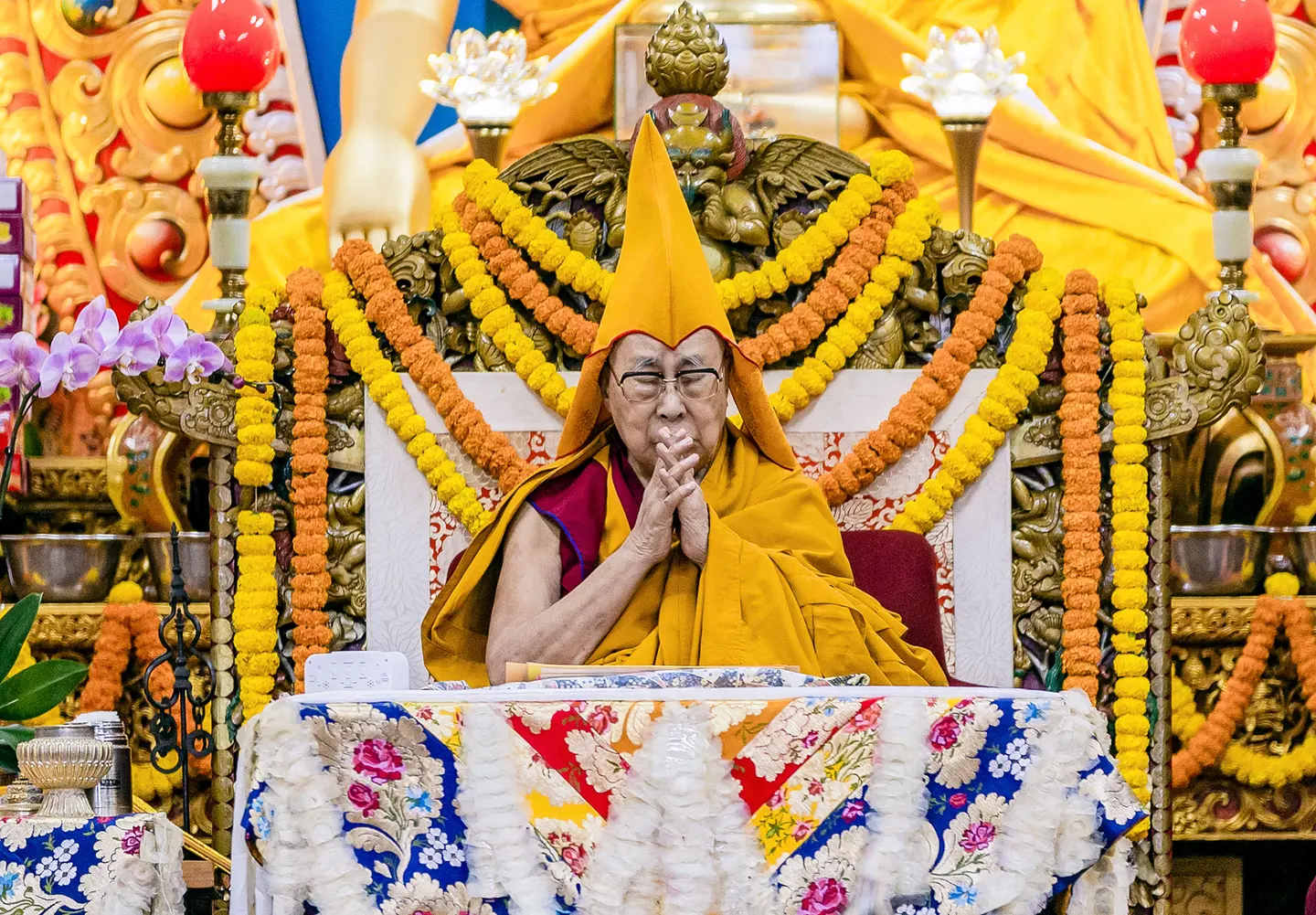
The Dalai Lama attends a prayer ceremony in dharamshala, India, in February PTI/AP
China Is Already Trying to Control Who the Next Dalai Lama Will Be
In early June, Tenzin Gyatso, the 14th Dalai Lama, was wheeled into an operating room at Apollo Hospital in New Delhi. Spiritually, His Holiness is an emanation, or tulku, of the bodhisattva Chenrezig, who renounced nirvana to help mankind. But his corporeal manifestation, which just turned 91 on July 6, requires maintenance; this time, it was a left-knee replacement. While he is recovering well, that physical frailty is an alarm bell for the Tibetan diaspora. The vessel is aging, and the war for what happens the moment he leaves it has already begun.
The Chinese Communist Party (CCP) officially rejects the existence of God, the afterlife, and the immortal soul. Back in 1954, Mao Zedong even whispered to His Holiness that “religion is poison.” But the Great Helmsman also vowed “to exterminate the bourgeoisie and capitalism in China,” and today’s People’s Republic of China (PRC) has more billionaires and sells more wares than any other nation in history. The party has proved as malleable to religion as to capitalism, spending billions on the rejuvenation of Buddhist shrines from Sri Lanka to Nepal.
And the officially atheist CCP is now preparing to assert control over the spirit world: when His Holiness dies, his reincarnation must be “approved by the central government,” Foreign Ministry spokeswoman Mao Ning reiterated last July. There is precedent. When in 1995 the Dalai Lama named a Tibetan child as the reincarnation of the Panchen Lama—Tibetan Buddhism’s second highest position—China abducted the boy and installed a state-backed figure instead. The whereabouts of the Dalai Lama’s choice remain unknown—a vanishing that, despite China’s wealth and technological advances, reveals a deep anxiety regarding its claim over Tibet’s land and people, and which its leadership is using diplomatic pressure to assuage.
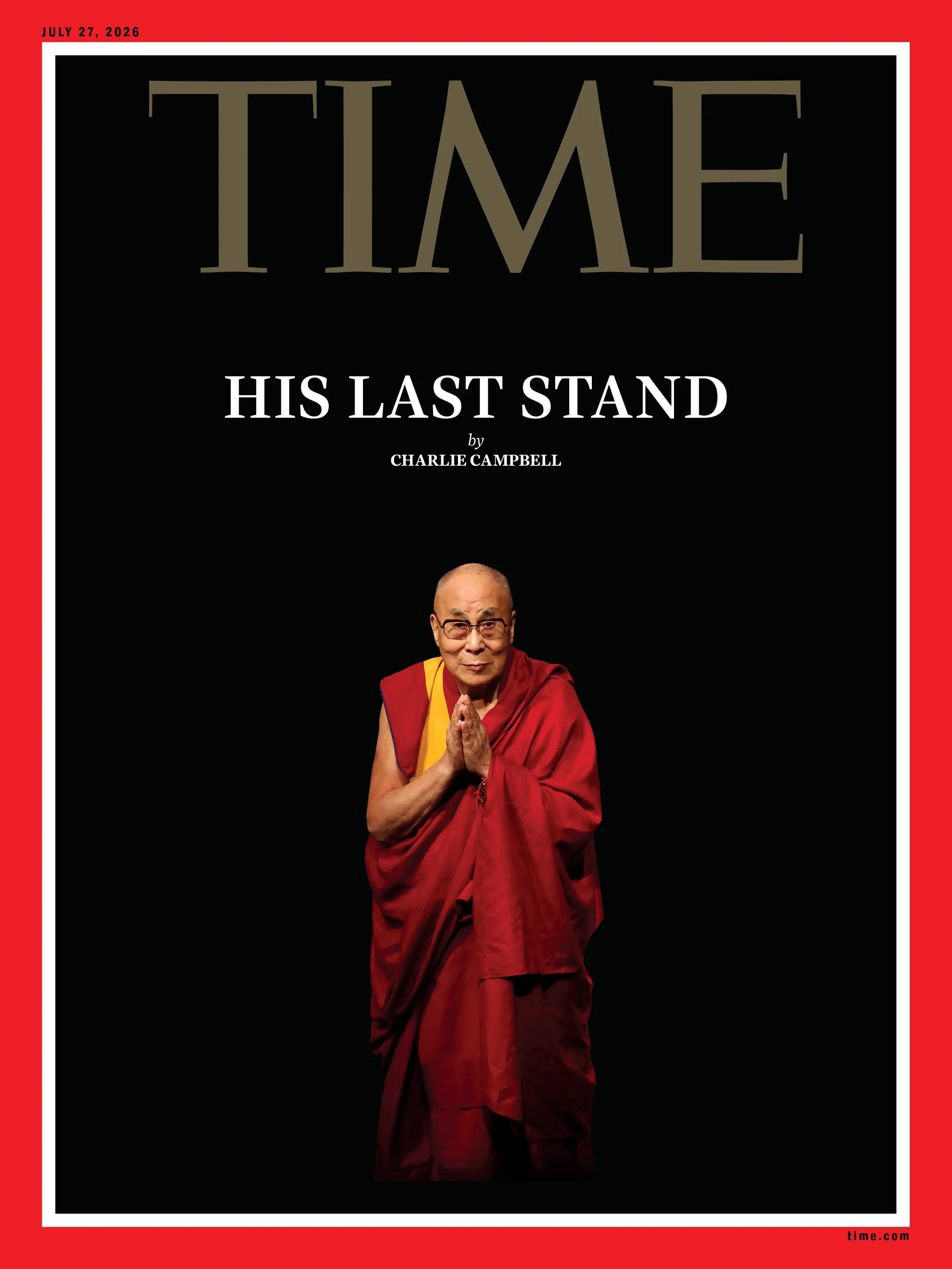
Photograph by Niall Carson—PA Images/Getty Images
Soon there will likely be two Dalai Lamas: one sanctioned by the CCP and another by the Office of His Holiness. Following the fate of the Panchen Lama, His Holiness decreed that he will be reborn in a “free” country and that his successor may even break precedent by being female. However, China insists a state-sanctioned short list of Chinese candidates will be placed inside a golden urn gifted to Tibet by the Qing Dynasty court, with the single name then withdrawn as the true reincarnation.
"It is total shamelessness,” Geshe Lhakdor, a Tibetan Buddhist scholar who for many years served as His Holiness’s personal translator, tells TIME. “It’s ludicrous because on the one hand they’re trying to destroy everything that resembles Buddhist practice; on the other hand they want to choose the reincarnation.”
Beijing denies human-rights violations in Tibet, insisting that it fully respects the religious and cultural rights of the 7 million Tibetans inside China, and highlights how development has raised living standards in what was a backward and impoverished land. But advocacy groups and U.N. monitors paint a grim picture of a land systematically surveilled and repressed. And for the over 140,000 Tibetans in exile, the fear is that the Dalai Lama’s passing could deal a major blow to hopes of Tibetan self-rule.
“Some people believe that we should not talk about [the succession] at all, but China is already planning for it,” Penpa Tsering, the Sikyong or Prime Minister of the Tibetan Central Administration (CTA) government-in-exile, tells TIME. “If there are two Dalai Lamas, it will be a lifelong headache. So, does China want a lifelong headache?”
Beijing’s calculation is that discomfort would be a worthwhile price to finally end the Tibetan question. For this spiritual succession is not merely a religious event, but a critical flash point amid a struggle for influence over a faith practiced by almost 500 million people worldwide. While the Dalai Lama has served as an outspoken advocate for democracy and human rights, that moral authority may now be co-opted by an authoritarian superpower.
“It’s not just a question of succession,” says Robert Barnett, founder of the Modern Tibetan Studies Program at Columbia University. “It’s a question of whether the Tibetan exile project will be able to continue as an effective movement.”
As the glue holding together the Tibetan diaspora, His Holiness has long championed the middle-way approach: rather than outright independence, he seeks genuine autonomy and cultural preservation for Tibet under the auspices of the PRC. But a leadership vacuum could fracture the Tibetan movement, potentially giving rise to younger, more radical factions that agitate for total independence, perhaps even violently.
From 2009, Tibet was hit by a wave of self-immolations, when at least 159 predominantly young Tibetans set themselves on fire in protest against Chinese rule. His Holiness has never supported violence, even against oneself, though he also would not condemn the fiery deaths for fear of upsetting bereaved kin. That ambiguity stoked Beijing’s denouncements of “a wolf in monk’s robes.”
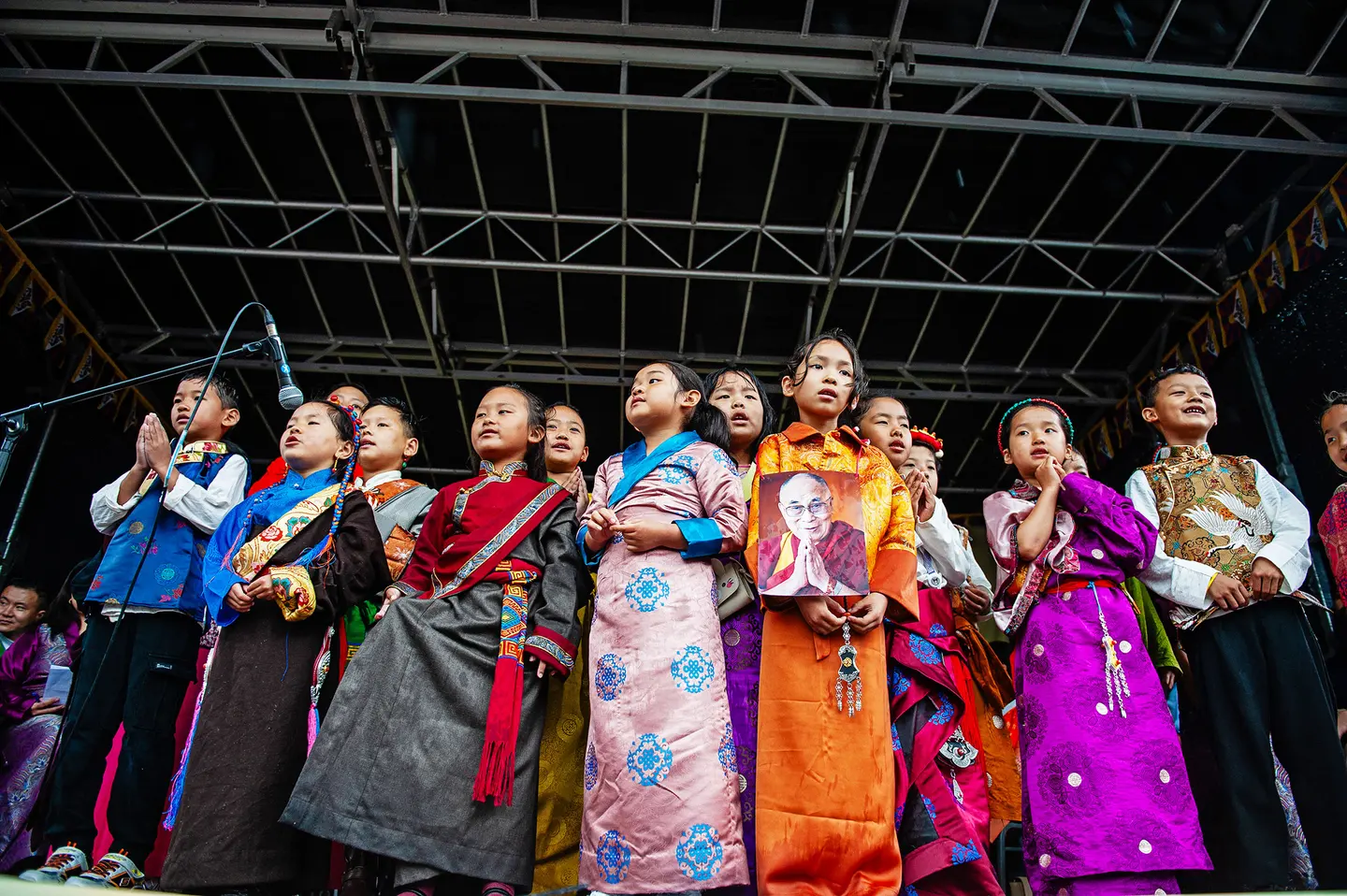
The Tibetan community in Amsterdam marks the Dalai Lama’s 90th birthday on July 6, 2025Romy Arroyo Fernandez—NurPhoto/Getty Images
Few outside China share that assessment. The boy born Lhamo Thondup to an impoverished farming family was meant to lead an arcane land veiled behind the planet’s loftiest peaks, but instead became the world’s pre-eminent peace tribune, holding court with world leaders, winning the Nobel Peace Prize and Congressional Gold Medal, and drawing a coterie of celebrity fans from Richard Gere to Lady Gaga.
But as China’s political clout has grown, and old age makes travel more difficult, that global prominence has shrunk. He has not given a press interview since 2020, and those who wish to receive his blessing must generally make the long journey to his home in the ramshackle northern Indian town of Dharamshala, wreathed in prayer flags and sandalwood smoke.
Read more: The God in Exile https://time.com/archive/6732009/the-god-in-exile/
His Holiness officially relinquished any political authority back in 2011 to prepare Tibetans for the arduous journey they must continue without him. But in a turbulent world, with conflicts from Iran to Ukraine occupying the public consciousness, keeping the cause of “Free Tibet” alive is a mounting challenge. Amid shrinking recognition, the Tibetan exile community also faces a brain drain to the West, where assimilation dilutes their culture.
While Beijing hopes that Tibetans will accept the party’s chosen Dalai Lama, the diaspora is fighting back. Shortly before His Holiness’s 90th birthday, he stated the nonprofit Gaden Phodrang Trust he created will have the sole authority to identify his reincarnation. (TIME spoke to six of its 17 members for this article.)
The CTA is also cementing ties with democratic nations around the world, using technology to keep His Holiness’s message alive, and planning for a legitimate succession that will safeguard his legacy. Officials from the U.S. Embassy attended the Sikyong’s swearing-in ceremony in Dharamshala on May 27, and the following month Republican Representative Michael McCaul introduced an amendment in Congress that the U.S. government recognizes the Dalai Lama’s succession as a private spiritual matter over which the CCP has no jurisdiction.
“When His Holiness passes away, that would be a huge loss for us and devastating for the Tibetan people,” says Yangten Rinpoche, who heads the Monastic Ordination Section at the Office of the Dalai Lama. “So we need to take steps to prepare for when His Holiness is not here with us.”
To contemporary eyes, the maroon-robed Dalai Lama is the personification of peace and tolerance, a global symbol of compassion famed for his heart and infectious grin. But the institution’s 450-year history is more complex, beset by war, invasion, and internal power struggles.
In 1642, the fifth Dalai Lama first unified Tibet by yoking the strength of Mongol forces, who razed the monasteries of rival sects, killing thousands. His successor was kidnapped by an adversary and never seen again. In the 19th century, four consecutive Dalai Lamas died mysteriously on the cusp of adulthood. Then there is the fate of the incumbent, who fled Tibet’s capital Lhasa for India in 1959 just days before red Chinese troops bombarded the sloping granite walls of his Potala Palace home.
Geopolitics defined His Holiness’s life from the moment he was identified. Following the death of the 13th Dalai Lama in 1933, the search for his heir was a matter of divine detective work. Monks noticed the late leader’s head tilted toward the northeast, while an unusual fungus sprouted on the same side of his shrine. Then came the visions: a mystical lake, a specific house with peculiar eaves, and the Tibetan letter A. The regent, the fifth Reting Rinpoche, believed the latter referred to Amdo, a disputed northeastern province of Tibet then subjugated by a Chinese warlord.
The Reting Rinpoche dispatched a search team of high lamas, who soon heard about a precocious 2-year-old who enjoyed larking inside chicken coops but also frequently spoke yearningly about making a long journey to Lhasa. Inside the modest home, legend has it, the toddler marched straight up to the lead monk, eyed a set of prayer beads belonging to the late Dalai Lama, and despite speaking only a local Chinese dialect demanded in perfect central Tibetan: “Give me my beads.”
Later, presented with an array of objects, the boy is said to have selected only those belonging to his predecessor. The hunt was over. But it would take two years of negotiation before a ransom was agreed with the Chinese warlord, who realized the child must be auspicious and initially refused to sanction his departure.
When the 4-year-old child eventually arrived in Lhasa, he was atop a golden palanquin carried by two dozen courtiers, while thousands of people flooded into the streets, including musicians, military officers, and noblemen in fine silk. His new life was an intense crucible of monastic discipline, complex logic, and rote memorization. Yet his truest education came from the palace sweepers—the humble monk-servants who raised him. From them, he learned a foundational truth: true authority is rooted in affection and kindness, not the rigid hierarchy of the elites.
He would need that grounding sooner than anyone expected. While copying the last testament of his predecessor—which warned of the dire need for a strong military—the young Dalai Lama discovered that corrupt officials were embezzling army funds. The weakness of Tibet’s forces soon became clear.
In October 1950, Chinese forces invaded and the ragtag Tibetan army was swiftly crushed. The regent turned to the 15-year-old boy and handed him full political power, five years ahead of schedule.
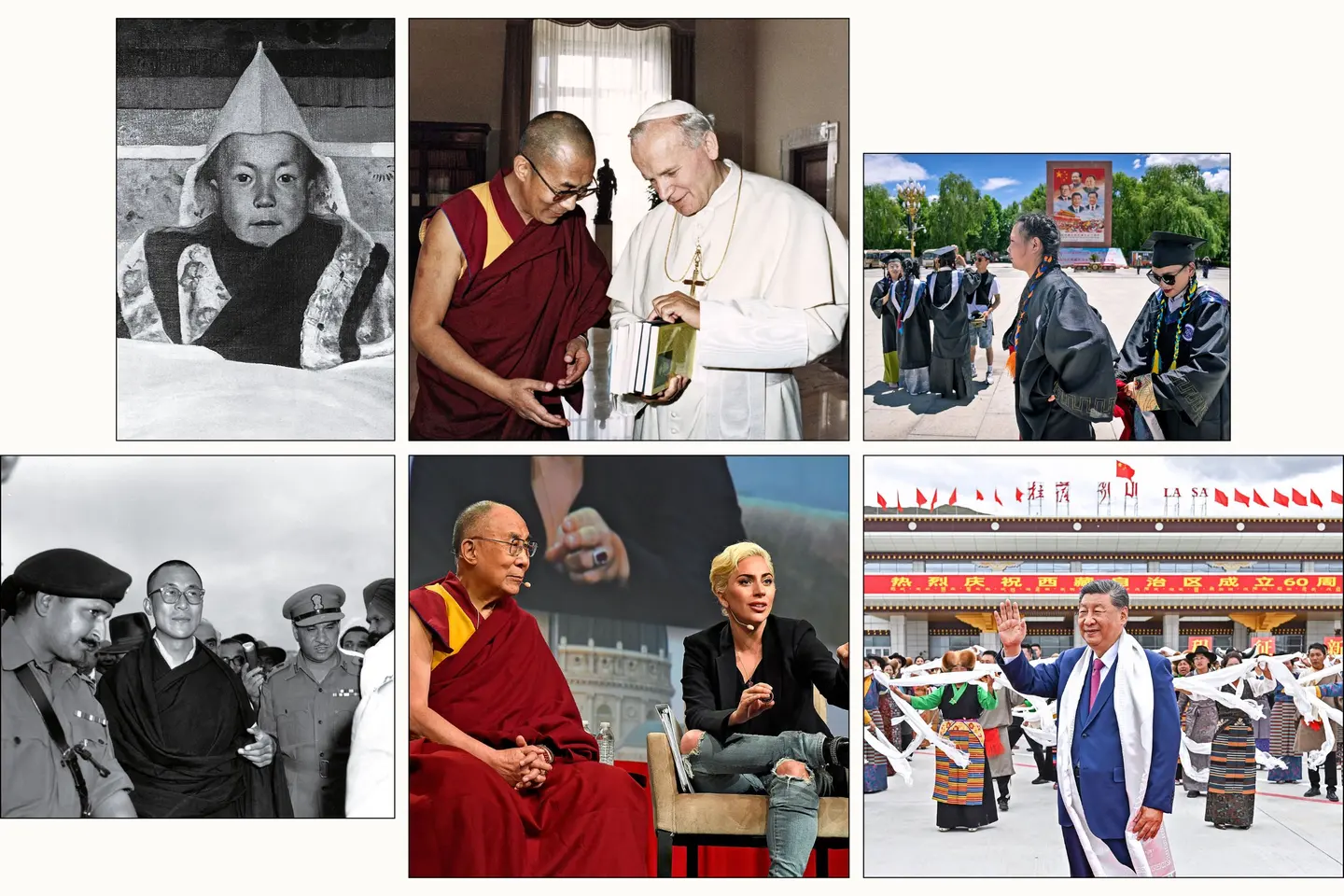
Clockwise from top left: A 1940 portrait depicts the young Dalai Lama after his enthronement in Lhasa; Meets Pope John Paul II at the Vatican in 1982; Tibet University graduates beside portraits of Chinese leaders in 2021; Xi Jinping visits Lhasa in August 2025 to mark 60 years of Chinese rule; With Lady Gaga in Indianapolis in 2016; Arrives in India after fleeing Tibet in 1959Gamma-Keystone/Getty Images; Archive Photos/Getty Images; Mark Schiefelbein—AP; Yan Yan—Xinhua/Getty Images; Kevin Mazur—Getty Images; AP
Deserted by Western nations like the U.S. and U.K., the young leader traveled to China to negotiate with Mao. By 1959, following a failed Tibetan uprising, he was forced to flee to India upon a dzo, a cross between a yak and a cow, beginning an exile that continues today. The Dalai Lama’s political displacement gave rise to a global spiritual phenomenon.
That prominence extends beyond the confines of Buddhism, which as a nontheistic religion without a creator deity is uniquely accessible to followers of other faiths, and even atheists, with practices like mindfulness and meditation adopted by millions around the globe. Bridging ideological divides, the Dalai Lama became the epitome of “soft power,” viewing even philosophical antagonists not as monsters, but as equally flawed siblings. He campaigned for the environment, secular ethics, and interfaith harmony: that, at the end of the day, we are all just humans on this planet together.
“My No. 1 commitment is to try to promote awareness about our inner value, not based on religion,” His Holiness told TIME in 2019. “How to bring inner peace, how to tackle our anger, fear, through training of our mind.
Read more: A Conversation with the Dalai Lama https://time.com/archive/6657187/a-conv ... alai-lama/
The paradox of Tibetan Buddhism is this blending of secular wisdom and mystical rite. Several times each year, His Holiness requests guidance from Kuten La, who in his role as State Oracle serves as mouthpiece for Nechung, an ancient deity and Tibet’s spiritual protector. The air inside his temple in Dharamshala thickens with the sharp, medicinal sting of burning juniper and the low, rhythmic thrum of drums and horns. In the center sits Kuten La, whom attendants drape with 80 pounds of ceremonial armor, before crowning him with a towering headdress of gold and mirrors, and securing a silk cord tightly around his throat.
Kuten La’s limbs twitch. His breathing shifts to an unnatural cadence. The physical strain is immense—his face flushes crimson under the regalia—but his consciousness is no longer entirely his own. As he passes the delicate threshold into the trance state, the oracle begins to dance with an otherworldly vigor. He hisses commands, bends iron swords with bare hands, and speaks in a high-pitched, archaic dialect: cryptic divinations sent to aid Tibet’s people and those who lead them. “When Nechung enters me it’s just a feeling of equanimity,” Kuten La says. “But when he’s gone, there’s a bit of discomfort in my heart, or maybe my muscles and joints.”
It is Nechung, via Kuten La, that will help steer the Gaden Phodrang Trust toward the next Dalai Lama. However, the most pressing issue facing Tibetan exiles is the looming gap in leadership. Even if the next emanation is discovered within months, Tibetans face a perhaps two-decade interregnum while his successor comes of age. While the Dalai Lama democratized the exile administration—separating his executive power and creating an elected leader in 2011—the new democratic structure lacks the charismatic gravity of his historic role.
China is maneuvering to exploit this vulnerability. Inside Tibet, Beijing is pursuing the “Sinicization of religion,” an active campaign to redefine Tibetan Buddhism to align with state directives. Monasteries are no longer exclusively places of spiritual study but regulated sites of political indoctrination. Through mandatory patriotic education campaigns, monks and nuns are required to study CCP ideology, Chinese law, and the speeches of Xi Jinping. Students must pass political exams to remain in their monasteries and publicly denounce the 14th Dalai Lama as a “separatist.” Refusal to participate or pass these exams routinely results in expulsion, arrest, or the institution’s closure.
Monks and ordinary Tibetans are forced to replace portraits of previous Dalai Lamas and even traditional thangkas with portraits of Xi Jinping and Mao Zedong. In March, the CCP introduced a new Law on Promoting Ethnic Unity and Progress, ostensibly to “foster a strong sense of community for the Chinese nation,” though critics argue it places severe curbs on minority languages, faiths, and cultures.
By forcing Tibetan children into state-run boarding schools where instruction is almost entirely in Mandarin, the state is weakening the linguistic tie that the next generation needs to read traditional Buddhist scriptures and engage in spiritual debate. “If you forget your language, you lose your identity,” says Jetsun Pema, His Holiness’s sister, who served as president of the Tibetan Children’s Villages for 42 years.
Tibet is far from alone. Article 4 of the PRC constitution guarantees equality for all its 56 ethnic groups, though in reality the national vision hews to a Han Chinese orthodoxy, which avers a direct lineage from the early Yellow River basin tribes. Critics see parallels between Beijing’s repressive policies in Tibet and attempts to muzzle minority language and inculcate a singular identity along China’s restive periphery, including Hong Kong, Inner Mongolia, Xinjiang, and indeed self-ruling Taiwan. “It’s the same thing,” says the Sikyong. “They are talking about peace, dialogue, negotiation ... but China always has double standards.”
Outside Tibet, China’s strategy is more insidious. From Sri Lanka to Myanmar, China has spent billions on rejuvenating ancient Buddhist sites, including $3 billion to transform the Nepalese town of Lumbini, birthplace of Lord Buddha, into a luxury pilgrimage site. China has hosted World Buddhist Forums since 2006, courting monks from across the globe. China actively targets Tibetan lamas in exile with inducements. “Some lamas who are not motivated to solve the Tibetan problem, or to preserve Tibetan culture, have a relationship with the Chinese government,” says the 13th Kundeling Rinpoche, whose role traditionally served as a regent of Tibet. “But they’re not motivated by fairness and openness or wanting to help the Tibetan society.”
Geopolitically, China uses the Dalai Lama succession as a bargaining chip. When foreign governments are pressed to support the CCP’s right to oversee the Dalai Lama’s reincarnation, the true objective is rarely about religion. Countries that agree effectively accept Beijing’s claims of authority, quashing Tibetan exile activities within their borders. Those that refuse are framed as an enemy of the Chinese people.
In 2008, reeling from the global financial crisis, the British government formally recognized Tibet as part of China—surrendering over a century of support for Tibetan autonomy. Just months later, Chinese Premier Wen Jiabao visited London and agreed to boost bilateral trade to $60 billion. In 2014, the Dalai Lama visited Norway to celebrate the 25th anniversary of his Nobel Peace Prize but was snubbed by the entire Norwegian government, which caved to Chinese threats to halt fish imports. Two years later, when the Dalai Lama visited Mongolia for a purely religious trip, China hit its export-reliant landlocked neighbor with retaliatory tariffs. “It’s a Trojan horse,” says Barnett. “If a country doesn’t concede on this issue, then China can then demand another, far more significant concession in exchange.”
China is also utilizing economic corridors through nations like Nepal—which is ramping up arrests of Tibetan new arrivals—to court other Buddhist countries, laying the groundwork for international compliance when the time comes to name their own successor. Nations like Mongolia, Bhutan, and Nepal are acutely aware of the danger, fearing that not capitulating on the Dalai Lama succession issue could open the door to broader Chinese territorial claims.
“Tibet is not just a territorial occupation,” says Dolma Tsering, deputy speaker of the CTA. “We are the front line of a totalitarian CCP whose eyes are far beyond Tibet.”
The Dalai Lama bet that modern, secular democracy would protect his people after his death. But as his succession looms, it’s clear that the survival of the Tibetan exile project will depend not just on democratic institutions, but also on whether the rest of the world will withstand Beijing’s pressure.
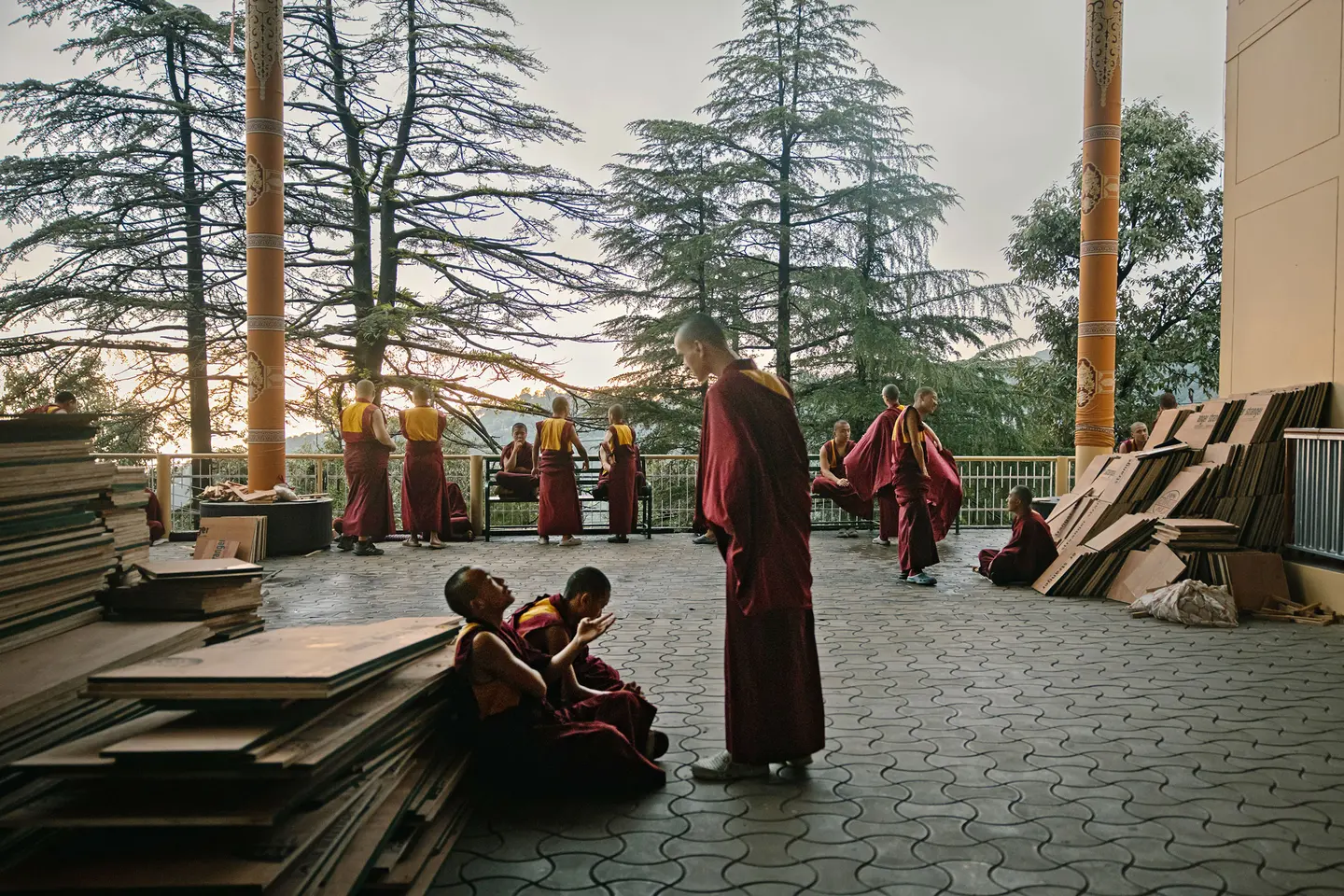
Tibetan monks at the Dalai Lama temple in Dharamshala in July 2025Elke Scholiers—Getty Images
The CTA maintains “Offices of Tibet” in over a dozen countries, which function as de facto embassies to lobby foreign governments and organize the diaspora. Civil groups such as the Tibetan Youth Congress and Tibetan Women’s Association continue to provide community welfare programs as well as mobilize protests outside Chinese embassies and international forums.
In India, the book Why Tibet Matters has been translated into 15 local dialects to galvanize solidarity among the host community. Tibetan Buddhist sites are being promoted as tourism destinations to both generate income and keep the struggle alive in visitors’ minds. Across the globe, the CTA runs 92 weekend Tibetan language and cultural classes to preserve solidarity among the diaspora. “But it’s still a huge challenge,” says the Sikyong.
The diaspora is also leaning into technology. Yangten Rinpoche is currently digitizing the entire canon of the 14th Dalai Lama’s teachings, comprising over 110 books, and is looking into coalescing that wisdom into an AI agent which people can solicit for his spiritual advice. “We will try to disseminate that information using different technologies and different means,” he says.
The U.N., as well as countries such as Canada, Australia, the U.K., and various European nations, have periodically passed legislative motions condemning human-rights violations in Tibet. The U.S. has had a special coordinator for Tibetan issues since 1997, and the CTA is lobbying the E.U. to create an equivalent post.
The U.S. remains unique in creating binding laws that specifically direct diplomatic strategy and impose direct sanctions over the Tibet issue, including the 2018 Reciprocal Access to Tibet Act; the 2020 Tibetan Policy and Support Act; and the 2024 Resolve Tibet Act. Despite today’s polarized political landscape, all were bipartisan and some even passed unanimously—under both Joe Biden and Donald Trump. “That’s not a product of Shangri-la, or yaks, or anything else in Tibet,” says Cameron Warner, a professor at Denmark’s Aarhus University. “The Dalai Lama did that.”
The challenge for the exile community is to maintain that broad support after His Holiness has departed. “It is a big concern, but it’s one we cannot avoid,” says Geshe Lhakdor. “His Holiness not being with us will, of course, set us a big challenge, but you need to test the reality.”
How could the CTA reshape that reality to its own benefit? His Holiness has said he would be reborn in a “free” country, and the assumption was that meant a democratic Asian nation, such as India, Bhutan, or Mongolia. But what about the self-styled land of the free? “Certainly,” says Kundeling Rinpoche with a chuckle. “Maybe His Holiness could be reborn in the USA. Anything is possible.”
Asked the same question, Kuten La goes further, expounding the historical precedent of previous reincarnations outside Tibet when geopolitically expedient. The fact that the fourth Dalai Lama was born in Mongolia empowered his successor to unite the territory in the 17th century. That the sixth Dalai Lama was born in modern-day Arunachal Pradesh of northern India helped seed an affinity for Buddhism, which led to a warm welcome for the incumbent almost three centuries later.
Given today’s fraught new era of great-power competition, where would be the most strategically useful birthplace for a figure Beijing regards as a threat? There are, after all, around 30,000 Tibetan Americans, mainly concentrated around Queens and Minneapolis. Catholics already have an American Pope. Could the 15th Dalai Lama be a Timberwolves fan? “The U.S. is a free country, it’s a democratic country,” grins Kuten La. “So if His Holiness sees benefit in taking rebirth there, that will happen.”
His Holiness has already tested the water. In 2023, he named an 8-year-old Mongolian boy called Aguidai Altannar as the 10th Khalkha Jetsun Dhampa Rinpoche, the third highest leader of Tibetan Buddhism. But Altannar was actually born in Washington, D.C., and his dual nationality is seen as a diplomatic shield. “It would be beneficial to the Dalai Lama’s institution if the next person also had a different nationality,” says Warner. “A kid who’s basically Tibetan but maybe born in America or the U.K. to parents from northern India.”
The Dalai Lama’s body may be ailing, true, but no one should bet against the punch line belonging to the monk who never stopped laughing. China has claimed Tibet’s soil, but by entrenching their identity in the free world, Tibetans can ensure their culture lives on. Perhaps longer than the regime that seeks its erasure.
https://time.com/article/2026/07/09/chi ... e9677ea768