Weather Related

Current issues, news and ethics
Post Reply
kmaherali
Posts: 23646
Joined: Thu Mar 27, 2003 3:01 pm

Weather Related

Post by kmaherali »

Once a Source of Life and Renewal, Monsoon Brings Death to Pakistan

With villages swept away and Pakistan’s largest city assailed by monsoon floods, climate change has brought a catastrophic new normal to the country.

Image
The funeral for Abdul Samad’s mother in Beshonai, a village in the Khyber-Pakhtunkhwa region of Pakistan, on Monday.

Listen to this article · 6:11 min Learn more
Share full article


By Zia ur-Rehman and Elian PeltierVisuals by Asim Hafeez
Zia ur-Rehman and Asim Hafeez reported from Beshonai, in northern Pakistan, and Elian Peltier from Islamabad, the country’s capital.

Aug. 19, 2025
Walking to his local mosque in northern Pakistan, Abdul Samad cast worried looks at a stream he had never seen so agitated and choked with debris. When he stepped outside again 10 minutes later, the mountain village that was his lifelong home had been nearly erased.

Swollen by pummeling rainfall, the stream had turned into a roaring torrent that swept mud, rocks and fallen trees through the village of Beshonai on Friday, crushing, burying or washing away everything in its path. Out of 210 homes, only 25 remain standing, according to local officials.

“Houses, fields of maize, everything was gone. All I saw were boulders upon boulders,” said Mr. Samad, an imam in his mid 40s. His wife and daughter were swept away with the family home and killed. His mother’s body was not found until Monday, three miles downstream.

Video

The Indus River, swollen far beyond its banks, near the Swabi district of the Khyber-Pakhtunkhwa Province.

The monsoon season, once revered as a source of life and renewal, has brought death and devastation across large parts of Pakistan, a South Asian nation of 250 million people. Monsoons have killed more than 700 people nationwide since the season began in late June. This increasingly frequent pattern is forcing Pakistan to reckon with a new reality: Destruction brought by extreme weather has become the norm, not the exception.

In northern Pakistan, floods cascaded down mountain slopes last week, eradicating entire villages. Boulders and pine trees smashed through houses. Mud swallowed whole families.

Video
Deadly Flash Floods Lash Northern Pakistan

1:25

Torrential rains continued pouring on dozens of villages in northern Pakistan, triggering flash floods that have wiped out houses and killed hundreds.
ImageA man stands near a destroyed building.
Image
A view of the destruction caused by monsoon flooding in Beshonai on Tuesday.

“What we were used to in Pakistan has changed, and for now it is too much,” said Dr. Maryam Ibrahim, an environmental expert and professor of environmental studies at the Lahore University of Management Sciences. “This phenomenon of streams or rivers gradually swelling, in a slow process that would give time for people to evacuate, is gone.”

Mr. Samad said he survived only because the mosque had been built on higher ground. His son and his nephew were pulled to safety by neighbors.

Video
A stream in the village of Beshonai, seen here Tuesday, turned into a roaring torrent that swept mud, rocks and fallen trees through the village last week.

As he led mourning prayers on Monday and paid a last tribute to his mother, he implored God to have mercy on the community.

Beshonai, in Buner district, is one of dozens of northern villages devastated by rains so heavy and sudden that flash flooding caught officials and communities off guard.

Image
Men wearing tunics and masks use tools to dig through piles of mud.
Image
Residents and disaster recovery workers dug through mud at a damaged house in the village of Qadir Nagar on Tuesday.

Image
Muslim men at prayer stand in a row, their eyes closed and their arms clasped in front of them.
Image
Imam Abdul Samad leading prayers at a service on Monday.

The highest toll has been recorded in Khyber Pakhtunkhwa, a province bordering Afghanistan, where flooding has killed at least 365 people since last Thursday. Buner district suffered the worst devastation, with at least 225 confirmed deaths.

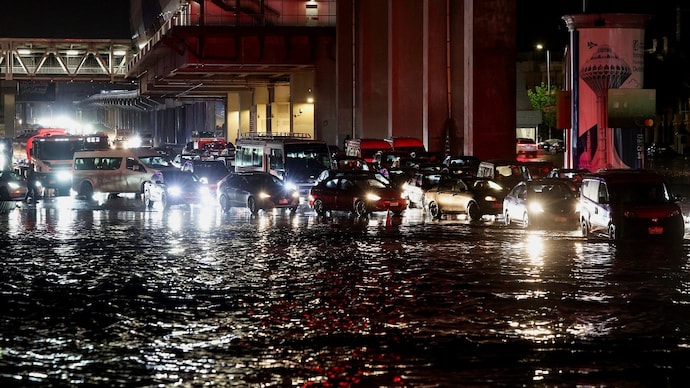
Pakistan’s troubles redoubled on Tuesday, as floodwaters flowed southward, inundating more areas. The port city of Karachi, the country’s economic hub with more than 20 million people, was paralyzed, as residents waded through water that was shoulder-deep in some streets.

The floods are the most devastating Pakistan has endured since 2022, when record monsoon rains killed 1,700 people and submerged a third of the country.

Map locates Beshonai in the Khyber Pakhtunkhwa province of Pakistan.

Beshonai

Kabul

AFGHANISTAN

KHYBER

PAKHTUNKHWA

Quetta

PAKISTAN

IRAN

INDIA

Karachi

Arabian Sea

200 MILES

By The New York Times

Since then, Pakistan’s successive governments have campaigned for better access to international climate finance, as the country contributes less than 1 percent of the world’s greenhouse gas emissions but is one of the most vulnerable countries to climate change. The World Bank has estimated that Pakistan needs $43 billion on average every year until 2030 to mitigate the effects of global warming.

But in recent days, the country’s authorities have also faced growing criticism for not doing enough to save lives. Critics say they have let deforestation go unchecked, worsening the impact of floods, and have failed to create effective early warning systems.

Video

Flooded streets in the bazaar in Pacha Kalay, in the hard-hit Buner district, on Tuesday.

Aisha Khan, the executive director at the Civil Society Coalition for Climate Change, a Pakistani nonprofit, said the worsening floods could have severe social and political consequences.

“If extreme weather keeps being an annual event, if it keeps hitting people so strongly and trapping them in a circle of perpetual poverty and misery, there will be upheaval,” she said.

Pakistan’s disaster management officials said they sent all the early warnings they could, including through a national app and communications to provincial authorities. But many areas have scant access to the internet, and in Beshonai and other places, people said the warnings from local mosques and police stations came late.

Image
A man rides a motorcycle through flood water.
Image
A motorcyclist riding through floodwaters in Qadir Nagar.

Image
A man standing in the doorway of a storefront dumps mud from a wheelbarrow. Another man uses an implement to dig the mud out.
Image
Taking mud out of the office of a travel agency in the Pacha Kalay bazaar.

Officials also said that nothing could have prepared the country for what was unleashed on villages like Beshonai.

Watching a video of a cascade of mud devastating a northern village, Muhammad Idriss, an official at the national disaster management agency, asked, “What can the government do against this?”

At the agency’s operation center in Islamabad, the capital, on Tuesday, dozens of weather analysts and officials raced to assess the latest data and issue warnings of more rainfall. Surrounding them in a huge octagonal room, screens displaying videos and maps showed a country assailed by extreme weather — not only floods, but also extreme heat and wildfires.

A week ago, Beshonai, which has become a symbol of Pakistan’s suffering, had 4,000 people, many of them relying on money sent by relatives working abroad.

The few businesses that sustained the other residents are gone.

“This was once a bustling village,” said Shiraz Ali, a college student who was helping with rescue operations on Monday.

“How can anyone be normal in a place like this?”

Image
A mud-stained clock on a wall.
Image
A clock in a flood-damaged house in Beshonai.

Elian Peltier is an international correspondent for The Times, covering Afghanistan and Pakistan.

https://www.nytimes.com/2025/08/19/worl ... e9677ea768
kmaherali
Posts: 23646
Joined: Thu Mar 27, 2003 3:01 pm

Re: Weather Related

Post by kmaherali »

Climate Change’s Toll in Europe This Summer: Thousands of Extra Deaths

Three times as many people in cities and towns died from severe heat as would have done in a world without human-caused warming, scientists said.

Image
A tourist outside the Acropolis in Athens in July.Credit...Angelos Tzortzinis/Agence France-Presse — Getty Images

Raymond Zhong

Sept. 17, 2025, 12:01 a.m. ET
Severe heat this summer killed three times as many people in European cities as would have died had humans not warmed the planet by burning fossil fuels, scientists said Wednesday.

The new analysis was based on historical mortality trends, not actual death records, which are not yet widely available. The researchers looked at 854 European cities and towns, where they estimated that a total of 24,400 people died as a result of this summer’s heat.

The findings reflect a worrying pattern: Rising temperatures are increasing the risks to human health more quickly than communities and societies can adapt.

Nearly all heat-related deaths are preventable, said Malcolm Mistry, an assistant professor of climate and geospatial modeling at the London School of Hygiene and Tropical Medicine who contributed to the analysis. And governments in Europe, the fastest-warming continent, have taken steps to protect their citizens.

So the fact that so many people still die each summer “shows that we are not able to keep pace with global warming,” Dr. Mistry said.

Summer after stifling summer, extreme heat is transforming Europe. Wildfires are worsening. Cities are rethinking the way they’re built. Companies are struggling to keep workers safe.

In 2022, during what was at that point the continent’s hottest summer on record, more than 61,000 people died from the heat, scientists have estimated. More than half of those people wouldn’t have died if not for global warming caused by greenhouse gas emissions, deforestation and other human activities, researchers concluded.

The scientists behind the new analysis, which hasn’t yet been published in a peer-reviewed journal, said their aim was to provide “early estimates” of this summer’s heat fatalities. They examined European cities and towns with more than 50,000 residents and adequately long records of local deaths. In total, these areas account for 30 percent of Europe’s population.

The researchers first used climate models to estimate that these areas would have been 4 degrees Fahrenheit, or 2.2 degrees Celsius, cooler on average from June through August in a hypothetical world that hadn’t been altered by planet-warming emissions.


//2024 Brought the World to a Dangerous Warming Threshold. Now What? https://www.nytimes.com/interactive/202 ... -goal.html
//Global temperatures last year crept past a key goal, raising questions about how much nations can stop the planet from heating up further.

Then, by extrapolating from past mortality rates, the researchers estimated that only around 8,000 people in these cities would have died from heat in those months in that alternate, cooler world, instead of the 24,400 people who likely did so in the real world.

Rome, Athens and Bucharest, Romania, were the European capitals with the highest number of heat-related deaths after adjusting for city population, the researchers found. But when it comes to the share of deaths that can be attributed to climate change, the highest ranked capitals were Stockholm, Madrid and Bratislava, Slovakia.

Sweden’s capital might seem like an unlikely holder of the top spot. “Before, we had very few, if any heat-related deaths in Northern Europe,” said Garyfallos Konstantinoudis, a climate scientist at Imperial College London who worked on the new analysis.

From that low base, however, global warming is now starting to lift summer temperatures in northern countries into the range where they can harm human health, Dr. Konstantinoudis said. Far fewer people still die of heat there than in Southern Europe, but when they do, it is much more squarely the result of climate change, he said.

Warming Summers in Europe

Climate Change Is Transforming Summer in Europe https://www.nytimes.com/2025/08/28/clim ... -heat.html
Aug. 28, 2025

As Europe’s Heat Waves Intensify, France Bickers About Air-Conditioning https://www.nytimes.com/2025/08/12/worl ... oning.html
Aug. 12, 2025

It’s Paradise Lost as Climate Change Remakes Europe’s Summers https://www.nytimes.com/2025/07/14/worl ... -heat.html
July 14, 2025
Raymond Zhong reports on climate and environmental issues for The Times

https://www.nytimes.com/2025/09/17/clim ... e9677ea768
kmaherali
Posts: 23646
Joined: Thu Mar 27, 2003 3:01 pm

Re: Weather Related

Post by kmaherali »

One Million Evacuated in China as Typhoon Ragasa Barrels Toward Coast

The storm left 14 dead in Taiwan, and flooded Hong Kong and Macau, disrupting flights.

Video
Hong Kong residents prepared for the worst as Typhoon Ragasa, the most powerful storm so far this year, approached. The typhoon has prompted thousands of evacuations in China.CreditCredit...Tyrone Siu/Reuters

Typhoon Ragasa, the most powerful storm in the world so far this year, slammed into Hong Kong early Wednesday, flooding coastal areas and lashing the city with pelting rain and powerful winds that toppled trees.

The typhoon — which made its first landfall in the Philippines on Monday before heading back out to sea — was expected to continue moving west on Wednesday, making a second landfall later in China’s southern Guangdong Province. The authorities there have evacuated more than a million people, state media reported.

The typhoon’s destructive path crossed the south of Taiwan on Tuesday, killing 14 people and leaving 124 people missing, as of Wednesday morning.

Raging floodwaters collapsed a bridge, the island’s emergency department said at a news conference Tuesday evening. The dead and missing came from one part of Hualien County, in the east, the agency said, and almost 8,000 people were evacuated across Taiwan.

ImageAn overhead view of a river of muddy floodwater amid a grassy valley.
Image
Mud and receding floodwaters flowed in Hualien County.Credit... Taiwan's Central News Agency, via Agence France-Presse — Getty Images

Videos posted on social media showed people trapped in their homes waiting to be rescued, and cars being carried away by murky floodwaters. In one dramatic clip, a woman is seen clinging to a utility pole in a market to avoid being carried away by chest-high water. Authorities later confirmed that she was rescued.

Ragasa has prompted the cancellation of hundreds of flights, mass evacuations and the closure of Hong Kong’s Disneyland and Macau’s casinos.

Experts say that typhoons are increasing in the region, and officials are bracing for Ragasa to be one of the worst in years.

The Hong Kong Observatory issued its highest storm signal, level 10, at 2:40 a.m. on Wednesday. The forecaster said that rain could fall at a rate of more than an inch per hour and that the sea level in eastern Hong Kong had reached more than 12 feet above normal by Wednesday morning. It urged residents not to go outside.

Image
A woman picks up a package of eggs from a mostly empty shelf.
Image
Empty shelves at a supermarket in Hong Kong on Tuesday as Typhoon Ragasa approached. Credit...Mladen Antonov/Agence France-Presse — Getty Images

On Tuesday, crowds had gathered by coastlines in Hong Kong to watch the crashing waves. Among the spectators, a child and his mother had gotten swept into the sea and were rushed to intensive care after being rescued, according to the police.

Hong Kong Observatory’s forecasters had earlier warned that Ragasa could cause damage comparable to that of Typhoon Mangkhut in 2018, when ferocious winds shattered hundreds of glass windows in the city’s skyscrapers. Eric Chan, Hong Kong’s No. 2 official, described Ragasa as a “serious threat” to the city.

Nineteen people were injured and dozens of trees had fallen as of Wednesday morning, the Hong Kong authorities reported.

The city’s Disneyland resort was closed, horse races were canceled, classes were suspended and office workers went home early. Supermarket shelves were emptied as residents stocked up on food, and many taped their windows at home. Maintenance workers set up flood barriers, covered outdoor escalators and secured sculptures to the ground.

Image
Two airline workers walk through an empty terminal.
Image
An empty check-in counter at the Hong Kong International Airport on Tuesday.Credit...Chan Long Hei/Associated Press

At least 600 flights from Cathay Pacific, Hong Kong Airlines and other carriers have been canceled at Hong Kong International Airport. The airport said that its runways would continue to operate and that some restaurants and shops would stay open for 24 hours for stranded passengers. The airport authority said that it handled 600 flights on Tuesday, and that there were no passengers remaining in restricted areas. In Taiwan, 270 flights were canceled.

The gambling hub of Macau announced that casinos would be temporarily closed from Tuesday evening.

After hitting China, the storm is expected to continue westward, reaching as far as Vietnam and Laos later this week.

In the Philippines, the state weather bureau said Monday that the storm had caused heavy rains and landslides in areas in the north, many of which were still struggling with flooding from previous storms.

Amy Chang Chien contributed reporting from Taipei and David Pierson from Hong Kong.

https://www.nytimes.com/2025/09/23/worl ... e9677ea768
kmaherali
Posts: 23646
Joined: Thu Mar 27, 2003 3:01 pm

Re: Weather Related

Post by kmaherali »

Typhoon Bualoi Slams Into Central Vietnam, Adding to Death Toll

At least 13 people were killed and dozens more injured in central Vietnam, where 2 million were without power. Bualoi’s deadly path had started with 10 deaths in the Philippines.

Video
Typhoon Bualoi lashed central Vietnam, making landfall on Sunday evening. The region was already reeling from Typhoon Kajiki which hit a month earlier.CreditCredit...Thai An/Agence France-Presse — Getty Images


By Tung Ngo
Reporting from Hanoi, Vietnam

Sept. 29, 2025
Updated 7:46 a.m. ET
Typhoon Bualoi tore into Vietnam’s central coast on Monday, leaving at least 13 people dead and 46 injured, according to a government official at the Ministry of Agriculture and Environment. The storm had hammered the Philippines over the weekend, killing at least 10 people there.

The storm made landfall on Sunday at around 11 p.m. local time with a wind speed of between 73 and 83 miles per hour, according to media reports that cited the state weather forecaster. On Monday, rescuers struggled to reach communities isolated by landslides and flash floods. As the storm moved west, rain continued to swell in hydropower reservoirs in the area, threatening to cause more damage.

Vietnam’s state-owned power utility EVN said efforts were underway to restore electricity to nearly two million homes across central Vietnam.

“This typhoon is one of the strongest to hit the areas it swept through in the last two decades,” said Huy Nguyen, a local weather forecaster. “It created widespread damage because it stayed inland for many hours — between six and 11 hours — after making landfall.”

Rescue teams saved 13 people who had been trapped by rising floodwaters at a farm by a river in Thanh Hoa Province on Monday afternoon, according to local media reports. At least 21 others were missing or had lost contact with their families, according to the government official.


Tracking Typhoon Bualoi
See the likely path and wind arrival times for Bualoi

Bualoi had maximum sustained winds of about 90 m.p.h., according to the Joint Typhoon Warning Center in Hawaii, as it ripped across a large swath of central Vietnam. The region was already reeling from the devastation caused by Typhoon Kajiki only a month earlier.

The timing of the storms has left little time for recovery.

“The previous typhoon destroyed my home. All the roof was blown away. I had just fixed my house with loans. Today, this typhoon has damaged my home again,” said Tran Thi Ha, 40, who lives in Ha Tinh Province.

Bualoi’s effects were felt across the region. In Ninh Binh Province, approximately 124 miles from the storm’s eye, severe thunderstorms caused homes to collapse and killed nine people. Vietnam’s central Ha Tinh Province, which the eye of the storm passed directly over, reported that vast areas lost power.

“We expect the rain will continue,” said Tran Huu Khanh, deputy director of the Ha Tinh Department of Agriculture and Environment. “We are mobilizing resources to respond to the further risks of flash floods and landslides.”

Vietnam had evacuated tens of thousands of residents over the weekend before Bualoi’s arrival as a precautionary measure.

It was expected to dissipate over the next 24 hours, according to the typhoon center. “The typhoon continues to pour rain over Laos and the border region with Vietnam,” Dr. Huy warned. “The impact and danger of the typhoon are not over yet.”

Tung Ngo is a Times reporter and researcher based in Hanoi, Vietnam.

https://www.nytimes.com/2025/09/29/worl ... e9677ea768
kmaherali
Posts: 23646
Joined: Thu Mar 27, 2003 3:01 pm

Re: Weather Related

Post by kmaherali »

Floods and Landslides in Nepal Worsen Woes of a Nation in Flux

Last month, nationwide protests ousted the government. Now, Nepal’s interim leaders are dealing with heavy rains that have snarled transportation and killed dozens.

Video:
Nepal’s interim leaders are dealing with flooding that has killed dozens and snarled transportation.CreditCredit...Navesh Chitrakar/Reuters

By Binod Ghimire
Reporting from Kathmandu, Nepal

Oct. 5, 2025
Landslides and floods set off by incessant rainfall have killed at least 40 people in Nepal, officials said on Sunday, adding to the woes of an interim government struggling to find its footing after violent protests deposed its predecessor.

The highways connecting the federal capital, Kathmandu, with the rest of the country have been obstructed since Saturday morning, and flights have been disrupted, police officials said.

The transportation nightmare stranded a large number of people who were returning to the capital at the end of Dashain, the biggest Hindu festival. The government closed offices on Sunday, which is a working day in Nepal, and Monday, indicating the gravity of the situation.

Officials said the death toll could rise. Nepal’s army mobilized troops and helicopters and was carrying out rescue operations in over two dozen locations, it said in a statement on Sunday.

Nepal’s disaster management authority said 40 people were killed in landslides and floods in Koshi Province, in the country’s southeast, while three others were struck by lightning in nearby Madhesh Province. Kalidas Dhaubaji, the spokesman for Nepal’s Armed Police Force, said at least 11 people, including four trekkers on the famous Langtang route, were still missing.

The central province of Bagmati was heavily affected by the intense rainfall that started on Friday night. The security agencies also evacuated dozens of people living in slums along river banks in the Kathmandu Valley as the overflowing rivers entered the settlements.

The rainfall stopped in the central provinces on Sunday morning, but it continued in eastern parts of the country.

Heavy rains also wreaked havoc in neighboring India. In the state of Bihar, which borders Nepal, officials said floods and lightning had killed at least 10 people and injured 13. Much of the state was under an emergency alert as rivers were swollen, and citizens were advised to stay away from low-lying areas.

In Darjeeling, in the Indian state of West Bengal, at least 20 people were killed in a cyclone, according to Harsh V. Shringla, a lawmaker from the state.

“Areas across the hills have been cut off, and roads destroyed,” Mr. Shringla said on social media. “This has disrupted normal life and caused considerable hardship to many.”

In Nepal, a small Himalayan nation that is highly prone to natural disasters, rain-induced disasters claim hundreds of lives and inflict huge damage to properties every year. But the disaster on Sunday comes as the country’s infrastructure and response mechanisms are particularly unstable, following a daunting political transition.

Violent protests over entrenched corruption and economic stagnation last month toppled the government and damaged many government offices.

Prime Minister Sushila Karki, who leads the interim government, urged the public in a brief video message to avoid commuting unless it was an emergency.

Ms. Karki, 73, a retired Supreme Court justice, was tapped by the protesters to lead the interim government and help change a system they saw as long exploited by a few elite political families. She has been trying to complete her cabinet appointments and clean up government buildings that were burned and ransacked, and she has called for elections to be held early next year.

Mujib Mashal and Suhasini Raj contributed reporting.

https://www.nytimes.com/2025/10/05/worl ... e9677ea768
kmaherali
Posts: 23646
Joined: Thu Mar 27, 2003 3:01 pm

Re: Weather Related

Post by kmaherali »

Hundreds of Hikers Stranded on Mount Everest by Snowstorm

The snowfall buried tents and reduced visibility. The local authorities said that they were in contact with the hikers and that rescue efforts were underway.

Video:
The snow reduced visibility and left hundreds of hikers stuck on Mount Everest.CreditCredit...Geshuang Chen, via Reuters

By Vivian Wang
Reporting from Beijing

Oct. 6, 2025, 1:55 a.m. ET

Hundreds of people were trapped on Mount Everest after heavy snow over the weekend, according to the Chinese authorities, prompting a closure of the scenic area during a national holiday that had drawn large numbers of tourists to the site.

The local government of Shigatse, a city in Tibet that includes the Chinese side of Mount Everest, said in an announcement on Sunday night that rescue workers were in touch with the stranded hikers, and that they had sufficient supplies, without saying for how long. It did not specify how many people were still on the mountain either. (Mount Everest is on the border of China and Nepal, and the eastern slopes are in Tibet.)

China’s central broadcaster reported on Sunday that 350 people had arrived safely at a rescue point in the town of Qudang in Tibet, and that over 200 others were on their way there. Reached by phone on Monday, staff members at several local tourism authorities said they were unclear about the state of the rescue operation.

Footage obtained by Reuters showed a line of hikers trekking through the snow on Sunday, with apparently poor visibility as snow continued to fall. Another video filmed from inside a tent, showed that the tent’s ropes were partly buried.

The snow began during the night on Saturday, according to the local government announcement. It buried tents at a campsite at an elevation of more than 4,900 meters, or 16,000 feet, on the mountain’s eastern slope, and left some hikers with hypothermia, according to Chinese Communist Party-controlled Metropolitan Express News, based in the city of Hangzhou.

The Mount Everest Scenic Area as well as surrounding tourist attractions were closed until further notice because of icy roads and unsafe conditions, according to a notice posted on social media by the area’s operators.

Shangyou News, a party-controlled outlet based in the city of Chongqing, said that the snowfall was the heaviest in recent years to fall during the weeklong holiday around China’s National Day on Oct. 1.

Chen Geshuang, a hiker who was safely evacuated to Qudang, told Reuters that her guide said he had never encountered such weather in October.

Mount Everest has become an increasingly popular site for Chinese visitors in recent years, as the government has poured money into building tourist infrastructure. Last year, more than 540,000 people visited the area, setting a record, according to Chinese state media.

Siyi Zhao contributed research.

https://www.nytimes.com/2025/10/06/worl ... e9677ea768
kmaherali
Posts: 23646
Joined: Thu Mar 27, 2003 3:01 pm

Re: Weather Related

Post by kmaherali »

Mount Everest Just Recorded Some of Its Most Intense Snowfall Ever

A storm buried tents and stranded people on the mountain last weekend. Some experts think it might have set a record.

Video:
The snow reduced visibility and left hundreds of hikers stuck on Mount Everest.CreditCredit...Geshuang Chen, via Reuters

The storm that came spinning out of the Bay of Bengal in the north of the Indian Ocean last weekend was already notable. It pounded the Himalayas — the tallest mountains in the world — and unleashed a torrent of snow that closed roads, buried tents and stranded hundreds of people on Mount Everest.

Now, data from a weather station at an Everest base camp suggests that the rate at which the snow fell during part of the storm may have broken records or, at the very least, was one of the most significant ever recorded.

Baker Perry, an expert in high mountain extremes and a professor at the University of Nevada, Reno, called one measurement of the snow that fell “off the charts.”

“No wonder tents were collapsing,” he said.

The Record at Stake

It wasn’t that long ago that a team of ambitious meteorologists trekked to Mount Everest, not to summit the mountain but to install weather stations at the highest points on Earth. They wanted to better understand the atmosphere and how it affects the water that is stored in the world’s highest mountain chains. The weather stations transmit real-time information about temperature, humidity and precipitation from five locations around the mountain.

Three of the stations transmit information in real time. Two others are offline, including one — the highest weather station in the world — near Everest’s summit. The other, down the mountain at a place called South Col, has data about last weekend’s snowstorm that Dr. Perry is eager to collect in person.

Based on what he had seen so far, though, Dr. Perry called last weekend’s storm “far and away the biggest” he had observed since he helped install the stations in 2019.

It all has to do with what meteorologists call “water equivalent precipitation,” or the amount of water that is left when a pile of snow is melted.

Water equivalent measurements are especially useful in comparing places that experience intense periods of precipitation, as with lake-effect snow around the Great Lakes or atmospheric rivers in the Pacific Northwest. It’s a scientific way to answer the question of how much rain or snow actually fell, and is often measured in 12-hour and 24-hour increments.

One of the highest water equivalent measurements ever recorded occurred in 1921 during a snowstorm in Silver Lake, Colo., when 142 millimeters, or about 5.6 inches, of precipitation fell as snow over 27 and a half hours. That amount has stood as the U.S. record and, though it is disputed, is considered by some to be a world record for snowfall.

On Everest, the highest measurements recorded before this storm were 38 millimeters in a 24-hour period in July 2021 and just over 26 millimeters in a 12-hour period in October that same year.

On Saturday, Dr. Perry said, the Everest base camp reported 122 millimeters in 24 hours, 92 millimeters of which came in just 12 hours. Both are more than three times as high as the totals from the 2021 storms.

This week, Dr. Perry has been feverishly checking with other scientists across the world to compare data. For now, he said, “I am certainly not comfortable claiming that this is a world record, but I can say that the 12-hour and 24-hour liquid equivalent totals are amongst the highest ever recorded.”

The Scientific Debate

As the storm swept into the region, it brought along with it water vapor from the Bay of Bengal, said Jay Cordeira, an assistant director for precipitation science at the Center for Western Weather and Water Extremes. He compared it to what happened last year when Hurricane Helene’s circulation passed from the Gulf of Mexico through the Southern Appalachians: The mountains caused the clouds to be squeezed and wrung dry, creating flooding as all that rain fell to the ground. Because of the higher elevation of the Himalayas, the precipitation fell as snow.

There’s disagreement over how significant the snowfall was.

Dinkar Kayastha, with the Nepal Department of Hydrology and Meteorology, said it was “part of the regular monsoon process and not considered unusual or extreme.” The region’s annual monsoon season is caused by the changing of winds and frequently features heavy rainfall.

But Arbindra Khadka, an expert in meteorology at Tribhuvan University in Nepal, said the “large-scale continuous precipitation and snowfall” set this storm apart, as did the amount of snow that fell over such a short period of time on Everest. He called it “a rare event in October,” the kind of snowstorm that happens only every 25 to 50 years.

This is where the water equivalent becomes more important than the snow depth.

Snow depth, which is how most records are kept in the United States, is not an apples-to-apples comparison, Dr. Baker said, because the air can change the density of snow. So, scientifically, the only way to compare snow amounts is to melt it down and get the water equivalent.

Several factors can influence a record, including the fact that someone from Dr. Perry’s team has to get back to base camp to retrieve the physical log of the data and calibrate it. That involves accounting for powerful wind speeds that can make it difficult for snow to fall into the bucket that collects the measurement. These wind readings can allow scientists to make adjustments that can add up to an accurate water equivalent reading.

Dr. Baker noted that accurate readings of precipitation from extreme locations like Everest have become possible only in recent years and that there are many remote places where very little data has been collected.

“These types of events may be more common under the right circumstances, especially in high mountain Asia, than we know,” he said. “We just happen to have these gauges at Everest base camp, and we’re seeing this.”

Image
Image
Rescuers ascended Mount Everest during efforts to reach hikers trapped by heavy snow at tourist campsites on Sunday.Credit...Lingsuiye/Xinhua, via Associated Press

Just as snow in the Sierra Nevada in the United States is beneficial for the water supply in California, the snow in this region is valuable for Nepal and India.

As the planet heats up, the mountains in the region have grown warmer in recent years. That can be a problem, as more of the precipitation that once fell as snow falls instead as rain.

Dr. Perry said the change could have “huge hydrological implications” and could cause more of the moisture to run off at once, potentially setting off floods as the landscape is unable to absorb so much moisture at one time.

Mount Everest

Mount Everest’s Record-Setting Sherpa Sees a Future of Snowless Mountains and Fewer Guides https://www.nytimes.com/2025/05/28/worl ... hange.html
May 28, 2025

Polish Skier Climbs Everest and Skis Down Without Extra Oxygen https://www.nytimes.com/2025/09/26/spor ... kiing.html
Sept. 26, 2025

Why Mount Everest Is Growing Taller Every Year https://www.nytimes.com/2024/09/30/scie ... owing.html
Sept. 30, 2024
Judson Jones is a meteorologist and reporter

https://www.nytimes.com/2025/10/10/weat ... e9677ea768
kmaherali
Posts: 23646
Joined: Thu Mar 27, 2003 3:01 pm

Re: Weather Related

Post by kmaherali »

Dozens Are Dead and Dozens More Missing as Catastrophic Rains Devastate Mexico

Torrential rains set off deadly floods and landslides across five Mexican states, leaving a trail of destruction.

Video
Floods and landslides in Mexico killed several dozen people, destroying homes and isolating communities in the central and eastern parts of the country.CreditCredit...Felix Marquez/Associated Press

By Emiliano Rodríguez Mega
Reporting from Mexico City

Published Oct. 13, 2025
Updated Oct. 14, 2025, 9:31 a.m. ET
Leer en español
Mexican authorities are searching for dozens of missing people and struggling to supply aid to thousands more who were caught off guard by torrential rains that drenched several parts of the country, causing severe damage over the weekend.

Officials said Monday that 64 people had been killed and 65 were missing across five affected states near the Gulf of Mexico.

The toll is expected to increase in the coming days as search and rescue teams continue to reach areas cut off by landslides.

President Claudia Sheinbaum said on Monday morning that her administration estimated that roughly 100,000 homes were affected by flooding and landslides. Dozens of communities remained isolated, and the president said food and water would need to be flown in.

“There were no scientific or meteorological conditions that could have indicated to us that the rainfall would be of this magnitude,” Ms. Sheinbaum told reporters, adding that the government’s eyes were mostly on the Pacific, where two storms, Priscilla and Raymond, had formed off western Mexico last week.

But it was in the central and eastern parts of the country — in the states of Veracruz, Hidalgo, San Luis Potosí, Querétaro and Puebla — where extremely intense and localized downpours caused the most destruction, overflowing rivers and setting off landslides.

Some towns saw around 20 inches of rain dumped in just four days, government figures show.

ImageDamaged houses next to muddy waters.
Image
A river overflowed in Veracruz, Mexico, inundating the town of Poza Rica.Credit...Felix Marquez/Associated Press

Torrential rains have emerged as a risk for wide areas of the country. Earlier this year, heavy flooding on Mexico’s border with the United States also caused fatalities and left widespread damage.

While it’s difficult to draw a connection between any specific downpour and climate change in real time, studies suggest that, as global temperatures rise, storms produce more extreme rain because warm air holds more moisture than cool air.

Ms. Sheinbaum is facing pressure to provide quick relief to the victims, a task hampered by recent budget cuts to climate-change mitigation efforts and the loss of a special disaster relief fund that was dissolved by her predecessor and mentor over corruption claims. (No cases of corruption directly linked to the fund have been legally proven).

Research has found that the fund — once considered one of the world’s most advanced financial instruments for disaster relief — saved lives and aided in restoring access to vital services.

But Ms. Sheinbaum vowed her administration would spare no expense to support those affected by the heavy rains.

“There are sufficient resources. There will be no skimping on that,” she said, adding that her administration still had $867 million this year to allocate to disaster relief.

But in some of the hardest hit places, desperation has been growing.

On Sunday, during a visit to Veracruz — where an overflowing river displaced thousands and had claimed at least 29 lives — Ms. Sheinbaum was met by crowds of angry residents in the town of Poza Rica.

“Where are they?” they shouted, holding up cellphone photos of the missing.

A young student rebuked the president as she tried to settle people down, speaking from the back of a pickup truck. Three of his university classmates, the man said, had been missing for three days, while locals responded on their own to the disaster.

“We have been here for three days, cleaning up,” he shouted, with emotion. “What good is it to have you here?”

Ms. Sheinbaum repeatedly asked the crowd to shush and listen to her, pressing her finger on her lips. “We are going to help everyone,” she said. “Nothing will be hidden.”

Asked about Sunday’s encounter, she said Monday that the university authorities told her that two students had died but they had not yet confirmed whether any others were missing.

Ms. Sheinbaum has also pointed to a “unique” factor that Mexico has heavily relied on in recent years: its armed forces.

In the absence of a special disaster fund, the Mexican Army, Air Force and Navy have played an expanding role in disaster relief efforts. The results have received mixed reviews.

In the aftermath of Hurricane Otis, a Category 5 storm that left a trail of destruction and death in Acapulco in 2023, the military was praised for its rapid deployment of aid and personnel. But recovery efforts were hindered, critics say, by a lack of local knowledge and initial neglect of poorer neighborhoods and outlying communities.

The financial impact of repairs, social assistance and direct cash transfers on Mexico’s public funds has been substantial.

Just like her administration has been doing in Acapulco, Ms. Sheinbaum said on Monday, she would give instructions to dredge rivers, build embankments, rebuild bridges and raise pumping stations for flood control in the recently affected states.

So far, more than 7,300 Army soldiers and National Guard members have been deployed to help rescue and evacuate people.

Health officials have also been deployed to prevent the spread of mosquito-borne illnesses such as dengue.

The rains also interrupted the power supply, leaving more than a quarter million people without electricity, though Mexico’s national power company said by Monday that power had largely been restored.

Annie Correal contributed reporting.

https://www.nytimes.com/2025/10/13/worl ... eaths.html
kmaherali
Posts: 23646
Joined: Thu Mar 27, 2003 3:01 pm

Re: Weather Related

Post by kmaherali »

Amid Flattened Homes, Jamaica Starts to Assess Hurricane Melissa’s Damage

The Jamaican authorities said they were not able to confirm the death toll from the storm yet, but expected it to rise in the coming days. At least 30 people died in Haiti, officials said.

Image
Black River, the capital of St. Elizabeth’s Parish in southwestern Jamaica. The town was severely damaged, officials said.Credit...Matias Delacroix/Associated Press

By Emiliano Rodríguez MegaDavid C. AdamsEd Augustin and Michael Levenson
Oct. 30, 2025
The storm flattened and flooded seaside communities, leaving piles of brick, wood and twisted metal. Floodwaters gouged asphalt roads and knocked cars into muddy pits. An elementary school still stood, days later, but roaring winds had sheared the roof off and sent beams splintering onto the desks below.

As Jamaica worked on Thursday to assess the damage from Hurricane Melissa, it faced a long and daunting road to recovery, particularly in the western part of the country. That region was hardest hit by the hurricane, among the strongest ever recorded in the Atlantic, and the memory of the 185 mile-per-hour winds and surging floodwaters was still vivid in residents’ minds.

Coleridge Minto, the police superintendent in St. Elizabeth Parish, said he had holed up with about three dozen people at the police station in Black River, a town devastated by the hurricane. He recalled their fear “to listen to the whistle of the wind and observe the vehicles just moving, like swimming in a river.”

“We literally watched some buildings crumble in front of us,” he added.

The hurricane killed at least 19 people in Jamaica, and at least 30, including children, in Haiti, officials said. Another 20 people were missing and around 20 were injured in Haiti, said Emmanuel Pierre, the director general of the country’s Civil Protection Office.

Image
A woman crying outside her damaged house in Black River on Thursday.
Image
Pamella Foster crying outside her damaged house in Black River on Thursday.Credit...Octavio Jones/Reuters

The storm also flooded cities and towns in eastern Cuba, leaving behind ruined homes and tangled electrical wires. About 2 million Cubans, or roughly a fifth of the country’s population, were in urgent need of shelter, food, water and health care because of the storm, the U.N.’s resident coordinator for Cuba, Francisco Pichón, said on Thursday.

Jamaican authorities were not able to provide “a proper update on the number of deaths so far” because they had not confirmed them all, Desmond McKenzie, Jamaica’s minister leading the emergency response, said on Thursday. But he said he expected the toll to rise, as the Jamaican military dispatched a helicopter to recover bodies.

Jamaican officials called St. Elizabeth, the southwestern parish where the hurricane made landfall on Tuesday, ground zero of the disaster. A courthouse, library, churches and other historic buildings had been reduced to rubble in the parish capital, Black River, which was decimated.

The town has long been known as the spot where the Black River meets the sea, and was once a key port where enslaved people packed sugar and rum onto ships. In recent years, it was known as a beloved spot for crocodile safaris or calm holidays at the Waterloo Guest House, which is said to have been the first private home in Jamaica lit by electricity.

Image
People and cars filling the streets of a town, with electrical poles and wires toppled over the street.
Image
Residents filling the streets of Black River, where utility poles were downed and officials were trying to take stock of the damage.Credit...Matias Delacroix/Associated Press

But on Thursday, Black River was now unrecognizable to the people who knew it best.

The Waterloo Guest House was “just a pile of wood,” said Amiri Bradley, who was visiting the town. Boulders littered the coastline, and a cellphone tower had twisted into a semicircle. The hospital and fire station had either been destroyed or severely damaged, said the mayor, Richard Solomon. Emergency supplies were wiped out when a container carrying them was overturned by floodwaters.

Along the main street in Black River, supermarkets, furniture stores and other buildings were gone — “all of them, every single one of them,” Superintendent Minto said.

“The area is totally flat,” he said. “There is severe damage to infrastructure, almost all buildings, private properties as well as government buildings were severely damaged — in some cases totally demolished, or 80 to 90 percent damaged.”

Many of the people who took shelter at the Black River police station were neighbors who had nowhere else to go as the floodwaters rose, Superintendent Minto said.

“As their houses started to crumble, they made their way to the station, and that included children,” he said. “It was dangerous, but they took the risk.”

Across Jamaica, more than 170 communities have been “moderately or severely affected” by flooding or landslides, Mr. McKenzie, Jamaica’s minister leading the emergency response, said on Thursday. Most of them were in the parishes of Manchester, St. Elizabeth, St. James, Trelawny and Westmoreland, he added.

About 13,000 people were still in shelters on Thursday, although the number has gone down as many have gone back home, Mr. McKenzie said. He added it had been difficult to assess shelter occupancy in the most devastated parishes because “the communication is very difficult.” More than 400,000 Jamaicans were still without power on Thursday, officials said.

The Jamaican government said it was it was working with aid groups and others to secure and distribute food and medications to the hardest-hit regions. A “giant working group” will look at how to distribute more than 200,000 aid packages over the next few weeks, Matthew Samuda, the country’s minister of water, environment and climate change, told reporters.

Britain, France and several of Jamaica’s Caribbean neighbors have pledged assistance. The United States was also prepared to provide aid “directly and via local partners who can most effectively deliver it to those in need,” Secretary of State Marco Rubio said.

Image
A man walks along the roof of a heavily damaged building.
Image
A resident of El Cobre, Cuba, on the roof of his damaged home on Wednesday.Credit...Yamil Lage/Agence France-Presse — Getty Images

He noted that U.S. law, which forbids nearly all commerce with Cuba, includes “exemptions and authorizations relating to private donations of food, medicine, and other humanitarian goods to Cuba, as well as disaster response.”

Cuba’s deputy minister of foreign affairs, Fernández de Cossio, indicated on social media that the country might be willing to accept U.S. assistance. “We have contacted the State Department and we are waiting for clarification on how and in what manner they are willing to help,” he wrote.

In Bayamo, Cuba, where the hurricane lifted metal roofs off homes or destroyed them entirely, Diana Iglesias, 50, was among the volunteers helping to clean up on Thursday. Her eldest son, she said, was cooking ham and spaghetti for lunch for about 100 people whose homes had flooded when the Bayamo River spilled over its banks.

“Cubans living abroad send donations,” she said. “Everybody does what they can. We help each other.”

Reporting was contributed by Michael Crowley, Andre Paulte, Camille Williams and Anushka Patil.

https://www.nytimes.com/2025/10/30/us/h ... e9677ea768
kmaherali
Posts: 23646
Joined: Thu Mar 27, 2003 3:01 pm

Re: Weather Related

Post by kmaherali »

After Jamaica’s Disastrous Storm, Solar Power Is a Bright Spot

People with rooftop solar panels got their power back almost immediately. The ‘entire neighborhood benefits,’ one resident said.

Image
A damaged home in Treasure Beach, Jamaica, following Hurricane Melissa. Its solar panels survived.

The morning after Hurricane Melissa tore through Jamaica, Jennifer Hue, a retired tax auditor living close to hard-hit Treasure Beach, woke up to devastation. Her mango, breadfruit and papaya trees were lost, their tops snapped off by 180-mile-per-hour winds. There was water everywhere.

But her roof was intact, and just as importantly, so were the solar panels she had installed two years ago. Most of her neighbors didn’t have electricity. But she did.

Neighbors began stopping by to charge their phones, to take a cool drink from the refrigerator, to message loved ones to let them know they were safe. Ms. Hue is still hosting a cousin and his mother, as well as two medical students from the local university, whose accommodations were damaged.

“The wind was like a tornado, and water came through every crevice,” Ms. Hue said. “But we didn’t lose any solar panels, and the next morning, the sun was shining bright and early,” she said. “We had our power back.”

A small but vibrant market for rooftop solar panels in Jamaica has long been seen as a promising way to wean the nation off imported fossil fuels. The country is reliant on oil and gas from abroad for its power plants, which not only is polluting but also makes Jamaica’s electricity some of the priciest in the world per kilowatt-hour.

ImagePortrait of Jennifer Hue, wearing sunglasses, standing on a blue tiled porch.
Image
Jennifer Hue’s solar panels survived the storm, while Jamaica’s traditional power grid collapsed.

Image
A line of cars, their headlights and taillights glowing in the dusk, snakes through a darkened community.
Image
In Westmorelands, Jamaica, the power remained out several days after the hurricane.Credit...Federico Rios for The New York Times

But now, solar power is also seen as a way for Jamaica and other nations in one of the world’s most hurricane-prone regions to become more resilient to ever-intensifying storms.

Rooftop solar has grown significantly in Jamaica over the past decade, from less than 1.4 megawatts in 2015 to nearly 65 megawatts in 2023, a significant amount for a small island, experts say. Overall, solar and other forms of renewable energy made up about 10 percent of Jamaica’s power generation in 2023.

The hope is that growth will start to cut down on Jamaica’s dependence on imported oil and liquefied natural gas, which is shipped in tankers to the island nation, at a time when ports, refineries, power plants and transmission lines are becoming vulnerable to extreme weather worsened by a warming planet.

Wide swaths of the country remain without electricity after Hurricane Melissa hit Jamaica as a Category 5 storm last week, killing at least 32 people and destroying an untold number of buildings and homes. “You’re talking about restoring a very lengthy, complex and expensive infrastructure,” said David Gumbs, an expert on energy in the Caribbean at the Rocky Mountain Institute and the former chief executive of the Anguilla Electricity Company.

“With solar, you maintain some ability to continue generating electricity” without relying on hundreds of miles of damaged power lines, he said. “And in the Caribbean context, when the hurricane passes, if I have rooftop solar and batteries and if I can keep my refrigerator running, my entire neighborhood benefits.”

The solar panels must survive the high winds, of course. Jason Robinson, who runs Solar Buzz, an installer based in Kingston, Jamaica’s capital, has been surveying the damage this week, navigating roads on the west side of the island strewed with downed trees and power lines. “With nearly 200 mile-per-hour winds, you’re in the universe’s hands,” Mr. Robinson said.

An electrical pole leans precariously across an unpaved lane with a dog standing in the middle.
Image
Great Bay, Jamaica. Repairs to the power grid will be costly and take time.

But so far, none of his nearly 300 clients have reported extensive damage, he said. Panels installed flat against the roof, in particular, fared well. Some rooftop solar owners have taken to removing their panels ahead of strong winds. Many were already back online.

“As long as you install to code, and your roof stays on, you have a chance of surviving extremely long power outages,” Mr. Robinson said. “Resiliency is becoming even more important than lowering your bill.”

Solar panels remain beyond the reach of many Jamaicans, but prices are falling rapidly as Chinese gear floods into the market. In recent years the Jamaican government has also started providing a solar income-tax credit, and banks have begun to offer more financing. Jamaica’s electric utility also now compensates solar households for excess electricity they put back into the grid.

That’s helping Jamaica make progress toward its goal of generating 50 percent of its electricity from renewable sources by 2030.

Annabelle Todd manages an oceanfront guest villa on Treasure Beach, where two dozen panels and battery storage were installed two-and-a-half years ago. The panels survived, apart from one that was punctured by flying debris. She had electricity and air-conditioning the morning after the storm, much to the envy of her neighbors.

The system wasn’t cheap, costing about $30,000. But it has virtually eliminated electricity bills that used to top $1,000 a month, because her guests “would run that A.C. morning and noon and night,” she said. “Honestly, we could pay it off in two, three years,” she said.

More than that, not losing power has been a relief, she said. It’s the second year in a row that the seaside community, known for its black sand beaches, has been ravaged by a hurricane.

“Now everyone who runs villas here wants solar. I already see solar suppliers driving up and down Treasure Beach,” Ms. Todd said. “They got hit two years in a row, and they’re not going to fool around anymore.”

Image
Annabelle Todd, who manages guest villas on Treasure Beach, and the solar panels.

Twila-Mae Logan, deputy executive director of the University of the West Indies’ business school, spent about $20,000 to install panels at her Kingston home two years ago. The capital was spared the worst of Hurricane Melissa, but even then, her neighborhood lost power, making her home one of the few with electricity. Ahead of the storm, her brother and her niece rushed to her home to store food in her freezer so it wouldn’t spoil.

“We’re a third-world country and our government is significantly under-resourced, but I really do think our government has put some fair degree of priority behind solar,” she said. “Most people would go solar, save for the expense.”

Leaders across the Caribbean have demanded more financial assistance from the world’s rich countries to help Jamaica contend with the consequences of climate change. Caribbean island nations will suffer the most from climate change, despite being least responsible for the greenhouse gas emissions that are warming the world, they say. The International Monetary Fund says the region requires about $100 billion in economic investment to build resilience to climate-fueled disasters.

Ms. Hue, the retired tax auditor, doesn’t expect to quickly make back the tens of thousands of dollars she paid for her solar panels in 2023. But “it was never about that,” she said. “It was about having very reliable power, and having peace of mind.”

“We were just fortunate to have the sun out the next morning,” she said.

Image
Ms. Hue stands in front of a white home cradling a dark brown dog in her arms.
Image
Ms. Hue with a neighborhood dog, Lolo.

https://www.nytimes.com/2025/11/08/clim ... e9677ea768
kmaherali
Posts: 23646
Joined: Thu Mar 27, 2003 3:01 pm

Re: Weather Related

Post by kmaherali »

‘Like It Was the End of the World’: A Million Flee From Typhoon in the Philippines

Grabbing children and leaving their homes behind, residents evacuated before Typhoon Fung-wong hit.

Image
Workers clear debris from a highway in Dipaculao, Philippines, on Monday, after Typhoon Fung-wong hit.Credit...Ezra Acayan/Getty Images

By Jason Gutierrez
Reporting from Manila and Bacoor, Philippines.

Nov. 10, 2025
Updated 5:21 a.m. ET
High waves whipped up by Typhoon Fung-wong swamped Sinbanali, a seaside village near the Philippine capital of Manila, forcing residents to flee their homes amid torrential rain.

Ivy Villamor said that the storm’s menacing howls, plus images of destruction caused by Typhoon Kalmaegi just last week, paralyzed her with fear.

“We did not want to be swept to sea, so we rushed here,” she said over an “evacuation breakfast” of instant noodles, hot dogs and eggs provided by the city of Bacoor. “The winds howled, and the rains were nonstop. Like it was the end of the world.”

She described the noise as “probably louder than an airplane.”

Mrs. Villamor, 34, shared her meal with her 11-year-old daughter Nicole, who said that her father, Jayson, went back home to check if their hut was still standing. They were among the nearly 1,000 villagers who had rushed to Bacoor Elementary School, which serves as an evacuation center, on Sunday night.

Categorized as a super typhoon by the state weather bureau, Fung-wong made landfall Sunday evening in Aurora Province, on the country’s main island of Luzon.

Image
Dozens of people stand on the broken-off edge of a highway, surrounded by dense vegetation.
Image
Residents surveying a highway destroyed by storm surges in Dipaculao on Monday.Credit...Ezra Acayan/Getty Images

The authorities had already preemptively moved 1.3 million people out of harm’s way, with President Ferdinand Marcos Jr. directly appealing to the residents to follow emergency protocols.

Perhaps because of this, Fung-wong’s death toll of two was significantly lower than that of Kalmaegi, which killed more than 200 people earlier this month. Still, about 1,000 homes had been damaged by Fung-wong, said the Office of Civil Defense deputy administrator, Bernardino Rafaelito Alejandro IV.

Jessica Amposta said she did not wait for village elders to call for an evacuation plan. She and her partner, Richard Marivelez, a construction worker, bundled up their children, aged 5 to 9, ahead of the storm’s landfall.

“We’re used to it. This is a bad cycle of events for us,” Ms. Amposta said, recalling that the family had been evacuated three times in the past year. “The heavy rains were scary. The water rose quickly, and the monitors said it was waist-deep in our home in a matter of hours.”

“I just prayed and prayed. But we are still luckier than Cebu, because we are alive,” Ms. Amposta said, referring to another part of the Philippines that Kalmaegi pummeled with deadly flooding.

Analyn Benairez, 25, was initially reluctant to evacuate.

“We held out as long as we could. But when the rains did not cease, we just had to,” Mrs. Benairez said, clutching a small backpack that contained her 4-year-old son’s clothes. “At first, we didn’t want to leave, but we remembered what happened in Cebu. I thought of my son. If the waters come, we’re in trouble because none of us know how to swim.”

Her husband Jerome, who was recently let go from his job as a bus conductor, said they had prepared as much as they could, and listened to the local authorities who had traveled around the area a day before Fung-wong made landfall.

By the time they evacuated, he said, the waters had already reached his waist, but were receding. “Hopefully, we’ll be home later and begin cleaning our home,” he said.


Mr. Alejandro, the civil defense official, said that 132 villages had been flooded. “There have been reported storm surges in coastal communities, then a number of landslides,” he added.

Image
An aerial view of a residential area flooded with muddy water. There are houses in the foreground, and trees and mountains in the background.
Image
Flooded houses in Tuguegarao City, north of Manila, on Monday, after a river overflowed.Credit...John Dimain/Agence France-Presse — Getty Images
Some areas in Aurora Province remain “isolated due to landslides,” he said, but added that cleanup work would happen immediately.

He said the government had deployed nearly a thousand search-and-rescue teams in anticipation of Fung-wong, the 21st storm to hit the Philippines this year.

“While Typhoon Uwan has exited our landmass, it will continue to bring rains to Luzon, and our operations to help local government units and their constituents continue,” he said, adding that there was “still danger” in certain areas.

https://www.nytimes.com/2025/11/10/worl ... e9677ea768
kmaherali
Posts: 23646
Joined: Thu Mar 27, 2003 3:01 pm

Re: Weather Related

Post by kmaherali »

Deadly Floods in Indonesia Leave Hundreds Missing

Hundreds of people have been killed and millions displaced as extreme weather has ravaged Southeast Asia this month. Indonesia’s heavy rain was linked to two tropical cyclones.

Image
A flood-damaged district in the Indonesian province of Aceh on Sunday.Credit...Chaideer Mahyuddin/Agence France-Presse — Getty Images

By Jin Yu Young and Muktita Suhartono
Nov. 30, 2025
Updated 7:13 a.m. ET

The authorities in Indonesia were searching on Sunday for hundreds of people they said were missing after days of unusually heavy rains across Southeast Asia that have killed hundreds and displaced millions.

The rescue efforts were underway on the island of Sumatra, where heavy rains pounded villages, blocked roads and damaged bridges, according to Indonesia’s National Disaster Management Agency. Nearly 300,000 people had been evacuated as of Saturday, the agency’s website said, and more rain was in the forecast.

Rescuers were digging through rubble with excavators and delivering aid by helicopters to inaccessible areas. Footage from Reuters showed survivors being airlifted out of murky floodwaters on Sumatra as wind whipped through treetops.

Indonesia is one of several Southeast Asian countries affected over the past few weeks by some of the region’s heaviest rainfall in years. The official death toll has surpassed 400 in Indonesia, 160 in Thailand and 90 in Vietnam. Malaysia has reported two deaths and extensive damage.

Recent flooding in southern Thailand displaced more than two million and left some people trapped on their roofs, clinging to electrical wires to stay afloat. That prompted the Thai military to deploy troops and other resources, including an aircraft carrier with helicopters, medical personnel and field kitchens.

Image
A woman and a child sitting together by candlelight.
Image
A mother and a child displaced by flooding taking shelter in Hat Yai, Thailand, on Saturday.Credit...Sirachai Arunrugstichai/Getty Images

Heavy rain is common across Southeast Asia around this time of year, but experts say the recent extreme weather has been exacerbated partly by La Niña, a weather phenomenon in which strong winds push warm water across the Pacific toward East Asia and create conditions for storms to form.

Elsewhere in Asia, 193 people have been killed by flooding in Sri Lanka, and emergency workers have been conducting rescues of stranded people for days, the country’s disaster management service reported.

The recent heavy rain in Indonesia was also linked to two tropical cyclones moving through the region. The storms pulled large amounts of warm, moist air toward the islands, helping to fuel more intense downpours than usual.


Tracking Tropical Storm Koto https://www.nytimes.com/interactive/202 ... acker.html
See the likely path and wind arrival times for Koto

One of them, Tropical Storm Koto, was traveling across the South China Sea toward Vietnam on Sunday with maximum sustained winds of 58 miles per hour, according to the U.S. Navy’s Joint Typhoon Warning Center.

Such storms are very rare in the region. Indonesia’s location near the Equator makes it less conducive to the formation or passage of tropical cyclones, according to Andri Ramdhani, the director of Public Meteorology at the Meteorology, Climatology, and Geophysics Agency in Jakarta. This is because areas very close to the Equator lack the spin, or Coriolis force, that storms need to develop.

Extreme Weather in Asia

As Cyclone Deaths Pass 150, Sri Lanka Is Overwhelmed by Rescue Demand https://www.nytimes.com/2025/11/29/worl ... loods.html
Nov. 29, 2025

Deadly Flooding in Thailand Prompts Rescues and Evacuations https://www.nytimes.com/2025/11/26/worl ... oding.html
Nov. 26, 2025

Vietnam’s Year of Floods, Mud and Death https://www.nytimes.com/2025/11/24/worl ... gency.html
Nov. 24, 2025

https://www.nytimes.com/2025/11/30/worl ... e9677ea768
kmaherali
Posts: 23646
Joined: Thu Mar 27, 2003 3:01 pm

Re: Weather Related

Post by kmaherali »

An Intense Monsoon Season Is Battering Parts of Asia. Here’s What We Know.

Unusually destructive storms have killed at least 1,350 people across the region and displaced millions in South and Southeast Asia.

Image
A village affected by a flash flood in Batang Toru, North Sumatra, Indonesia, on Monday.Credit...Binsar Bakkara/Associated Press

By Amelia NierenbergMuktita Suhartono and Sachi Kitajima Mulkey
Muktita Suhartono reported from Jakarta, Indonesia.

Published Dec. 1, 2025
Updated Dec. 2, 2025, 5:10 a.m. ET
阅读简体中文版閱讀繁體中文版
Three cyclones happened simultaneously across South and Southeast Asia this week, the latest of several huge storms that have battered the region, killing at least 1,350 people, with hundreds more still missing and millions displaced.

Since the start of this year, there have been at least 16 cyclones and dozens of depressions in the Pacific and Indian oceans. Even moderate cyclones now produce extreme rainfall and can cause widespread flooding, said Roxy Mathew Koll, a climate scientist at the Indian Institute of Tropical Meteorology.

“It is the rainfall and the cascading impacts — landslides and flash floods — that stand out this year, not necessarily the number of storms,” Dr. Koll said.

Cyclone Ditwah hit Sri Lanka and is expected to move toward India. Cyclone Senyar reached Indonesia and is now headed toward Malaysia.

In Sri Lanka, the president said on Monday that the island nation was facing the “largest and most challenging natural disaster in our history,” affecting every part of the country, exceeding the scope of the devastating 2004 tsunami, which hit coastal areas.

Here’s what to know about this year’s devastating monsoon season.

What to know about this year's deadly monsoons
Which countries are affected?
What is unusual about this year?
How is climate change affecting these storms?
How are governments responding?

Which countries are affected?

Flooding and landslides in Sri Lanka, have affected more than a million people, and more than 15,000 homes have been destroyed. The death toll in Sri Lanka rose to 410 on Tuesday, official data shows, with hundreds more still missing.

Officials in Indonesia said the flooding had affected 1.5 million people and displaced about 570,000. Nearly 300,000 people in Indonesia had been evacuated from their homes as of Saturday. Indonesia’s official death toll has exceeded 700, and more than 400 people were still missing.

Vietnam has been hit by 14 typhoons this year, with the 15th major storm forming off the country’s south central coast. More than 90 people in the nation were killed in November from flooding and landslides.

At least 160 people have died in Thailand, where flooding has displaced more than two million residents. Last week, Thailand’s military sent troops, helicopters and boats to rescue people stranded by flooding in its southern provinces.

In early November, the Philippines was hit by two typhoons in the span of one week. Troops mobilized alongside emergency workers to prepare for Super Typhoon Fung-wong on Nov. 9, less than a week after another storm left more than 200 people dead.

ImageMurky floodwater covers a street, with people wading. A person in the foreground holds a yellow bag; others carry items.
Image
Residents carrying belongings wade through a flooded area after heavy rainfall in Wellampitiya on the outskirts of Colombo, Sri Lanka, on Monday.Credit...Ishara S. Kodikara/Agence France-Presse — Getty Images

What is unusual about this year?

This year’s monsoon season has been unusually intense, partly because of La Niña — a weather phenomenon in which strong winds push warm water across the Pacific toward East Asia, creating conditions for storms to form. The words hurricane, typhoon and cyclone all refer to the same type of storm, but different terms are used for such storms in different parts of the world.

While monsoon rains happen every year, cyclones are rare in regions near the Equator. Tropical cyclones spin because of a force caused by the planet’s rotation. It is unusual for storms to form near the Earth’s Equator, where this force is weakest. But Typhoon Senyar formed about 5 degrees above the Equator in an ocean strait between Indonesia and Malaysia.

Image
A group of rescuers use ropes to secure an orange stretcher with a body on it. They are standing on a pile of broken branches and other debris.
Image
Evacuating the body of a flood victim in Tanah Datar, in the West Sumatra province of Indonesia, on Monday.Credit...Nazar Chaniago/Associated Press

How is climate change affecting these storms?

For over a century, greenhouse gases emitted by human activity have trapped heat inside the planet’s atmosphere. Last year was the hottest year since reliable record-keeping began. The oceans have also heated significantly, and warmer water helps tropical cyclones form and strengthen more rapidly.

In the Bay of Bengal, the body of water between India and Myanmar, the proportion of storms that become extreme has increased over the last 50 years.

The hotter climate is also weakening vertical wind shear, the winds that often help break up developing storms, in some places around the world. A 2024 study suggested that warming of the Tibetan Plateau may have reduced wind shear over the Pacific Ocean surrounding Southeast and East Asia, while others show that wind shear over the Arabian Sea has also weakened since the 1990s, allowing stronger cyclones.

This year’s storms occurred alongside extreme regional rains. In Southeast Asia, late-season typhoons often coincide with monsoon rains in November and December, though this overlap is unusual in South Asia.

Because warmer air can hold more moisture, rising global temperatures increase the potential amount of rainfall, making the monsoon season more variable, intense and unpredictable.

Image
A crowded hall with many people and children sitting and lying on red mats. Others are visible on bleachers in the background.
Image
Displaced residents rest in a shelter following flash floods and landslides in the North Sumatra province of Indonesia on Sunday.Credit...Yt Hariono/Agence France-Presse — Getty Images

How are governments responding?

The countries affected by this year’s storms have uneven climate adaptation plans and are already struggling to adapt to environmental pressures. Many of these governments are also facing complex economic and political challenges, along with public pressure to respond to disasters quickly and effectively.

Sri Lanka’s recovery from a man-made economic crash in 2022 is still fragile. Dr. Vinya Ariyaratne, the president of one of Sri Lanka’s largest community-based development organizations, said that all the country’s 25 districts have been affected.

“The whole country is a disaster zone, except for a few places,” he said. “That’s the difference between the tsunami and this one — the tsunami was only coastal areas.”

In Indonesia, the world’s fourth most populous nation, thousands of people came to the streets in September to protest the yawning wealth gap. Youth unemployment has exceeded 16 percent, and the capital, Jakarta, is sinking into the Java Sea, its groundwater sucked dry and rivers overrun by its millions of residents.

Some in Vietnam have begun to criticize the government’s lack of preparedness and slow response. Natural disasters have caused more than $2 billion in damage between January and October, according to the national statistics office.

In September, thousands of Filipinos filled the streets of Manila to protest the government, which they accuse of misappropriating billions of dollars that were designated for flood relief projects. Greenpeace, an environmental group, estimated that about a trillion Philippine pesos, or $17.6 billion, that was supposed to help the country confront chronic and deadly flooding had been embezzled.

Image
Two men carry an older man in a street whose floodwaters reach their shins.
Image
Flooding in Wellampitiya, on the outskirts of Colombo, the capital of Sri Lanka, on Sunday.Credit...Ishara S. Kodikara/Agence France-Presse — Getty Images

https://www.nytimes.com/2025/12/01/worl ... e9677ea768
Post Reply