TECHNOLOGY AND DEVELOPMENT

Current issues, news and ethics
Post Reply
kmaherali
Posts: 24482
Joined: Thu Mar 27, 2003 3:01 pm

Re: TECHNOLOGY AND DEVELOPMENT

Post by kmaherali »

Doctors Thought It Was Asthma. A.I. Flagged a Serious Heart Problem.

Artificial intelligence programs can spot patterns in electrocardiograms that humans miss. Now, one program is going to be widely available — for free — to doctors.

A close-up view of a health technician placing sensors on the chest of a patient to perform an electrocardiogram.
Image
A clinical trial using an A.I. program found evidence of possible severe heart damage in the electrocardiogram of a 45-year-old patient.Credit...Jessica Rinaldi/Reuters

Gina Kolata
By Gina Kolata
Gina Kolata has been writing about heart disease for decades and continues to be surprised by how the field has evolved.

June 22, 2026
Artificial intelligence most likely saved Louie Quiros’s life.

Mr. Quiros, a 45-year-old caregiver and security guard, showed up at a Queens emergency room in February 2025. For the past four days, he said, he had been coughing up blood and finding it harder and harder to breathe.

His heart was beating fast, and he wasn’t getting much air to his lungs, but a chest X-ray showed no abnormalities. He also had an electrocardiogram, or ECG, a common test that records the heart’s electrical activity. It was abnormal but showed nothing that would lead to a clear diagnosis. It indicated he might have coronary heart disease — rare in someone his age. But, as it turned out, that was not his problem.

The emergency room doctors learned Mr. Quiros had been exposed to wildfire smoke on a recent visit to California and sent him home with asthma medicine and an inhaler.

Luckily for Mr. Quiros, that emergency room is part of NewYork-Presbyterian’s medical system. Researchers were analyzing all electrocardiograms done on patients in that medical system with an A.I. program, EchoNext, to see if it could find patterns in the scans indicating damage to the heart — patterns a human would not detect.

It’s part of a clinical trial evaluating the A.I. program, which was developed there by Dr. Pierre Elias, medical director of A.I. and cardiologist at NewYork-Presbyterian and Columbia University Irving Medical Center, and his colleagues. Dr. Elias says EchoNext reads an ECG less than 10 minutes after it is performed, and that they analyze nearly 500,000 ECGs a year. Dr. Elias has started a company, Pathway Labs, to market it.

EchoNext found evidence of possible severe heart damage in Mr. Quiros’s electrocardiogram. The team called him back to the hospital one week later for an echocardiogram, a scan that shows the beating heart. What they found was dire. His heart was beating so feebly that just 10 percent of its blood was pumped out with each contraction. At the same time, his mitral valve was leaking blood back into his heart.

When Mr. Quiros’s doctors investigated the cause of his problems using genetic testing, they discovered he had a rare genetic disorder associated with sudden death. To save him, doctors did a heart transplant.

His case was published on Monday in the journal Nature Medicine.

Dr. Roxana Mehran, president of the American College of Cardiology and a cardiologist at Mount Sinai, said this was a dramatic example of the power of A.I. to help address missed diagnoses and disparities in heart disease treatments, as heart problems in women and patients of color often go unnoticed.

Yes, she said, Mr. Quiros’s electrocardiogram was abnormal, and a cardiologist sitting in a quiet office would have asked for an echocardiogram. But in a busy emergency room, it is all too easy for that scan to be overlooked.

“It’s the kind of story we see all the time,” she added.

But the world of medicine is rapidly changing.

EchoNext will be available — for free — to any doctor who uses the popular medical chatbot OpenEvidence and submits a patient’s electrocardiogram. Dr. Travis Zack, OpenEvidence’s chief medical officer, said this was the first time OpenEvidence would offer such an A.I. tool.

It can flag possible poor pumping action, damage to heart valves, abnormally thick walls of the heart and high blood pressure in the part of the lungs connecting to the heart, all of which can indicate serious damage.

The hope is not that A.I. will replace doctors, but that it could be a tool to augment their skills and flag overlooked medical issues.

EchoNext was chosen as the first A.I. program to be available in OpenEvidence, Dr. Zack said, because it was recently approved by the Food and Drug Administration, meaning it was sufficiently validated to be marketed and advertised. That’s a qualification that many A.I. programs, developed within academic centers, do not yet have. As a result, they are limited to academic uses, leaving most patients and doctors out.

Even when A.I. models are approved, Dr. Zack said, “it typically will take a long time before they are used outside of Boston or San Francisco,” shorthand for hubs of major medical centers.

But about half the doctors in the country use OpenEvidence to help with diagnoses or to mull over a patient’s condition or prognosis.

Dr. Elias said it had been a struggle at times to explain to doctors that A.I. can really help by finding patterns in data and images that humans miss. And that includes things that, on closer examination, can seem obvious, like Mr. Quiros’s abnormal electrocardiogram.

“The reality is that who is sick and who is not is not black and white,” Dr. Elias said.

“The ECG is abnormal, but many ECGs are abnormal,” he said. “If we ordered echoes for every single abnormal ECG, we’d probably bankrupt health care.”

“To say an otherwise healthy 45-year-old who is coming in with mild shortness of breath had horrendous heart failure based off the ECG would be shocking,” he added.

Gina Kolata reports on diseases and treatments, how treatments are discovered and tested, and how they affect people.

https://www.nytimes.com/2026/06/22/heal ... roid-share
kmaherali
Posts: 24482
Joined: Thu Mar 27, 2003 3:01 pm

Re: TECHNOLOGY AND DEVELOPMENT

Post by kmaherali »

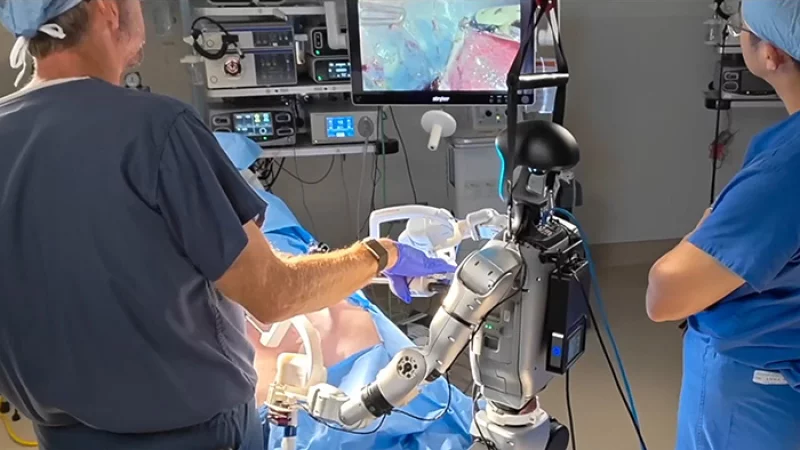
Teleoperated humanoid robots complete first-ever live surgery

Image
Surgeons controlled the movements of the robots remotely to perform the proceduresUC San Diego

Gallery https://newatlas.com/robotics/first-liv ... #gallery:1

Surgeons at UC San Diego just handed the scalpel to two humanoid robots, who went on to complete live surgical procedures for the first time in history. This milestone moves beyond the fixed robotic arms found in operating rooms today and hints at an operating room of the future where humans and humanoids work side by side.

Humanoid robots are already showing up in factories, warehouses, and even on battlefields, precisely because their human-like shape lets them operate in spaces built for people without any redesign. A Morgan Stanley report from late June projects that China, the current leader in the field, will produce 446,000 humanoid units annually by 2030, with full-size humanoids growing from 30% market share in 2026 to 70% by 2028.

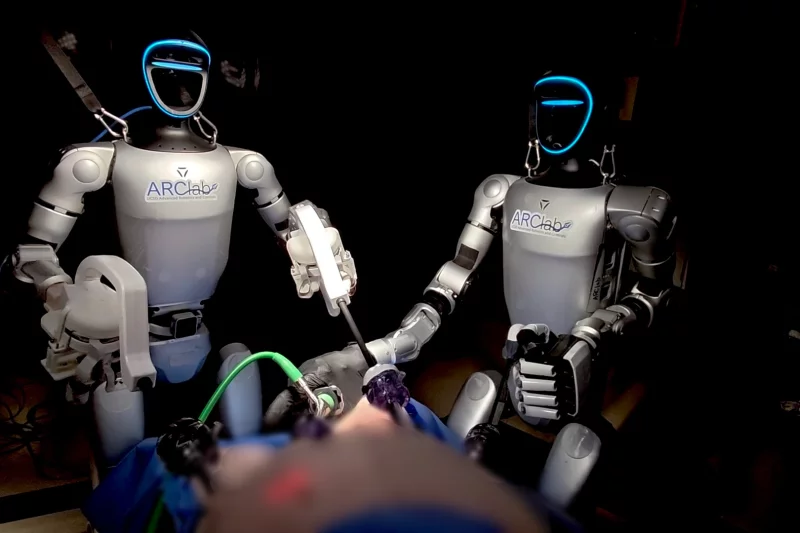
UC San Diego's team wants to bring that same flexibility into the operating room. In one procedure, a humanoid robot and a human surgeon acting as an assistant completed a cholecystectomy (gallbladder removal). In a second, two humanoid robots worked together and finished the operation solo.

Image
In one surgery, a humanoid robot and a human surgeon acting as an assistant successfully performed a gallbladder removalUC San Diego

The trials, described in a paper published in Nature, were carried out on large non-primate mammals, but the achievement matters because it moves the technology from concept to something that has demonstrably handled real surgical tasks.

The researchers say their real target is the growing shortage of surgeons and the surgical backlogs it creates, especially in rural areas or regions far from major hospitals. Traditional surgical robots address none of that: they're bulky, expensive, and typically require rebuilding the operating room around them.

A conventional robotic system weighs around 800 kg (1,764 lb) and needs significant space. The humanoid system used here, nicknamed Surgie, looks to have started life as a Unitree G1, and stands just 1.5 m (about 5 ft) tall and weighs only 27 kg (60 lb) – compact enough to wheel into a small clinic or a field hospital.

"It's a fraction of the cost, and it takes a fraction of the space in an operating room," says Dr. Shanglei Liu, assistant professor of surgery at UC San Diego School of Medicine and one of the study's lead authors, who personally operated one of the robots during the trials. "So it’s easy to deploy, anywhere from rural areas to the battlefield and even to space."

Image
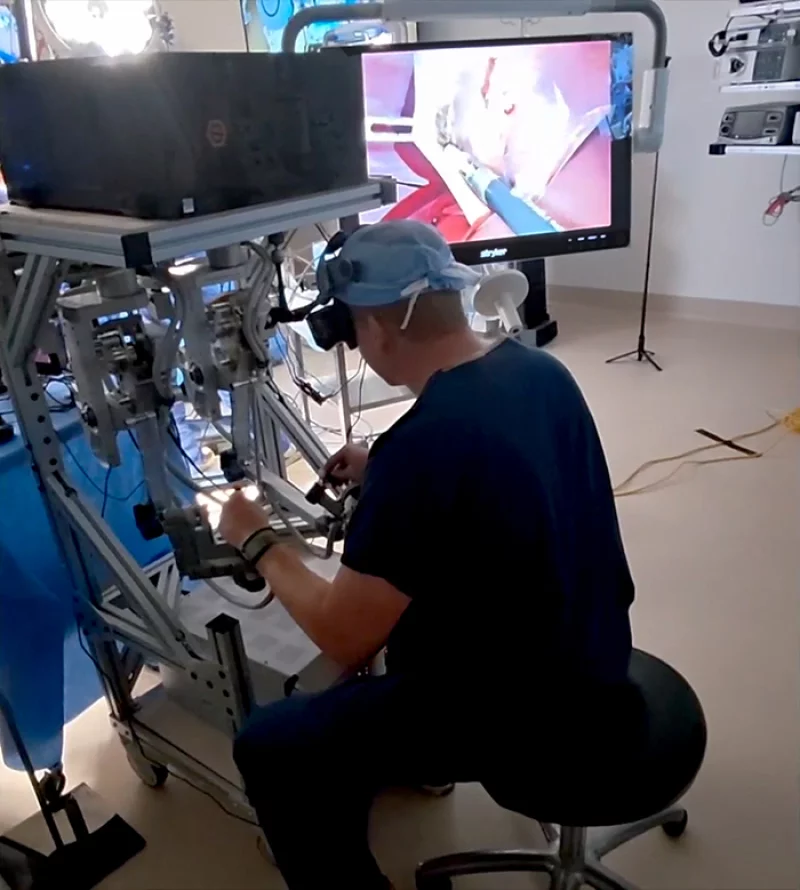
Dr. Ryan Broderick controls a robot during a gallbladder removal procedureUC San Diego

The surgeons control the robots remotely, using standard surgical tools fitted with adapters so the robotic hands can grip and maneuver them properly. Testing moved through stages: lab simulations, animal trials, and finally live surgery. The results are promising but not flawless – the robots needed recalibration mid-procedure, operations took longer than usual, and latency (the lag between a surgeon's hand movement and the robot's response) remains a challenge for any remote-controlled surgery.

That said, today's routine surgical robots also started out slow and clumsy. "This achievement reflects the power of bringing engineers and surgeon innovators together to solve meaningful clinical problems at our world-class training and research lab," says Dr. Ryan Broderick, interim director of UC San Diego's Center for the Future of Surgery.

The team envisions humanoids eventually doing more than assisting in surgery: fetching instruments, tidying the room, or working alongside human staff as full team members.

"Many communities struggle with adequate staffing on the surgical team, which means patients are not being treated," says Dr. Michael Yip, a UC San Diego engineering professor and co-author. "Our goal is an operating theater of the future, where humanoid robots and humans work side by side as an integrated team to deliver procedures to those in need, both in traditional hospital settings as well as in non-traditional, field medicine scenarios."

A short video of the project has been posted to the YouTube channel of UC San Diego's Advanced Robotics and Controls Lab, which we'll link to https://www.youtube.com/watch?v=Qp0eiQL6vB8 rather than embed as it contains graphic imagery of surgery.

Source: UC San Diego

VIEW GALLERY - 4 IMAGES
We recommend
Tri-Co Robots for the future: an interview with Guang-Zhong Yang https://rev.trendmd.com/open/gcOEA1WlB1 ... wd2_1nhwRs
Tiefeng Li, National Science Review, 2022
China's space robotics for on-orbit servicing: the state of the art https://rev.trendmd.com/open/WJjE3w6FK4 ... Lyrgw08XFg
XueAi Li, National Science Review, 2023
The world’s first pure single-port robotic radical total gastrectomy for advanced gastric cancer https://rev.trendmd.com/open/qRa2gzjlQi ... CvR_t20pTs
Liang Shang, Ronghua Zhang, Kangdi Dong, et al., Chinese Medical Journal, 2024
Preface to special topic on Tri-Co Robots https://rev.trendmd.com/open/UUfQypoVrL ... WucyVEU6so
National Science Review
Advances of surgical robotics: image-guided classification and application https://rev.trendmd.com/open/4SqRV2MeG0 ... WelizHuqMQ
Changsheng Li, National Science Review
Expert consensus on neoadjuvant PD-1 inhibitors for locally advanced oral squamous cell carcinoma (2026 edition) https://rev.trendmd.com/open/23UtiO4KU_ ... HQfX-iYzqE
XU Siying, Journal of Prevention and Treatment for Stomatological Diseases , 2026
Powered by

https://newatlas.com/robotics/first-liv ... cover/m1/4
Post Reply