Infrastructure and Construction

Current issues, news and ethics
kmaherali
Posts: 24255
Joined: Thu Mar 27, 2003 3:01 pm

Re: Infrastructure and Construction

Post by kmaherali »

China completes 11 km underwater tunnel beneath Yangtze river, bullet trains to run at 350 kmph speed

China completes an underwater tunnel beneath the Yangtze river, enabling bullet trains to run at speeds of up to 350 kmph. Check key project details.

Image
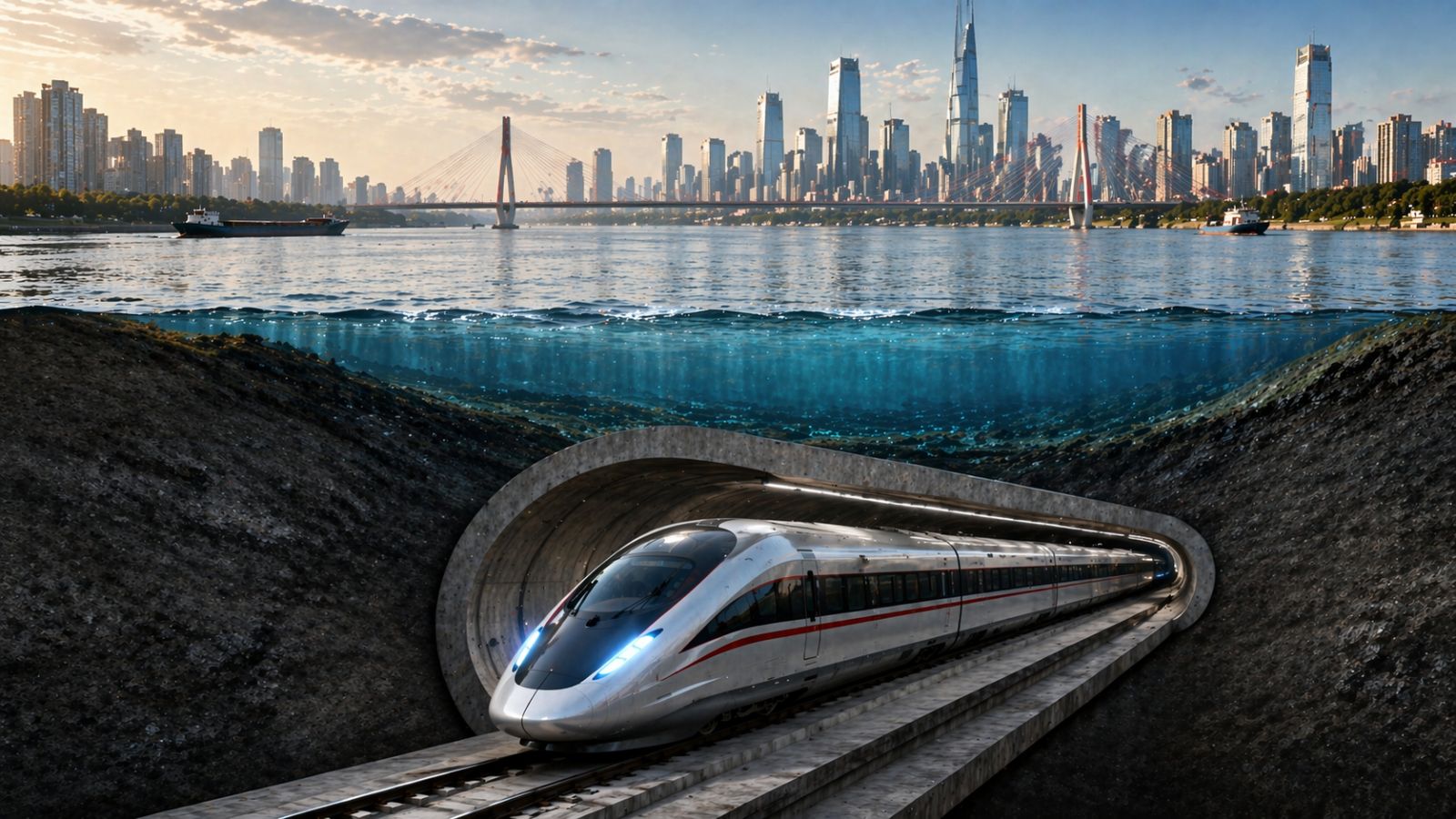
China's Yangtze underwater tunnel enables bullet trains to run at 350 kmph speed (Image generated using AI)

Bullet train in China: China has completed an 11.18-km-long high-speed underwater tunnel beneath the Yangtze River. The structure forms part of the underwater section of the Chongming-Taicang Yangtze River tunnel. The tunnelling work was carried out using the shield tunnelling machine “Linghang.”

According to Xinhua News Agency, the tunnel connects Chongming District in Shanghai with Taicang in east China’s Jiangsu, and spans a total length of 14.25 km. Out of this, 11.18 km tunnel runs beneath the river. Once operational, it will enable bullet trains to run at speeds of up to 350 kmph.

CR450 train speed

Unveiled in 2024, CR450 bullet train is being hailed as the world’s fastest bullet train. According to CGTN, the CR450 has established new world records during trials, including a top speed of 453 kmph and a relative passing speed of 896 kmph. The CR450 prototype has been developed by CRRC Changchun Railway Vehicles and CRRC Sifang Co. Ltd.

The key factors of the train are its aerodynamic design and structural enhancements. The nose cone, for instance, has been extended from 12.5 meters on existing 350 km/h trains to a more streamlined 15 meters. The CR450 can accelerate from a standstill to 350 kmph in just 4 minutes and 40 seconds. The report also highlights that the train’s overall resistance has been reduced by 22 per cent.

“These include fully enclosing the bogies and lowering the skirt panels beneath the carriages, minimizing the exposure of the wheels to the air, a design philosophy akin to high-performance race cars. The train’s height has also been reduced by 20 centimeters, and its weight has been trimmed by 50 tonnes,” the CGTN report said.

https://indianexpress.com/article/world ... -10644972/
kmaherali
Posts: 24255
Joined: Thu Mar 27, 2003 3:01 pm

Re: Infrastructure and Construction

Post by kmaherali »

Norway is drilling 27 kilometers of rock 392 meters below the bottom of a fjord to build the world’s largest and deepest underwater road tunnel — when completed, a 21-hour journey will be reduced to 10.

Image

With 27 kilometers in length and a deepest point of 392 meters below sea level, Rogfast will replace seven ferry crossings on the west coast of Norway and cut a 21-hour journey in half
On the west coast of Norway, the E39 highway winds between deep fjords for 1,090 kilometers.

To travel this stretch from Trondheim to Kristiansand, drivers need 21 hours — and rely on seven ferry crossings that stop in bad weather.

The Rogfast project aims to change that by drilling through the rock beneath the fjords.

ARTICLE CONTINUES BELOW
See also
//Engineers from China spent more than 580 days drilling in the Taklamakan Desert, and the project reached a depth of 10,910 meters, crossed 12 geological layers, reached rocks more than 500 million years old, and faced temperatures and pressures so extreme that the last 910 meters took almost a year to complete. https://en.clickpetroleoegas.com.br/eng ... _de_artigo


////A new bridge costing up to $2 billion is beginning to redesign the Panama Canal with six lanes, integration for mass transport, and a strategic crossing aimed at alleviating one of the most critical logistical bottlenecks in Central America. https://en.clickpetroleoegas.com.br/a-n ... _de_artigo


//The 634-meter Tokyo Skytree tower became Japan’s tallest antenna by combining a triangular base embedded in mud, 37,000 steel parts, and a pagoda-inspired core that cuts oscillation by up to 50%, keeping 35 million connected even with 1,500 tremors per year. https://en.clickpetroleoegas.com.br/the ... _de_artigo


//650 m² of walls erected in a few weeks by a giant printer that deposits concrete layer by layer, Apis Cor’s project in Dubai accelerates structural construction and integrates a plan for 25% of the city’s buildings to use 3D printing by 2030.https://en.clickpetroleoegas.com.br/650 ... _de_artigo


When completed in 2033, the tunnel will have 27 kilometers in length and reach 392 meters below sea level — the deepest in the world for vehicles.

The crossing that currently depends on ferries will take only 35 minutes by car inside the tunnel.

The estimated cost is US$ 2.4 billion (about 20 billion Norwegian kroner).

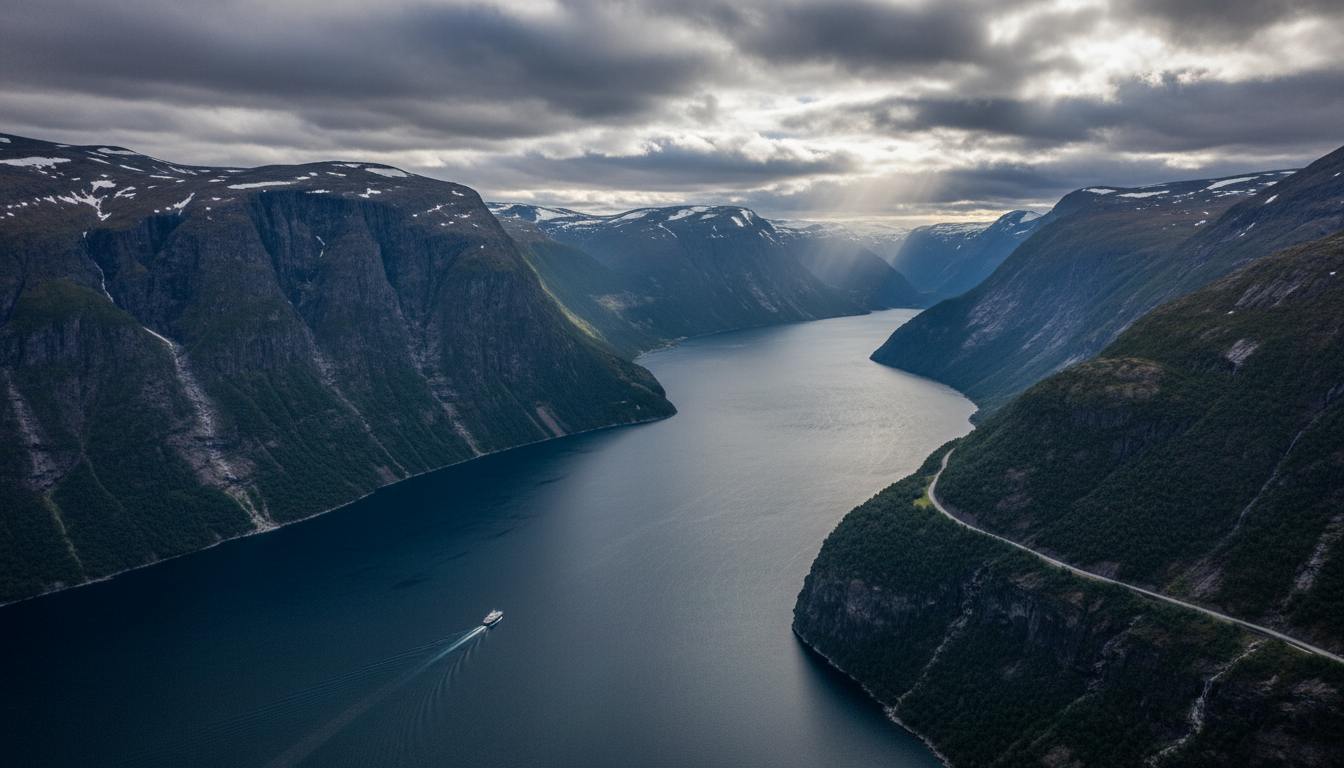
Deep Norwegian fjord with cliffs and dark blue water
Image
The fjords of Norway are spectacular but force drivers to rely on ferries that stop in bad weather.

392 meters of rock and water above: how it works

The Rogfast tunnel will pass under the bed of the Boknafjorden fjord, in the Rogaland region.

There will be four lanes — two in each direction.

At the deepest point, the road will be 392 meters below sea level.

In the middle of the tunnel, there is an unprecedented feature: an exit to the island of Kvitsøy, with an underground roundabout at 250 meters depth.

It will be the deepest road roundabout on the planet.

Construction began in 2018, with the first main contract in the fall of 2021.

The project faced a pause in 2019 due to rising costs but has resumed.

Why Norway needs this tunnel

The Norwegian west coast is cut by fjords that act as natural barriers.

Each fjord forces cars and trucks to stop, board ferries, and wait — sometimes for hours on stormy days.

The E39 has seven ferry crossings, making transportation unpredictable and slow.

Rogfast eliminates one of these barriers, connecting Stavanger, Haugesund, and Bergen by continuous land.

The total time for the E39, from 21 hours, will drop to about 10 hours when all projects are completed.

Interior of a road tunnel under construction with drilling equipment
Image
Excavating Rogfast needs to drill 27 km of rock nearly 400 meters deep under the fjord.

Norway is the country of tunnels: Rogfast will be the king

Norway already has the longest road tunnels in the world.

The Laerdal Tunnel, at 24.5 kilometers, is the current world record holder.

The Ryfast, at 14.4 kilometers, holds the record for road depth at 292 meters.

Rogfast will surpass both: it will be 2.5 km longer than the Laerdal and 100 meters deeper than the Ryfast.

The country has more than 1,100 road tunnels — drilling through mountains is part of the Norwegian DNA.

The economic impact: tourism, trade, and jobs

The continuous road connection will accelerate trade and tourism on the west coast.

Businesses that depended on ferry schedules will have logistical predictability.

Tourists will be able to travel the coast without maritime interruptions.

Funding combines tolls and support from the Norwegian government.

For a country that already relies on oil from the North Sea, investing US$ 2.4 billion in transportation infrastructure is a bet on economic diversification.

Ferry crossing Norwegian fjord with mountains in the background
Image
The ferries crossing the Norwegian fjords are picturesque, but make transportation unpredictable and slow.

The challenges of drilling rock 392 meters under water

The engineering of Rogfast faces extreme hydrostatic pressure.

The rock at this depth may have fractures and water seepage from the fjord.

Ventilation for a 27 km road tunnel is complex — vehicle gases need to be continuously extracted.

The underground roundabout for Kvitsøy adds an unprecedented layer of complexity.

The Norwegians have experience: Laerdal, Ryfast, and dozens of other tunnels have proven that the local geology is viable.

But 392 meters is a new record, and every additional meter of depth increases the risks.

What could go wrong

The project has already faced cost increases that caused a pause in 2019.

The budget rose from the estimated €1.9 billion to US$ 2.4 billion.

The completion, initially expected for earlier dates, now points to 2033.

Unpredictable geology under the fjord could cause further delays.

However, Norway has a strong track record of delivering tunnels — even if delayed.

When Rogfast opens, driving along the Norwegian coast will be like traveling on a European highway — only 392 meters under a fjord.

https://en.clickpetroleoegas.com.br/nor ... nn-davila/
kmaherali
Posts: 24255
Joined: Thu Mar 27, 2003 3:01 pm

Re: Infrastructure and Construction

Post by kmaherali »

To solve a drought that threatened 185 million people, China built a 2,700 km artificial river with 13 pumping stations, which today supplies 70% of all the water that comes out of Beijing’s taps.

Image

The world’s largest artificial river cost US$ 79 billion, extends for 2,700 kilometers of canals, tunnels, and aqueducts, and has already transferred 76.7 billion cubic meters of water from the humid south to the arid north of China, transforming the water map of an entire country
While northern China faced one of the planet’s worst water crises, with the Yellow River drying up in entire sections and tributaries of the Hai River disappearing for most of the year, Chinese engineers designed something no other country had even attempted: an artificial river in China capable of moving water on a continental scale.

The South-to-North Water Diversion Project, known as SNWD, officially began construction in 2002. Since then, it connects four river basins through more than 2,700 kilometers of canals, tunnels, and aqueducts.

According to Brazil’s Ministry of Regional Development, which visited the project on a technical mission, it is the largest water security undertaking in the world.

The system benefits about 185 million people in densely populated and industrialized regions of northern China. In addition, it has already transferred 76.7 billion cubic meters of water by April 2026.

The three routes of China’s artificial river that cross the country from end to end

The project operates through three main routes: East, Central, and West. Together, they will have the capacity to transfer 44.8 billion cubic meters of water per year when fully completed.

The East route extends for 1,112 kilometers of canals and tunnels. It utilizes the ancient Beijing-Hangzhou Grand Canal, the world’s oldest artificial waterway. It has been operating since 2013 with an annual capacity of 14.8 billion cubic meters.

On this route alone, engineers installed 13 pumping stations with more than 100 sets of motor pumps. The total power in some sections exceeds 454 megawatts.

Image
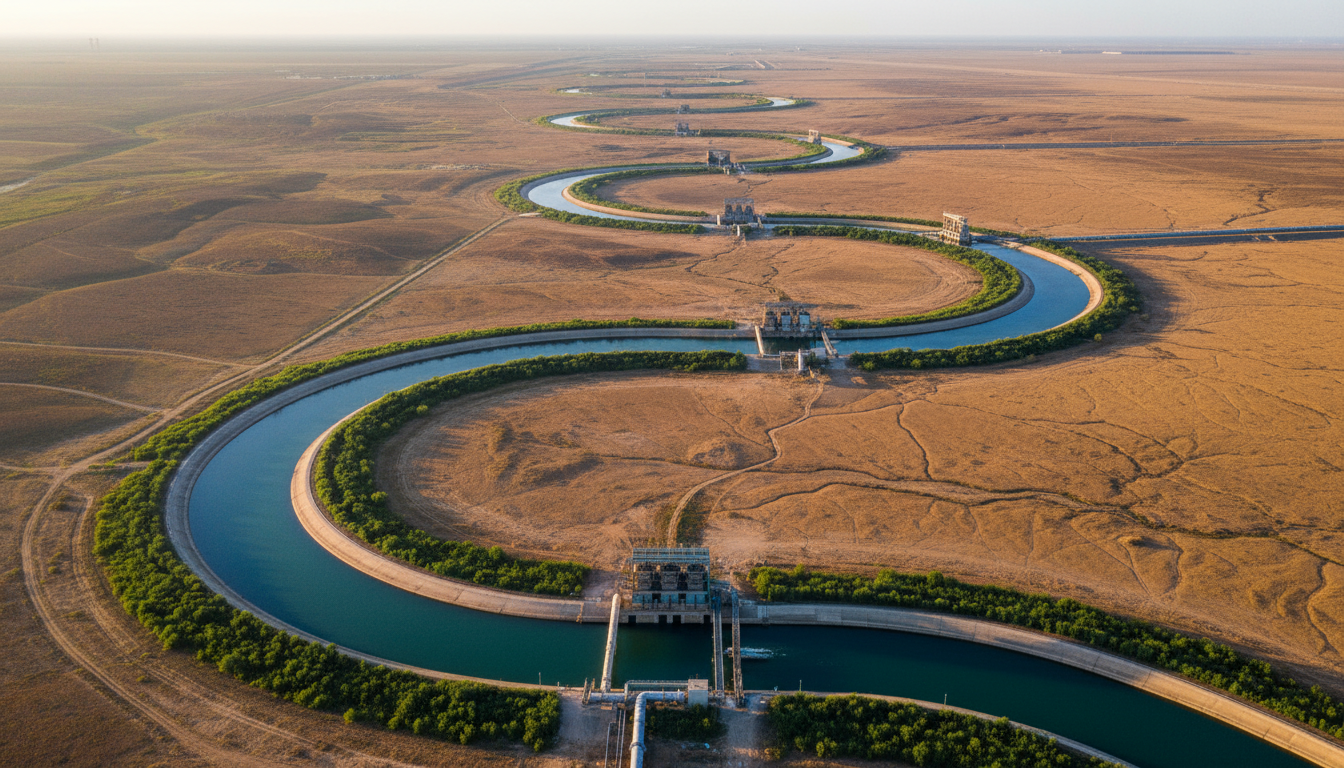
Pumping station of China's artificial river with industrial motor pumps

Giuseppe Vieira, Brazil’s National Secretary for Water Security, described what he saw during a technical visit: “We had the opportunity to visit some pumping stations, which have more than 13 stations installed only on the eastern branch. These 13 total more than 100 sets of motor pumps installed and operating.”

The Central route, on the other hand, runs between 1,264 and 1,400 kilometers from the Danjiangkou reservoir to Beijing. The flow occurs mostly by gravity, without the need for pumping.

This route crosses the Yellow River through two large underground tunnels. Furthermore, it supplies 70% of all water coming out of Beijing’s taps — a fact that reveals the Chinese capital’s dependence on this system.

Image
Beijing skyline with water canal of China's artificial river in the foreground

The West route is still in the planning phase. When completed, it will have the capacity to transfer 17 billion cubic meters per year, but it faces significant technical and environmental challenges.

Impressive numbers: US$ 79 billion and 330,000 people relocated

The total cost of the project has already exceeded US$ 79 billion. This value makes China’s artificial river the most expensive water infrastructure project in human history.

To enable construction, the Chinese government had to relocate 330,000 people who lived along the canal route. The resettlement involved entire communities that lost their land to make way for the project.

When all routes are completed in 2050, the system will have a full capacity of 44.8 billion cubic meters of water per year. This volume is equivalent to supplying entire countries the size of Portugal or Switzerland.

Image
Giant underground tunnel of China's artificial river transporting water under the Yellow River

Other Chinese megaprojects like the 164-kilometer Danyang-Kunshan bridge also impress with their scale. However, none of them move a resource as essential as drinking water.

Comparison with the São Francisco: China’s artificial river is 50 times larger

To gauge the scale, one only needs to compare it with Brazil’s São Francisco River Integration Project. The Brazilian transposition cost US$ 3 billion and extends for 477 kilometers.

The Chinese system is more than 50 times larger in length, 50 times greater in annual volume, and 26 times more expensive. While the PISF benefits 12 million Brazilians in the Northeast, the Chinese diversion serves 185 million.

According to the Ministry of Regional Development, the visit to the project serves as a reference to expand technical cooperation between Brazil and China in the area of water security.

Giuseppe Vieira stated that the MIDR team “had the opportunity to learn about the world’s largest water security undertaking, which transports water from the Yangtze River from more favored regions to less favored regions of China.”

Environmental challenges and the risks that persist after 24 years of work

Despite the impressive numbers, the project carries considerable challenges. Water pollution remains a permanent risk, especially on routes that cross industrial regions.

The impacts on local ecosystems are still being evaluated. The preservation of springs and banks receives continuous investment, with public leisure areas created along the canals.

Furthermore, the West route faces technical and environmental obstacles that delay its completion. More ambitious proposals from Chinese academics diverge from the government’s more modest versions.

Other extreme engineering works in China, such as the 4,000-ton drilling machine, show that the country continues to invest in continental-scale infrastructure.

As reported by Revista Oeste, the total length of the system can reach 2,700 km when all routes are operational.

It is worth noting that data on the project varies among sources. Some indicate a length of 1,200 km for specific sections, while others cite 2,700 km for the complete system. Furthermore, the mark of 76.7 billion cubic meters transferred represents an accumulation since the start of operations, not the annual volume.

The total completion of the project is expected only by 2050, with the West route still in its initial phase. Until then, China’s artificial river will continue to be the largest water project in history — a system that literally redrew the map of a country to ensure the survival of nearly 200 million people.

https://en.clickpetroleoegas.com.br/to- ... -7-davila/
kmaherali
Posts: 24255
Joined: Thu Mar 27, 2003 3:01 pm

Re: Infrastructure and Construction

Post by kmaherali »

World's longest bridge takes 40 minutes to drive across and cost $15billion to build

Image
HONG KONG CHINA MACAU BRIDGE TRANSPORT

The bridge connects Hong Kong and Macau more directly with cities in Guangdong province (Image: AFP/Getty Images)

Spanning 34 miles across the Pearl River Delta, the Hong Kong-Zhuhai-Macau Bridge stands as the world's longest sea crossing, linking the southern Chinese cities of Hong Kong, Zhuhai and Macau. The 55km infrastructure project required nine years of construction at an estimated cost of around $15 billion.

It has substantially reduced travel times between the three cities, converting what was previously an hour-long ferry journey into approximately 40 minutes by road. The bridge represents part of a larger strategy to enhance transportation networks throughout the Greater Bay Area, a region Beijing is developing into a significant economic hub.

By providing more direct connections between Hong Kong and Macau with cities across Guangdong province, the crossing aims to facilitate increased trade and mobility across the region. The structure comprises multiple components, including extensive bridges, artificial islands and connecting roadways.

//'Total anguish' as Colombia bridge collapses during opening ceremony https://www.the-express.com/news/world- ... al-anguish

//Tourists flock as America's 'scariest' bridge re-opens after $10 million revamp https://www.the-express.com/news/us-new ... as-rainbow

The central portion includes three navigation channel bridges - Jiuzhou, Jianghai and Qingzhou.

These were built to allow large vessels passage through one of China's busiest shipping corridors, reports the Mirror UK.

Drone view ofThe Hong Kong-Zhuhai-Macau Bridge
Image
The Hong Kong-Zhuhai-Macau Bridge is the longest ever sea crossing on record (Image: CHUNYIP WONG via Getty Images)

Engineers faced demanding conditions, including frequent typhoons and a challenging marine environment, reports the Express.

The bridge utilizes single-column piers anchored in the seabed to minimize interference with water currents and lessen environmental impact on local marine life, including the Chinese white dolphin. The crossing comprises three main bridges with cable-supported designs, each distinguished by its unique tower configuration.

These structures were conceived to give the crossing a cohesive yet varied appearance, particularly important given its visibility from multiple vantage points on land, at sea and from above.

The Jiuzhou Bridge retained its distinctive sail-shaped towers following adjustments made during the detailed design phase.

Engineering firm Arup contributed to multiple components of the project, including early design phases, construction of artificial islands and critical road and tunnel connections on both the Hong Kong and Macau ends.

Additional infrastructure connected to the crossing includes border checkpoint facilities and linkages such as the Tuen Mun-Chek Lap Kok Link, helping integrate the bridge into the wider transportation system.

Since opening to traffic, the bridge has become an essential corridor within the region's transportation framework, reflecting both the scale of China's infrastructure ambitions and the tangible need for faster connections between its principal metropolitan areas.

https://www.aol.com/news/footbridge-ove ... 23025.html
kmaherali
Posts: 24255
Joined: Thu Mar 27, 2003 3:01 pm

Re: Infrastructure and Construction

Post by kmaherali »

China built a 300-meter horizontal skyscraper that connects four towers at a height of 250 meters, with a steel structure weighing 12,000 tons, equivalent to the Eiffel Tower, and it was assembled on the ground before being lifted with hydraulic systems.

Image

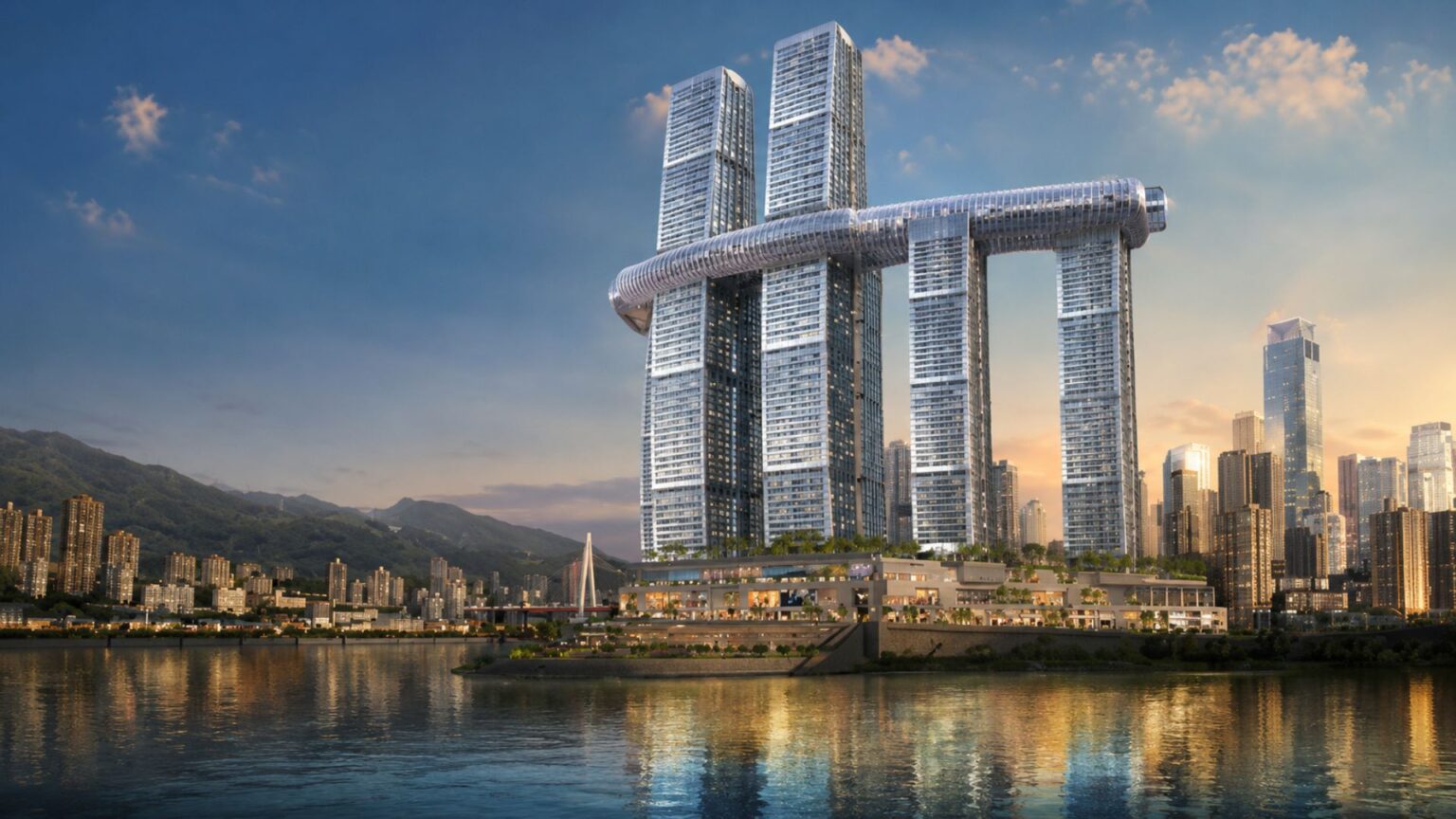
China has built in Chongqing a horizontal skyscraper 300 meters long that connects four towers 250 meters high on the 42nd floor of the Raffles City complex. According to NSC, the structure, called The Crystal, weighs 12 thousand tons of steel, equivalent to the Eiffel Tower, and was partially assembled on the ground before being lifted with precision hydraulic systems to its final position between the towers.
The project was conceived by the firm Safdie Architects, the same that designed the iconic Marina Bay Sands in Singapore, and developed by CapitaLand, an Asian real estate company, with a budget of 1.1 billion dollars. The complex is located at the confluence of the Yangtze and Jialing rivers, one of the most densely populated areas of Chongqing, a city with over 30 million inhabitants.

The horizontal skyscraper is 32.5 meters wide, covered with 3,000 glass panels and nearly 5,000 aluminum pieces, and its main attraction is the Exploration Deck, an observation deck with a glass floor of 1,500 square meters where visitors walk over the void 250 meters above the ground. The result is a structure that challenges the conventional idea that skyscrapers need to be vertical and once again places China at the center of the debate on the limits of contemporary engineering.

300 meters long on the 42nd floor

The Crystal is not a simple walkway between buildings. With 300 meters in length and 32.5 meters in width, the horizontal structure is a complete building suspended in the air, positioned on the 42nd floor of the complex and supported on four of the eight towers that make up Raffles City. Its dimensions place it among the largest elevated horizontal structures in the world, comparable in length to three football fields lined up.

ARTICLE CONTINUES BELOW
See also
//A R$ 25 million bridge in Santa Catarina will replace a ferry at a tourist spot, cross the Araranguá River, gain two lanes, LED lighting, and create a new road connection with construction authorized in 2026. https://en.clickpetroleoegas.com.br/a-r ... -cre-afch/


//China built the largest railway station in Asia in just two years, with 475,200 m², solar energy, welding robots, and smart technology. https://en.clickpetroleoegas.com.br/chi ... ogy-rpc95/


//Material once seen as a poor man’s choice returns as a climate bet, with red clay replacing part of the gray concrete in modern buildings, hospitals, houses, and a cultural center that transforms tradition into a solution against urban heat. https://en.clickpetroleoegas.com.br/mat ... osp-btl96/


//Saudi Arabia transforms sewage into a living oasis in the desert, with plants, algae, and fish filtering millions of liters per day while treated water irrigates farms and aids a plan for 7.5 million trees by 2030. https://en.clickpetroleoegas.com.br/sau ... eat-btl96/

Image

The height at which the horizontal skyscraper is located amplifies the perception of scale. At 250 meters above the ground, The Crystal is above most commercial buildings in any city in the world. For the engineers who designed the structure, the challenge was not only to support the weight of steel and glass but also to withstand the lateral forces of the wind that hit a structure exposed at this altitude, especially in a region where storms are not uncommon.

12 thousand tons of steel: the weight of the Eiffel Tower in the air

Image

The steel structure that supports China’s horizontal skyscraper weighs 12 thousand tons, a volume comparable to the weight of the Eiffel Tower in Paris. The difference is that the Eiffel Tower distributes its weight on the ground, while The Crystal transfers its 12 thousand tons to the four towers that support it at 250 meters high. Each tower needs to support not only its own weight but also the additional load transmitted by the horizontal structure, which required foundations and pillars sized for loads much greater than those of a conventional building.

Part of the steel structure was assembled on the ground before being elevated with precision hydraulic systems to its final position between the towers. This technique, known as lift-up, reduces the risk of working at height and allows entire sections of the structure to be welded and inspected in controlled conditions before being hoisted. The process required millimetric coordination between the crane and hydraulic teams to ensure that each section fit perfectly into the prepared connections at the top of the towers.

Image
image: Safdie Architects

Glass, aluminum, and an observation deck over the void

The external cladding of The Crystal combines 3 thousand glass panels with almost 5 thousand aluminum pieces, creating a translucent facade that reflects light during the day and shines illuminated at night. The visual contrast between the transparency of the horizontal skyscraper and the solidity of the concrete and steel towers that support it is a deliberate part of the Safdie Architects’ design, which sought to create a structure that seemed light despite its 12 thousand tons.

The main attraction of the building is the Exploration Deck, an observation deck with a 1,500 square meter glass floor that allows visitors to walk over the void 250 meters above the ground. Looking down through the transparent glass and seeing the streets of Chongqing dozens of floors below is an experience that attracts tourists from all over China and the world. The glass floor is designed to withstand loads far greater than the weight of visitors, but the sensation of walking over nothing generates vertigo even in those who rationally know that the structure is safe.

More than a million square meters of vertical city

The Raffles City is not just the horizontal skyscraper. The entire complex totals more than a million square meters of built area distributed across eight interconnected towers, with residences, offices, a hotel, and commercial areas. It is a complete vertical city where residents can live, work, shop, and stay without needing to leave the complex. The four main towers, which support The Crystal, are 250 meters each, while two side towers exceed 350 meters.

The location at the confluence of the Yangtze and Jialing rivers positions Raffles City at a strategic point in Chongqing, offering panoramic views of the two rivers and the mountainous landscape surrounding the city. For CapitaLand, which invested 1.1 billion dollars in the project, the scale of the complex justifies the investment through the combination of residential, commercial, and tourist revenues that a million square meters can generate in one of China’s most populous cities.

The engineering behind the impossible

Building a 300-meter building on top of four 250-meter towers required engineering solutions that few projects in the world have demanded. The precision hydraulic systems used to lift sections of the steel structure from the ground to the top of the towers represent one of the most advanced techniques in contemporary civil construction. Each section lifted weighed hundreds of tons and needed to be positioned with millimeter tolerance for the structural connections to work correctly.

The Safdie Architects project also needed to solve the problem of thermal expansion. A 300-meter steel structure exposed to Chongqing’s tropical sun expands and contracts throughout the day, and these variations need to be absorbed by the connection joints between the horizontal skyscraper and the towers, without compromising stability or causing cracks in the glass facade. The engineering of flexible joints that accommodate thermal movements in structures of this scale is a specialized field that few architecture and engineering firms master.

A skyscraper that does not point to the sky

China has built in Chongqing a skyscraper that does not rise, but extends horizontally for 300 meters between four towers at 250 meters high. The Crystal weighs 12,000 tons of steel, was partially assembled on the ground and lifted with hydraulics, and houses an observation deck with a glass floor of 1,500 square meters where visitors walk over the void. The Raffles City complex cost 1.1 billion dollars, has more than one million square meters, and redefines what is possible when engineering and ambition know no conventional limits.

Would you walk on the glass floor at 250 meters high? Tell us in the comments what you think of China’s horizontal skyscraper, if the engineering of assembling the structure on the ground and lifting it with hydraulics impresses you, and if Brazil should attempt projects of this scale. We want to hear your opinion.

https://en.clickpetroleoegas.com.br/chi ... ns-mhbb01/
kmaherali
Posts: 24255
Joined: Thu Mar 27, 2003 3:01 pm

Re: Infrastructure and Construction

Post by kmaherali »

Egypt launches desert mega-project to grow wheat using an “artificial river”

Image

Egyptian President Abdel Fattah el-Sisi has officially inaugurated the massive New Delta agricultural project aimed at growing wheat and other crops on reclaimed desert land. The ceremony took place during the 2026 wheat harvest on newly cultivated fields west of the Nile Delta.

According to the government, New Delta is the largest land reclamation project in the country’s history. The scheme is expected to eventually cover 2.2 million feddans, or about 9,000 square kilometers. Egypt plans to expand its cultivated land area by around 15%, focusing on wheat, corn, vegetables, as well as export-oriented crops such as olives and figs.

Total investment in the project has already reached 800 billion Egyptian pounds (more than $15 billion). The funds have been used to prepare farmland and build grain silos, industrial zones, and new roads connecting the desert areas with the Nile Valley and Egyptian ports. Authorities also expect the project to create more than two million jobs.

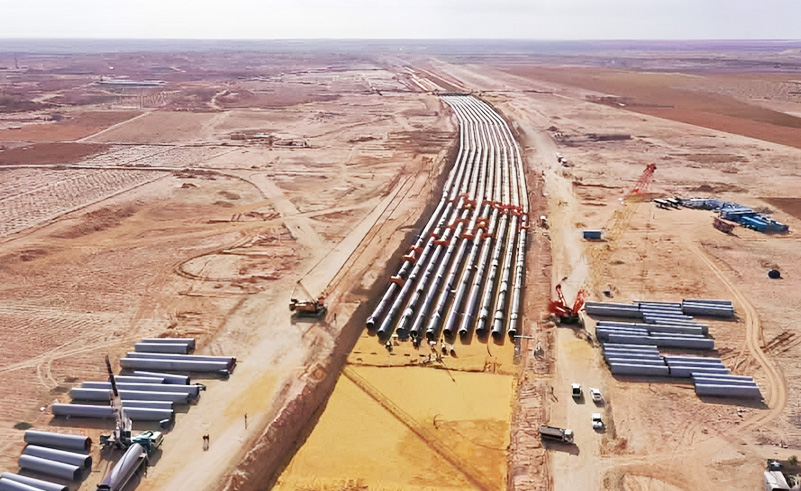
A key feature of the New Delta project is its large-scale irrigation system, already being described in Egypt as an “artificial river.” Agricultural drainage water from the western Nile Delta is sent to the El Hammam treatment complex on the Mediterranean coast, where up to 7.5 million cubic meters of water are treated daily. The water is then pumped through a 170-kilometer canal and 13 pumping stations into desert farming areas.

The Egyptian government sees the project as a strategic response to food security threats intensified by the COVID-19 pandemic and the war in Ukraine. However, environmental experts and rights groups have raised concerns over the system’s high energy consumption, massive public spending, and the concentration of control in military-linked institutions overseeing the project.

For almost 30 years of expertise in the agri markets, UkrAgroConsult has accumulated an extensive database, which became the basis of the platform AgriSupp.

It is a multi-functional online platform with market intelligence for grains and oilseeds that enables to get access to daily operational information on the Black Sea & Danube markets, analytical reports, historical data.

You are welcome to get a 7-day free demo access!!! https://agrisupp.com/en/register/1?_ga= ... 1779360164

https://ukragroconsult.com/en/news/egyp ... ial-river/
Post Reply